Warsaw 22:08:2026 Steve Walker
AQUIS — THERE IS NO AWAY
OPEN KIMONO | THE THINGS WE THOUGHT WE HAD THROWN AWAY
If we truly intend to leave this planet in better condition than we found it, we must develop and activate the methods and means to deal with what previous generations left behind.
For much of the twentieth century, humanity had a remarkably convenient environmental technology.
We called it:
AWAY.
Put it underground.
Put it in a landfill.
Put it into a river.
Take it far enough offshore and put it into the sea.
If we could no longer see it, smell it or measure it, we had a tendency to consider the problem solved.
It wasn’t.
There is no away.
There is only somewhere else.
And sometimes somewhere else waits eighty years before sending the problem back.
1. THE SEA WAS BIG
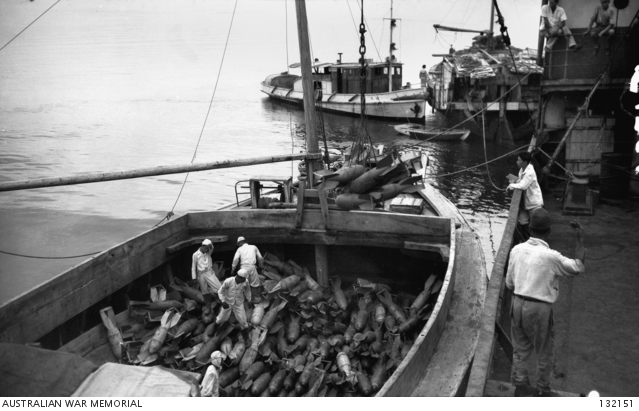
At the end of the Second World War, governments faced enormous quantities of conventional and chemical munitions for which there was no obvious peacetime use.
The sea appeared to provide an answer.
It was vast.
It was deep.
And compared with today’s environmental understanding, it appeared almost infinitely capable of dilution.
Chemical weapons were consequently dumped at sea in several parts of the world. European waters were among them. So were waters around Japan and the United States.
What was considered disposal was, in many cases, actually storage without an inventory-management system and with seawater slowly attacking the packaging.
The ocean had not destroyed the problem.
It had inherited it.
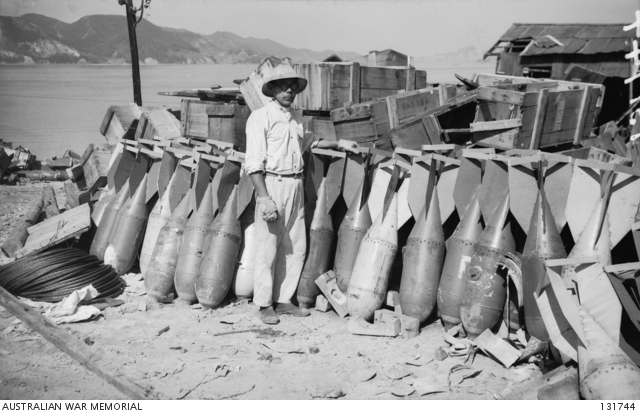
2. KANDA — WHEN “AWAY” CAME BACK
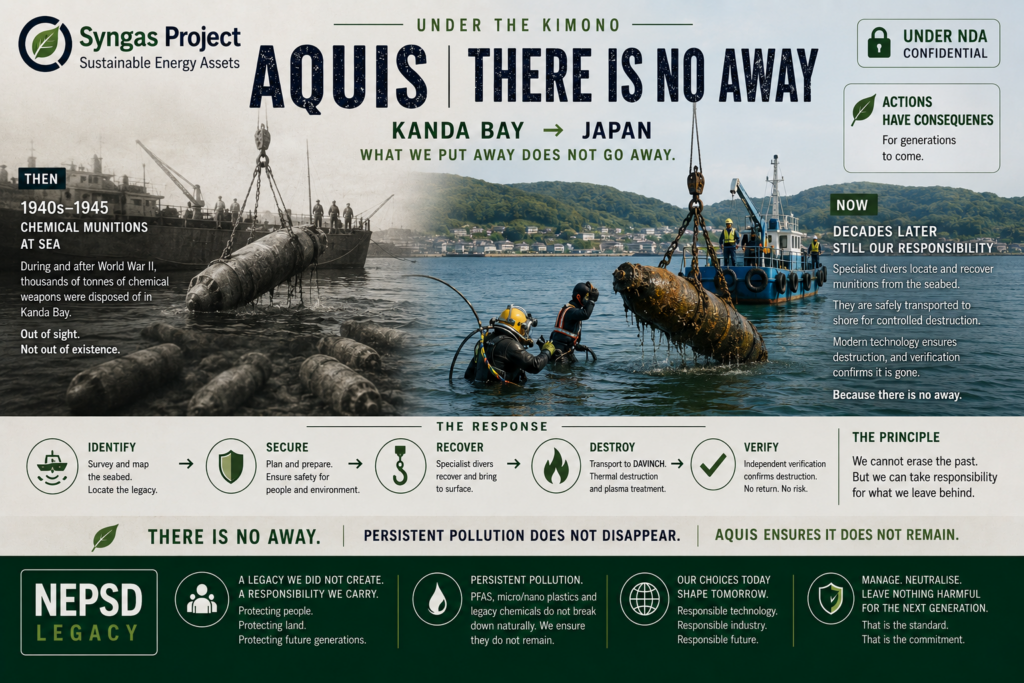
In 2000, Second World War chemical weapons were discovered on the seabed at Port Kanda in Kyushu, Japan.
Some were lying on the seabed.
Others were buried in thick bottom sediment.
They included 15 kg “Red” bombs containing Clark I/II agents and 50 kg “Yellow” bombs containing mustard agent and Lewisite.
There was an additional complication.
People wanted to build.
Dredging associated with infrastructure development meant that yesterday’s forgotten problem was now sitting in the path of tomorrow’s economy.
Japan could no longer leave the weapons where history had put them.
Someone had to go down and get them.
3. SEND IN THE DIVERS
This is where the story becomes extraordinary.
The solution was not simply a remotely operated grab reaching into the mud.
A complete recovery system had to be engineered.
High-precision magnetometers located suspicious objects.
Specialist divers equipped with chemical-agent-resistant protection uncovered them.
Underwater X-ray equipment helped determine the condition of individual munitions before lifting.
Double-walled containers were developed so recovered weapons could be isolated and transported safely.
And the destruction system waiting for them was:
DAVINCH
The Kanda programme became a complete chain:
DETECT
↓
IDENTIFY
↓
DIVE
↓
UNCOVER
↓
X-RAY
↓
RECOVER
↓
CONTAIN
↓
DESTROY
↓
ANALYSE
↓
VERIFY.
Published accounts describe thousands of chemical munitions ultimately being recovered and destroyed.
These were not theoretical environmental liabilities anymore.
Human beings had to descend into the water and retrieve them.
There is something rather important in that image.
One generation put the problem into the sea.
Another generation sent divers down to bring it back.
4. DAVINCH
Kobe Steel developed DAVINCH — Detonation of Ammunition in a Vacuum Integrated Chamber — as a controlled-detonation technology for chemical munitions.
The recovered munition was placed inside a substantial double-walled containment vessel.
The chamber was brought close to vacuum.
A donor explosive opened and destroyed the munition.
For fractions of a second, the interior experienced conditions around 3,000 K and 10 GPa.
Shock.
Heat.
Pressure.
Cavitation.
Fireball.
The objective was not to move the chemical agent.
It was to destroy it.
But the engineers did not stop when the bomb disappeared.
There was still gas.
And therefore there was still a question.
WHAT IS IN THE GAS?
5. ENTER PLASMA
This is where the Kanda story unexpectedly approaches our own.
DAVINCH’s off-gases required secondary treatment.
National Academies documentation describes DAVINCH configurations in which those gases were treated using a cold-plasma oxidiser followed by activated-carbon filtration.
The earlier engineering literature goes further.
Published descriptions of the DAVINCH work specifically identify a cold-plasma stage based upon GlidArc discharge for treatment of residual pollutants.
And that is where our story finds Albin.
Not because Albin invented DAVINCH.
He did not.
Not because he designed Kanda.
He did not.
But because the scientific world in which his GlidArc work developed intersected with a very serious real-world problem:
destroying what remained after the primary destruction process had already done its job.
That distinction matters enormously to NEPSD.
And it matters even more to AQUIS.
6. DESTRUCTION IS NOT ENOUGH
The Kanda programme contains another lesson that is easy to miss.
After recovery and destruction came measurement.
Environmental samples were taken before and after recovery operations, and analytical results were disclosed as part of demonstrating that contamination had not simply been redistributed.
That gives AQUIS perhaps its most important operating principle:
CAPTURE → DESTRUCTION → VERIFICATION.
Not:
capture → disposal.
Not:
capture → landfill.
Not:
capture → somebody else’s problem.
And certainly not:
capture → away.
7. EIGHTY YEARS IS NOT FOREVER
This is the part of the story that belongs to our generation.
We have become very good at designing things to last.
Containers.
Membranes.
Coatings.
Polymers.
Landfills.
Underground storage.
Waste repositories.
But fifty years is not forever.
Neither is eighty.
Corrosion does not care what was written in the original engineering report.
Groundwater moves.
Rivers move.
Sediments move.
Coastlines move.
Containers fail.
And chemistry continues long after the project team has gone home.
The question therefore changes.
Instead of asking:
Where can we safely put this?
we should increasingly ask:
HOW DOES THIS MOLECULE’S STORY END?
8. AFTER NET ZERO
Our generation has correctly identified atmospheric carbon as an existential environmental challenge.
We have therefore constructed an enormous global programme around:
NET ZERO.
It is necessary.
But it will not be the last environmental programme humanity ever needs.
Behind carbon comes another inheritance.
PFAS.
Microplastics.
Nanoplastics.
Pharmaceutical residues.
Persistent industrial chemicals.
Heavy metals.
Contaminated sediments.
Legacy landfills.
Industrial sludge.
Digestate carrying whatever persistent contaminants entered upstream.
And, still beneath our seas, the physical remains of decisions taken generations ago.
These problems are different from atmospheric carbon.
Many cannot simply be avoided through renewable electricity.
Some must actually be:
found.
captured.
concentrated.
recovered.
and ultimately:
DESTROYED.
9. THIS IS WHY AQUIS EXISTS
AQUIS begins somewhere much less dramatic than a Japanese seabed full of chemical bombs.
It begins with our own water.
TITAN manages hundreds of tonnes of water.
We want that water in closed loop.
But closed loop does not mean contamination cannot enter.
It means that when persistent contamination enters, we become responsible for knowing where it goes.
So AQUIS begins on our own turf.
Find it.
Measure it.
Mobilise it.
Flocculate it.
Filter it.
Capture it.
Then deal with what we have captured.
Biochar gives us a filtration medium.
Aerobic fermentation gives us microbial workers.
BRAD gives us monitoring and intelligence.
Gasification gives us thermal destruction.
NEPSD gives us another barrier when difficult chemistry demands something more.
And laboratory analysis tells us whether we actually succeeded.
Different technology.
Different century.
Different contaminant.
But the lesson from Kanda remains remarkably familiar:
DON’T JUST MOVE THE PROBLEM.
FINISH THE JOB.
10. LEAVE IT BETTER
Circularity cannot mean endlessly circulating contaminants.
Sustainability cannot mean producing a cleaner molecule while quietly concentrating yesterday’s pollution somewhere else.
And environmental responsibility cannot end at the boundary fence.
If we truly desire to leave the planet in better condition than we found it, then eventually we must do more than stop creating new problems.
We must develop and activate the methods and means to deal with some of the problems others left behind.
The divers at Kanda did exactly that.
They descended into somebody else’s away.
They brought it back.
Engineers contained it.
Technology destroyed it.
Scientists measured what remained.
That is a rather good definition of responsibility.
And perhaps an equally good definition of AQUIS.
THERE IS NO AWAY.
There is only what we choose to leave for somebody else to deal with.
AQUIS intends to choose differently.
National Academies — DAVINCH technology review
Kanda Port technical paper — detection, recovery and destruction
US EPA HERO — Port Kanda study record