
Warsaw 22:08:2026 Steve Walker
UNDER THE KIMONO
THE IRON HARVEST
YPRES → POELKAPELLE
The war ended. The fields did not.
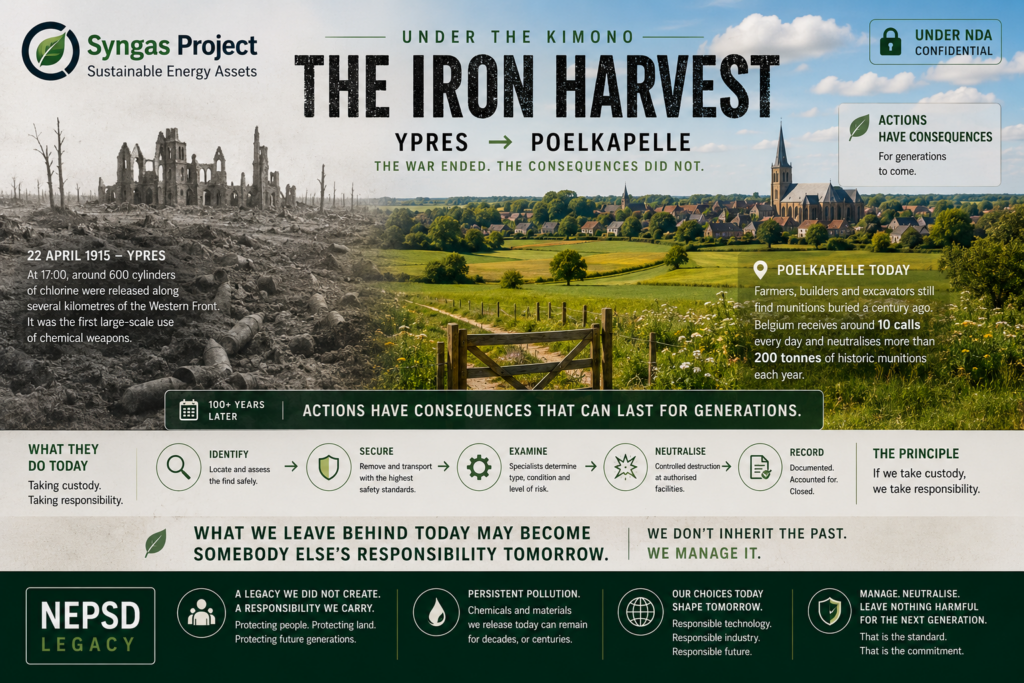
At five o’clock in the afternoon on 22 April 1915, near Ypres in Belgium, approximately 600 cylinders released chlorine across several kilometres of the Western Front.
A yellow-green cloud moved towards French and Algerian troops.
It was the first large-scale use of chemical weapons in modern warfare.
It also began a story that, more than a century later, is still being written in the same fields.
The armies eventually left.
The trenches disappeared.
Farms returned.
Roads were rebuilt.
Villages grew again.
Europe moved on.
The ground did not.
1. THE IRON HARVEST
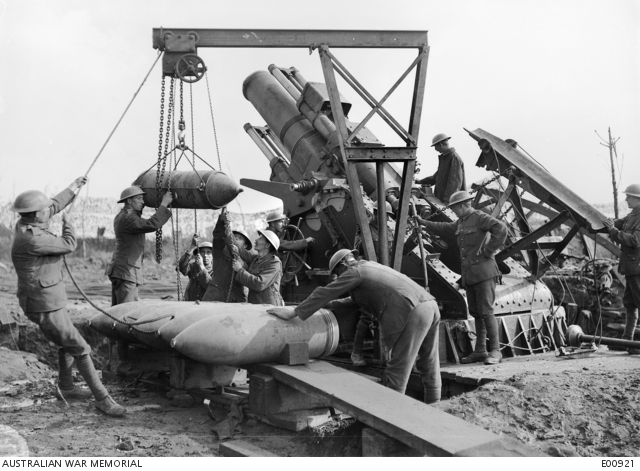
Every year the soil of Belgium continues to return ammunition from the First and Second World Wars.
Farmers find it.
Construction workers find it.
Excavators find it.
Sometimes it is conventional ammunition.
Sometimes it contains something considerably more difficult.
Chemical agents.
The Belgian Explosive Ordnance Disposal and Destruction Service — DOVO — remains on permanent standby today. Belgian Defence says it receives an average of around ten calls every day and neutralises more than 200 tonnes of historical ammunition each year. Its specialist dismantling facility is at Poelkapelle, only a short distance from Ypres.
Think about that number.
Not an archaeological curiosity every few years.
Hundreds of tonnes every year.
More than a century after the Armistice.
This continuing recovery has acquired an extraordinary name:
THE IRON HARVEST
The fields continue producing what war planted in them.
2. THE WAR ENDED
This is where the story becomes important to AQUIS.
There is a natural human tendency to associate the end of an activity with the end of its environmental consequences.
The factory closes.
The mine closes.
The landfill closes.
The war ends.
The project is finished.
But chemistry does not recognise a completion certificate.
A shell buried beneath a Belgian field in 1917 does not know that the Armistice was signed in 1918.
Its casing corrodes.
The explosive ages.
The chemical agent remains.
Soil moves.
Groundwater moves.
A plough eventually arrives.
And suddenly a decision made more than one hundred years ago becomes somebody’s job on a Tuesday morning.
3. POELKAPELLE
Belgium therefore required something rather unusual.
Not a museum.
Not a memorial.
An operating destruction capability.
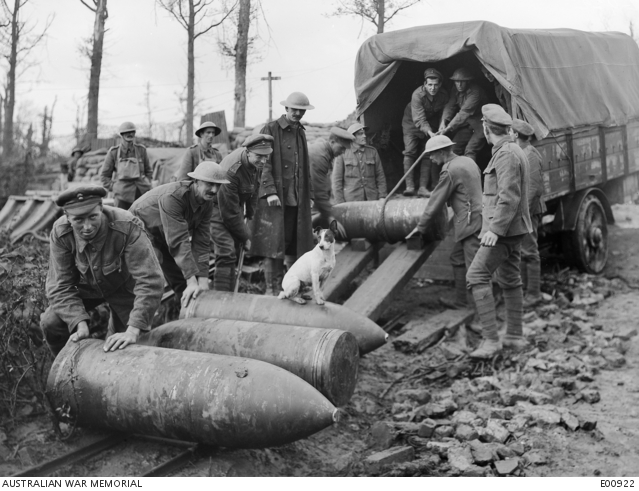
At Poelkapelle, recovered munitions are identified, handled and dismantled by specialists.
And this is where our story unexpectedly becomes personal to the technology behind NEPSD.
Because Albin Czernichowski’s GlidArc work came here.
Not conceptually.
Not as a laboratory comparison.
To Poelkapelle.
His published work describes an industrial GlidArc plasma oxidiser incorporated into the treatment system associated with destruction of conventional and chemical munitions.
That distinction matters.
GlidArc was not being asked to make the unexploded shell disappear.
Other equipment performed the primary destruction.
The plasma system was there because primary destruction still left another engineering question:
WHAT REMAINS IN THE GAS?
4. ALBIN
This is the part of Albin’s scientific history that makes our return to NEPSD particularly interesting.
GlidArc creates a non-equilibrium plasma.
The objective is not simply to heat an entire gas stream until everything becomes plasma.
Electrical discharge creates energetic electrons, radicals and highly reactive chemical conditions capable of attacking difficult molecules.
For Poelkapelle, that capability became part of dealing with the gases arising from the destruction of weapons that had survived in the earth for generations.
There is an extraordinary symmetry in that.
Chemical science helped industrialise warfare at Ypres.
Decades later, another branch of chemical science was required to help clean up what remained.
And Albin was part of that second story.
5. ONE HUNDRED YEARS LATER
This is why The Iron Harvest belongs under AQUIS.
Not because PFAS are chemical weapons.
They are not.
Not because today’s water contamination is equivalent to the Western Front.
It isn’t.
The connection is responsibility across time.
In 1915 nobody standing at Ypres was designing an environmental-management programme for 2026.
They were trying to win a war.
Yet Belgian engineers and soldiers today still have an operational responsibility created by decisions taken before their grandparents were born.
Belgian Defence still maintains the Poelkapelle dismantling capability today.
The technology changes.
The people change.
The institutions change.
The responsibility survives.
6. OUR IRON HARVEST
Our generation is creating its own extraordinarily persistent materials.
PFAS.
Microplastics.
Nanoplastics.
Pharmaceutical residues.
Complex industrial chemicals.
Some are tremendously useful.
Some have transformed medicine, manufacturing, food safety, electronics and modern life.
That is precisely why the lesson from Ypres is not that chemistry is bad.
The lesson is more demanding:
MAKING A MOLECULE IS ONLY THE BEGINNING OF OUR RESPONSIBILITY FOR IT.
We should know where it goes.
We should understand what happens when it enters water.
We should understand where it concentrates.
And when it becomes a pollutant, we should develop the methods and means to recover and ultimately destroy it.
Otherwise somebody else may inherit our harvest.
7. FROM POELKAPELLE TO AQUIS
And now an old piece of scientific history comes back into our own technology story.
Albin
↓
GlidArc
↓
Poelkapelle
↓
GATO
↓
NEPSD
↓
AQUIS
The contaminant has changed.
The application has changed.
The engineering will have to change.
And we absolutely do not yet claim that the historical GlidArc results demonstrate PFAS destruction by NEPSD.
That experiment remains to be done.
But the scientific inheritance matters.
We are not taking a technology whose history began yesterday and inventing an impressive future for it.
We are taking a technological lineage that has already been asked to deal with extraordinarily difficult man-made chemistry and asking:
What can it do for the chemistry our own generation must now confront?
8. THE FIELDS DID NOT FORGET
Ypres is covered in memorials.
They remind us of the people.
The fields provide another kind of memorial.
Every recovered shell says something slightly different.
Consequences can survive their creators.
Belgium’s Iron Harvest continues.
Poelkapelle continues to exist because somebody still has to finish work that began more than a century ago.
That is an uncomfortable thought.
It is also a useful one.
Because if we genuinely intend to leave the planet in better condition than we found it, we cannot measure success only by what we stop emitting today.
We must also think about what we are leaving behind.
The road to Net Zero matters enormously.
But eventually society will have to look beyond carbon and ask another question:
WHAT ARE WE LEAVING IN THE FIELDS?
The soldiers left Ypres more than one hundred years ago.
The chemistry stayed.
And every year, the earth still gives some of it back.