Warsaw 22:08:2026 Steve Walker
NEPSD — THE EXTINCTION MACHINE
OPEN KIMONO | TITAN → AQUIS → NEPSD
Some technologies become obsolete. Others simply wait for the world to invent their next problem.
NEPSD has been sitting in our technological toy cupboard for years.
We built it for another time and another problem.
It has already lived through three iterations of development. Behind it sits an extraordinary scientific history involving non-equilibrium plasma, GlidArc, the destruction of some extremely difficult molecules, GATO and a deliberately badly behaved gasifier called Fat Kate.
We did not develop NEPSD for PFAS.
We certainly did not imagine that one day we would bring it back because of water.
But that is exactly what is happening.
The PFAS family has given an old technology a new mission.
PART ONE — THE PROBLEM ARRIVES AT HOME
TITAN ONE PHASE TWO
TITAN One Phase Two introduces another capability into Sector 5.1 — Fermentation Station:
Aerobic Fermentation.
For those just joining the TITAN story, our common resource is Hydrogen Producer Gas — HPG.
We use HPG as a renewable molecular platform supporting different fermentation pathways rather than building a facility around one fixed product.
Phase Two adds aerobic fermentation.
And the timing is interesting because another renewable resource is becoming increasingly abundant:
biogenic CO₂.
TITAN produces it.
Europe’s thriving anaerobic-digestion industry produces it.
Through CUMULUS, we are developing the logistics and commercial opportunity around LCO₂ and LOX, including with TITAN’s offshore partners in the Baltic.
That creates a new resource environment on CAMPUS.
Oxygen can increasingly displace nitrogen where appropriate in gasification. It also becomes available to support aerobic fermentation.
And aerobic fermentation gives TITAN another capability.
We can cultivate microbes whose useful working life does not necessarily finish inside the fermentation vessel.
We call them our external workforce.
More about them in another chapter.
First we have somewhere for them to work.
AQUIS STARTS ON OUR OWN TURF
Fermentation manages a huge resource of water.
TITAN was always intended to manage that water in a closed loop.
Recover it.
Treat it.
Reuse it.
It is good practice, good engineering and common sense.
Nobody, however, should confuse closed loop with closed to pollution.
Pollutants will get in.
They arrive with water.
They arrive with biomass.
They arrive through industrial processes.
They arrive because modern society has become exceptionally good at manufacturing useful molecules and considerably less accomplished at thinking about where those molecules eventually go.
And there is an additional problem with a closed loop.
Persistent contaminants that enter it have somewhere to stay.
That makes AQUIS’s first assignment very simple.
Our own water.
Before AQUIS offers to solve anybody else’s water problem, it must protect the TITAN water cycle.
PFAS.
Microplastics.
Nanoplastics.
Pharmaceutical residues.
And whatever other persistent man-made contaminants analytical science tells us have joined the party.
First we find them.
Then we capture them.
But that is where the difficult part starts.
CAPTURE IS NOT EXTINCTION
Removing PFAS from water does not destroy PFAS.
It creates a PFAS-loaded filter.
Removing microplastics creates a microplastic-loaded filter.
And sending either of those filters to landfill is not circularity.
It is logistics.
AQUIS therefore needs two quite different capabilities:
CAPTURE
and
EXTINCTION.
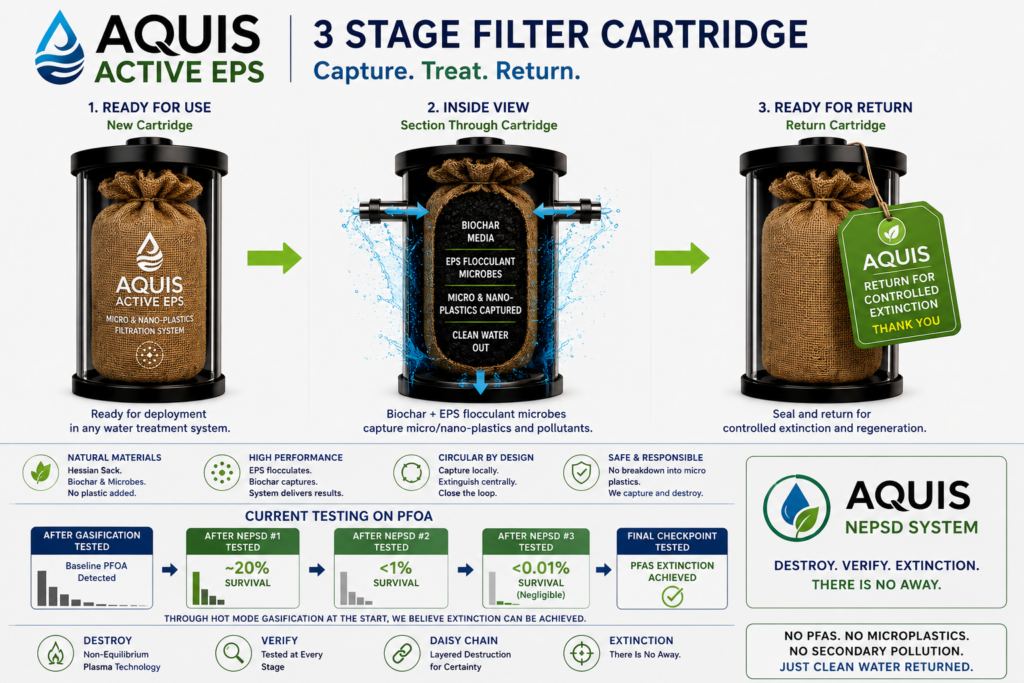
Fortunately, TITAN already manufactures a potentially valuable material for the first job.
Biochar.
Each TITAN cluster produces more than 30 tonnes every day.
We can use biochar together with cellulose structures and responsibly sourced natural carrier materials to develop filtration systems designed from the beginning around their complete lifecycle.
The precise cartridges, cellulose sponges, hessian bags and manufacturing arrangements come later.
The principle comes first.
The filter comes home.
Use it.
Load it.
Remove it.
Return it to TITAN.
And destroy what it captured.
EUROPE HAS JUST MOVED THE GOALPOSTS
This is no longer a theoretical environmental discussion.
The European Drinking Water Directive introduced PFAS parameters of:
| EU Drinking Water PFAS Parameter | Limit |
| Sum of PFAS — 20 specified substances | 0.10 μg/L |
| PFAS Total | 0.50 μg/L |
Member States were required to comply with those parameters by 12 January 2026. (EUR-Lex)
EU PFAS Drinking Water Monitoring Guidance
Look carefully at the units.
Micrograms per litre.
Europe is no longer asking whether PFAS in water is interesting.
It is requiring it to be measured and controlled.
For anyone operating water infrastructure, that changes the conversation.
But water is only the beginning.
NOW LOOK AT THE SLUDGE
The recast Urban Wastewater Treatment Directive — Directive (EU) 2024/3019 pushes the regulatory spotlight further through the treatment system.
It requires monitoring of microplastics in relevant urban wastewater systems and specifically requires monitoring of microplastics in sludge where relevant, particularly when that sludge is reused in agriculture.
For agglomerations above 10,000 population equivalent, that requirement becomes explicit.
The Directive also requires the European Commission to establish methodologies for measuring PFAS Total and Sum of PFAS in urban wastewater by 2 January 2027. (EUR-Lex)
EU Urban Wastewater Treatment Directive 2024/3019
That should attract the attention of the European water industry.
It should also attract the attention of another rapidly expanding circular industry.
Anaerobic digestion.
A digester is a magnificent biological machine.
But biology does not issue a certificate declaring that every persistent man-made molecule entering the digester has ceased to exist.
If PFAS or MNPs enter with feedstock, there is a straightforward question:
Where did they go?
Into the gas?
Into the process water?
Into the separated liquid?
Into the digestate?
And if that digestate is returned to agriculture, eventually:
into the soil?
The new European regulatory direction should therefore be read carefully by the water, sludge, AD and digestate industries.
Circularity will increasingly have to account not only for where its carbon goes.
It will have to account for where its contaminants go.
AQUIS intends to answer that question on TITAN before somebody else asks it for us.
THE TRAINING GASIFIER
Loaded AQUIS filtration media comes home.
Our training gasifier now gets another job.
The carbonaceous filter medium can itself become feedstock.
Captured plastics and MNPs encounter gasification.
Organic contaminants and pharmaceutical residues encounter a severe thermal environment capable of breaking down their original molecular structures.
For much of the captured load, gasification potentially gives us our extinction route.
Then we meet PFAS.
The carbon-fluorine bond is among the strongest bonds in organic chemistry.
That extraordinary persistence is why PFAS chemistry became so useful.
And why it has become such a problem.
Our gasifier gets very hot.
But hot is not a scientific measurement of PFAS destruction.
Temperature matters.
Residence time matters.
Atmosphere matters.
The particular PFAS matters.
And most importantly, we need to know what happened to the fluorine afterwards.
AQUIS therefore needs another barrier.
Fortunately, we have one.
Time to open the toy cupboard.
PART TWO — ENTER NEPSD
THE THIRD ITERATION
NEPSD is not something we found while searching for PFAS technologies.
It is ours.
It is the third iteration of an experimental development programme undertaken years before AQUIS existed.
NEPSD takes an already-hot gas stream and subjects it to a very different environment.
Non-equilibrium plasma.
Rather than attempting to turn an entire process stream into a conventional ultra-high-temperature plasma furnace, an electrical discharge creates energetic electrons, radicals and highly reactive local conditions within the flowing gas.
Difficult chemistry encounters a different kind of violence.
That is what interests us now.
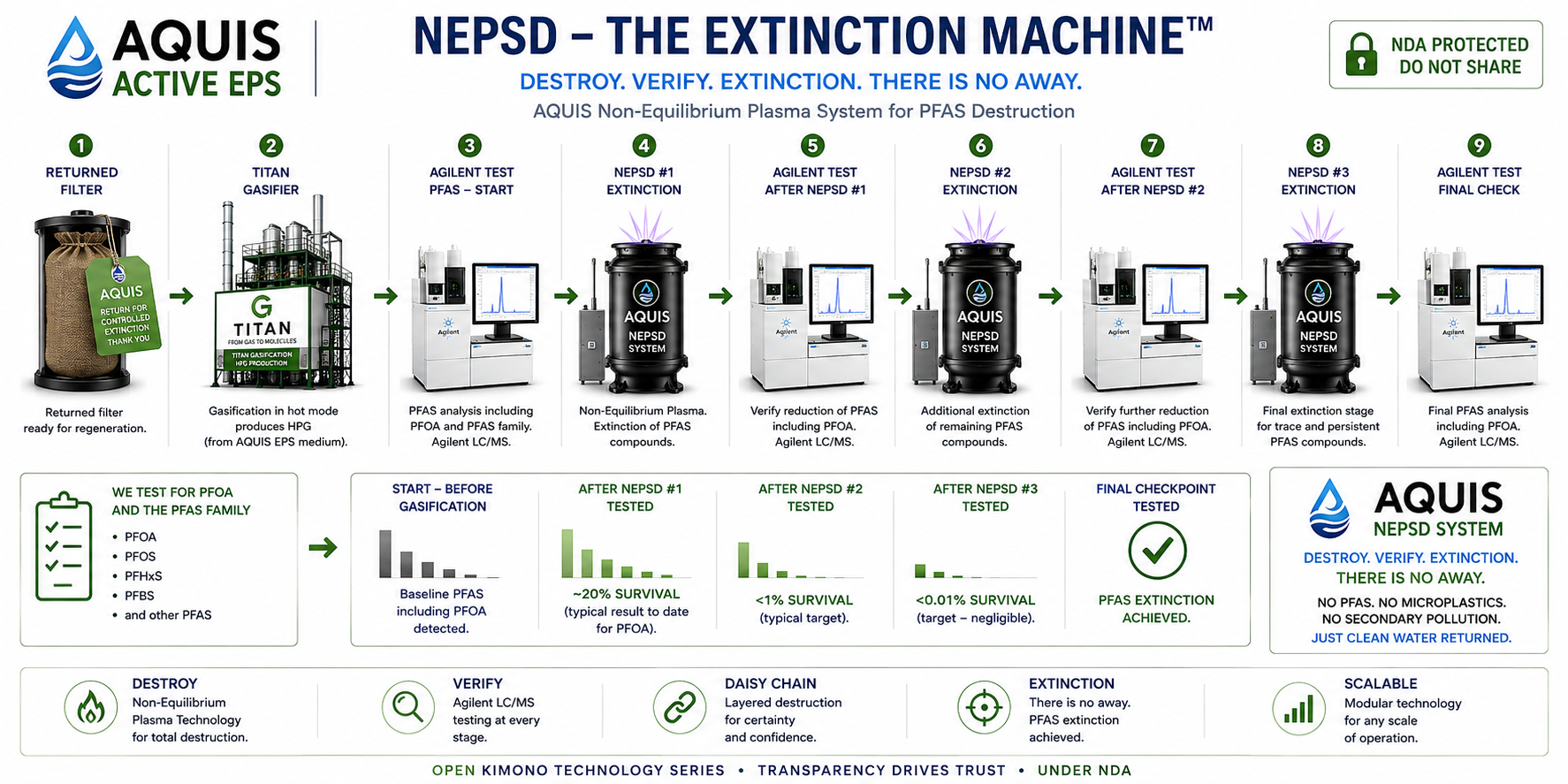
The proposed AQUIS pathway becomes:
WATER
↓
CAPTURE
↓
CONCENTRATE
↓
GASIFY
↓
NEPSD
↓
ANALYSE
↓
VERIFY
↓
EXTINCTION
And we mean verify.
PFAS disappearing from one analytical measurement is insufficient.
We want the fluorine mass balance.
We want destruction and removal efficiency.
We want to know what products remain.
Only after that do we earn the right to use the word extinction.
That experiment is still ahead of us.
But NEPSD itself is not an idea waiting to become hardware.
To understand that, we go back to RUMIA.
PART THREE — FAT KATE
SOMETIMES GOOD ENGINEERING MEANS DELIBERATELY BUILDING SOMETHING AWFUL
At RUMIA we built a one-off experimental gasifier:
PG UD350
An updraft gasifier.
Normally, producer-gas engineering spends a great deal of effort trying to reduce tar.
Albin wanted the opposite.
He wanted a tar breather.
He wanted a gas stream sufficiently difficult to provide a genuine challenge to the downstream technology.
So, against practically every instinct of good clean-gas practice, we specified, designed, engineered and delivered one.
Albin called her:
FAT KATE.
Fat Kate’s job was to breathe tar.
And she was very good at it.
That was not an engineering accident.
We deliberately built the problem so that Albin’s science could be properly tested against it.
And, importantly, we measured what happened.
THE RUMIA DATA
The October 2015 test programme gives us something far more valuable than a photograph of an interesting machine.
It gives us measured data.
| RUMIA PG UD350 / GATO — October 2015 | Before Treatment | After Treatment | Reduction |
| Tar | 12,362 mg/m³ | 346 mg/m³ | 97.20% |
| Solid particles | 55,122 mg/m³ | 75 mg/m³ | 99.86% |
| Combined tar + particles | 67,484 mg/m³ | 421 mg/m³ | 99.37% |
This is why NEPSD is not a PowerPoint technology.
Fat Kate provided a deliberately hostile producer-gas environment.
The treatment programme operated against that real gas.
And the results were measured.
These numbers do not prove that NEPSD destroys PFAS.
We have not performed that experiment.
That distinction is critical.
What the RUMIA work establishes is that there was a physical development programme, operating equipment, deliberately challenging producer gas and measured downstream performance.
AQUIS is therefore not starting from a sketch.
We are reopening an experimental programme.
And behind that programme sits Albin’s much longer scientific story.
PART FOUR — ALBIN’S LEGACY
GLIDARC
This is where NEPSD’s history becomes unusual.
Albin’s work in non-equilibrium plasma did not begin with TITAN, AQUIS or even GATO.
It leads back through GlidArc.
In simplified terms, GlidArc forms an electrical discharge between diverging electrodes.
The flowing gas stretches the discharge and drives it along the electrodes until it extinguishes and reforms.
Again.
And again.
The result is a highly reactive environment containing energetic electrons, radicals and excited chemical species.
The clever part is not the spectacular-looking arc.
The clever part is the chemistry it makes possible.
And that chemistry had already been given an extraordinarily serious job.
DAVINCH
FROM CHEMICAL WEAPONS TO AN ENVIRONMENTAL EXTINCTION PLATFORM
DAVINCH — Detonation of Ammunition in a Vacuum Integrated Chamber — was developed for the destruction of recovered chemical warfare materiel.
Chemical munitions were destroyed inside a near-vacuum detonation chamber.
But destroying the munition was not the end of the problem.
There was still off-gas.
And the off-gas still required treatment.
The National Academies documents DAVINCH systems in which off-gases were treated using plasma oxidation followed by further filtration. A later National Academies review describes a diverging-electrode plasma arc reactor operating at approximately 1,600°C arc temperature, with treated gas capable of being held, tested and recirculated for further treatment before release. (National Academies)
The connection to Albin’s work is explicit in the scientific literature.
His 2009 paper on GlidArc-assisted cleaning of flue gas from conventional or chemical-weapons destruction describes the DAVINCH Cold-Plasma Oxidizer as being based on GlidArc discharge and records its use as the secondary treatment barrier for the detonation off-gas. (ResearchGate)
Read about the Kanda Bay Project
This matters enormously to the NEPSD story.
Not because PFAS is a chemical weapon.
It isn’t.
And not because previous chemical-agent treatment proves PFAS destruction.
It doesn’t.
It matters because the scientific ancestry of the technology was already concerned with a very demanding proposition: destroying hazardous molecules and then treating and verifying the gas before release.
That is an unusually relevant inheritance for AQUIS.
GATO
Eventually that scientific lineage reached our own development programme.
GlidArc.
Plasma-assisted gas treatment.
GATO.
Fat Kate.
Successive experimental iterations.
NEPSD.
The objective changed as the programme evolved, but the underlying question remained remarkably consistent:
What do we do with the difficult molecules that ordinary treatment leaves behind?
At RUMIA we asked that question about producer gas and tar.
AQUIS is asking it again.
This time about water.
PART FIVE — THE NEW EXTINCTION MISSION
There is an elegant circularity to bringing NEPSD back.
TITAN creates renewable molecules.
Fermentation requires us to manage a huge water resource.
Closed-loop water management forces us to confront persistent contaminants on our own site.
AQUIS captures them.
TITAN biochar provides a potential filtration medium.
The filter comes home.
Gasification provides the first destruction environment.
And where gasification alone cannot yet give us the confidence we require, NEPSD provides another potential barrier.
Then analytical science tells us whether we succeeded.
We capture.
We concentrate.
We destroy.
We measure.
We verify.
And only then:
We declare extinction.
FIRST TITAN. THEN CAMPUS.
AQUIS starts inside TITAN because that is where our responsibility starts.
But the problem does not stop at our fence.
Water companies are now operating under a European regime that measures PFAS in fractions of a microgram per litre.
Wastewater operators are entering a world of increasing micropollutant and microplastic monitoring.
Sludge returned to agriculture is entering that same spotlight.
And the enormous European AD industry should be asking today what happens to persistent contaminants entering tomorrow’s digestate.
There is a potentially substantial new environmental-services industry emerging here.
AQUIS does not need to invent that market.
Regulation is creating it.
Our job is to develop a technically credible closed-loop response.
First our own water.
Then CAMPUS.
Then process water, sludge, process cake and digestates.
And eventually external water systems.
WELCOME BACK, NEPSD
NEPSD was not designed for PFAS.
Neither was TITAN.
That may ultimately be what makes this story interesting.
We did not start with PFAS and go shopping for a technology.
We started with a responsibility.
Pollutants will get into our closed water loop.
AQUIS has to remove them.
Once removed, we refuse simply to move them somewhere else.
And when we looked through our own engineering history for something capable of taking us from capture toward extinction, we found an old machine waiting for another assignment.
Behind it was RUMIA.
Fat Kate.
Real test data.
GATO.
Three iterations of engineering.
And behind all of those was Albin and a scientific legacy that had already travelled from GlidArc into one of the most demanding hazardous-molecule destruction environments imaginable.
That does not prove NEPSD will destroy PFAS.
That is precisely why we are going to test it.
We have the machine.
We have the gasification platform.
We have the biochar.
We have the water.
We have the analytical question.
And unfortunately, society has supplied us with plenty of molecules to work on.
Time to take NEPSD out of the toy cupboard.
Welcome back.