Acetogenic Worker Profile
| Characteristic | Acetogenic profile |
| Microbial family | Bacteria — Acetogens |
| Fermentation family | Anaerobic Dark Side |
| Carbon diet | Single-carbon gaseous diet |
| Principal outcome | 2G Ethanol and ABE chemicals |
| Biomass production | Medium–light |
| Oxygen tolerance | Very low |
| Impurity tolerance | Medium and worker-specific |
| Preferred environment | Clean, conditioned HPG |
| Best applications | TITAN ethanol trains, ATJ and chemical production |
| Syngas Project role | Feed preparation, platform integration and industrial deployment |
Change the Worker. Change the Molecule.
Acetogenic bacteria belong to the same broad microbial family, but different workers perform different industrial jobs.
The TITAN base case is configured for 2G Ethanol. Future Microbial Capabilities can target other alcohols, solvents, organic acids and chemical intermediates.
ABE means Acetone, Butanol and Ethanol.
The additional acetate pathway is separate. At fermentation conditions, acetic acid is commonly present in the broth as acetate. It can be recovered as a product, converted into acetic acid or upgraded biologically into another molecule.
Changing the target product may require a different worker, operating protocol and recovery module. The common infrastructure remains the clean HPG supply, gas buffering, utilities, fermentation environment and industrial platform.
From HPG to 2G Ethanol
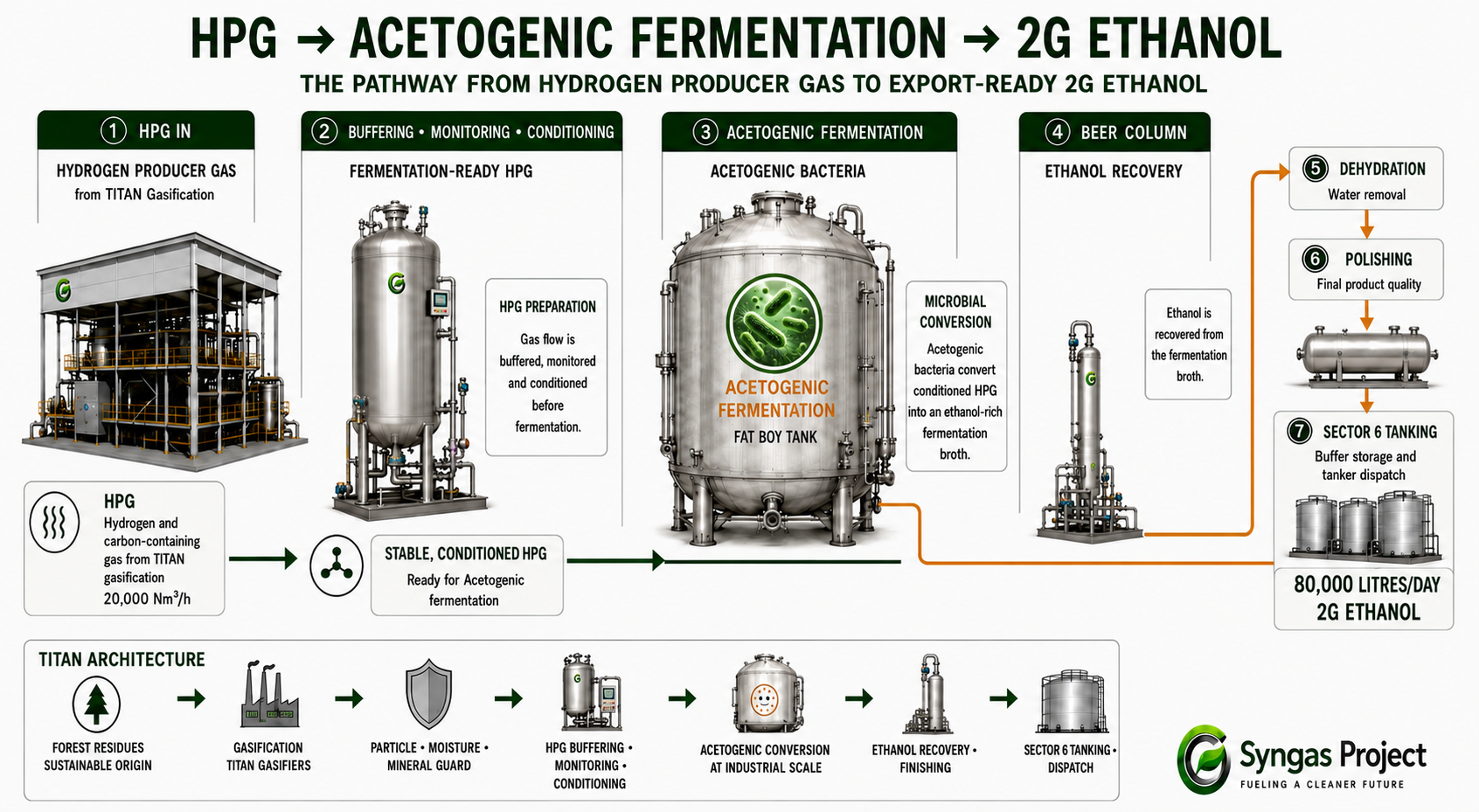
One TITAN Acetogenic island receives:
20,000 Nm³/h of conditioned HPG
The HPG first enters the buffering, monitoring and conditioning tank. It then passes to the Acetogenic Fat Boy Tank, where the microbes manufacture an ethanol-rich fermentation broth.
The liquid broth passes through the beer column for initial ethanol recovery. Water is then removed through dehydration before final product polishing and transfer into static Sector 6 buffer tanks.
One Acetogenic island produces:
80,000 litres/day of 2G Ethanol
The TITAN Acetogenic Stack
Each TITAN location is developed through three phases. Every phase adds one two-island HPG cluster.
| Development stage | Installed configuration | Total ethanol production |
| Phase One | 1 RNG island + 1 Acetogenic island | 80,000 litres/day |
| Phase Two | Adds 2 RNG islands | 80,000 litres/day |
| Phase Three | Adds 1 RNG island + 1 Acetogenic island | 160,000 litres/day |
At full Phase Three development, one TITAN location contains six islands across three clusters:
- four RNG islands; and
- two Acetogenic ethanol islands.
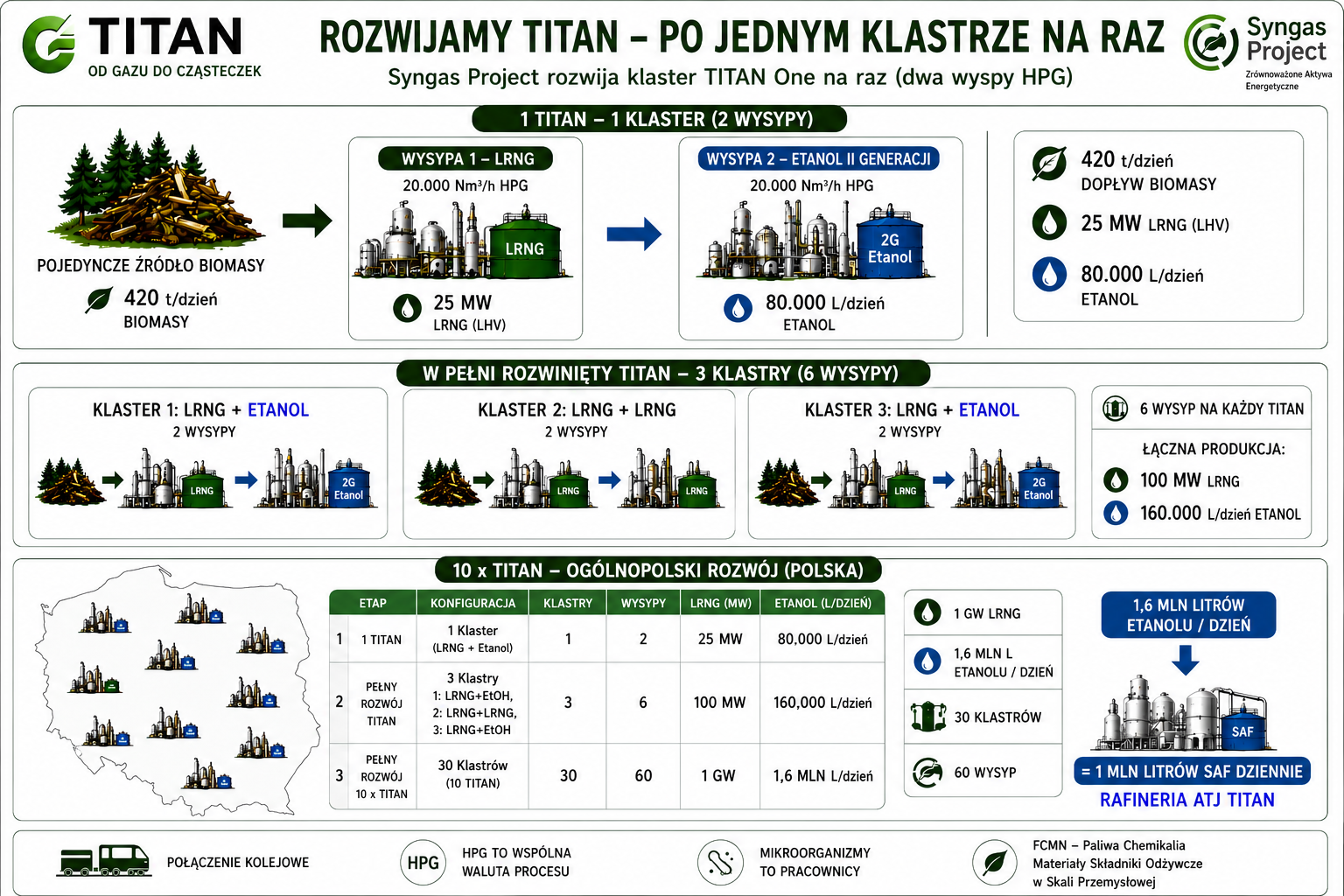
The second Acetogenic island is added during Phase Three. Total site production then increases from 80,000 to 160,000 litres/day of 2G Ethanol.