AUSTRIA
★★★★★
TITAN RESIDUE & BIOMASS DUE DILIGENCE
Investment Statement
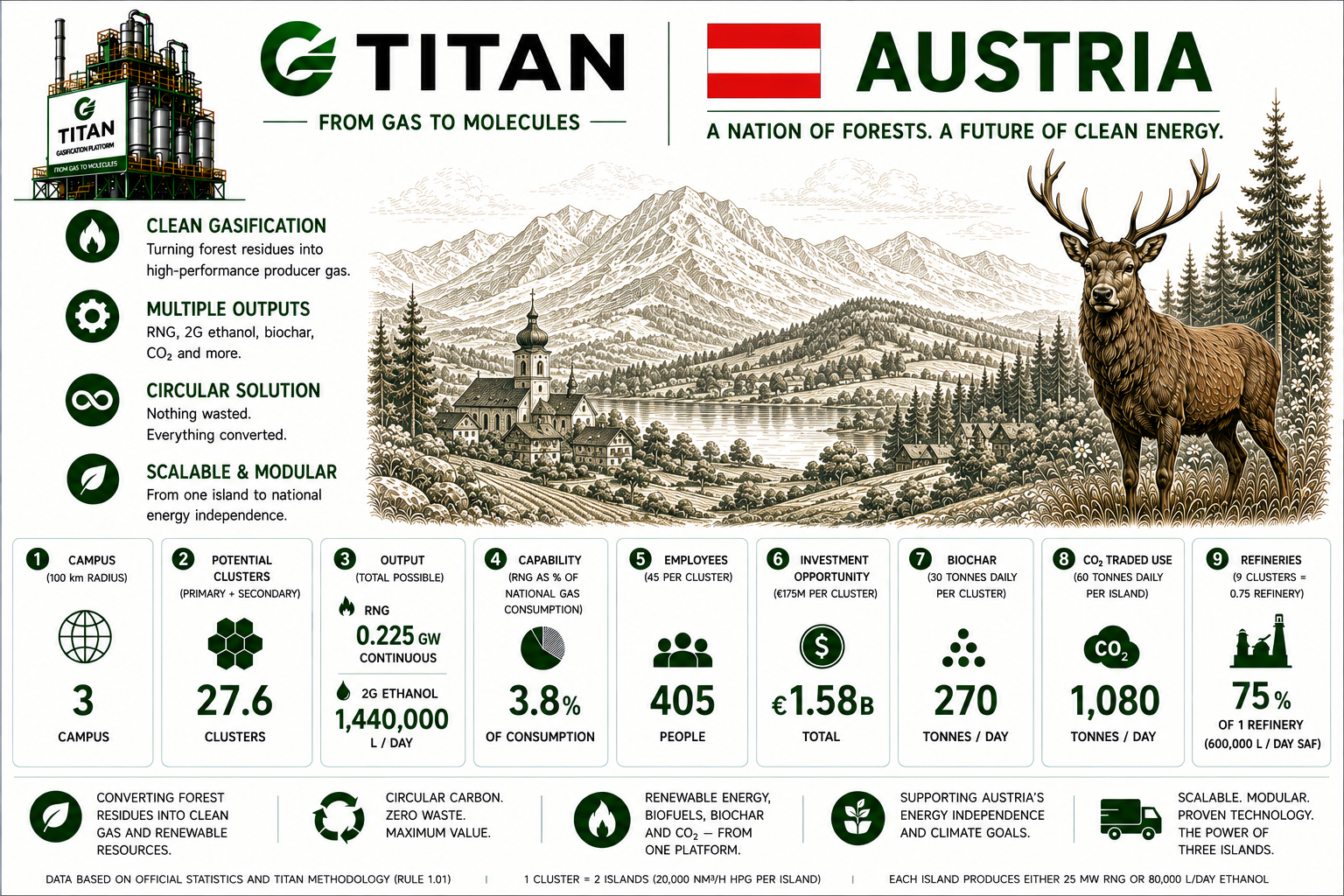
Austria is a five-star, three-CAMPUS TITAN opportunity.
Austria covers approximately 83,900 km² and has more than 4.0 million hectares of forest, representing approximately 47.9% of national territory. Austria is therefore geographically equivalent to approximately 2.7 standard TITAN CAMPUS reaches and is classified as a three-CAMPUS country. (bmluk.gv.at)
The Primary managed-forest resource supports approximately 27.1 TITAN clusters, three times the nine clusters required to fully develop three CAMPUS.
Austria can therefore support the complete proposed three-CAMPUS / nine-cluster / eighteen-island deployment from Primary Resource alone, before any Secondary Resource is required.
Instant Review
| Resource Market | Available Residue | TITAN Clusters |
| PRIMARY RESOURCE | ||
| State / Public Forest | 0.77 Mt/y | 5.1 |
| Private Forest | 3.29 Mt/y | 21.9 |
| Primary Total | 4.06 Mt/y | 27.1 |
| SECONDARY RESOURCE | ||
| Sawmill Residues | 6.01 Mt/y | 40.1 |
| Joinery & Carpentry Residues | 2.80 Mt/y | 18.7 |
| Park & Avenue / Non-Forest | 2.00 Mt/y | 13.4 |
| Reclaimed / Recovered Wood | 4.01 Mt/y | 26.7 |
| Secondary Total | 14.82 Mt/y | 98.8 |
| TOTAL IDENTIFIED RESOURCE | 18.88 Mt/y | 125.9 |
| National Classification | Three-CAMPUS Country | 3 CAMPUS |
| Recommended Deployment | 1.35 Mt/y | 9 clusters / 18 islands |
| Available for Duty | — | 3 of 3 CAMPUS — 100% |
National Materiality
| Measure | Austria |
| TITAN renewable methane capacity | 300 MW |
| Annual RNG / LRNG | ~2.63 TWh/y |
| Austrian gas consumption, 2024 | 74.4 TWh/y |
| Share of national gas consumption | ~3.5% |
Austria consumed approximately 74.4 TWh of natural gas in 2024. (E-Control)
1. Geography & CAMPUS Opportunity
Austria is a three-CAMPUS country.
Its approximately 83,900 km² national territory represents around 2.7 nominal 100 km-radius CAMPUS reaches.
Austria’s Alpine geography means that theoretical area alone cannot determine final CAMPUS locations. Mountain ranges, protection forests and transport corridors make practical journey time and resource accessibility particularly important.
The opportunity is nevertheless strong because Austria combines dense forest resources with developed road, rail and industrial infrastructure.
A three-CAMPUS national structure provides the appropriate starting point:
3 TITAN-led CAMPUS
9 TITAN clusters
18 TITAN islands
REACH and CACHE locations can extend each CAMPUS through Alpine resource areas and toward strategic logistics, industrial and downstream infrastructure.
Each CAMPUS can subsequently become live with the wider Syngas Project platform family according to the municipal, agricultural, water, gaseous-carbon and other resources identified within its reach.
2. State & Public Forest
Austria differs materially from Poland in forest ownership.
Approximately 19% of Austrian forests are publicly owned, while the Austrian Federal Forests manage around 600,000 hectares. The Federal Forests are wholly owned by the Republic of Austria. (bmluk.gv.at)
The assessed State/Public Primary Resource provides approximately:
0.77 Mt/year
equivalent to:
5.1 TITAN clusters
This is a substantial public procurement opportunity.
Public forest alone could theoretically support more than one complete three-cluster CAMPUS, with additional capacity remaining.
The Austrian Federal Forests should therefore be a priority strategic procurement counterparty in any Austrian development programme.
3. Private Forest
Private ownership represents approximately 81% of Austria’s forest area, shared among around 137,000–140,000 owners. (bmluk.gv.at)
The assessed Private Primary Resource provides approximately:
3.29 Mt/year
equivalent to:
21.9 TITAN clusters
Private forest is therefore the dominant Austrian Primary Resource.
Austria does, however, have an established forestry structure for aggregating smaller owners. The Federal Ministry identifies forestry associations, owner cooperatives, authorities and service providers as existing mechanisms supporting organised management and marketing. (bmluk.gv.at)
This makes Austria structurally different from a country where fragmented ownership exists without a developed aggregation framework.
The preferred TITAN procurement architecture is therefore:
Public forest anchor + established private-forest aggregation + Secondary Resource resilience.
4. Sawmill Residues
Austria has a major forestry and wood-processing industry.
Official Austrian data record approximately 20.03 million solid cubic metres of timber harvesting in 2024. (bmluk.gv.at)
The assessed sawmill residue opportunity provides approximately:
6.01 Mt/year
equivalent to:
40.1 TITAN clusters
This is Austria’s largest individual Secondary Resource market.
Austria already has a sophisticated wood-products and bioenergy economy, so competition for sawmill residues is likely to be significant.
TITAN does not need to rely upon this market to establish the Austrian programme. This allows Syngas Project to contract selectively where local pricing, logistics and long-term availability strengthen an individual CAMPUS.
5. Joinery & Carpentry
Austria’s large downstream timber economy creates a substantial industrial residue market from joinery, carpentry, engineered wood, furniture, construction products and related manufacturing.
The assessed opportunity provides approximately:
2.80 Mt/year
equivalent to:
18.7 TITAN clusters
The material can be attractive because it is already concentrated at industrial sites and can require less collection infrastructure than forest-floor residue.
Competition is expected to be stronger because clean industrial wood has established material and energy markets.
The sector is therefore an important downstream strategic and resilience market, rather than a dependency of the Austrian TITAN programme.
6. Park & Avenue / Non-Forest Woody Residues
Austria’s Park & Avenue / Non-Forest market includes qualifying woody residues arising outside managed forestry, including municipal trees, parks and avenues, road and railway corridors, utility corridors, airports, waterways and industrial estates.
The assessed opportunity provides approximately:
2.00 Mt/year
equivalent to:
13.4 TITAN clusters
Austria’s extensive transport infrastructure and significant management requirements in mountainous terrain make this an important additional national woody-carbon pool.
The distributed nature of the resource makes it particularly suitable for REACH collection arrangements associated with the three principal CAMPUS.
7. Reclaimed & Recovered Wood
The assessed Austrian reclaimed and recovered wood resource provides approximately:
4.01 Mt/year
equivalent to:
26.7 TITAN clusters
Austria already has mature recycling and wood-processing markets, so TITAN should focus only on qualifying residual fractions after higher-value reuse and recycling opportunities have been respected.
Chain of custody, waste classification and contaminant control remain essential.
The scale of the market nevertheless provides significant long-term circular-carbon optionality.
8. Resource Security
| Resource Position | TITAN Clusters |
| State / Public Primary | 5.1 |
| Private Primary | 21.9 |
| Total Primary | 27.1 |
| Sawmill | 40.1 |
| Joinery & Carpentry | 18.7 |
| Park & Avenue | 13.4 |
| Reclaimed & Recovered | 26.7 |
| Total Secondary | 98.8 |
| Total Identified Potential | 125.9 |
| Maximum Austrian Deployment | 9.0 |
Austria’s proposed three-CAMPUS programme requires only approximately:
33% of assessed Primary Resource
Primary managed-forest residue alone therefore provides approximately:
3 times the resource required for full national deployment
Only around 7% of the total screened Primary + Secondary opportunityis required for the proposed nine-cluster programme.
This provides very substantial procurement headroom.
9. National Materiality
Austria consumed approximately 74.4 TWh of natural gas in 2024. (E-Control)
A three-CAMPUS TITAN deployment producing 300 MW RNG/LRNGrepresents approximately:
2.63 TWh/year renewable methane
equivalent to:
~3.5% of Austrian annual natural-gas consumption
Austria’s Renewable Expansion Act also sets an objective of increasing domestic renewable-gas production to 5 TWh by 2030. (E-Control)
The proposed TITAN programme would therefore be nationally material.
10. Market Assessment
Austria combines the characteristics required for a ★★★★★ TITAN opportunity.
High forest coverage. Almost 48% of national territory is forested. (bmluk.gv.at)
Three-CAMPUS geography.
27.1 clusters of Primary Resource against only nine required.
Meaningful public forestry anchor.
Very large private forestry resource supported by established aggregation structures.
Major domestic sawmill and downstream wood industries.
Exceptional Secondary Resource depth.
National renewable-gas materiality.
The principal development issue is not national resource availability.
It is CAMPUS siting across Alpine geography and the commercial structure required to combine public, organised private and Secondary resources efficiently.
Austria therefore warrants:
★★★★★
Five-Star TITAN Opportunity Rating
11. Deployment Recommendation
AUSTRIA — ★★★★★ PRIME THREE-CAMPUS MARKET
Syngas Project should proceed on the basis of:
3 TITAN-led CAMPUS
9 TITAN clusters
18 TITAN islands
1.35 million tonnes/year maximum programme feedstock requirement
100% AVAILABLE FOR DUTY
Primary managed-forest residue alone supports approximately 27.1 clusters, compared with only nine required for complete three-CAMPUS deployment.
The State/Public forest resource alone supports approximately 5.1 clusters, providing an important procurement anchor, while organised private forestry provides more than enough additional capacity to complete the national programme.
The next development stage should concentrate on identifying the three optimum Austrian CAMPUS locations, particularly where forest concentration, rail and motorway infrastructure, industrial sites and accessible Alpine resource catchments overlap.
Austria combines a dense forest economy, substantial resource headroom and a national geography capable of supporting three fully developed TITAN-led CAMPUS.
AUSTRIA | ★★★★★ | 3 CAMPUS | 9 CLUSTERS | 18 ISLANDS | 100% AVAILABLE FOR DUTY