Warsaw 30:01:2023 08:16 AM Steve Walker
Climbing the Biochar Value Ladder
From stable carbon to certified strategic value
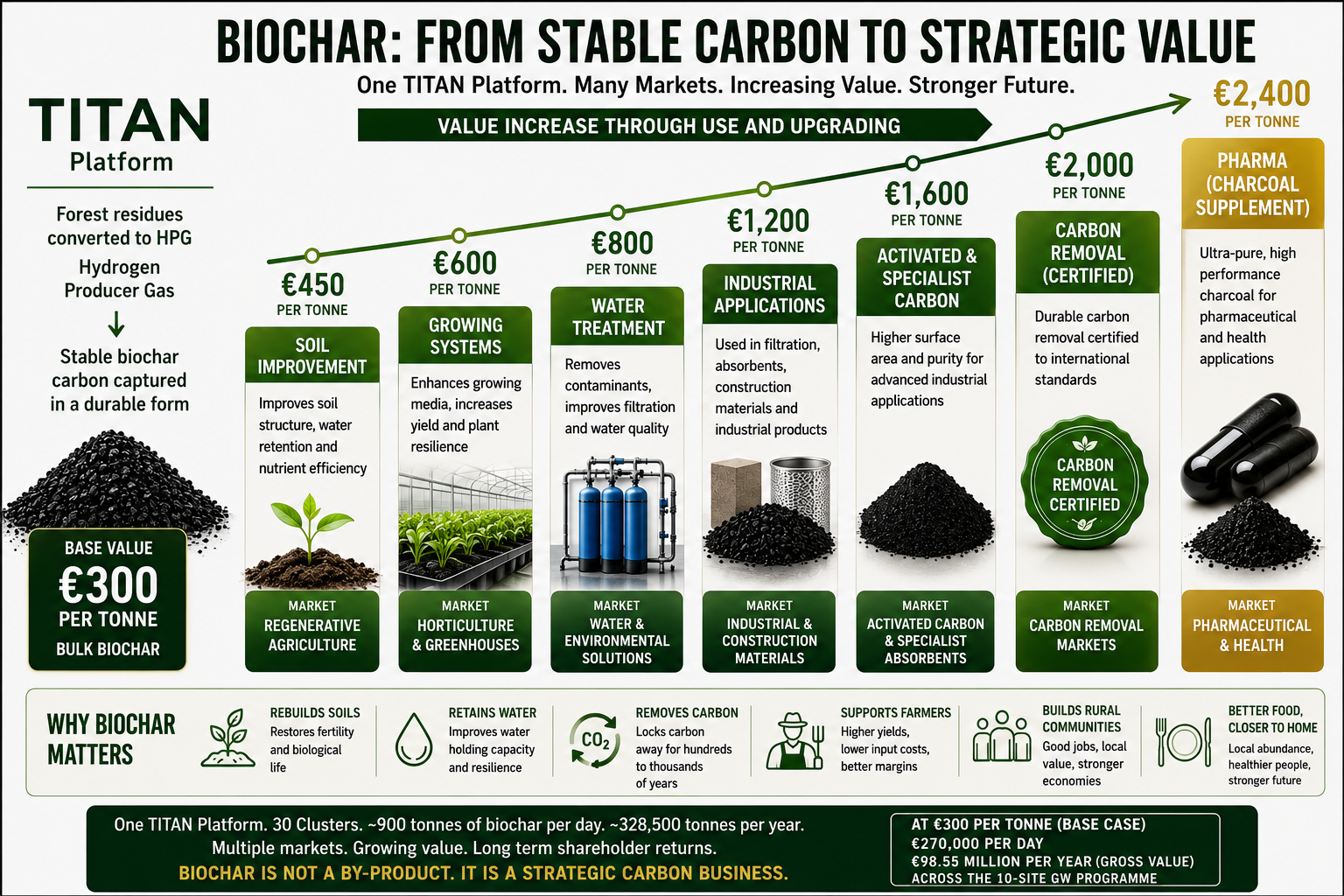
Biochar does not leave the TITAN Platform as a finished €2,400-per-tonne product.
It begins as stable carbon produced from sustainably sourced forest residues during the production of Hydrogen Producer Gas. Its value then increases through controlled processing, product development, certification and verified use.
The value ladder is therefore not simply a price list. It is a structured development programme.
At every step, Syngas Project must answer four questions:
What was the biochar made from?
How was it produced?
Is every production batch safe and consistent?
What certified purpose will it serve?
The better the evidence, consistency and demonstrated performance, the higher the biochar can progress.
Importantly, this is a commercial value ladder, not a legal ranking system. Certification classes confirm that a biochar is suitable for a particular application. They do not automatically describe one product as better than another. A single well-controlled production batch may qualify for several different uses, but it must be tested, documented and marketed correctly for each one.
The foundation: controlled biochar production
The ladder begins inside TITAN.
Forest residues are converted through gasification into Hydrogen Producer Gas, renewable molecules and a stable carbon fraction. That carbon fraction must first become a repeatable industrial product.
TITAN must establish:
Approved and traceable forest-residue feedstocks.
Defined feedstock preparation and moisture limits.
A controlled gasification temperature and residence time.
Restricted oxygen conditions.
Capture or destruction of methane and other process emissions.
Controlled cooling, handling and storage.
Separation of production into identifiable batches.
Representative sampling and retention of reference samples.
Laboratory testing of every defined production batch.
Under the new EU methodology for Biochar Carbon Removal, eligible production must heat biomass to at least 350°C, capture or destroy methane produced during the process and make productive use of the co-produced heat. Each batch must be connected to consistent feedstock and operating conditions. Commission Delegated Regulation (EU) 2026/285
This production discipline creates the foundation for every subsequent market.