
Warsaw 14:08:2026 Steve Walker
CROATIA 🇭🇷
★★★★★
TITAN Forest Residue Opportunity — Country Due Diligence
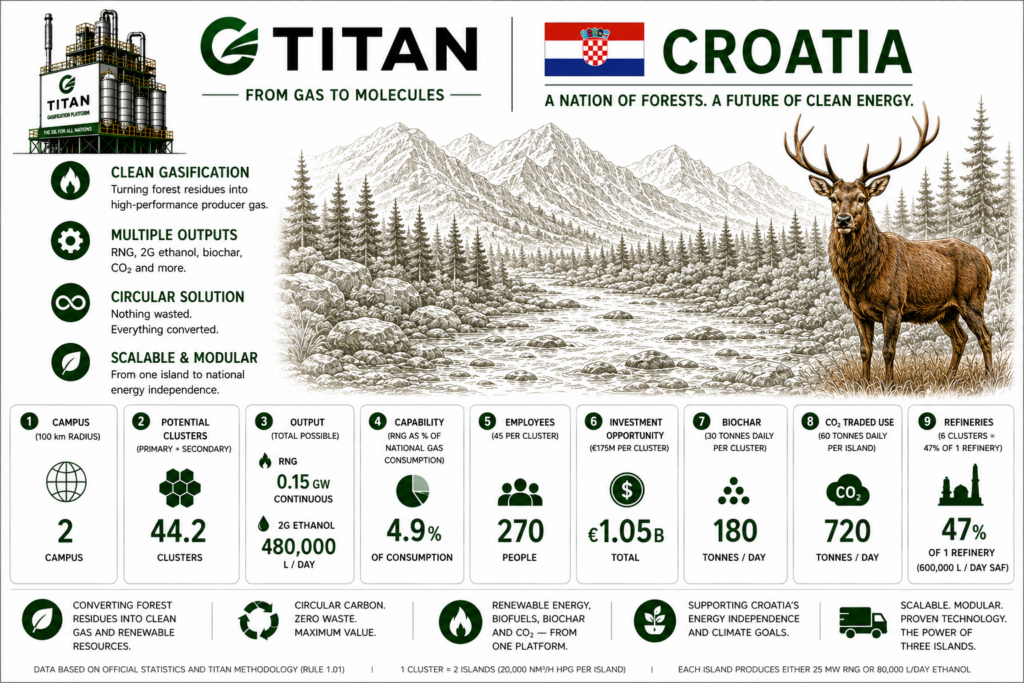
Croatia has a land area of 56,594 km² and is a 2-CAMPUS country under the TITAN 100 km planning model. Both CAMPUS are relevant to TITAN. Croatia combines the forested continental north and east with the heavily forested mountain regions of central Croatia and the long Adriatic corridor. Its 2.560 million ha of forest support 17.2 TITAN clusters from primary forest residues alone, before the substantial Croatian wood-processing and circular wood markets are included. Croatia’s terrain ranges from the lowland Drava–Sava region through the forested mountains of Gorski Kotar and Lika to the Adriatic coast, requiring CAMPUS sites to be placed on the principal transport corridors rather than in difficult mountain locations. (mzo.gov.hr)
| CROATIA — INSTANT REVIEW | Resource | TITAN Clusters | Assessment |
| Public Forest | 76% of forest | 13.1 | Exceptional primary position |
| Private Forest | 24% of forest | 4.1 | Strong additional supply |
| Primary Forest Residue | 2.560 million ha | 17.2 | Exceptional |
| Sawmill Residue | 1.637 Mt/year | 10.9 | Major secondary market |
| Wood Manufacturing Residue | 0.764 Mt/year | 5.1 | Strong industrial market |
| Park & Avenue | 0.546 Mt/year | 3.6 | Strong distributed resource |
| Reclaimed Wood | 1.092 Mt/year | 7.3 | Major circular resource |
| Secondary Resource | 4.039 Mt/year | 26.9 | Exceptional |
| Total Identified Opportunity | 6.625 Mt/year | 44.2 | ★★★★★ |
1. Country & CAMPUS Geography
Croatia covers 56,594 km², giving the country 2 geographic CAMPUSunder the TITAN 100 km radius planning model. Croatia’s official investment information confirms the 56,594 km² land area. (investcroatia.gov.hr)
Croatia: 2 CAMPUS | 2 TITAN-relevant CAMPUS
Croatia has an unusual elongated geography, but the two CAMPUS remain relevant to TITAN because the forest resource extends across both the continental and central Croatian regions.
Northern and eastern Croatia contain extensive lowlands between the Drava and Sava rivers, while central Croatia contains the heavily forested Gorski Kotar and Lika mountain regions. The Adriatic region is more geographically difficult, but Croatia’s national road, rail and port infrastructure provides suitable locations from which these resources can be aggregated. (mzo.gov.hr)
The CAMPUS strategy should therefore place processing infrastructure at accessible logistics nodes and bring residue out of forested mountain areas rather than attempting to place industrial infrastructure deep within those areas.
2. Primary Forest Opportunity
The Croatian Bureau of Statistics reports 2,560,058 ha of forest in 2024, within a total forest-land estate of 2,757,583 ha. (Državni zavod za statistiku)
The productive forest base supports:
17.2 TITAN clusters
Croatia’s forest ownership is dominated by the public sector. Croatian government reporting identifies 76% of forest as state-owned and 24% as privately owned. (vlada.gov.hr)
| Forest Ownership | Share | TITAN Clusters |
| Public Forest | 76% | 13.1 |
| Private Forest | 24% | 4.1 |
| Total | 100% | 17.2 |
The strategic number is therefore:
13.1 clusters from public forest
This gives Croatia a particularly strong primary-market structure.
TITAN can establish its initial position through the large public forest estate, while private forestry provides a further 4.1 clusters of resource depth.
The Croatian forest floor should therefore remain the primary supply point for TITAN.
3. Sawmill Residues
Croatia produced 5.458 million m³ of roundwood in 2024, up 5.0% from 2023. Industrial roundwood accounted for 2.843 million m³, including 2.596 million m³ of sawlogs and veneer logs. (Državni zavod za statistiku)
The Croatian sawmill residue market provides:
1.637 million tonnes/year
supporting:
10.9 TITAN clusters
This is an exceptionally strong secondary market.
Croatia therefore provides substantial resource capacity immediately below the forest floor, allowing TITAN to establish additional supply positions with sawmills and primary wood processors without relying upon them as the foundation of the programme.
4. Wood Manufacturing Residues
Croatia’s downstream wood-processing sector creates a further significant industrial residue pool.
The wood-manufacturing resource provides:
0.764 million tonnes/year
supporting:
5.1 TITAN clusters
This material is more commercially contested than forest-floor residue but remains strategically valuable because it is concentrated at industrial production sites and already sits within established logistics systems.
The Croatian TITAN programme should therefore develop these relationships as secondary and contingency supply positions.
5. Park & Avenue
Croatia’s cities, municipalities, roads, railways, electricity corridors, public parks, tourism infrastructure and managed landscapes generate a continuing non-forest woody-residue stream.
The Park & Avenue market provides:
0.546 million tonnes/year
supporting:
3.6 TITAN clusters
Croatia’s geography makes this market particularly interesting because the country’s transport and tourism infrastructure extends across both continental Croatia and the long Adriatic corridor.
These materials arise from necessary maintenance and therefore create a distributed carbon resource around both CAMPUS areas.
6. Reclaimed Wood
Croatia also has a strong reclaimed-wood opportunity from construction, demolition, pallets, packaging, furniture, tourism infrastructure and other end-of-life wood products.
The identified reclaimed-wood market provides:
1.092 million tonnes/year
supporting:
7.3 TITAN clusters
This is the second-largest secondary market after sawmill residues and materially strengthens the Croatian circular-carbon proposition.
7. Total TITAN Opportunity
Croatia’s primary forest resource supports:
17.2 TITAN clusters
The four secondary markets provide:
| Secondary Market | TITAN Clusters |
| Sawmill Residues | 10.9 |
| Wood Manufacturing Residues | 5.1 |
| Park & Avenue | 3.6 |
| Reclaimed Wood | 7.3 |
| Total Secondary | 26.9 |
The combined identified Croatian resource therefore supports:
44.2 TITAN CLUSTERS
This is a very strong resource position for a country with only two geographic CAMPUS.
The resource intensity is the key feature of Croatia. TITAN does not need to establish a large national network of CAMPUS to access substantial carbon availability. Two strategically positioned CAMPUS provide access to a primary forest resource supporting 17.2 clusters and a total identified resource supporting 44.2 clusters.
Strategic Assessment
Croatia is a 2-CAMPUS country and both CAMPUS are relevant to TITAN.
Its 2.560 million ha forest base supports 17.2 TITAN clusters, including 13.1 clusters from public forest. Croatia’s official 2024 forestry statistics also record 5.458 million m³ of roundwood production, confirming a substantial active forestry and wood-processing economy. (Državni zavod za statistiku)
Secondary wood resources add another 26.9 clusters, producing a national identified opportunity of:
44.2 TITAN clusters
Croatia therefore combines three characteristics particularly favourable to TITAN: high forest coverage, dominant public forest ownership and substantial resource availability concentrated within only two CAMPUS areas.
The development strategy is clear: establish the primary position with the Croatian public forestry sector, locate the two CAMPUS on strong road and rail logistics corridors serving the principal forest regions, and progressively integrate sawmill, manufacturing, Park & Avenue and reclaimed wood.
CROATIA — ★★★★★
2 CAMPUS | 2 TITAN-RELEVANT CAMPUS | 17.2 PRIMARY CLUSTERS | 44.2 TOTAL IDENTIFIED CLUSTERS
:::