
Warsaw 14:08:2026 Steve Walker
DENMARK 🇩🇰
★★★★★
TITAN Forest Residue Opportunity — Country Due Diligence
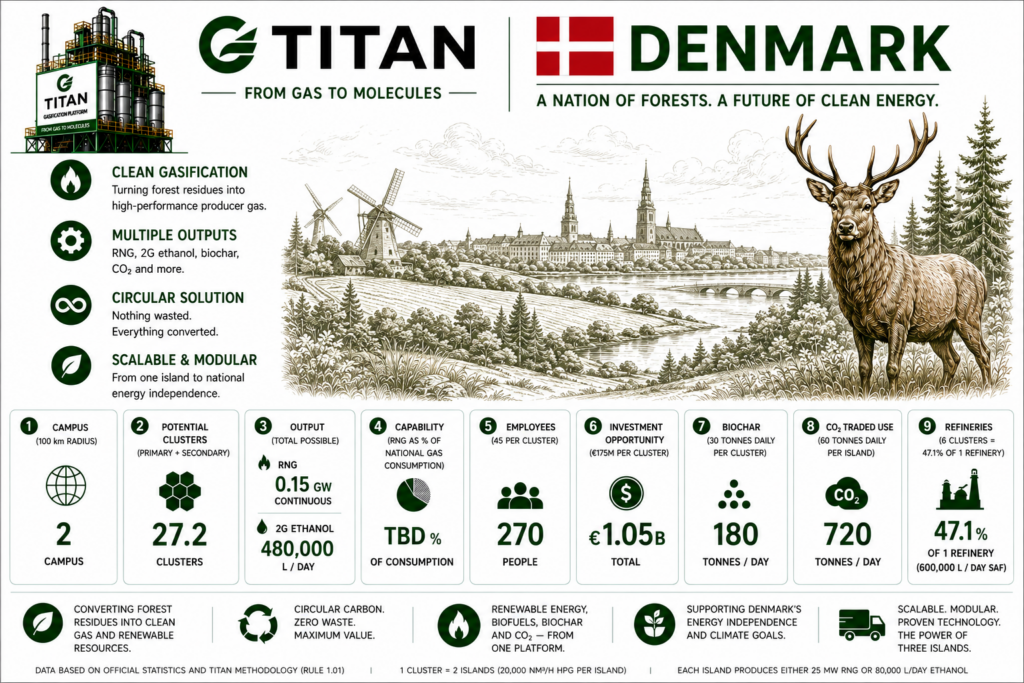
Denmark has a land area of 42,952 km² and is a 2-CAMPUS country under the TITAN 100 km planning model. Both CAMPUS are relevant to TITAN. Denmark is predominantly low and relatively flat, with excellent road, port and energy infrastructure, meaning virtually the entire national operating geography is accessible to the CAMPUS model. Denmark has 666,622 ha of forest, supporting 4.5 TITAN clusters from primary forest residues before secondary wood markets are included. The country’s active forestry, wood-processing and circular-resource economy increases the identified national opportunity to 27.2 TITAN clusters. Denmark’s official 2024 land-use reporting records 666,622 ha of forest, equal to 15% of the national land area. (envs.au.dk)
| DENMARK — INSTANT REVIEW | Resource | TITAN Clusters | Assessment |
| Public Forest | 24% of forest | 1.1 | Concentrated institutional opportunity |
| Private / Other Forest | 76% of forest | 3.4 | Principal forest market |
| Primary Forest Residue | 666,622 ha | 4.5 | Strong |
| Sawmill Residue | 1.380 Mt/year | 9.2 | Major secondary market |
| Wood Manufacturing Residue | 0.644 Mt/year | 4.3 | Strong industrial market |
| Park & Avenue | 0.460 Mt/year | 3.1 | Strong distributed resource |
| Reclaimed Wood | 0.920 Mt/year | 6.1 | Major circular resource |
| Secondary Resource | 3.404 Mt/year | 22.7 | Exceptional |
| Total Identified Opportunity | 4.077 Mt/year | 27.2 | ★★★★★ |
1. Country & CAMPUS Geography
Denmark covers 42,952 km².
Under the TITAN 100 km radius planning model:
DENMARK = 2 CAMPUS
2 CAMPUS | 2 TITAN-RELEVANT CAMPUS
Denmark is particularly well suited to the CAMPUS model.
The country is predominantly low and relatively flat, with forest concentrated particularly along the Jutland ridge, northern Zealand and smaller forest areas distributed around towns and cities. The Danish forestry authority identifies Jutland, northern Zealand and Bornholm as important forest areas. (en.lbst.dk)
Denmark’s extensive motorway system, rail network and ports mean that both national CAMPUS areas can operate effectively.
Unlike mountainous forestry markets, terrain does not materially restrict Danish residue logistics.
2. Primary Forest Opportunity
Denmark’s official 2024 LULUCF inventory records:
666,622 ha OF FOREST
representing 15% of national land area. (envs.au.dk)
This forest base supports:
4.5 TITAN CLUSTERS
Danish forest ownership is predominantly private. National forestry ownership data identify 70% private ownership and 24% state and municipal ownership, with the remaining forest held by trusts, foundations and other ownership categories. (dk.fsc.org)
For the TITAN market assessment these additional non-public holdings are included within the wider non-public supply market.
| Forest Ownership | Share | TITAN Clusters |
| Public Forest | 24% | 1.1 |
| Private / Other Forest | 76% | 3.4 |
| Total | 100% | 4.5 |
Denmark therefore differs from the heavily public-forest markets.
The public estate provides an important institutional entry point, but a national Danish TITAN programme will ultimately require a strong commercial position with private forest owners and forestry organisations.
3. Sawmill Residues
Statistics Denmark reports 4.6 million m³ of total wood felling in Danish forests and plantations in 2024. (dst.dk)
The resulting sawmill residue market provides:
1.380 MILLION TONNES/YEAR
supporting:
9.2 TITAN CLUSTERS
This is more than twice the primary forest-floor cluster opportunity.
Sawmill residues are therefore strategically important in Denmark and represent the country’s largest immediately downstream wood resource.
4. Wood Manufacturing Residues
Denmark has a mature woodworking, furniture, building-products, joinery and timber-manufacturing economy.
The wood-manufacturing residue market provides:
0.644 MILLION TONNES/YEAR
supporting:
4.3 TITAN CLUSTERS
This creates an industrial resource almost equal in scale to the entire primary forest-residue opportunity.
The material is more competitive than forest-floor residue, but its concentration at manufacturing facilities makes it highly attractive as a secondary CAMPUS supply stream.
5. Park & Avenue
Denmark’s towns, municipalities, roads, railways, utility corridors, parks, coastal infrastructure and managed landscapes create a substantial distributed woody-residue market.
The Park & Avenue resource provides:
0.460 MILLION TONNES/YEAR
supporting:
3.1 TITAN CLUSTERS
Denmark’s compact geography and excellent infrastructure make this particularly interesting.
Material generated across municipal and infrastructure networks remains within practical collection distance of the two national CAMPUS areas.
6. Reclaimed Wood
Denmark’s construction sector, building stock, furniture economy, pallets, packaging and demolition activities create a significant end-of-life wood resource.
The reclaimed-wood market provides:
0.920 MILLION TONNES/YEAR
supporting:
6.1 TITAN CLUSTERS
Reclaimed wood is therefore the second-largest Danish secondary resource after sawmill residues.
It materially strengthens Denmark’s position as a circular-carbon market rather than simply a forestry market.
7. Total TITAN Opportunity
Denmark’s primary forest resource supports:
4.5 TITAN CLUSTERS
The secondary markets provide:
| Secondary Market | TITAN Clusters |
| Sawmill Residues | 9.2 |
| Wood Manufacturing Residues | 4.3 |
| Park & Avenue | 3.1 |
| Reclaimed Wood | 6.1 |
| Total Secondary | 22.7 |
The combined identified Danish resource therefore supports:
27.2 TITAN CLUSTERS
This is a strong result for a country containing only two geographic CAMPUS.
Denmark’s value to TITAN comes from resource density: relatively modest forest area combined with an active wood economy, dense infrastructure and substantial circular wood flows.
Strategic Assessment
Denmark is a 2-CAMPUS country and both CAMPUS are relevant to TITAN.
Its 666,622 ha forest base supports 4.5 primary TITAN clusters, while Denmark’s 2024 forestry production of 4.6 million m³ demonstrates an active domestic wood economy. (envs.au.dk)
Secondary resources add another 22.7 clusters, taking the identified national opportunity to:
27.2 TITAN CLUSTERS
Denmark also has an important longer-term structural advantage. National policy is intended to add 250,000 ha of new forest over the coming decades, meaning Denmark’s forest resource is expected to expand materially rather than contract. (AP News)
The development strategy is therefore to establish the two national CAMPUS around strong logistics infrastructure, secure forest-floor positions across both public and private forestry, and progressively integrate sawmill, manufacturing, Park & Avenue and reclaimed wood.
DENMARK — ★★★★★
2 CAMPUS | 2 TITAN-RELEVANT CAMPUS | 4.5 PRIMARY CLUSTERS | 27.2 TOTAL IDENTIFIED CLUSTERS
:::