
Warsaw 14:08:2026
ESTONIA 🇪🇪
★★★★★
TITAN Forest Residue Opportunity — Country Due Diligence
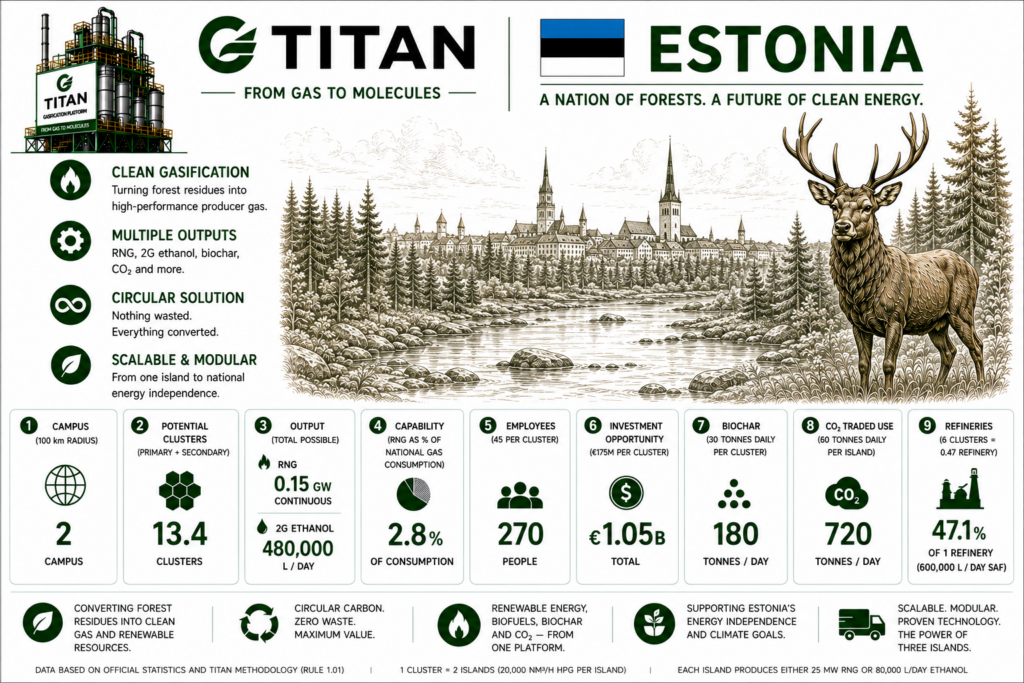
Estonia has a national area of 45,339 km² and is a 2-CAMPUS country under the TITAN 100 km planning model. Both CAMPUS are relevant to TITAN. Estonia is predominantly low and accessible, with its forest resource distributed across the mainland and western islands. Forest covers 2.351 million ha, equal to 51.8% of the country, and supports 15.8 TITAN clusters from primary forest residues alone. Estonia’s major forestry and wood-processing economy increases the total identified opportunity to 72.9 TITAN clusters. The Estonian Environment Agency reports 2,350,597 ha of forest in its 2024 National Forest Inventory. (keskkonnaportaal.ee)
| ESTONIA — INSTANT REVIEW | Resource | TITAN Clusters | Assessment |
| State Forest — RMK | 45% of forest | 7.1 | Major institutional opportunity |
| Private / Other Forest | 55% of forest | 8.7 | Major additional market |
| Primary Forest Residue | 2.351 million ha | 15.8 | Exceptional |
| Sawmill Residue | 3.469 Mt/year | 23.1 | Exceptional |
| Wood Manufacturing Residue | 1.619 Mt/year | 10.8 | Major industrial market |
| Park & Avenue | 1.156 Mt/year | 7.7 | Strong distributed resource |
| Reclaimed Wood | 2.313 Mt/year | 15.4 | Exceptional circular resource |
| Secondary Resource | 8.557 Mt/year | 57.0 | Exceptional |
| Total Identified Opportunity | 10.931 Mt/year | 72.9 | ★★★★★ |
1. Country & CAMPUS Geography
Estonia covers 45,339 km².
Under the TITAN 100 km radius planning model:
ESTONIA = 2 CAMPUS
2 CAMPUS | 2 TITAN-RELEVANT CAMPUS
Estonia is particularly well suited to a national CAMPUS approach. The country is predominantly low, with limited terrain barriers, while forestry is distributed extensively across both western and eastern Estonia.
The principal constraint is not terrain but Estonia’s islands and extensive wetlands. These affect individual collection routes but do not undermine the two-CAMPUS operating model.
Both CAMPUS therefore have direct access to substantial forest resource.
2. Primary Forest Opportunity
The Estonian Environment Agency’s 2024 National Forest Inventory records:
2,350,597 ha OF FOREST
representing 51.8% of Estonia’s territory. (keskkonnaportaal.ee)
This forest base supports:
15.8 TITAN CLUSTERS
The State Forest Management Centre — RMK — manages approximately 45% of Estonia’s forests, representing more than one million hectares of state forest. (rmk.ee)
For the TITAN market assessment:
| Forest Position | Share | TITAN Clusters |
| State Forest — RMK | 45% | 7.1 |
| Private / Other Forest | 55% | 8.7 |
| Total | 100% | 15.8 |
The state forest position alone therefore represents more than seven TITAN clusters.
This provides a strong institutional entry point for TITAN, while Estonia’s substantial private forestry sector creates an equally important second supply market.
Estonia’s forest floor should remain the primary TITAN supply position.
3. Sawmill Residues
Estonia has one of Europe’s most intensive forestry and wood-processing economies relative to national population and land area.
Statistics Estonia currently reports 11.564 million m³ of timber removals, demonstrating the scale of the active national timber economy. (stat.ee)
The resulting sawmill residue market provides:
3.469 MILLION TONNES/YEAR
supporting:
23.1 TITAN CLUSTERS
This secondary market alone is larger than the entire primary forest cluster opportunity.
Sawmills therefore represent an exceptionally important secondary supply position for the Estonian TITAN programme.
4. Wood Manufacturing Residues
Estonia has a substantial downstream timber, engineered wood, furniture, building-products and manufacturing economy.
The wood-manufacturing residue resource provides:
1.619 MILLION TONNES/YEAR
supporting:
10.8 TITAN CLUSTERS
This material is concentrated at industrial facilities and therefore attractive from a collection and logistics perspective.
The factory gate remains a more competitive supply point than the forest floor, but the scale of Estonia’s industry makes this resource strategically important.
5. Park & Avenue
Estonia’s cities, municipalities, roads, railways, transmission corridors, parks, urban forestry and other managed infrastructure create a significant non-forest woody-resource market.
The Park & Avenue resource provides:
1.156 MILLION TONNES/YEAR
supporting:
7.7 TITAN CLUSTERS
Statistics Estonia explicitly distinguishes urban parks, avenues and gardens from its formal forest definition, confirming that these woody resources sit outside the national forest inventory and therefore represent a genuinely additional supply category. (stat.ee)
Within Estonia’s compact two-CAMPUS geography, this distributed material can be aggregated effectively.
6. Reclaimed Wood
Estonia’s construction sector, timber housing industry, pallets, packaging, furniture and industrial wood economy create a major end-of-life wood stream.
The reclaimed-wood resource provides:
2.313 MILLION TONNES/YEAR
supporting:
15.4 TITAN CLUSTERS
Reclaimed wood therefore represents another resource almost equal to Estonia’s entire primary forest opportunity.
This reinforces the strength of Estonia as a circular-carbon market rather than simply a forestry market.
7. Total TITAN Opportunity
Estonia’s primary forest resource supports:
15.8 TITAN CLUSTERS
The four secondary markets provide:
| Secondary Market | TITAN Clusters |
| Sawmill Residues | 23.1 |
| Wood Manufacturing Residues | 10.8 |
| Park & Avenue | 7.7 |
| Reclaimed Wood | 15.4 |
| Total Secondary | 57.0 |
The combined identified Estonian resource therefore supports:
72.9 TITAN CLUSTERS
This is an exceptional resource concentration within only two geographic CAMPUS.
The objective is not to develop 73 clusters. The figure demonstrates that a material national TITAN programme can be developed while consuming only a controlled share of the identified resource base.
Strategic Assessment
Estonia is a 2-CAMPUS country and both CAMPUS are relevant to TITAN.
Its 2.351 million ha forest base supports 15.8 primary TITAN clusters, while RMK alone manages around 45% of the country’s forests, creating a substantial state-sector entry point. (keskkonnaportaal.ee)
Estonia’s forestry economy is unusually deep for its size. Statistics Estonia reports 11.564 million m³ of timber removals, while the country’s forest inventory continues to show more than half of Estonia covered by forest. (stat.ee)
The secondary markets add another 57.0 clusters, producing a total identified national opportunity of:
72.9 TITAN CLUSTERS
Estonia therefore combines high forest coverage, two fully relevant CAMPUS areas, significant state forest control, a major timber-processing economy and very high resource density.
The development strategy is to establish one CAMPUS serving western Estonia and one serving eastern Estonia, secure the initial forest-floor position through both state and private forestry, and progressively integrate sawmill, manufacturing, Park & Avenue and reclaimed wood resources.
ESTONIA — ★★★★★
2 CAMPUS | 2 TITAN-RELEVANT CAMPUS | 15.8 PRIMARY CLUSTERS | 72.9 TOTAL IDENTIFIED CLUSTERS
:::