
Publish Date 27 April 2026
Warsaw 27:04:2026 11.35 AM Steve Walker
Europe was built on industrial revolutions.
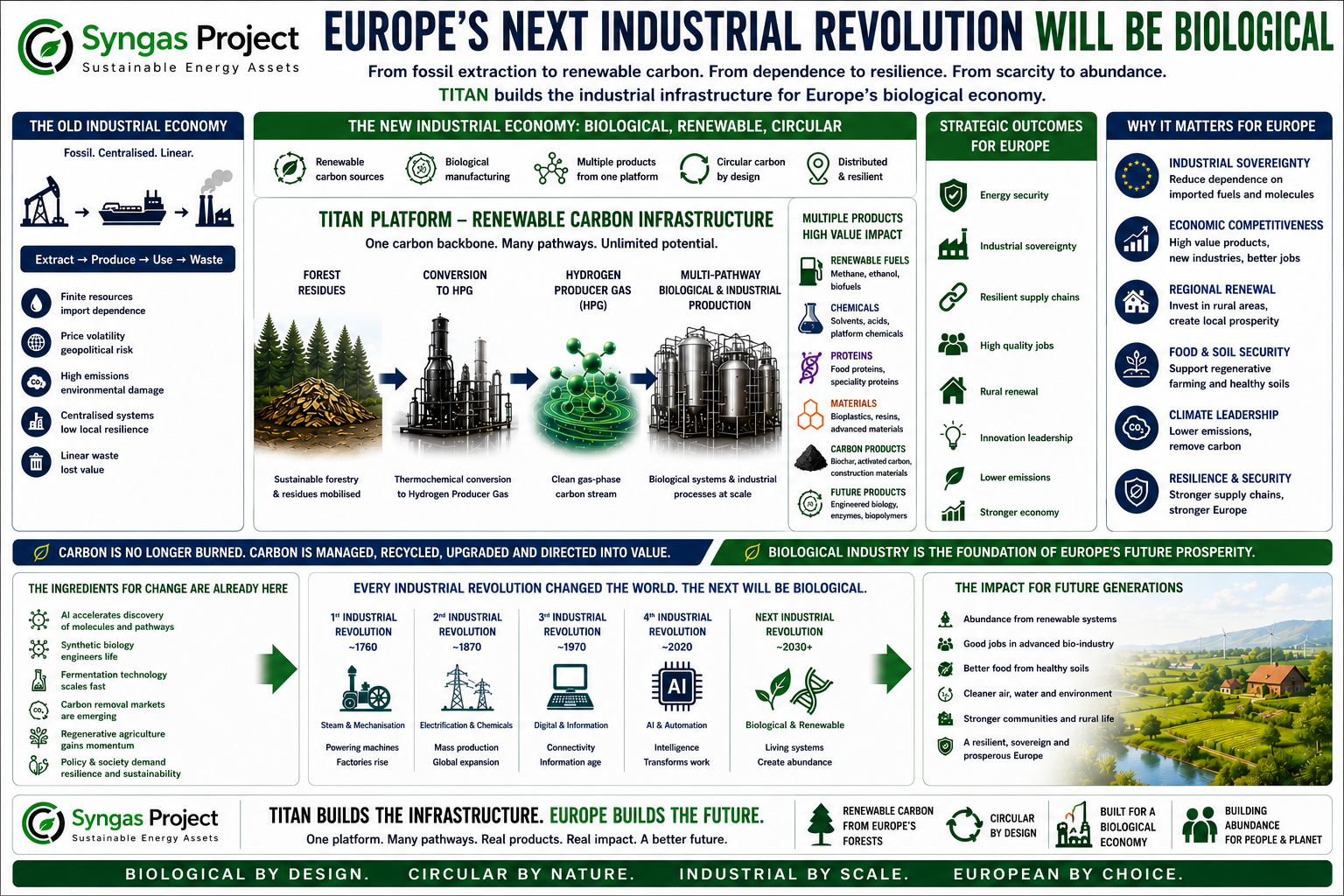
The first industrial age was powered by coal, steam and mechanisation. The second was built around oil, gas, chemicals and mass electrification. The digital era transformed communications, finance and information systems.
The next industrial revolution may be biological.
Not in the science-fiction sense.
In the industrial sense.
The global economy is beginning to move away from extracting fossil carbon from underground and toward managing renewable carbon flows above ground. This transition will affect far more than energy production. It will reshape fuels, chemicals, agriculture, food systems, materials, manufacturing and industrial supply chains.
This matters because modern economies do not run on electricity alone.
They also run on molecules.
Fuels.
Chemicals.
Plastics.
Solvents.
Proteins.
Materials.
Industrial gases.
Carbon products.
For more than a century, most of these products originated from oil, coal and gas extraction. The fossil economy did not only produce energy. It produced the molecular foundation of industrial civilisation.
That foundation is now beginning to change.
Europe faces a strategic challenge.
The continent has world-class science, engineering and biotechnology capability. But it imports large quantities of critical molecules and remains structurally dependent on external energy and feedstock systems. Geopolitical instability, supply chain disruption and rising resource competition are exposing the risks of this dependence.
The solution may not simply be replacing fossil electricity generation.
The solution may be rebuilding Europe’s molecule economy around renewable carbon systems.
This is where biological manufacturing becomes important.
Biological systems are extraordinarily efficient molecular factories. Microbes, enzymes and fermentation systems can already produce fuels, proteins, chemicals and specialist compounds. Artificial intelligence is now accelerating the discovery of entirely new biological pathways and material possibilities.
But these systems require industrial platforms capable of operating at scale.
That is where TITAN positions itself.