
Warsaw 14:08:2026 Steve Walker
FRANCE 🇫🇷
★★★★★
TITAN Forest Residue Opportunity — Country Due Diligence
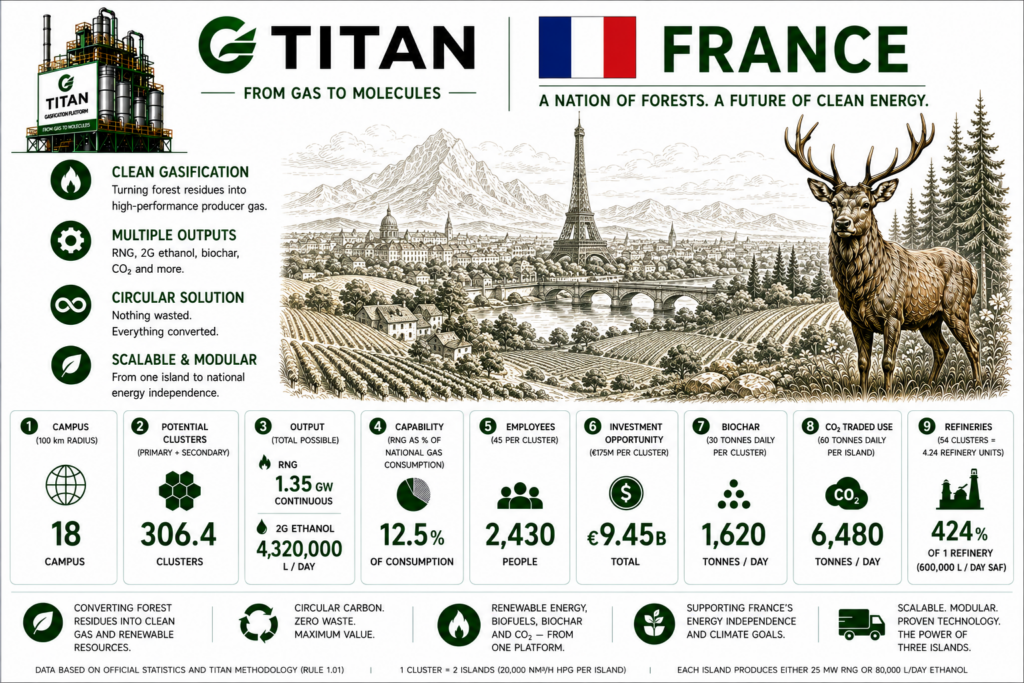
Metropolitan France has a land area of 549,970 km² and is an 18-CAMPUS country under the TITAN 100 km planning model. All 18 CAMPUS are relevant to TITAN. France has 17.6 million ha of forest, covering 32% of metropolitan territory, and this primary forest resource supports 118.5 TITAN clusters before secondary wood resources are included. France combines one of Europe’s largest forest estates with a major forestry, sawmill, wood-manufacturing and circular-material economy, increasing the total identified national opportunity to 306.4 TITAN clusters. France’s National Forest Inventory confirms 17.6 million ha of forest and records continuing expansion of the national forest estate. (Inventaire Forestier)
| FRANCE — INSTANT REVIEW | Resource | TITAN Clusters | Assessment |
| Public Forest | 25% of forest | 29.6 | Exceptional institutional market |
| Private Forest | 75% of forest | 88.9 | Exceptional national market |
| Primary Forest Residue | 17.600 million ha | 118.5 | Exceptional |
| Sawmill Residue | 11.425 Mt/year | 76.2 | Exceptional |
| Wood Manufacturing Residue | 5.332 Mt/year | 35.5 | Major industrial market |
| Park & Avenue | 3.808 Mt/year | 25.4 | Major distributed resource |
| Reclaimed Wood | 7.617 Mt/year | 50.8 | Exceptional circular resource |
| Secondary Resource | 28.182 Mt/year | 187.9 | Exceptional |
| Total Identified Opportunity | 45.958 Mt/year | 306.4 | ★★★★★ |
1. Country & CAMPUS Geography
Metropolitan France covers 549,970 km².
Under the TITAN 100 km radius planning model:
FRANCE = 18 CAMPUS
18 CAMPUS | 18 TITAN-RELEVANT CAMPUS
France provides an unusually strong geographic fit for a national TITAN programme.
Its forests extend across virtually the entire country, although density varies substantially. The National Forest Inventory identifies particularly high forest coverage in the northeast, southeast, Corsica and major established forest massifs, while parts of western France have lower forest coverage. National forest cover nevertheless stands at 32%. (Inventaire Forestier)
The principal forestry regions include Nouvelle-Aquitaine, Grand Est, Bourgogne-Franche-Comté, Auvergne-Rhône-Alpes, Occitanie and the major Mediterranean and Alpine forest areas.
France’s road, rail, river and port infrastructure allows CAMPUS infrastructure to be positioned on established logistics corridors rather than inside difficult mountain or remote forest terrain.
All 18 national CAMPUS therefore have a meaningful TITAN resource position.
2. Primary Forest Opportunity
The French National Forest Inventory records:
17.6 MILLION ha OF FOREST
covering 32% of metropolitan France. (Inventaire Forestier)
This forest resource supports:
118.5 TITAN CLUSTERS
France differs from many Central and Eastern European forestry markets because private ownership dominates.
IGN reports that three-quarters of metropolitan French forest — 13.2 million ha — is privately owned. State forests account for 9%, with the remaining public forest principally owned by municipalities and other public bodies. (Inventaire Forestier)
For TITAN:
| Forest Ownership | Share | TITAN Clusters |
| Public Forest | 25% | 29.6 |
| Private Forest | 75% | 88.9 |
| Total | 100% | 118.5 |
The public position alone therefore supports:
29.6 TITAN CLUSTERS
This is important because France offers sufficient public forest resource to establish a substantial initial programme without requiring immediate penetration of the much larger private market.
The private estate then provides a further 88.9 clusters, creating exceptional long-term expansion capacity.
The ownership pattern also varies significantly by region. IGN reports that private forest exceeds 90% in several western regions, while Grand Est is the only region where public forest exceeds private forest. (Inventaire Forestier)
This means the contracting strategy should be regional rather than uniform across France.
3. Sawmill Residues
France has one of Europe’s largest active timber economies.
Official Agreste statistics report 38.084 million m³ of commercial roundwood harvested in metropolitan France during 2024. (Agreste)
The French sawmill residue market provides:
11.425 MILLION TONNES/YEAR
supporting:
76.2 TITAN CLUSTERS
This is an exceptional secondary resource.
France has major concentrations of sawmills and primary wood processors around its principal forestry regions. These provide geographically concentrated secondary resources with established timber collection and transport networks.
Sawmills therefore represent the first major contingency supply position below the forest floor.
4. Wood Manufacturing Residues
France has an extensive downstream wood-products economy encompassing joinery, structural timber, engineered wood, furniture, packaging, panels and other manufactured products.
The wood-manufacturing residue market provides:
5.332 MILLION TONNES/YEAR
supporting:
35.5 TITAN CLUSTERS
This resource is already concentrated at industrial facilities, making it operationally attractive.
Competition is greater at the factory gate than on the forest floor, so TITAN should build a strategic market position without making these residues the foundation of the national programme.
5. Park & Avenue
France has an enormous non-forest woody-resource market generated by municipalities, highways, railways, electricity corridors, waterways, urban forestry, parks, estates and infrastructure management.
The Park & Avenue resource provides:
3.808 MILLION TONNES/YEAR
supporting:
25.4 TITAN CLUSTERS
The national scale of France makes this a material standalone resource category.
These woody residues are generated through necessary management and maintenance and can be aggregated around individual CAMPUS areas without competing directly with conventional timber markets.
6. Reclaimed Wood
France’s building stock, construction and demolition sector, pallets, packaging, furniture and industrial economy create a substantial end-of-life wood resource.
The reclaimed-wood market provides:
7.617 MILLION TONNES/YEAR
supporting:
50.8 TITAN CLUSTERS
This is France’s second-largest secondary TITAN resource after sawmill residues.
It materially expands the programme beyond active forestry into the wider circular economy and provides significant contingency capacity around metropolitan and industrial CAMPUS areas.
7. Total TITAN Opportunity
France’s primary forest resource supports:
118.5 TITAN CLUSTERS
The four secondary resource markets provide:
| Secondary Market | TITAN Clusters |
| Sawmill Residues | 76.2 |
| Wood Manufacturing Residues | 35.5 |
| Park & Avenue | 25.4 |
| Reclaimed Wood | 50.8 |
| Total Secondary | 187.9 |
The combined identified French resource therefore supports:
306.4 TITAN CLUSTERS
France consequently has sufficient resource depth for a very substantial national rollout while requiring only a minority share of the identified resource base.
A programme of three TITAN clusters per CAMPUS would require 54 clusters nationally, equal to only 17.6% of the identified 306.4-cluster resource opportunity.
That is a particularly strong development position.
Strategic Assessment
France is an 18-CAMPUS country and all 18 CAMPUS are relevant to TITAN.
Its 17.6 million ha forest estate supports 118.5 primary TITAN clusters, including 29.6 clusters from public forest and 88.9 clusters from private forest. IGN confirms that French forest area continues to expand and has doubled from 8.9 million ha in 1840 to 17.6 million ha today. (Inventaire Forestier)
France’s active forestry economy adds substantial downstream depth. Official Agreste data record 38.084 million m³ of commercial roundwood harvest in 2024. (Agreste)
The four secondary wood markets provide another 187.9 clusters, taking the total identified resource opportunity to:
306.4 TITAN CLUSTERS
France therefore combines national scale, extensive forest coverage, a very large active timber economy, substantial public forest, enormous private forest depth and 18 usable CAMPUS markets.
The development strategy should be regional: establish early CAMPUS programmes in the highest-density forestry and logistics regions, develop public forest positions through the state and communal forestry system, progressively aggregate the larger private forest market, and integrate sawmill, manufacturing, Park & Avenue and reclaimed wood as each CAMPUS matures.
France has sufficient resource depth for a national programme of three TITAN clusters per CAMPUS without approaching the limits of the identified resource base.
FRANCE — ★★★★★
18 CAMPUS | 18 TITAN-RELEVANT CAMPUS | 118.5 PRIMARY CLUSTERS | 306.4 TOTAL IDENTIFIED CLUSTERS
:::