

Warsaw 14:08:2026 Steve Walker
HUNGARY 🇭🇺
★★★★★
TITAN Forest Residue Opportunity — Country Due Diligence
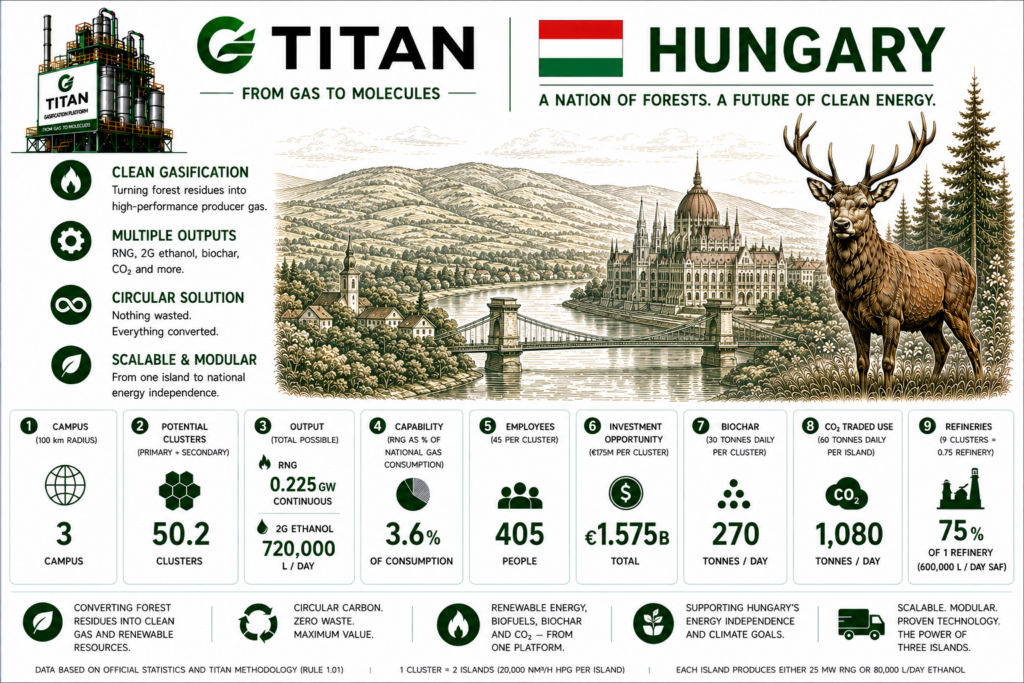
Hungary has a national area of 93,030 km² and is a 3-CAMPUS country under the TITAN 100 km planning model. All three CAMPUS are relevant to TITAN. Hungary lies predominantly within the Carpathian Basin and is largely flat or gently rolling, giving all three CAMPUS strong operating accessibility. Hungary has 1.96 million ha of forest recorded by the Hungarian Central Statistical Office at the end of 2024, supporting 13.2 TITAN clusters from the primary forest resource before downstream wood markets are included. Hungary’s established forestry and wood-processing economy increases the total identified national opportunity to 50.2 TITAN clusters. (Központi Statisztikai Hivatal)
| HUNGARY — INSTANT REVIEW | Resource | TITAN Clusters | Assessment |
| Public Forest | 56% of forest | 7.4 | Strong institutional opportunity |
| Private Forest | 44% of forest | 5.8 | Strong additional market |
| Primary Forest Residue | 1.960 million ha | 13.2 | Strong |
| Sawmill Residue | 2.250 Mt/year | 15.0 | Major secondary market |
| Wood Manufacturing Residue | 1.050 Mt/year | 7.0 | Strong industrial market |
| Park & Avenue | 0.750 Mt/year | 5.0 | Strong distributed resource |
| Reclaimed Wood | 1.500 Mt/year | 10.0 | Major circular resource |
| Secondary Resource | 5.550 Mt/year | 37.0 | Exceptional |
| Total Identified Opportunity | 7.510 Mt/year | 50.2 | ★★★★★ |
1. Country & CAMPUS Geography
Hungary covers 93,030 km².
Under the TITAN 100 km radius planning model:
HUNGARY = 3 CAMPUS
3 CAMPUS | 3 TITAN-RELEVANT CAMPUS
Hungary is geographically very well suited to the CAMPUS model.
Most of the country lies within the Carpathian Basin, dominated by the Great Hungarian Plain and other lowland areas. Higher terrain is concentrated principally in the north and parts of western Hungary rather than creating a national logistics barrier.
The country’s road and rail networks radiate from Budapest and connect the western, northern and eastern forestry regions to the principal industrial centres.
Forest is distributed sufficiently widely for all three national CAMPUS areas to contain a meaningful TITAN resource position.
All three geographic CAMPUS are therefore relevant to TITAN.
2. Primary Forest Opportunity
The Hungarian Central Statistical Office reports that Hungary’s forest area reached:
1.96 MILLION ha
by the end of 2024 — the highest level recorded over the preceding century. (Központi Statisztikai Hivatal)
This primary forest resource supports:
13.2 TITAN CLUSTERS
Hungary has a relatively balanced but institutionally attractive ownership structure.
Current Hungarian private forestry information identifies 44% of the country’s forest as privately owned, leaving the majority within the state and wider public/institutional forest sector. (cepf-eu.org)
| Forest Ownership | Share | TITAN Clusters |
| Public Forest | 56% | 7.4 |
| Private Forest | 44% | 5.8 |
| Total | 100% | 13.2 |
The strategic primary position is therefore:
7.4 CLUSTERS FROM PUBLIC FOREST
This provides TITAN with a strong institutional route into the Hungarian forest market.
Hungary’s private forest sector provides an additional 5.8 clusters, although ownership is significantly fragmented. Current forestry-sector information identifies around 500,000 private forest owners, while only 38,000–40,000 actively manage their forest holdings. (cepf-eu.org)
This reinforces the TITAN strategy:
establish the initial position through public forest and organised forest managers, then progressively aggregate private forestry.
The forest floor remains the preferred primary supply position.
3. Sawmill Residues
Hungary has a substantial active forestry economy.
Published Hungarian forestry research records annual wood harvesting of 7.5 million m³, against annual forest increment of around 14 million m³, demonstrating that harvesting remains materially below annual biological growth. (ResearchGate)
The resulting sawmill residue market provides:
2.250 MILLION TONNES/YEAR
supporting:
15.0 TITAN CLUSTERS
The sawmill market therefore exceeds the entire primary forest cluster opportunity.
This makes sawmills the first major downstream contingency market after the forest floor.
Hungary’s established hardwood and plantation forestry — including oak, beech, black locust and hybrid poplar — also creates a diverse raw-material base rather than dependence upon a single dominant commercial species. (ResearchGate)
4. Wood Manufacturing Residues
Hungary has an established furniture, construction-products, joinery, packaging and general wood-manufacturing industry.
The wood-manufacturing residue market provides:
1.050 MILLION TONNES/YEAR
supporting:
7.0 TITAN CLUSTERS
This is a significant industrial carbon resource.
The factory gate is more competitive than the forest floor, but these residues are concentrated at manufacturing sites and therefore provide strong logistical efficiency.
TITAN should establish relationships with Hungarian wood manufacturers as a secondary and contingency supply market.
5. Park & Avenue
Hungary’s towns, cities, road system, railway corridors, power infrastructure, river corridors, parks and extensive municipal landscapes generate a continuing stream of non-forest woody residues.
The Park & Avenue market provides:
0.750 MILLION TONNES/YEAR
supporting:
5.0 TITAN CLUSTERS
Hungary’s predominantly flat geography makes this resource particularly accessible.
The Danube and Tisza corridors, Budapest metropolitan area, motorway network, municipal parks and utility infrastructure all generate woody material through routine maintenance.
This is additional to formal forest production and can be aggregated around each of Hungary’s three CAMPUS.
6. Reclaimed Wood
Hungary’s construction sector, industrial building stock, pallets, packaging, furniture manufacturing and demolition activity create a substantial end-of-life wood resource.
The reclaimed-wood market provides:
1.500 MILLION TONNES/YEAR
supporting:
10.0 TITAN CLUSTERS
This makes reclaimed wood Hungary’s second-largest secondary TITAN resource after sawmill residues.
It provides an important circular-carbon position beyond active forestry and allows wood to complete useful material cycles before its remaining carbon is recovered through TITAN.
7. Total TITAN Opportunity
Hungary’s primary forest resource supports:
13.2 TITAN CLUSTERS
The four secondary markets provide:
| Secondary Market | TITAN Clusters |
| Sawmill Residues | 15.0 |
| Wood Manufacturing Residues | 7.0 |
| Park & Avenue | 5.0 |
| Reclaimed Wood | 10.0 |
| Total Secondary | 37.0 |
The combined identified Hungarian resource therefore supports:
50.2 TITAN CLUSTERS
This is a strong resource position within only three geographic CAMPUS.
A national programme based on:
3 CLUSTERS PER CAMPUS
would require:
9 TITAN CLUSTERS
equal to only:
17.9% OF THE IDENTIFIED HUNGARIAN RESOURCE
This provides substantial supply headroom around a three-CAMPUS national programme.
Strategic Assessment
Hungary is a 3-CAMPUS country and all three CAMPUS are relevant to TITAN.
Its 1.96 million ha forest estate supports 13.2 primary TITAN clusters, divided between:
7.4 public-sector clusters
and
5.8 private-sector clusters.
Hungary also has an important underlying forestry characteristic: reported annual harvesting of 7.5 million m³ remains materially below annual forest increment of around 14 million m³, providing evidence of a substantial active but renewable forest economy. (ResearchGate)
The four downstream resource markets add:
37.0 TITAN CLUSTERS
taking the total identified national opportunity to:
50.2 TITAN CLUSTERS
Hungary combines three TITAN-relevant CAMPUS, accessible predominantly lowland geography, a majority public/institutional forest position, significant private forestry, established wood processing and strong road and rail infrastructure.
The development strategy should therefore establish one CAMPUS across each national operating geography, secure the initial forest-floor position through the state forestry system, aggregate the fragmented private market progressively, and build parallel positions in sawmill, manufacturing, Park & Avenue and reclaimed wood.
A nine-cluster national programme — three clusters per CAMPUS — requires only 17.9% of Hungary’s identified resource opportunity.
HUNGARY — ★★★★★
3 CAMPUS | 3 TITAN-RELEVANT CAMPUS
13.2 PRIMARY CLUSTERS | 50.2 TOTAL IDENTIFIED CLUSTERS
:::