
Warsaw 16:08:2026 Steve Walker
ICELAND 🇮🇸
★★☆☆☆
TITAN Forest Residue Opportunity — Country Due Diligence
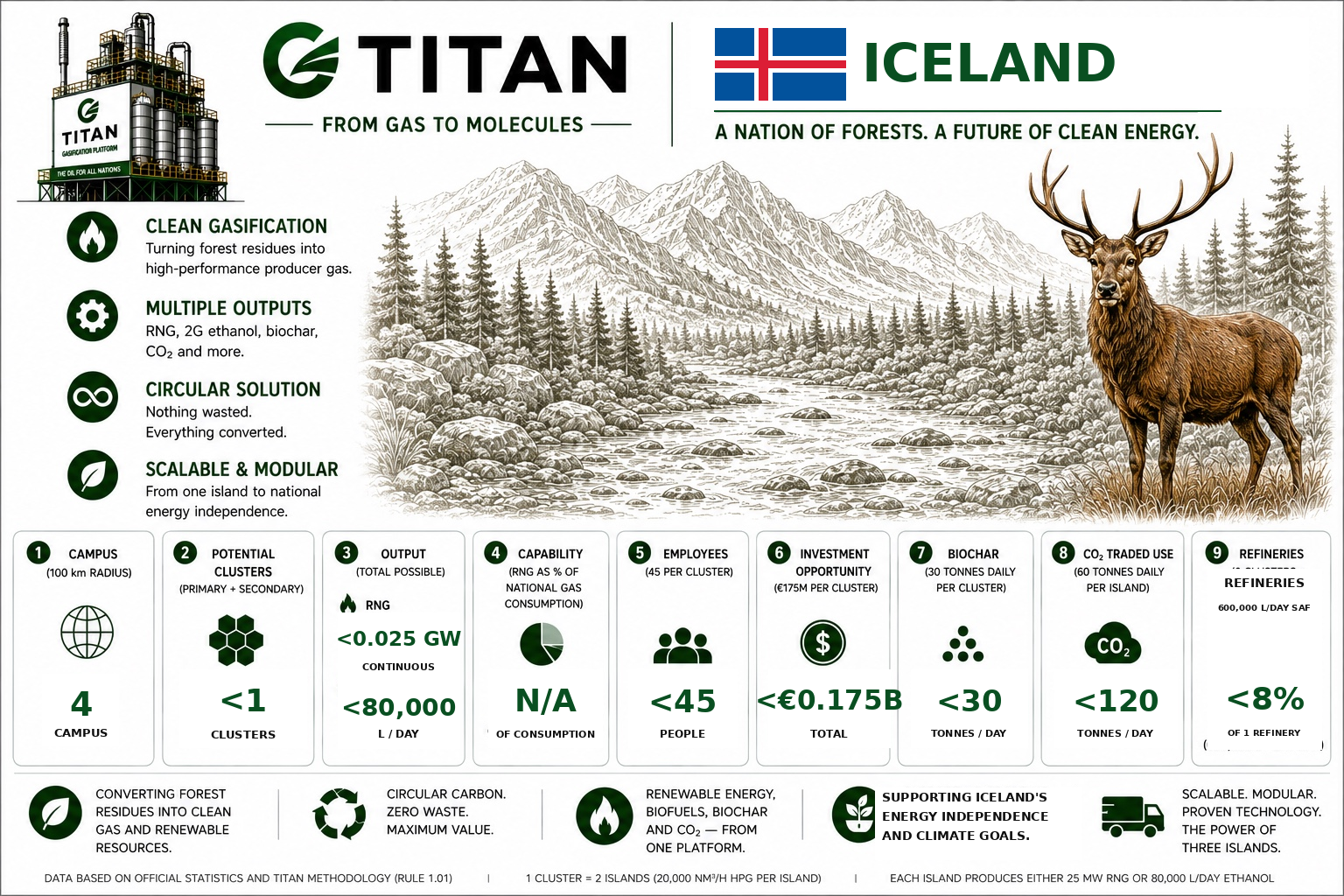
Iceland has a land area of 103,000 km² and is a 4-CAMPUS country under the TITAN 100 km planning model. All four CAMPUS are geographically usable, but Iceland is not a conventional forest-led TITAN market. Under the FAO/UNECE forest definition, forest cover is only 0.6% of national territory, while broader woodland measurements are higher because much Icelandic birch scrub does not reach the international five-metre forest threshold. The domestic commercial forestry base is therefore too small to support a meaningful TITAN rollout from forest-floor residues alone. Iceland should be classified as a limited TITAN opportunity within a broader circular-carbon CAMPUS strategy rather than as a forest-resource deployment market.
| ICELAND — INSTANT REVIEW | Resource Position | TITAN Clusters | Assessment |
| Forest Resource | 0.6% of national area | <0.5 | Very limited |
| Broader Woodland | Higher than FAO forest definition | <1.0 | Ecological rather than industrial |
| Primary Forest Residue | Insufficient commercial forest base | <0.5 | Not stand-alone TITAN |
| Sawmill Residue | Negligible | <0.1 | Negligible |
| Wood Manufacturing Residue | Import-based / limited | <0.1 | Supplementary |
| Park & Avenue | Limited | <0.1 | Supplementary |
| Reclaimed Wood | Material relative to domestic forestry | <1.0 | Principal woody opportunity |
| Overall TITAN Position | Circular carbon rather than forestry | <1 cluster | ★★☆☆☆ |
1. Country & CAMPUS Geography
Iceland covers approximately:
103,000 km²
Under the TITAN 100 km radius planning model:
ICELAND = 4 CAMPUS
4 CAMPUS | 4 GEOGRAPHICALLY USABLE CAMPUS
Iceland is a large island geographically, but population, industrial activity and transport infrastructure are concentrated primarily around the coast.
The country contains extensive volcanic terrain, glaciers, highlands and sparsely inhabited interior regions.
This means the four-CAMPUS geometry is useful for national coverage, but it does not imply four viable forest-led TITAN markets.
The strongest operating geographies are around the populated and industrial coastal corridors rather than the central highlands.
2. Primary Forest Opportunity
The latest FAO Forest Resources Assessment identifies forest cover in Iceland at:
0.6% OF NATIONAL TERRITORY
under the international definition of forest.
This definition requires trees capable of reaching at least five metres in height.
That distinction matters in Iceland because a significant proportion of native birch woodland and scrub does not satisfy that threshold. Statistics Iceland explicitly notes this limitation in its forest indicator methodology.
The primary commercial forest resource is therefore extremely small relative to the national land area.
Using the internationally defined forest base gives roughly:
60,000 ha OF FOREST
and therefore:
LESS THAN 0.5 TITAN CLUSTER
under the standard TITAN forest-resource methodology.
This is insufficient for a conventional TITAN national programme.
3. Forestry Development
Iceland’s forestry story is nevertheless strategically interesting.
The country was historically much more wooded, while modern forestry policy is actively rebuilding the forest estate.
Land and Forest Iceland reports that forest cover has been expanding through afforestation and restoration, while native birch woodland protection and commercial forestry remain national objectives.
The implication for TITAN is long-term rather than immediate.
Iceland’s forest resource is:
growing
but it is not presently an industrial-scale residue market.
TITAN should therefore not be positioned as a reason to accelerate harvesting of Iceland’s developing forest estate.
4. Sawmill Residues
Iceland does not have a significant commercial roundwood and sawmill economy comparable with Sweden, Finland or the Baltic countries.
Domestic timber production remains very small, and Iceland imports much of the timber used by construction and industry.
Therefore:
SAWMILL RESIDUE = NEGLIGIBLE
for TITAN national planning.
This removes the major secondary resource that supports TITAN in most Northern European forestry markets.
5. Wood Manufacturing Residues
Iceland has construction, joinery, furniture, packaging and other wood-using industries.
However, much of the wood entering these activities is imported.
The resulting residues are still useful as a domestic circular-carbon stream, but they cannot be treated as evidence of a larger Icelandic forest resource.
For TITAN:
WOOD MANUFACTURING = SUPPLEMENTARY RESOURCE
rather than a primary supply market.
6. Park & Avenue
Municipal tree management, parks, roads, tourism infrastructure and landscaped areas generate some woody material.
However, the limited extent of trees across Iceland means this market is also small in absolute terms.
It can contribute locally to an integrated CAMPUS but does not independently support TITAN scale.
7. Reclaimed Wood
Reclaimed wood is more strategically interesting.
Iceland imports substantial quantities of timber, furniture, pallets, packaging and construction products.
Once these products enter Iceland, they eventually become a domestic circular-carbon resource.
The hierarchy should remain:
Reuse → material recycling → TITAN recovery
This means Iceland’s reclaimed-wood opportunity can be larger than its indigenous forestry opportunity, even though the original biomass was grown elsewhere.
8. Total TITAN Opportunity
Iceland does not currently possess enough domestic forest and woody residue to support a conventional TITAN cluster on the same basis as Sweden, Finland or Estonia.
The correct national conclusion is:
ICELAND < 1 TITAN CLUSTER
from currently identifiable domestic woody resources.
We should not artificially inflate this number using Iceland’s total land area or theoretical woodland restoration potential.
Strategic Assessment
Iceland is a:
4-CAMPUS COUNTRY
geographically.
However, it is not a four-CAMPUS forest-resource market.
The limiting factor is not logistics.
It is:
FOREST RESOURCE SCALE
The internationally defined forest estate covers only 0.6% of Iceland, and broader woodland measurements remain dominated by ecological restoration and native birch landscapes rather than industrial timber production.
Iceland therefore should not be developed as a conventional forest-floor TITAN programme.
The stronger national opportunity lies in an integrated circular-carbon CAMPUS combining reclaimed wood and other suitable residual carbon streams, while allowing Iceland’s expanding forest estate to continue developing primarily for restoration, carbon sequestration, resilience and future sustainable forestry.
That makes the correct classification:
ICELAND — ★★☆☆☆
4 GEOGRAPHIC CAMPUS | <1 TITAN CLUSTER
NOT A STAND-ALONE FOREST-RESIDUE TITAN MARKET
PRIMARY OPPORTUNITY: WIDER CIRCULAR-CARBON CAMPUS