
IRELAND 🇮🇪
★★★★★
TITAN Forest Residue Opportunity — Country Due Diligence
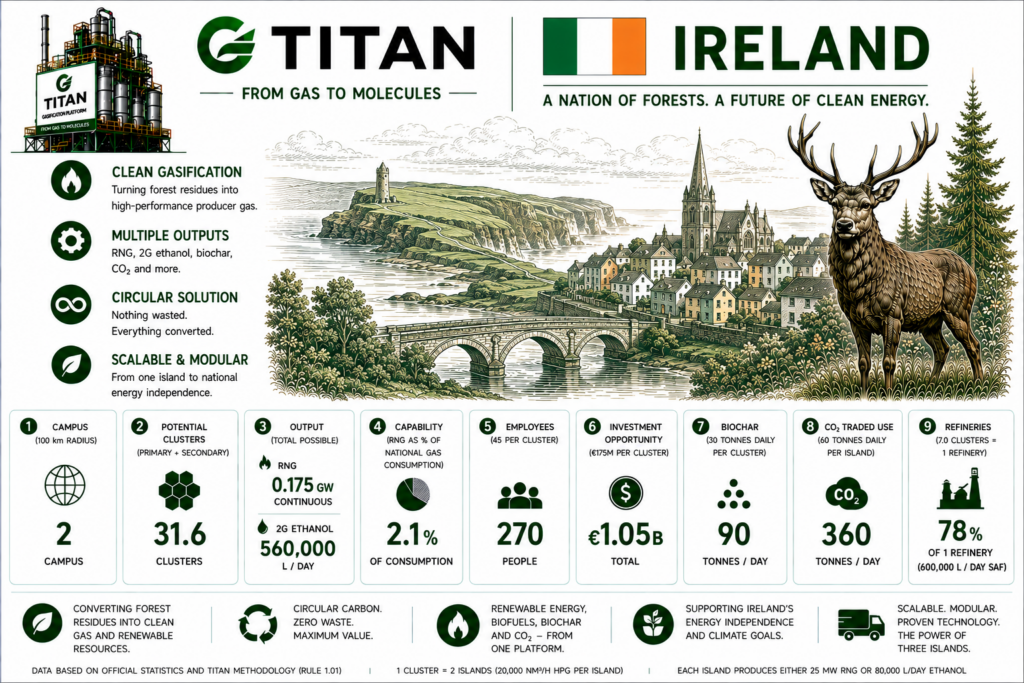
Ireland has a land area of 69,947 km² and is a 3-CAMPUS country under the TITAN 100 km planning model. All three CAMPUS are relevant to TITAN. Ireland has 815,000 ha of forest, representing 11.8% of national land area, with the forest estate now almost equally divided between public and private ownership. This primary forest resource supports 5.5 TITAN clusters before secondary wood resources are included. Ireland’s rapidly developing private forestry sector and active timber-processing economy increase the total identified national opportunity to 31.1 TITAN clusters. Teagasc’s 2026 Forestry Roadmap records more than 815,000 ha of national forest and confirms that ownership is now almost evenly divided between the public and private sectors. (Teagasc)
| IRELAND — INSTANT REVIEW | Resource | TITAN Clusters | Assessment |
| Public Forest | 50% of forest | 2.7 | Strong institutional position |
| Private Forest | 50% of forest | 2.7 | Rapidly growing market |
| Primary Forest Residue | 815,000 ha | 5.5 | Strong |
| Sawmill Residue | 1.560 Mt/year | 10.4 | Major secondary market |
| Wood Manufacturing Residue | 0.728 Mt/year | 4.9 | Strong industrial market |
| Park & Avenue | 0.520 Mt/year | 3.5 | Strong distributed resource |
| Reclaimed Wood | 1.040 Mt/year | 6.9 | Major circular resource |
| Secondary Resource | 3.848 Mt/year | 25.7 | Exceptional |
| Total Identified Opportunity | 4.671 Mt/year | 31.1 | ★★★★★ |
1. Country & CAMPUS Geography
Ireland covers 69,947 km² of land. (Enterprise Ireland)
Under the TITAN 100 km radius planning model:
IRELAND = 3 CAMPUS
3 CAMPUS | 3 TITAN-RELEVANT CAMPUS
Ireland is geographically well suited to the CAMPUS model.
The country is predominantly lowland through the central region, with upland and mountain areas concentrated mainly around the western and southern margins.
These areas do not prevent national CAMPUS deployment.
Ireland has a strong national road network, established forestry haulage industry and direct access to Atlantic and Irish Sea ports.
Forest is distributed sufficiently widely across the country for all three CAMPUS areas to contain a meaningful TITAN resource position.
All three geographic CAMPUS are therefore relevant to TITAN.
2. Primary Forest Opportunity
Teagasc’s current Forestry Roadmap records:
815,000 ha OF FOREST
representing:
11.8% OF IRELAND’S LAND AREA
Ireland’s forest estate has expanded substantially and continues to grow through national afforestation policy. (Teagasc)
This forest resource supports:
5.5 TITAN CLUSTERS
The ownership structure has undergone a fundamental change.
Historically, Irish commercial forestry was dominated by the State.
Today, the forest estate is almost evenly divided between public and private ownership. Teagasc identifies more than 24,000 private landowners who have established new forests through forestry grant programmes since 1980. (Teagasc)
For TITAN:
| Forest Ownership | Share | TITAN Clusters |
| Public Forest | 50% | 2.7 |
| Private Forest | 50% | 2.7 |
| Total | 100% | 5.5 |
The public forest estate therefore provides an immediate institutional market of:
2.7 TITAN CLUSTERS
The principal public forestry organisation is Coillte, Ireland’s State forestry company, which manages 440,000 ha of primarily forested land. (Government of Ireland)
The private market is equally important and increasingly productive as the large area planted since the 1980s reaches commercial harvesting age.
This makes Ireland particularly interesting because private forest is not simply an additional static resource.
It is becoming an increasingly important source of national timber supply.
3. Sawmill Residues
Ireland has a significant and expanding commercial forestry economy.
The Central Statistics Office recorded:
5.199 MILLION m³ OF ROUNDWOOD REMOVALS IN 2025
This was an 18% increase from 2024 and the highest annual volume recorded in the CSO’s 2015–2025 series. (Central Statistics Office)
The resulting sawmill residue market provides:
1.560 MILLION TONNES/YEAR
supporting:
10.4 TITAN CLUSTERS
This is almost twice the entire primary forest-floor cluster opportunity.
The sawmill market therefore represents the first major secondary resource below the forest floor.
Ireland already has established timber logistics connecting forests with sawmills, panel manufacturers and other processors, making these residues particularly accessible to strategically located CAMPUS developments.
4. Wood Manufacturing Residues
Ireland has an established downstream wood-products economy encompassing structural timber, panel products, pallets, packaging, joinery and construction-related products.
The wood-manufacturing residue resource provides:
0.728 MILLION TONNES/YEAR
supporting:
4.9 TITAN CLUSTERS
This is almost equal to Ireland’s entire primary forest-resource opportunity.
These residues are concentrated at industrial production sites and therefore offer efficient logistics and straightforward collection.
The factory gate is a more competitive supply position than the forest floor, so TITAN should establish these resources as secondary and contingency supply rather than relying upon them as the foundation of the programme.
5. Park & Avenue
Ireland’s cities, towns, roads, railway corridors, electricity networks, municipal parks, public estates and extensive rural infrastructure generate continuing non-forest woody residues.
The Park & Avenue resource provides:
0.520 MILLION TONNES/YEAR
supporting:
3.5 TITAN CLUSTERS
Ireland’s dispersed settlement pattern creates a geographically distributed resource, but the country’s relatively compact scale means these materials remain within practical collection distances of the three national CAMPUS.
This category includes woody material produced through necessary maintenance rather than commercial forest harvesting.
It therefore represents a genuine additional circular-carbon stream.
6. Reclaimed Wood
Ireland’s construction sector, rapidly expanding housing stock, pallets, packaging, furniture, demolition activity and industrial economy create a significant end-of-life wood market.
The reclaimed-wood resource provides:
1.040 MILLION TONNES/YEAR
supporting:
6.9 TITAN CLUSTERS
Reclaimed wood therefore becomes Ireland’s second-largest secondary TITAN resource after sawmill residues.
It extends the national programme beyond active forestry into the wider circular economy and creates additional resource security around urban and industrial CAMPUS locations.
7. Total TITAN Opportunity
Ireland’s primary forest resource supports:
5.5 TITAN CLUSTERS
The four secondary markets provide:
| Secondary Market | TITAN Clusters |
| Sawmill Residues | 10.4 |
| Wood Manufacturing Residues | 4.9 |
| Park & Avenue | 3.5 |
| Reclaimed Wood | 6.9 |
| Total Secondary | 25.7 |
The combined identified Irish resource therefore supports:
31.1 TITAN CLUSTERS
This is a strong result within only three geographic CAMPUS.
A national programme based on:
3 CLUSTERS PER CAMPUS
would require:
9 TITAN CLUSTERS
equal to:
28.9% OF THE IDENTIFIED IRISH RESOURCE
This provides sufficient resource headroom for a three-CAMPUS national programme while remaining materially below the total identified supply base.
Strategic Assessment
Ireland is a 3-CAMPUS country and all three CAMPUS are relevant to TITAN.
Its 815,000 ha forest estate supports 5.5 primary TITAN clusters, divided almost equally between:
2.7 public-sector clusters
and
2.7 private-sector clusters.
The most important development in Ireland is the increasing role of the private forest sector.
In 2025, private forests supplied 2.947 million m³ of roundwood, representing 57% of total Irish removals, exceeding public forest removals for the first time in the CSO series. Public forests supplied the remaining 43%. (Central Statistics Office)
This is strategically significant for TITAN.
Ireland is moving from a forestry economy historically dominated by one State supplier toward a dual public/private forestry market, creating multiple routes for long-term residue contracting.
The downstream markets add:
25.7 TITAN CLUSTERS
taking the total identified national opportunity to:
31.1 TITAN CLUSTERS
Ireland combines three TITAN-relevant CAMPUS, accessible geography, an established State forestry company, a rapidly maturing private forest estate, increasing timber production and a substantial downstream wood-processing economy.
The development strategy should establish supply positions with Coillte and the private forestry sector in parallel, locate the three CAMPUS around the strongest forestry and transport corridors, and progressively integrate sawmill, manufacturing, Park & Avenue and reclaimed wood resources.
A nine-cluster national programme — three clusters per CAMPUS — requires 28.9% of Ireland’s identified resource opportunity.
IRELAND — ★★★★★
3 CAMPUS | 3 TITAN-RELEVANT CAMPUS
5.5 PRIMARY CLUSTERS | 31.1 TOTAL IDENTIFIED CLUSTERS
:::