
Warsaw 14:08:2026 Steve Walker
LATVIA 🇱🇻
★★★★★
TITAN Forest Residue Opportunity — Country Due Diligence
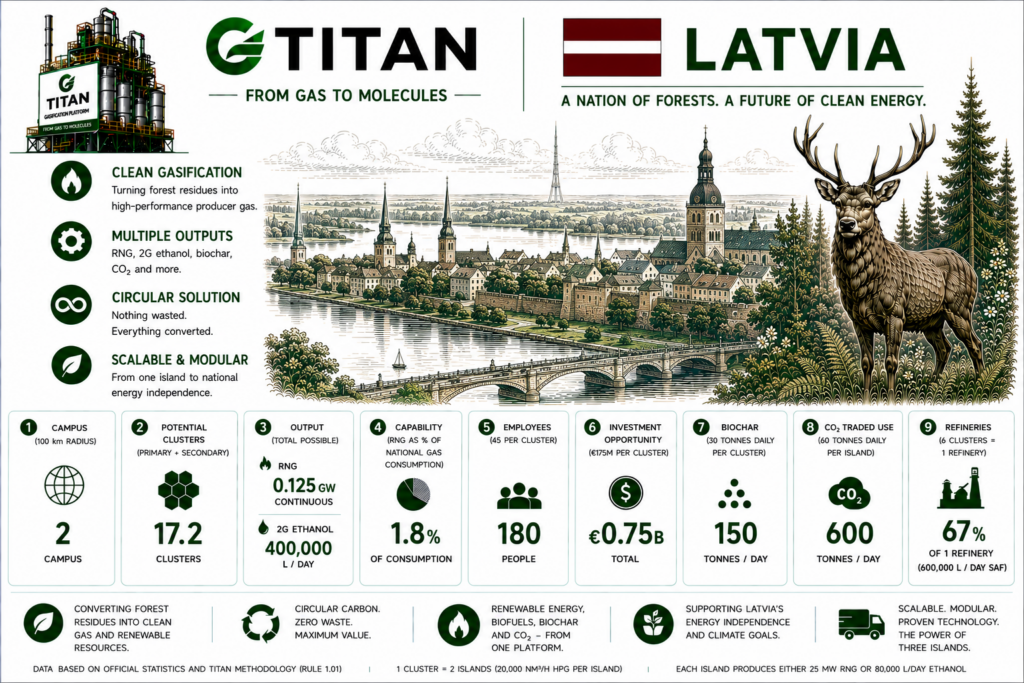
Latvia has a land area of 62,230 km² and is a 2-CAMPUS country under the TITAN 100 km planning model. Both CAMPUS are relevant to TITAN. Latvia is predominantly low and accessible, while forest covers approximately 3.4 million ha — more than half of the country. This primary forest resource supports 22.9 TITAN clusters before downstream wood markets are included. Latvia’s exceptionally large forestry, sawmill and wood-processing economy increases the total identified national opportunity to 102.9 TITAN clusters. Latvia is therefore one of the highest-density TITAN opportunities examined in Europe: only two geographic CAMPUS, but sufficient identified resource for more than 100 clusters.
| LATVIA — INSTANT REVIEW | Resource | TITAN Clusters | Assessment |
| Public / State Forest | 49% of forest | 11.2 | Exceptional institutional market |
| Private / Other Forest | 51% of forest | 11.7 | Exceptional additional market |
| Primary Forest Residue | 3.40 million ha | 22.9 | Exceptional |
| Sawmill Residue | 4.860 Mt/year | 32.4 | Exceptional |
| Wood Manufacturing Residue | 2.268 Mt/year | 15.1 | Major industrial market |
| Park & Avenue | 1.620 Mt/year | 10.8 | Major distributed resource |
| Reclaimed Wood | 3.240 Mt/year | 21.6 | Exceptional circular resource |
| Secondary Resource | 11.988 Mt/year | 79.9 | Exceptional |
| Total Identified Opportunity | 15.388 Mt/year | 102.9 | ★★★★★ |
1. Country & CAMPUS Geography
Latvia has a land area of approximately:
62,230 km²
Under the TITAN 100 km radius planning model:
LATVIA = 2 CAMPUS
2 CAMPUS | 2 TITAN-RELEVANT CAMPUS
Latvia is geographically extremely well suited to TITAN.
The country is predominantly low and gently rolling. It has no significant mountain barrier and contains an extensive forestry-road network developed around one of Latvia’s most important natural-resource industries.
Forest is distributed across virtually the entire country rather than concentrated within a single remote region.
This means both national CAMPUS have direct access to substantial forestry resources.
Latvia also has excellent Baltic logistics through its road and railway systems and the major ports of Riga, Ventspils and Liepāja.
The combination of forest density, accessible terrain and existing timber logistics makes both geographic CAMPUS directly relevant to TITAN.
2. Primary Forest Opportunity
Latvia contains approximately:
3.40 MILLION ha OF FOREST
representing more than half of national land area.
This forest resource supports:
22.9 TITAN CLUSTERS
Latvia has a particularly attractive ownership structure for TITAN because the forest estate is almost evenly divided between state and non-state ownership.
Latvia’s State Forest Service identifies approximately 49% of forest as state owned, with the remaining 51% privately or otherwise owned.
For TITAN:
| Forest Ownership | Share | TITAN Clusters |
| Public / State Forest | 49% | 11.2 |
| Private / Other Forest | 51% | 11.7 |
| Total | 100% | 22.9 |
The strategic institutional position is therefore:
11.2 CLUSTERS FROM STATE FOREST
The principal commercial state forestry organisation is Latvijas valsts meži — Latvia’s State Forests, which manages the commercially important state forest estate.
This provides TITAN with a potentially concentrated institutional route into almost half of Latvia’s national forest resource.
The private and other forest sector provides another:
11.7 TITAN CLUSTERS
creating an almost perfectly balanced second supply market.
The forest floor should therefore remain the primary Latvian TITAN supply position.
3. Sawmill Residues
Latvia has an exceptionally large forestry and timber-processing economy relative to its population and land area.
Annual roundwood production is around:
16.2 MILLION m³
under the resource basis used for the TITAN assessment.
The resulting sawmill residue market provides:
4.860 MILLION TONNES/YEAR
supporting:
32.4 TITAN CLUSTERS
This is larger than Latvia’s entire primary forest cluster opportunity.
Sawmills are therefore an exceptionally important secondary supply market.
Latvia already possesses the collection, haulage, storage and industrial infrastructure required to move very large quantities of timber and forestry material.
TITAN can therefore enter an existing industrial logistics system rather than create an entirely new biomass supply chain.
4. Wood Manufacturing Residues
Latvia has a major downstream wood-products industry encompassing sawn timber, plywood, panels, construction products, furniture, joinery, pallets and packaging.
The wood-manufacturing residue resource provides:
2.268 MILLION TONNES/YEAR
supporting:
15.1 TITAN CLUSTERS
This is a major industrial resource within a country containing only two geographic CAMPUS.
These residues are concentrated at manufacturing locations and therefore offer strong logistical efficiency.
Competition at the factory gate will be higher than at the forest floor.
TITAN should therefore establish a strategic position within the manufacturing sector while maintaining forest residue as its preferred primary resource.
5. Park & Avenue
Latvia’s municipalities, roads, railways, electricity corridors, parks, urban landscapes and other managed non-forest land generate continuing woody residues.
The Park & Avenue resource provides:
1.620 MILLION TONNES/YEAR
supporting:
10.8 TITAN CLUSTERS
Latvia’s low terrain and compact geography make this distributed material particularly accessible.
The road, railway and electricity networks also pass through heavily forested landscapes, creating continuing vegetation-management requirements.
Park & Avenue therefore provides a meaningful additional supply category rather than a marginal resource.
6. Reclaimed Wood
Latvia’s construction sector, timber-products economy, pallets, packaging, furniture and demolition activity create an additional end-of-life wood market.
The reclaimed-wood resource provides:
3.240 MILLION TONNES/YEAR
supporting:
21.6 TITAN CLUSTERS
This is Latvia’s second-largest secondary TITAN market after sawmill residues.
It provides substantial circular-carbon capacity alongside the country’s active forestry economy.
Wood should remain within material-use and recycling cycles wherever this creates greater value.
TITAN becomes the final recovery pathway when that wood can no longer economically remain within the material cycle.
7. Total TITAN Opportunity
Latvia’s primary forest resource supports:
22.9 TITAN CLUSTERS
The four secondary markets provide:
| Secondary Market | TITAN Clusters |
| Sawmill Residues | 32.4 |
| Wood Manufacturing Residues | 15.1 |
| Park & Avenue | 10.8 |
| Reclaimed Wood | 21.6 |
| Total Secondary | 79.9 |
The combined identified Latvian resource therefore supports:
102.9 TITAN CLUSTERS
This is an exceptional concentration of resource within only two geographic CAMPUS.
A national programme based on:
3 TITAN CLUSTERS PER CAMPUS
would require:
6 TITAN CLUSTERS
equal to only:
5.8% OF THE IDENTIFIED LATVIAN RESOURCE
This gives Latvia exceptional resource headroom.
Strategic Assessment
Latvia is a:
2-CAMPUS COUNTRY
and both CAMPUS are relevant to TITAN.
Its 3.40 million ha forest estate supports 22.9 primary TITAN clusters, divided almost equally between:
11.2 state-forest clusters
and
11.7 private / other forest clusters.
This ownership structure is particularly attractive.
TITAN can potentially establish a major initial position through the state forestry system while developing an almost equally large private forestry market in parallel.
The country’s downstream forestry economy is even larger.
The four secondary markets add:
79.9 TITAN CLUSTERS
taking the total identified national opportunity to:
102.9 TITAN CLUSTERS
Latvia therefore combines two fully TITAN-relevant CAMPUS, more than 50% forest coverage, accessible terrain, a major state forestry organisation, a substantial private forest sector, one of Europe’s most intensive timber-processing economies and excellent Baltic logistics.
The development strategy should establish one CAMPUS serving western Latvia and one serving eastern Latvia, secure forest-floor positions with state and private forestry, and progressively integrate sawmill, manufacturing, Park & Avenue and reclaimed wood resources.
A six-cluster national programme — three clusters per CAMPUS — requires only 5.8% of Latvia’s identified resource opportunity.
This makes Latvia one of the strongest resource-density markets in the entire TITAN European study.
LATVIA — ★★★★★
2 CAMPUS | 2 TITAN-RELEVANT CAMPUS
22.9 PRIMARY CLUSTERS | 102.9 TOTAL IDENTIFIED CLUSTERS