
Warsaw 14:08:2026 Steve Walker
LITHUANIA 🇱🇹
★★★★★
TITAN Forest Residue Opportunity — Country Due Diligence
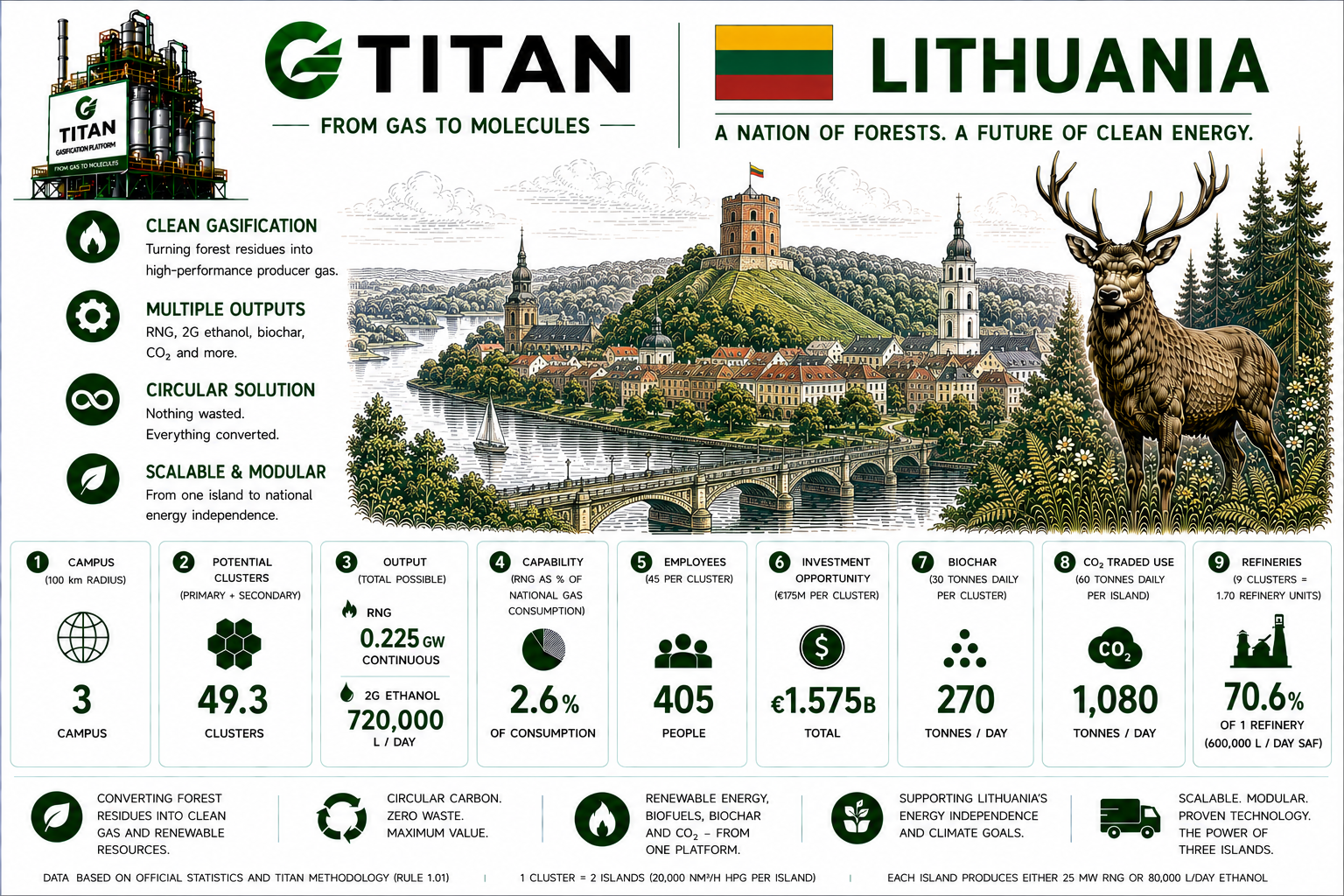
Lithuania has a geographical area of 65,284 km² and is a 3-CAMPUS country under the TITAN 100 km planning model. All three CAMPUS are relevant to TITAN. Lithuania is predominantly flat and highly accessible, with forest distributed across the country and no significant terrain barrier to residue logistics. Lithuania has 2.20 million ha of forest, supporting 14.8 TITAN clusters from the primary forest resource before downstream wood markets are included. Its substantial forestry and wood-processing economy increases the total identified national opportunity to 49.3 TITAN clusters. Forest covers 33.8% of Lithuania, while recent forestry reporting places annual timber removals at around 7 million m³.
| LITHUANIA — INSTANT REVIEW | Resource | TITAN Clusters | Assessment |
| State Forest | 51% of forest | 7.5 | Major institutional opportunity |
| Private / Other Forest | 49% of forest | 7.3 | Major additional market |
| Primary Forest Residue | 2.20 million ha | 14.8 | Exceptional |
| Sawmill Residue | 2.100 Mt/year | 14.0 | Major secondary market |
| Wood Manufacturing Residue | 0.980 Mt/year | 6.5 | Strong industrial market |
| Park & Avenue | 0.700 Mt/year | 4.7 | Strong distributed resource |
| Reclaimed Wood | 1.400 Mt/year | 9.3 | Major circular resource |
| Secondary Resource | 5.180 Mt/year | 34.5 | Exceptional |
| Total Identified Opportunity | 7.380 Mt/year | 49.3 | ★★★★★ |
1. Country & CAMPUS Geography
Lithuania has a geographical area of:
65,284 km²
The country is predominantly low and gently rolling. Its highest terrain is below 300 metres, meaning topography does not materially restrict the TITAN collection model.
Under the TITAN 100 km radius planning model:
LITHUANIA = 3 CAMPUS
3 CAMPUS | 3 TITAN-RELEVANT CAMPUS
Lithuania’s forest resource is distributed widely enough for all three CAMPUS areas to be relevant.
The country also has strong road and rail connections between Vilnius, Kaunas, Klaipėda, Šiauliai and Panevėžys, together with access to the Baltic through the Port of Klaipėda.
The logistics proposition is therefore straightforward.
Unlike mountainous European forest markets, Lithuania does not require TITAN to overcome major terrain constraints before establishing regional residue collection.
All three CAMPUS can therefore combine forest, industrial wood, municipal woody residue and reclaimed material within their operating geography.
2. Primary Forest Opportunity
Lithuania has:
2.20 MILLION ha OF FOREST
representing 33.8% of national territory. Recent Lithuanian forestry data identify approximately 50.6% of the forest as state owned, 42.4% as privately owned and 7.2% associated with restitution status.
For the TITAN DD, the ownership position is therefore consolidated into the two principal supply channels:
| Forest Position | Share | TITAN Clusters |
| State Forest | 51% | 7.5 |
| Private / Other Forest | 49% | 7.3 |
| Total | 100% | 14.8 |
The primary forest resource therefore supports:
14.8 TITAN CLUSTERS
The strategic institutional position is:
7.5 CLUSTERS FROM STATE FOREST
Most Lithuanian state forest is managed through the State Forest Enterprise, giving TITAN a concentrated institutional entry point into approximately half of the national forest estate. Lithuania’s state forests are also FSC certified.
The private side provides a further:
7.3 TITAN CLUSTERS
The private market is more fragmented, with relatively small average holdings, meaning aggregation through forest managers and owner organisations will be important.
The forest floor should therefore remain the preferred TITAN entry position, beginning with the state forest system and expanding progressively into organised private forestry.
3. Sawmill Residues
Lithuania has an established commercial forestry economy.
Recent forestry analysis records annual timber removals of approximately:
7.0 MILLION m³/YEAR
with national removals having increased substantially since independence as forestry and wood-processing markets developed.
Under the TITAN downstream methodology, the resulting sawmill residue market provides:
2.100 MILLION TONNES/YEAR
supporting:
14.0 TITAN CLUSTERS
The sawmill market is therefore almost equal in scale to Lithuania’s entire primary forest opportunity.
This makes sawmills the first major contingency market below the forest floor.
Lithuania’s established timber-processing infrastructure also means that these materials are already concentrated at industrial locations and connected to functioning timber logistics.
4. Wood Manufacturing Residues
Lithuania has a substantial downstream wood-products economy encompassing furniture, panels, structural wood products, joinery, pallets, packaging and other manufactured products.
The wood-manufacturing residue market provides:
0.980 MILLION TONNES/YEAR
supporting:
6.5 TITAN CLUSTERS
Lithuania has a particularly significant furniture and woodworking sector relative to the size of the domestic economy.
These residues are more competitive than material at the forest floor, but they offer an important advantage: industrial concentration.
Individual CAMPUS developments should therefore establish relationships with the major wood-processing and manufacturing clusters within their operating regions.
5. Park & Avenue
Lithuania’s municipalities, roads, railways, electricity corridors, parks, urban forestry and other managed non-forest landscapes create a continuing woody-residue stream.
The Park & Avenue market provides:
0.700 MILLION TONNES/YEAR
supporting:
4.7 TITAN CLUSTERS
Lithuania’s low terrain and compact three-CAMPUS geography make these resources particularly accessible.
Roadside vegetation, railway corridors, municipal tree management and utility infrastructure generate woody material irrespective of demand from TITAN.
This therefore represents an additional carbon stream rather than simply another part of conventional forest production.
6. Reclaimed Wood
Lithuania’s construction sector, furniture industry, pallets, packaging, building stock and demolition activity create a significant end-of-life wood resource.
The reclaimed-wood market provides:
1.400 MILLION TONNES/YEAR
supporting:
9.3 TITAN CLUSTERS
This becomes Lithuania’s second-largest secondary TITAN resource after sawmill residues.
It also extends the Lithuanian proposition beyond primary forestry.
Where wood can continue to be reused or materially recycled, it should remain within that higher-value material cycle.
TITAN becomes the final carbon-recovery pathway when the material can no longer economically remain in circulation.
7. Total TITAN Opportunity
Lithuania’s primary forest resource supports:
14.8 TITAN CLUSTERS
The four secondary markets provide:
| Secondary Market | TITAN Clusters |
| Sawmill Residues | 14.0 |
| Wood Manufacturing Residues | 6.5 |
| Park & Avenue | 4.7 |
| Reclaimed Wood | 9.3 |
| Total Secondary | 34.5 |
The combined identified Lithuanian resource therefore supports:
49.3 TITAN CLUSTERS
A national programme based on:
3 TITAN CLUSTERS PER CAMPUS
would require:
9 TITAN CLUSTERS
equal to:
18.3% OF THE IDENTIFIED LITHUANIAN RESOURCE
This provides substantial resource headroom around a three-CAMPUS national programme.
Strategic Assessment
Lithuania is a:
3-CAMPUS COUNTRY
and all three CAMPUS are relevant to TITAN.
Its 2.20 million ha forest estate supports 14.8 primary TITAN clusters, divided between:
7.5 state-forest clusters
and
7.3 private / other forest clusters.
Lithuania combines an attractive institutional forest position with a substantial private forestry sector. Around half of the country’s forest remains state owned, while most state forest is managed through a single national enterprise.
The country’s active forestry economy provides an additional advantage. Annual timber removals have been running at approximately 7 million m³, while the total growing stock remains substantial.
The four secondary markets add:
34.5 TITAN CLUSTERS
taking the total identified national opportunity to:
49.3 TITAN CLUSTERS
Lithuania therefore combines three TITAN-relevant CAMPUS, accessible lowland geography, one-third national forest coverage, a major state forest organisation, substantial private forestry, established timber processing and strong Baltic logistics.
The development strategy should establish one CAMPUS across each national operating geography, secure the first forest-floor position through the State Forest Enterprise, progressively aggregate private forestry, and develop parallel sawmill, manufacturing, Park & Avenue and reclaimed-wood supply chains.
A nine-cluster national programme — three clusters per CAMPUS — requires only 18.3% of Lithuania’s identified resource opportunity.
LITHUANIA — ★★★★★
3 CAMPUS | 3 TITAN-RELEVANT CAMPUS
14.8 PRIMARY CLUSTERS | 49.3 TOTAL IDENTIFIED CLUSTERS