Warsaw 20:08:2026 Steve Walker
Methanogenic Fermentation Open Kimono
TITAN Technology Due Diligence
Confidential Technology Disclosure — Provided Under NDA
Syngas Project sp. z o.o. | TITAN
1. PURPOSE
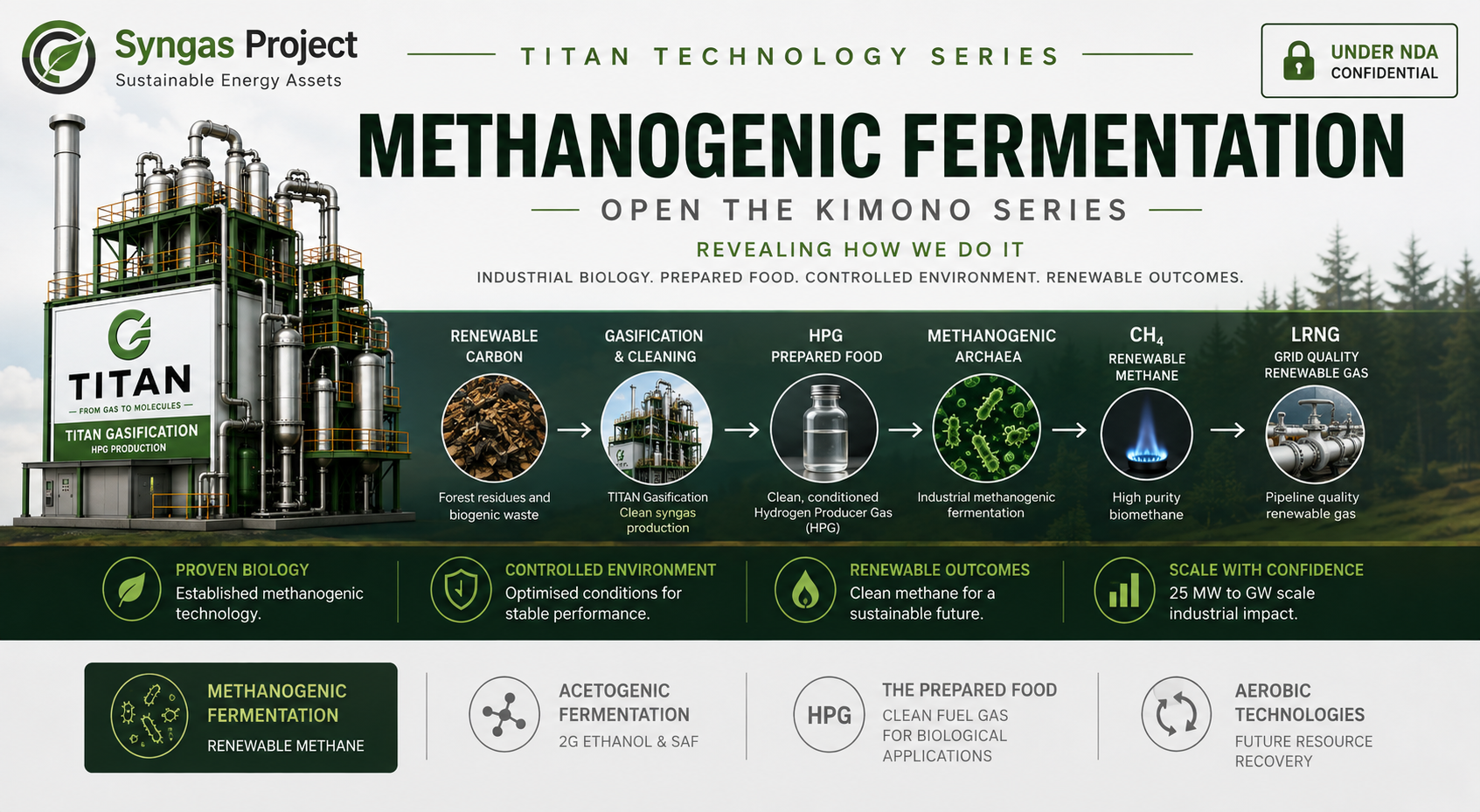
This document provides the Due Diligence reader with technical disclosure of the Methanogenic Fermentation architecture incorporated within TITAN.
Our public material explains what TITAN does.
This document explains how we intend to do it.
Under NDA, Syngas Project provides the design basis, biological operating envelope, modular configuration, Hydrogen Producer Gas interface, principal inputs and outputs, integration with Acetogenic Fermentation, operating philosophy and technology status that are not disclosed within our general public material.
TITAN is not a research programme seeking to establish whether biological methanation works.
Methanogenic technologies have already been developed, demonstrated and operated by leaders within the industry. TITAN incorporates this established technology within an integrated onshore Hydrogen Producer Gas and Targeted Microbial Fermentation platform.
Following project green light, the remaining technology work principally moves into normal project execution:
Vendor Confirmation → Detailed Engineering → Workshop Drawings → Fabrication → Installation → Commissioning → Performance Testing
2. THE RENEWABLE MOLECULE INDUSTRY
In the early development of the renewable molecule industry, hydrogen provided the elegant chemistry.
Renewable electricity can split water into hydrogen and oxygen. The rapid development of offshore wind created a natural route towards renewable hydrogen production at very large scale.
But hydrogen is not the end of the molecule story.
Methane is consumed every day across domestic and industrial markets.
Methanol is an important chemical building block and an increasingly important marine fuel.
Ethanol is an established industrial molecule and can be refined through the Alcohol-to-Jet pathway into Sustainable Aviation Fuel.
Acetone and butanol provide further opportunities within the wider fermentation family.
| Renewable Molecule | Principal Industrial Role |
| Hydrogen — H₂ | Industrial feedstock and renewable molecule intermediate |
| Methane — CH₄ | Gas, industrial, marine and distributed gas markets |
| Methanol — CH₃OH | Marine fuel, chemicals and industrial feedstock |
| Acetone | Chemicals and materials |
| Butanol | Fuels, chemicals and materials |
| 2G Ethanol | Renewable fuel, chemical feedstock and AtJ SAF feedstock |
| SAF | Downstream aviation fuel |
The renewable transition is therefore no longer simply a discussion about hydrogen.
It is becoming a renewable molecule industry.
The challenge is to manufacture the molecules society already needs from renewable resources, at industrial scale and at an affordable price.
3. TWO COMPLEMENTARY ROUTES TO SCALE
Two complementary renewable molecule models have evolved.
OFFSHORE — ELECTRONS FIRST
Offshore starts with renewable electricity:
Wind → Electricity → Electrolysis → H₂ + O₂
Renewable hydrogen can subsequently be combined with renewable or recovered biogenic CO₂ to manufacture methane, methanol and other renewable molecules.
ONSHORE — CARBON FIRST
Onshore starts with renewable carbon:
Renewable Carbon → Gasification → HPG
Hydrogen Producer Gas provides hydrogen and carbon gases that can be presented to downstream biological and chemical conversion technologies.
Syngas Project operates firmly within this onshore HPG model.
| Parameter | Offshore | Onshore — TITAN |
| Primary renewable resource | Wind | Renewable carbon |
| Primary conversion | Electricity + electrolysis | Gasification |
| Primary intermediate | Hydrogen | Hydrogen Producer Gas |
| Renewable carbon | Recovered / biogenic CO₂ | Carbon contained within feedstock |
| Methane pathway | H₂ + CO₂ → Methanogenic conversion | HPG → Methanogenic Fermentation |
| Other molecule pathways | Methanol and other synthesis | Acetogenic / other TMF pathways |
| Oxygen | Electrolysis coproduct | Valuable process resource |
| Biogenic CO₂ | Required renewable-carbon resource | Recoverable process resource |
| Scale direction | GW | GW |
| Fundamental resource limitation | How much the wind blows | How much carbon grows |
Offshore, the limitation is how much the wind blows.
Onshore, the limitation is how much carbon grows.
Neither is unlimited.
Both are capable of supporting enormous renewable molecule industries.
Importantly, they increasingly share the same downstream technologies.
Different upstream resources. Common downstream molecules.
4. OXYGEN AND BIOGENIC CO₂
The offshore and onshore models are complementary rather than competing systems.
Electrolysis produces oxygen alongside hydrogen.
Onshore renewable-carbon processing can recover biogenic CO₂ while requiring oxygen within parts of the process architecture.
| Offshore | Onshore |
| Renewable H₂ | Renewable carbon |
| O₂ coproduct | Biogenic CO₂ coproduct |
| Requires renewable carbon for downstream molecules | Requires oxygen within parts of the process architecture |
This creates the potential for a valuable resource exchange:
O₂ moves towards renewable-carbon processing.
Biogenic CO₂ moves towards renewable-hydrogen molecule production.
The upstream technologies may be different.
The downstream molecule industry increasingly brings them together.
5. WHAT IS METHANOGENIC FERMENTATION?
Methanogenic Fermentation is the biological conversion of hydrogen and carbon dioxide into methane using methanogenic Archaea.
The fundamental reaction is:
4H₂ + CO₂ → CH₄ + 2H₂O
The biology is ancient.
Methanogenic Archaea are also responsible for the final methane-producing stage of conventional Anaerobic Digestion.
Industrial Methanogenic Fermentation changes the environment around these microbial workers.
In conventional AD, wet organic material passes through multiple biological stages before suitable substrates become available to the methanogens.
TITAN approaches the problem differently.
We prepare the food first.
| Biological Requirement | TITAN Approach |
| Microbial worker | Methanogenic Archaea |
| Food | Prepared gaseous hydrogen and carbon |
| Temperature | Controlled |
| Pressure | Controlled |
| Oxygen | Controlled |
| Nutrients | Controlled |
| Gas composition | Controlled |
| Gas transfer | Engineered |
| Biological population | Selected and maintained |
| Principal product | Renewable methane |
The quality of biological work is related to the quality of the food, environment and working conditions.
This moves Methanogenic Fermentation beyond waste processing and into industrial biotechnology.
6. TARGETED MICROBIAL FERMENTATION — TMF
Syngas Project describes the wider TITAN biological architecture as Targeted Microbial Fermentation — TMF.
| TMF Principle | TITAN Implementation |
| Select the worker | Methanogenic or Acetogenic microorganism |
| Prepare the food | Renewable carbon → Gasification → HPG |
| Clean the food | Deep gas cleaning |
| Condition the food | Controlled gas composition |
| Control the workplace | Temperature, pressure and oxygen |
| Deliver the food | Engineered gas transfer |
| Support the biology | Nutrients and media |
| Select the molecule | Methane or 2G ethanol |
| Recover resources | Water, heat, CO₂ and residual energy |
| Control the platform | Integrated process controls / BRAD |
Gasification prepares the carbon. Fermentation manufactures the molecule.
7. TITAN HPG — THE BIOLOGICAL FOOD
TITAN begins with dry renewable carbon, initially forest residues.
The forest residue does not enter the fermentation system.
It is gasified.
Forest Residue → Gasification → Hydrogen Producer Gas
HPG is then deeply cleaned and conditioned before entering the fermentation boundary.
HPG → Deep Cleaning → Conditioning → Biological Fermentation
The biological system therefore does not have to manage heterogeneous forest residue.
TITAN delivers prepared gaseous food to the biological boundary.
8. TITAN 25 MW DESIGN BASIS
TITAN incorporates Methanogenic Fermentation around a modular 25 MW unit.
Each unit comprises:
2 × 12.5 MW = 25 MW
| Parameter | TITAN 25 MW Design Basis | DD Status |
| Methanogenic capacity | 25 MW | TITAN design basis |
| Internal configuration | 2 × 12.5 MW | TITAN design basis |
| Operating pressure | ~10 bar | Historical technical basis |
| Operating temperature | 60–65°C | Historical technical basis |
| HPG feed temperature | ~40°C | Historical technical basis |
| Electrical requirement | ~850 kW | Historical 25 MW basis |
| Heat production / management | ~4.1 MW | Historical 25 MW basis |
| Metabolic water | ~1,966 kg/h | Historical 25 MW basis |
| Mixed-feed O₂ limit | ~0.025% @ 10 bar | Historical technical basis |
| Nutrients | Within historical ~€1/MW operating allowance | Historical project basis |
| Biological worker | Methanogenic Archaea | Technology basis |
| Final performance guarantees | Vendor confirmation | Project execution |
These parameters represent the historical TITAN design basis established through Syngas Project’s technical work with leading Methanogenic technology providers, including Electrochaea.
They are not presented as a current vendor warranty. Final equipment guarantees and interface values will be established through the appointed technology package and detailed engineering.
9. TITAN METHANOGENIC PHASING
The 25 MW figure describes the modular unit.
It does not describe the Phase 1 installation.
| Stage | 12.5 MW Modules | 25 MW Units | Installed Capacity |
| Phase 1 | 4 | 2 | 50 MW |
| Phase 2 Addition | +4 | +2 | +50 MW |
| Completed Platform | 8 | 4 | 100 MW |
25 MW is the unit.
50 MW is Phase 1.
100 MW is the completed Methanogenic platform.
10. HPG / BIOLOGICAL BATTERY LIMIT
| TITAN Upstream | Biological Boundary | TITAN Downstream |
| Renewable carbon | ||
| Feedstock preparation | ||
| Gasification | ||
| HPG deep cleaning | Methanogenic Archaea | Renewable methane |
| HPG conditioning | Fermentation vessels | Gas conditioning |
| Gas distribution | Gas-transfer system | RNG |
| Water | Nutrients / media | Metabolic water |
| Utilities | Biological controls | Recoverable / process heat |
| Process controls | LRNG preparation |
The fermentation technology is not being asked to solve the upstream waste problem.
TITAN prepares the food before the biological boundary.
11. METHANOGENIC INPUTS AND CONSUMABLES
| Input | Current TITAN DD Basis |
| Hydrogen Producer Gas | TITAN gasification platform |
| H₂ | HPG / process conditioning |
| CO₂ | HPG / process conditioning |
| Water | Integrated TITAN water system |
| Electricity | ~850 kW / 25 MW historical basis |
| Nutrients | Within historical ~€1/MW allowance |
| Biological inventory | Methanogenic Archaea |
| O₂ management | Controlled |
| Operating temperature | 60–65°C historical basis |
| Operating pressure | ~10 bar historical basis |
| Heat management | ~4.1 MW / 25 MW |
| Detailed consumables schedule | Final technology-provider engineering |
12. METHANOGENIC OUTPUTS
| Output | 25 MW Unit | 100 MW Platform |
| Renewable methane capability | 25 MW | 100 MW |
| Metabolic water | ~1.966 t/h | ~7.864 t/h* |
| Heat | ~4.1 MW | ~16.4 MW* |
| Biological gas product | RNG | RNG |
| Commercial despatch product | LRNG | LRNG |
*Arithmetic extrapolation from the historical 25 MW design basis. Final integrated values remain subject to vendor engineering and performance guarantees.
13. METHANOGENIC + ACETOGENIC — SIDE BY SIDE
Methanogenic and Acetogenic Fermentation are different biological processes producing different molecules.
Their biological boundaries remain separate.
Much of the infrastructure surrounding those boundaries is common.
| TITAN Infrastructure | Methanogenic | Acetogenic |
| Renewable-carbon logistics | ✓ | ✓ |
| Gasification | ✓ | ✓ |
| HPG deep cleaning | ✓ | ✓ |
| HPG conditioning | ✓ | ✓ |
| Gas distribution | ✓ | ✓ |
| Water infrastructure | ✓ | ✓ |
| Heat integration | ✓ | ✓ |
| Gas storage / balancing | ✓ | ✓ |
| Process controls | ✓ | ✓ |
| BRAD | ✓ | ✓ |
| Laboratory | ✓ | ✓ |
| O&M organisation | ✓ | ✓ |
| CAMPUS infrastructure | ✓ | ✓ |
| Biological reactor | Distinct | Distinct |
| Microbial worker | Archaea | Acetogen |
| Principal molecule | CH₄ | 2G EtOH |
The biological boundaries are separate. The infrastructure around them is shared.
Technically, the processes can operate independently.
Within TITAN, their shared HPG, energy, water, control, laboratory, operating and CAMPUS infrastructure makes their integration commercially inseparable.
14. TITAN INTEROPERABILITY
TITAN produces a common prepared gaseous resource.
This creates the ability to determine what we ask HPG to do.
| Requirement | HPG Destination | Output / Function |
| Renewable methane | Methanogenic Fermentation | RNG → LRNG |
| SAF feedstock | Acetogenic Fermentation | 2G EtOH → AtJ SAF |
| Balancing requirement | PowerCan | Dispatchable electricity |
| Internal energy | Acetogenic header gas | ~8 MW |
| Carbon management | Integrated platform | CO₂ recovery / utilisation |
| Water management | Integrated TITAN / AQUIS | Recovery and reuse |
It is an interoperable renewable molecule manufacturing platform.
15. THE MICROBES CAN WAIT
Methanogenic Archaea provide an important operating characteristic.
If gaseous food is temporarily unavailable, the microbial population does not have to be recreated from the beginning.
Under appropriate controlled conditions, the Archaea can remain within the fermentation environment awaiting suitable feed conditions.
| Operating Condition | Response |
| HPG available | Normal methane production |
| HPG temporarily diverted | Biological population maintained under controlled conditions |
| Balancing requirement | HPG may be directed to PowerCan |
| HPG returned | Methanogenic gas service resumes |
| AD-style biological rebuild | Not required solely because gaseous feeding was interrupted |
| Mechanical equipment | Normal start / stop / ramp requirements remain |
We do not stop producing HPG. We change what we ask it to do.
16. TECHNOLOGY READINESS — THE GREEN LIGHT
| Activity | TITAN DD Position |
| Methanogenic biology | Established |
| Biological methanation | Demonstrated by industry |
| Industrial operating evidence | Publicly available |
| TITAN standard unit | 25 MW defined |
| Phase 1 | 50 MW defined |
| Phase 2 | +50 MW defined |
| Completed platform | 100 MW defined |
| Principal operating parameters | Established design basis |
| HPG interface | Defined |
| Methanogenic / Acetogenic integration | Defined |
| Final technology-provider confirmation | Project execution |
| Detailed engineering | Project execution |
| Workshop drawings | Project execution |
| Fabrication | Project execution |
| Installation | Project execution |
| Commissioning | Project execution |
| Performance testing | Project execution |
| Fundamental pre-project R&D | None intended |
| Critical next step | Project green light |
The technology is waiting for the green light.
17. PUBLIC INDUSTRY EVIDENCE
The confidential TITAN design basis sits within a wider international biological methanation industry.
| Public Evidence | DD Relevance |
| BioCat — Denmark | Biological methanation and renewable methane production |
| STORE&GO — Solothurn, Switzerland | Renewable H₂ + wastewater-derived CO₂ + biological methanation + gas-grid integration |
| STORE&GO European Programme | Multiple methanation technologies and integration models |
| Published BioCat configurations | Modular biological methanation at increasing capacities |
| Electrochaea / Baker Hughes engineering programme | Commercial engineering towards substantially larger installations |
These references provide public evidence of industry maturity. They are not presented as TITAN projects.
18. WE ARE NOT COMPETING WITH AD
Syngas Project is not developing Methanogenic Fermentation to displace Anaerobic Digestion.
Far from it. We are working hard to make AD better.
AD is an excellent solution for misplaced carbon in a wet environment.
Wet organic carbon should follow the process naturally suited to wet carbon.
Dry renewable carbon should follow the process naturally suited to dry carbon.
In the real world, both resources exist side by side.
19. WET AND DRY GO HAND IN HAND
| Resource | Best-Fit Route | Function |
| Wet organic carbon | AD | Biological digestion |
| AD methane | Gas cleaning / upgrading | Renewable methane |
| AD biogenic CO₂ | Recovery | Renewable-carbon resource |
| Digestate water | AQUIS | Water recovery / treatment |
| Digestate solids | AQUIS | Separation and contaminant control |
| Suitable carbon-rich cake | Gasification | Additional HPG |
| Dry renewable carbon | TITAN | HPG production |
| Prepared HPG | TMF | Renewable molecule production |
Wet carbon follows the wet route.
Dry carbon follows the dry route.
Managing both side by side in rural and urban environments is fundamental to resource efficiency and sustainability.
20. AD — UNFINISHED BUSINESS
AD performs the first wet-carbon conversion extremely well.
But methane production is not necessarily the end of the carbon journey.
The process also leaves biogenic CO₂, water, nutrients, digestate, residual carbon and potentially contaminants.
Whether the digester is located on an isolated farm, at a food-processing facility or within a public wastewater-treatment plant, the same question remains:
What do we do with what is left?
AD is not yesterday’s technology.
It is unfinished business.
21. THE AD FACE LIFT — SYNGAS PROJECT OBJECTIVES
| # | Objective | Development Direction |
| 1 | Better microbial workers | Identify and develop higher-performing non-GMO microbial consortia |
| 2 | Faster establishment | Reduce biological start-up periods where technically achievable |
| 3 | Better digestion | Improve conversion, stability and digestion time |
| 4 | Wider feedstock envelope | Improve management of difficult wet organic streams |
| 5 | Better gas management | Improve control of siloxanes and other unwanted compounds |
| 6 | Recover biogenic CO₂ | Treat CO₂ as a renewable-carbon resource |
| 7 | Better water management | Integrate AQUIS treatment and recovery |
| 8 | Emerging contaminants | Improve management of PFAS, MNPs and other emerging pollutants |
| 9 | Better digestate management | Improve liquid / solid separation |
| 10 | Recover residual carbon | Prepare suitable carbon-rich cake for gasification |
| 11 | Rural integration | Manage wet agricultural and dry forestry/agricultural resources together |
| 12 | Urban integration | Integrate wastewater, sludge and suitable recovered-carbon pathways |
Better microbes. Better water. Better solids. More carbon recovered.
Our objective is not a smaller AD industry.
It is a better-performing AD industry.
22. AQUIS — COMPLETING THE WET-CARBON PATHWAY
| Stage | Input | Process | Output |
| 1 — Wet Carbon | Wet organic residue | AD | Methane + CO₂ + digestate |
| 2 — Water | Digestate / process water | AQUIS | Recovered water |
| 3 — Contaminants | Water / solids | AQUIS | Controlled concentrated residuals |
| 4 — Carbon | Suitable carbon-rich solids | Gasification | HPG |
| 5 — Molecules | HPG | Targeted Microbial Fermentation | Renewable molecules |
The objective is to recover more useful carbon from every tonne entering the system.
23. EU REGULATORY CONTEXT
| EU Instrument | Relevance |
| RED III — Directive (EU) 2023/2413 amending Directive (EU) 2018/2001 | Renewable-energy framework, sustainability and GHG-saving criteria relevant to biomass-derived renewable fuels |
| Directive (EU) 2024/1788 | EU internal-market framework for renewable gas, natural gas and hydrogen |
| Regulation (EU) 2024/1789 | Renewable-gas market integration, infrastructure, gas quality and interoperability |
| Regulation (EU) 2023/2405 — ReFuelEU Aviation | Downstream SAF market framework relevant to the TITAN 2G ethanol → AtJ pathway |
| Industrial Emissions Directive 2010/75/EU as amended by Directive (EU) 2024/1785 | Industrial permitting, emissions prevention/control and resource efficiency |
| Directive (EU) 2024/3019 — Urban Wastewater Treatment | Relevant to AQUIS/AD water, sludge, circularity and contaminant-management pathways |
These instruments establish the regulatory context. Eligibility, certification and compliance remain dependent upon the actual feedstock, production pathway, installation, chain of custody and final product.
24. FROM MW TO GW
| Scale | TITAN Architecture |
| Basic Methanogenic module | 12.5 MW |
| Standard Methanogenic unit | 25 MW |
| TITAN Phase 1 | 50 MW |
| Completed Methanogenic platform | 100 MW |
| 20 × 50 MW clusters | 1 GW |
| Industry direction | GW-scale renewable molecule production |
Twenty 50 MW clusters establish 1 GW of Methanogenic capacity.
That is no longer a demonstration market.
It is an industrial renewable molecule platform.
25. THE ONSHORE–OFFSHORE SCALE RACE
Two complementary renewable molecule platforms are developing towards GW scale.
Offshore begins with wind.
Onshore begins with renewable carbon.
| OFFSHORE | ONSHORE — TITAN | |
| Renewable resource | Wind | Renewable carbon |
| Primary intermediate | Hydrogen | Hydrogen Producer Gas |
| Carbon source | Recovered / biogenic CO₂ | Carbon contained within feedstock |
| Methanogenic pathway | H₂ + biogenic CO₂ | Conditioned HPG |
| Downstream opportunity | Methane, methanol and other renewable molecules | Methane, ethanol and other renewable molecules |
| Oxygen | Electrolysis coproduct | Valuable process resource |
| Biogenic CO₂ | Required downstream resource | Recoverable downstream resource |
| Scale | GW | GW |
| Fundamental limitation | How much the wind blows | How much carbon grows |
This is the fundamental distinction.
Offshore, the only restriction is how much the wind blows.
Onshore, the limitation is how much carbon grows.
Both feed the imagination.
Both increasingly share downstream molecule technologies.
And both have the potential to manufacture renewable molecules at the scale required to materially displace fossil molecules.
The scale race is therefore not hydrogen versus methane.
It is not offshore versus onshore.
It is the race to manufacture renewable molecules at GW scale.
Competition between the two models is positive.
It drives technology.
It drives efficiency.
It drives scale.
And it drives affordability.
Sustainability must embrace affordability.
26. DD CONCLUSION
TITAN’s Methanogenic technology is one component of a larger renewable molecule manufacturing architecture.
Gasification prepares renewable carbon.
HPG provides the gaseous biological feed.
Methanogenic Archaea manufacture renewable methane.
Acetogenic microorganisms manufacture 2G ethanol.
Their biological boundaries remain separate, while the infrastructure surrounding them is extensively shared.
That shared HPG, water, heat, energy, laboratory, control, operating and CAMPUS infrastructure makes Methanogenic and Acetogenic Fermentation commercially inseparable within TITAN.
AD completes the wet-carbon side of the onshore resource picture.
AQUIS provides the developing bridge between water treatment, contaminant management and further carbon recovery.
TITAN provides the dry-carbon pathway.
The resulting onshore architecture is straightforward:
| Platform | Principal Function |
| AD | Wet carbon |
| AQUIS | Water, contaminants and residual carbon |
| TITAN | Dry renewable carbon |
| HPG | Prepared gaseous feed |
| Targeted Microbial Fermentation | Renewable molecules |
The scale is equally straightforward:
25 MW is the unit.
50 MW is Phase 1.
100 MW is the completed Methanogenic platform.
20 × 50 MW clusters establish 1 GW.
And the wider renewable molecule industry has two enormous complementary resource bases:
Offshore, the only restriction is how much the wind blows.
Onshore, the limitation is how much carbon grows.
Methanogenic Fermentation is not waiting for another fundamental biological breakthrough.
It is waiting for the green light.
CONFIDENTIAL — PROVIDED FOR DUE DILIGENCE UNDER NDA
Syngas Project sp. z o.o. | TITAN