
TITAN One Due Diligence 2025
Warsaw 03:08:2025: Steve Walker
Forest Residue Availability for the Polish TITAN CAMPUS Programme
Methodology
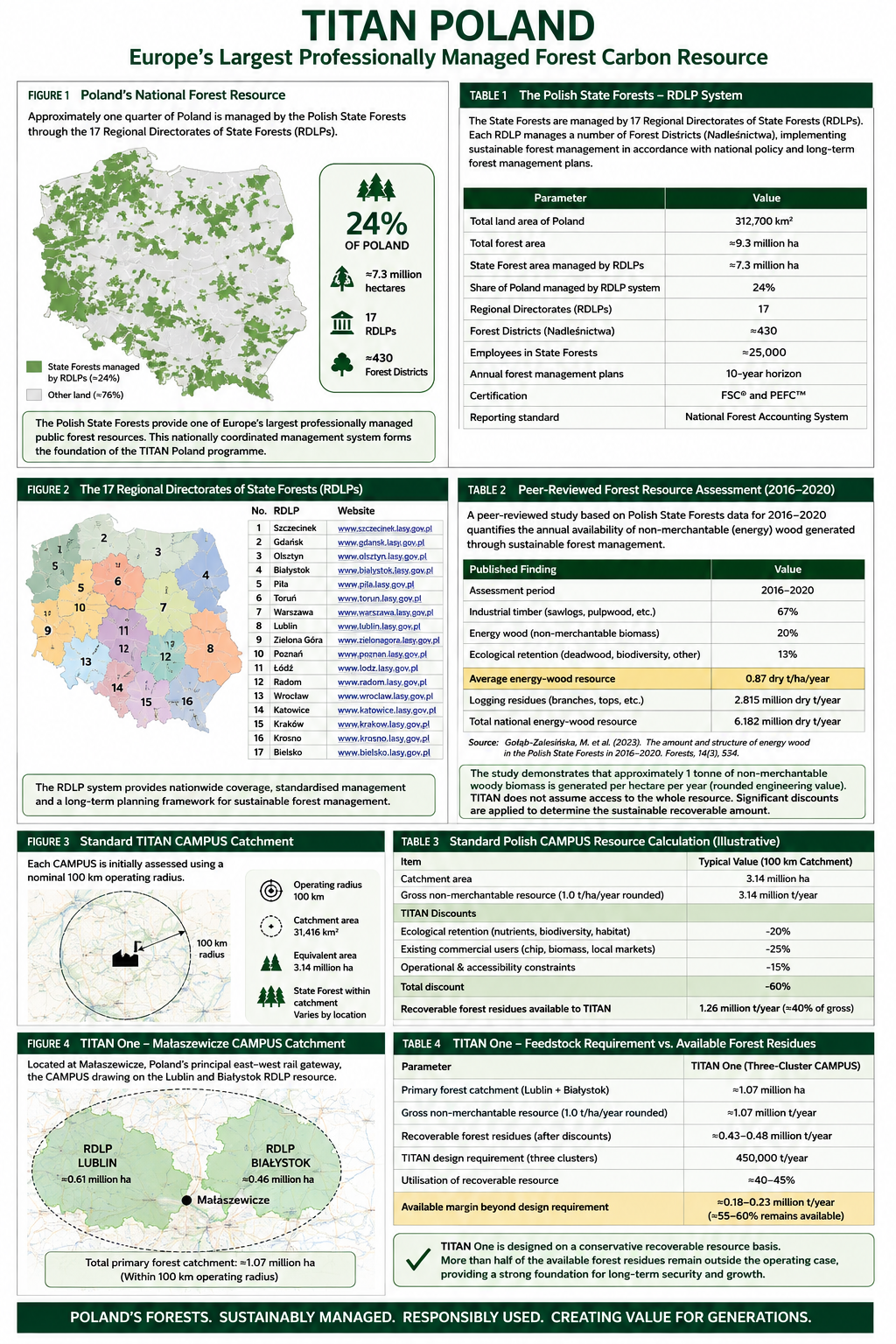
The study examined Polish State Forests data for the period 2016–2020 and identified approximately 0.81 dry tonnes of non-merchantable wood and forest residue per hectare per year.
TITAN receives forest residue at approximately 20% moisture content. The dry-mass result is therefore converted to delivered feedstock as follows:
0.81 dry tonnes ÷ 0.80 = 1.0125 delivered tonnes per hectare per year.
For ease of application and to maintain a conservative basis, Syngas Project rounds this value down to:
Rule 1.01 One hectare of managed forest supports one tonne of delivered non-merchantable forest residue per year.
This base case applies only to upstream forest residue recovered directly following normal forest-management operations.
It does not include:
- Sawmill residues.
- Wood-factory and manufacturing residues.
- Reclaimed packaging wood, construction wood and demolition wood.
- Exceptional material resulting from fire, flood, storm damage or windthrow.
These additional sources provide contingency and expansion potential but are not required to demonstrate the base TITAN resource case.
TITAN as the Foundation of CAMPUS
TITAN is the foundation of each Syngas Project CAMPUS because forest residue is Poland’s largest consistently available renewable-carbon resource.
Each CAMPUS contains six TITAN Islands arranged as three two-Island clusters.
Each TITAN Island:
- consumes approximately 210 tonnes of forest residue per day;
- produces approximately 20,000 Nm³ per hour of Hydrogen Producer Gas; and
- supplies the common CAMPUS gas-treatment and microbial-fermentation system.
Each two-Island cluster therefore consumes approximately:
420 tonnes per day, or approximately 150,000 tonnes per year.
Each cluster receives approximately 70 MW of feedstock energy and can produce either:
- approximately 25 MW of renewable methane, exported as LRNG; or
- approximately 80,000 litres per day of second-generation ethanolfor the Alcohol-to-Jet SAF pathway.
A complete three-cluster CAMPUS therefore requires approximately:
450,000 tonnes of forest residue per year.