
The Polish CAMPUS Programme
A standard CAMPUS screening radius of 100 kilometres covers approximately 3.14 million hectares.
Applying the national State Forest share of approximately 24% gives an indicative average of approximately 750,000 hectares of State Forest within a theoretical CAMPUS catchment, equivalent to approximately 750,000 tonnes of non-merchantable forest residue per year before any local adjustment.
This national average is not used to place CAMPUS sites uniformly across Poland.
Poland’s forests are not distributed evenly. Large forest concentrations occur principally in the eastern and western parts of the country, while much of central Poland contains more agricultural and urban land.
The ten planned Polish CAMPUS locations are therefore selected at rail-port and rail-logistics sites positioned close to these forest-rich regions. The programme comprises:
- ten CAMPUS locations;
- three TITAN clusters at each location; and
- thirty TITAN clusters in total.
The national average confirms that Poland has sufficient overall resource. The detailed investment case for each CAMPUS is then based on the actual managed forest area within its local supply region.
TITAN One – Małaszewicze
TITAN One is located at Małaszewicze in eastern Poland, where the forest regions managed by RDLP Lublin and RDLP Białystok meet the CAMPUS supply area.
Together, these two Regional Directorates provide approximately one million hectares of managed forest relevant to the TITAN One resource case.
Applying the conservative TITAN rule of one delivered tonne per hectare per year gives:
1 million hectares = approximately 1 million tonnes of non-merchantable forest residue per year.
Syngas Project then applies a further 50% availability discount to allow for ecological requirements, access constraints, existing local demand, operating losses and commercial limitations.
The discounted resource is therefore:
1 million tonnes × 50% = approximately 500,000 tonnes per year.
The three TITAN clusters at TITAN One require approximately:
3 × 150,000 tonnes = 450,000 tonnes per year.
The result is clear:
| TITAN One resource case | Tonnes per year |
| Gross non-merchantable forest residue | 1,000,000 |
| Resource after 50% discount | 500,000 |
| Three-cluster CAMPUS requirement | 450,000 |
| Remaining margin | 50,000 |
TITAN One can therefore support all three TITAN clusters using only the discounted upstream forest-residue resource available from the RDLP Lublin and RDLP Białystok supply regions.
This conclusion does not require TITAN One to procure feedstock from sawmills, wood factories, recycled wood, construction and demolition wood or exceptional climate-event material.
Those downstream and exceptional resources remain outside the base case and provide additional contingency, resilience and future expansion capacity.
Conclusion
The published forest study supports a conservative TITAN design basis of one delivered tonne of non-merchantable forest residue per hectare per year.
The national average demonstrates sufficient overall resource for the Polish programme, but CAMPUS locations are selected according to the actual distribution of Poland’s forests rather than positioned uniformly across the country.
TITAN One demonstrates the strength of this approach. Approximately one million hectares of managed forest within the RDLP Lublin and RDLP Białystok resource regions provide approximately one million tonnes of non-merchantable residue annually. After applying a 50% availability discount, approximately 500,000 tonnes remain available.
This is sufficient to meet the approximately 450,000-tonne annual requirement of all three TITAN clusters at the Małaszewicze CAMPUS solely from upstream forest residue.
Downstream Wood Residues in Poland
A Second Resource Layer Beyond the TITAN Forest-Floor Base Case
The TITAN feedstock case is proven using stranded, non-merchantable residues recovered directly from the forest floor. Merchantable timber is not included and cannot be diverted into professional energy production where it is suitable for higher-value industrial use. Polish policy now formally applies this cascading-use principle: full-value wood is reserved for products such as furniture, joinery and other industrial applications, while only wood unsuitable or of limited use for industrial processing may enter professional energy use.
This upstream position is strategically important because competition for stranded forest-floor residues is substantially lower than competition for downstream industrial residues. Nevertheless, the processing of merchantable timber generates a second, large renewable-carbon resource after the wood has first completed its higher-value industrial purpose.
The downstream market comprises two principal pathways:
- residues arising from sawmilling, drying, profiling and wood-product manufacture; and
- by-products arising from pulp and paper production.
These resources are additional to the TITAN base case. They are not required to demonstrate the feedstock sufficiency of TITAN One.
1. Starting National Wood Balance
The peer-reviewed Polish State Forest study separates the national woody-biomass balance into industrial timber, energy wood and ecological retention.
| National woody-biomass category | Share |
| Industrial and merchantable timber | 67% |
| Non-merchantable energy wood and forest residues | 20% |
| Ecological retention in the forest | 13% |
| Total | 100% |
The study estimates the energy-wood category at approximately 6.18 million dry tonnes per year. As this represents 20% of the assessed woody-biomass balance, the implied total is approximately:
6.18 million tonnes ÷ 20% = 30.9 million dry tonnes per year
The corresponding industrial-timber category is therefore approximately:
30.9 million tonnes × 67% = 20.7 million dry tonnes per year
This industrial category remains legally and economically dedicated to material use. Downstream residues appear only after the timber has been processed into sawn products, panels, pulp, paper, furniture, joinery and other products. The published study confirms the 67% industrial, 20% energy-wood and 13% ecological structure and identifies approximately 6.18 million dry tonnes of energy wood annually.
TITAN_Polish_State_Forest_Biomass_Evidence_Extract.pdf
A. Sawmill, Drying and Profile-Industry Residues
How the Residue Is Created
A sawmill cannot convert the complete round log into finished rectangular timber. The circular and tapered shape of a log creates slabs and edgings during primary breakdown. Sawing creates sawdust, while drying, planing, profiling and final sizing create further shavings, chips and trim ends.
The typical resource pathway is:
Sawlog → sawn timber → dried timber → planed or profiled product
At each stage, additional residues are generated.
| Processing stage | Principal residue |
| Debarking | Bark |
| Primary sawing | Slabs, edgings and offcuts |
| Cutting | Sawdust |
| Drying and grading | Rejected or cracked pieces |
| Planing and profiling | Shavings, chips and dust |
| Furniture and joinery manufacture | Cut-outs, trim ends and machining dust |
For a broad national screening assessment, approximately 46% of sawlog input may emerge as primary sawmill residue. A further approximately 8%may arise during drying, planing, profiling and finishing. This gives an indicative total solid-residue factor of approximately 54% of sawlog input.
This does not mean that 54% is discarded. Much of it already has commercial value.
Indicative National Sawmill and Profile Resource
The Polish study’s industrial-timber category includes sawlogs, veneer wood, pulpwood and other industrial grades. It does not provide a single audited national split showing exactly how much of the 67% category enters sawmills rather than pulp mills or other processing.
For screening purposes, an indicative assumption that approximately 30% of the total woody-biomass balance enters saw and veneer production gives:
| Sawmill and profile calculation | Indicative value |
| Total national woody-biomass balance | 30.9 million dry t/year |
| Indicative saw and veneer input | 30% |
| Saw and veneer wood | 9.27 million dry t/year |
| Primary sawmill residue at 46% | 4.26 million dry t/year |
| Further profile and finishing residue at 8% | 0.74 million dry t/year |
| Total sawmill and profile residue | Approximately 5.0 million dry t/year |
The approximately 5 million-tonne annual figure is an indicative material-flow estimate, not a claim that this amount is uncontracted or immediately available to TITAN.
Who Competes for Sawmill Residues?
Sawmill residues are already important raw materials. The principal competing buyer groups are:
| Competing market | Materials sought | Commercial position |
| Particleboard manufacturers | Chips, sawdust, clean offcuts and recycled wood | Strong and established |
| MDF and fibreboard manufacturers | Clean fibres, chips and sawmill residues | Strong and quality-sensitive |
| Pellet and briquette producers | Dry sawdust and shavings | Highly price-sensitive |
| Pulp and paper manufacturers | Clean chips and suitable fibre | Large-volume demand |
| Sawmill boilers and CHP | Bark, wet residues and lower-grade fines | Frequently consumed on site |
| Animal bedding producers | Clean, dry shavings | Regional specialist market |
| Horticulture and landscaping | Bark and selected chips | Seasonal and regional |
| Biochemical and materials producers | Clean lignocellulosic residues | Emerging higher-value market |
Kronospan is a clear example of an established industrial competitor. The company manufactures particleboard, MDF, OSB and other wood-based panels and states that it uses residues from the sawmill industry as part of its raw-material strategy.
Other significant Polish and regional competitors include wood-panel manufacturers, pellet producers, paper mills and large integrated furniture or joinery businesses that consume their own residues internally. Public information identifies the categories of buyers, but individual supply contracts, tender volumes and prices are generally commercially confidential. The market should therefore be described as actively competed, rather than suggesting that every named company is currently bidding for every residue stream.
TITAN’s Position in the Sawmill Market
TITAN should not attempt to displace higher-value material uses. Clean chips suitable for particleboard, MDF, pulp or other material products should continue through those routes.
The strongest TITAN opportunities are likely to be:
- mixed or variable residues that fail panel or pulp specifications;
- contaminated fines that remain legally suitable for treatment;
- wet bark and difficult fractions;
- residues generated intermittently in volumes too small for large industrial buyers;
- materials located beyond the economical collection radius of existing panel plants;
- final residues after the maximum practical material value has been recovered.
This places TITAN at the end of the cascading-use hierarchy, converting residues that have no remaining higher-value material route into Hydrogen Producer Gas and then into renewable methane, 2G ethanol, chemicals or materials.
B. Pulp and Paper By-Products
How the Resource Is Created
Pulp and paper manufacture separates cellulose fibres from the lignin, hemicellulose, bark, minerals and other components of wood.
The main residue and by-product streams include:
| Pulp and paper stream | Description |
| Bark | Removed before pulping and commonly used in mill boilers |
| Screening rejects | Knots, oversized chips and unsuitable fibres |
| Black liquor | Dissolved lignin, hemicellulose and pulping chemicals |
| Fibre sludge | Short fibres and solids lost during processing |
| De-inking sludge | Fibre, ink and mineral residues from recycled paper |
| Paper sludge | Fibre and filler solids from wastewater treatment |
| Recovered-paper rejects | Plastics, coatings, adhesives and unsuitable fibres |
| Ash | Residue from on-site biomass and recovery boilers |
The European Commission’s Pulp&Fuel programme identifies bark and black liquor as two major pulp-mill residue streams and investigates their conversion into renewable fuels through gasification and related processes.
Indicative National Pulpwood Resource
Using an indicative pulpwood allocation of approximately 30% of the total national woody-biomass balance gives:
| Pulpwood calculation | Indicative value |
| Total national woody-biomass balance | 30.9 million dry t/year |
| Indicative pulpwood share | 30% |
| Pulpwood input | 9.27 million dry t/year |
Chemical pulp production commonly recovers approximately 43–55% of dry wood input as saleable pulp. The remaining 45–57% is separated from the cellulose fibre.
Applied to the indicative Polish pulpwood input:
| Pulp pathway | Indicative annual quantity |
| Pulpwood input | 9.27 million dry t |
| Pulp produced at 43–55% yield | 3.99–5.10 million t |
| Non-fibre fraction at 45–57% | 4.17–5.28 million t |
| Indicative non-fibre by-product flow | Approximately 4.2–5.3 million dry t/year |
This figure must not be described simply as external waste. A large part of the non-fibre fraction becomes black liquor, which integrated kraft pulp mills normally concentrate and use internally in recovery boilers. This provides process heat, steam and chemical recovery and is therefore already a valuable internal energy and chemical stream.
Competition for Pulp and Paper Residues
The pulp and paper resource is generally more integrated and less openly traded than sawmill residue.
| Residue stream | Existing competing use | Potential TITAN relevance |
| Black liquor | Chemical recovery and internal energy | Low immediate external availability |
| Bark | Mill boilers, CHP and biomass markets | Regional opportunity where surplus exists |
| Clean fibre rejects | Reintroduction to process or lower-grade paper | Limited where material recovery remains possible |
| Paper sludge | Cement, land application, combustion or disposal | Potential after moisture and ash assessment |
| De-inking sludge | Cement, energy recovery or disposal | Potential but contamination-sensitive |
| Recycling rejects | Waste-to-energy or disposal | Strong potential for tailored gasification |
| Boiler ash | Construction, land use or disposal | STRATA recovery opportunity rather than TITAN fuel |
Large Polish pulp and paper companies—including integrated mills and packaging-paper producers—are important competitors because they frequently consume bark, black liquor and other process residues internally. Their priority is continuous mill operation, steam generation and chemical recovery rather than selling these resources externally.
TITAN should therefore focus not on disrupting closed internal recovery systems, but on:
- surplus bark beyond mill boiler demand;
- fibre and paper sludges with limited outlets;
- recovered-paper rejects;
- contaminated or mixed carbon fractions;
- residues that mills currently pay to transport, treat or dispose of;
- future lignin streams released when mills adopt new chemical-recovery or biorefinery systems.
Combined Downstream Resource
The combined national downstream flow can be illustrated as follows:
| Downstream industrial pathway | Indicative dry-equivalent flow |
| Sawmill, drying and profile residues | Approximately 5.0 million t/year |
| Pulpwood non-fibre by-products | Approximately 4.2–5.3 million t/year |
| Combined downstream flow | Approximately 9.2–10.3 million t/year |
This represents an indicative flow equal to approximately 30–33% of the total national woody-biomass balance.
However, the commercially accessible quantity is much smaller because:
- significant volumes are already used for panels, pulp, pellets and bedding;
- integrated mills use bark and black liquor internally;
- some material is geographically remote;
- moisture, ash and contamination reduce fuel value;
- supply contracts may already be long-term;
- only the final fraction with no remaining higher-value material use should pass to fuel production.
The table therefore describes resource generation, not uncontracted TITAN availability.
Competition and Future Policy Direction
Upstream Versus Downstream
| Market characteristic | Forest-floor residues | Downstream industrial residues |
| Primary TITAN role | Base feedstock | Supplementary resource |
| Competition | Relatively low | Moderate to high |
| Existing contracts | Less developed | Frequently established |
| Material consistency | Variable | Often more controlled |
| Moisture | Often higher | Can be dry and attractive |
| Main competing users | Limited local energy and biomass users | Panels, pulp, pellets, CHP and materials |
| TITAN strategy | Direct collection using dedicated machinery | Selective procurement and partnerships |
The low-competition upstream resource is why TITAN is the foundation of CAMPUS. TITAN One can support its three clusters from discounted forest-floor residues without depending on sawmills, panel plants or paper mills.
Downstream resources remain commercially valuable because they are often concentrated, already handled and located at industrial or rail-connected sites. However, these benefits also attract established buyers and produce stronger price competition.
How Policy May Change Availability
Polish policy is moving toward more rigorous cascading use of wood. Full-value timber must first be directed to industrial products, and professional energy users may use only material unsuitable or of limited value for industrial processing. The 2025 rules also removed the former energy pool from State Forest sales and promoted local processing and deeper domestic conversion.
In the near term, this may strengthen competition for clean sawmill residues because panel, pulp and furniture industries will receive more merchantable timber and consequently generate more processing by-products.
Over time, however, the same cascading principle should also improve the separation and classification of residue streams. More material will pass through one or several product lives before reaching its final energy-recovery stage. This can increase the quantity of clearly identified end-of-life carbon available to TITAN from:
- panel and profile production residues;
- exhausted recycled wood;
- paper-recycling rejects;
- contaminated fibre sludge;
- packaging and construction wood after reuse;
- fractions no longer suitable for further material recycling.
The long-term opportunity is therefore not to compete for the cleanest and most valuable residue. It is to become the preferred final carbon-conversion platform after every practical material use has been exhausted.
Conclusion
Poland’s downstream wood economy generates a very substantial secondary carbon flow.
Indicative national material balances suggest approximately:
- 5.0 million dry tonnes per year of sawmill, drying and profile residues; and
- 4.2–5.3 million dry tonnes per year of pulp and paper non-fibre by-products.
Together, these pathways represent approximately 9.2–10.3 million dry-equivalent tonnes per year.
These resources are more competitive than TITAN’s upstream forest-floor feedstock. Panel manufacturers, pulp and paper mills, pellet producers, CHP operators and other wood-product industries already purchase or internally consume significant quantities.
TITAN’s commercial strategy should therefore remain clear:
The forest-floor resource proves the CAMPUS base case. Downstream industrial residues provide additional security, selective commercial opportunities and long-term expansion—but are not required to make TITAN One viable.
Future Carbon Policy and the Role of TITAN
European climate and circular economy policy is steadily changing the way renewable carbon is managed. The long-term objective is no longer simply to reduce emissions, but to maximise the value extracted from every tonne of renewable carbon before it is finally recovered for energy.
This principle, known as the cascading use of wood, requires that timber is first directed towards its highest-value industrial application. Merchantable timber should become buildings, furniture, engineered wood products, packaging or paper before any remaining carbon is considered for energy recovery. Polish legislation now reflects this principle by preventing full-value industrial timber from being used as fuel in professional energy installations.
Paper and wood products should therefore not be viewed as waste. They represent renewable carbon stored within the economy. Every product has a useful life and, where technically possible, should be repaired, reused and recycled before reaching the end of its economic value. Paper fibres may be recycled several times before they become too short for further papermaking, while timber products may pass through multiple applications before finally becoming unsuitable for material recovery.
As European recycling rates continue to improve, increasing quantities of renewable carbon will eventually reach the end of the cascading chain. These materials include contaminated wood, exhausted paper fibres, recycled packaging, construction and demolition timber, paper sludges, fibre rejects and other residues that no longer have a technically or economically viable material use.
This represents an important long-term opportunity for TITAN. The platform is not designed to compete with higher-value wood industries. Instead, TITAN has been developed as the final renewable carbon conversion platform, processing materials only after their maximum material value has been extracted.
Unlike conventional combustion systems, TITAN does not simply destroy renewable carbon to produce heat. Through hydrogen producer gas and targeted microbial fermentation, the remaining renewable carbon is converted into Liquefied Renewable Natural Gas (LRNG), second-generation ethanol for Sustainable Aviation Fuel, renewable chemicals, advanced biological products, renewable carbon dioxide and biochar. In doing so, TITAN extends the productive life of renewable carbon before its eventual return to the atmosphere.
For this reason, tightening European circular economy legislation should strengthen, rather than weaken, the long-term strategic position of TITAN. As more renewable carbon is retained within the economy through successive material uses, a larger proportion will ultimately require a final, sustainable conversion route. TITAN has been specifically designed to fulfil this role, completing the circular carbon economy by transforming end-of-life renewable carbon into the next generation of renewable fuels, chemicals and materials.
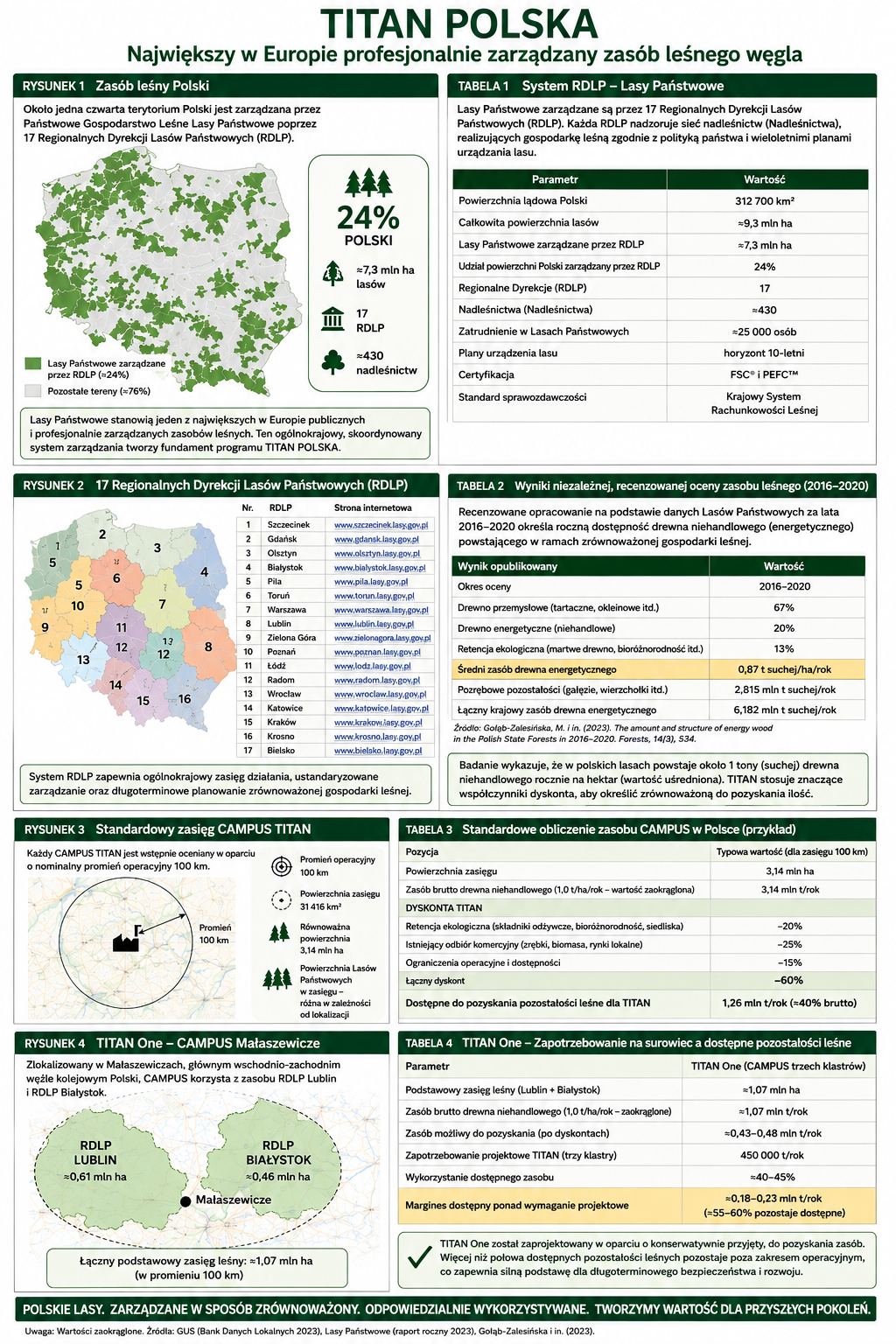
Dostępność Biomasy dla Programu TITAN CAMPUS
Dostępność Pozostałości Leśnych
Ocena zasobów biomasy dla platformy TITAN została oparta na recenzowanej publikacji naukowej „Using Timber as a Renewable Resource for Energy Production in Sustainable Forest Management”autorstwa Jana Banasia i Katarzyny Utnik-Banaś, opublikowanej w czasopiśmie Energies.
Autorzy przeanalizowali dane Lasów Państwowych z lat 2016–2020 i określili ilość biomasy powstającej podczas zrównoważonej gospodarki leśnej.
Badanie wykazało średnią dostępność około 0,81 tony suchej masy niehandlowych pozostałości leśnych z jednego hektara rocznie.
Po przeliczeniu na biomasę dostarczaną do instalacji TITAN przy wilgotności około 20%, wartość ta odpowiada około 1,01 tony biomasy z jednego hektara rocznie.
Dla zachowania konserwatywnego podejścia projektowego Syngas Project przyjmuje uproszczoną zasadę:
1 hektar lasu = 1 tona niehandlowych pozostałości leśnych rocznie
Przyjęta wartość została świadomie zaokrąglona w dół, zapewniając dodatkowy margines bezpieczeństwa.
Obliczenia obejmują wyłącznie pozostałości pozostające na dnie lasu po zakończeniu normalnych prac leśnych.
Nie obejmują one:
- odpadów tartacznych,
- odpadów zakładów przemysłu drzewnego,
- drewna z recyklingu,
- odpadów budowlanych i rozbiórkowych,
- biomasy powstałej w wyniku pożarów, powodzi i wiatrołomów.
Platforma TITAN wykorzystuje wyłącznie niehandlowe pozostałości leśne.
Drewno handlowe nie może być wykorzystywane jako paliwo, ponieważ obowiązujące przepisy realizujące zasadę kaskadowego wykorzystania drewna wymagają, aby drewno nadające się do zastosowań przemysłowych pozostało w gospodarce materiałowej.
Każdy CAMPUS obejmuje sześć Wysp TITAN zorganizowanych w trzy klastry.
Trzy klastry zużywają około 450 000 ton biomasy rocznie.
W przypadku TITAN One w Małaszewiczach obszar RDLP Lublin i RDLP Białystok obejmuje około 1 miliona hektarów lasów.
Przy zastosowaniu konserwatywnego współczynnika:
1 mln ha = 1 mln ton pozostałości leśnych rocznie
Po zastosowaniu dodatkowego współczynnika dostępności 50%pozostaje około:
500 000 ton rocznie
Oznacza to, że trzy klastry TITAN wymagające 450 000 ton roczniemogą zostać zasilone wyłącznie pozostałościami pozostającymi na dnie lasu, bez konieczności pozyskiwania biomasy z przemysłu drzewnego lub innych źródeł wtórnych.
Zasoby Wtórne Przemysłu Drzewnego i Papierniczego
Po zakończeniu pierwszego etapu wykorzystania drewna powstaje drugi, bardzo istotny strumień odnawialnego węgla.
Nie jest on uwzględniany w podstawowym modelu TITAN, jednak stanowi znaczący potencjał dla przyszłego rozwoju platformy.
Największe źródła tych zasobów to:
- przemysł tartaczny,
- produkcja wyrobów drewnianych,
- przemysł celulozowo-papierniczy.
Podczas produkcji tarcicy znaczna część drewna przekształca się w:
- korę,
- trociny,
- zrębki,
- oflisy,
- ścinki,
- wióry,
- pył drzewny.
Materiały te stanowią cenny surowiec wykorzystywany obecnie przez producentów płyt drewnopochodnych, papiernie, producentów pelletu oraz zakłady kogeneracyjne.
Podobnie przemysł papierniczy wytwarza znaczne ilości:
- kory,
- osadów włóknistych,
- osadów papierniczych,
- odrzutów z recyklingu,
- pozostałości ligninowych,
- innych frakcji organicznych.
Znaczna część tych materiałów wykorzystywana jest obecnie wewnętrznie przez papiernie lub znajduje zastosowanie w innych gałęziach przemysłu.
W przeciwieństwie do pozostałości leśnych konkurencja o surowiec wtórny jest znacznie większa.
Najważniejszymi odbiorcami są:
- producenci płyt wiórowych,
- producenci MDF,
- przemysł papierniczy,
- producenci pelletu,
- elektrociepłownie,
- producenci biomateriałów.
Z tego względu Syngas Project nie opiera ekonomiki TITAN na rynku tych surowców.
Stanowią one wyłącznie drugą warstwę zabezpieczenia oraz potencjał dalszego rozwoju.
Podstawowym źródłem biomasy pozostają pozostałości leśne odzyskiwane bezpośrednio z dna lasu.
Przyszłość Polityki Węglowej i Rola TITAN
Europejska polityka klimatyczna i gospodarki o obiegu zamkniętym zmienia sposób postrzegania odnawialnego węgla.
Celem nie jest już wyłącznie ograniczenie emisji, lecz maksymalne wykorzystanie wartości każdego kilograma odnawialnego węgla przed jego ostatecznym odzyskiem energetycznym.
Zasada kaskadowego wykorzystania drewna oznacza, że drewno powinno być kolejno wykorzystywane do produkcji budynków, mebli, materiałów drewnopochodnych, opakowań oraz papieru.
Dopiero po wyczerpaniu możliwości dalszego wykorzystania materiałowego powinno zostać skierowane do odzysku energetycznego.
Papier i drewno nie są więc odpadami.
Stanowią magazyn odnawialnego węgla funkcjonujący przez wiele kolejnych cykli życia produktu.
Wraz z rozwojem gospodarki o obiegu zamkniętym coraz większa ilość tego węgla będzie ostatecznie trafiała do końcowego etapu przetwarzania.
To właśnie w tym miejscu rozpoczyna się rola TITAN.
Platforma TITAN nie konkuruje z przemysłem drzewnym ani papierniczym.
Stanowi końcowy etap kaskadowego wykorzystania odnawialnego węgla.
Zamiast prostego spalania biomasy TITAN przekształca pozostały odnawialny węgiel w:
- wodór gazowy (HPG),
- odnawialny metan,
- bioetanol II generacji,
- paliwo lotnicze SAF,
- biochemikalia,
- produkty biologiczne,
- biochar,
- odnawialny dwutlenek węgla.
W praktyce TITAN wydłuża gospodarcze życie odnawialnego węgla do absolutnego maksimum.
Dlatego rozwój europejskiej gospodarki o obiegu zamkniętym nie stanowi zagrożenia dla TITAN.
Wręcz przeciwnie.
Każdy kolejny etap recyklingu powoduje, że coraz większa ilość odnawialnego węgla będzie ostatecznie wymagała technologii zdolnej do jego końcowego, zrównoważonego przekształcenia.
TITAN został zaprojektowany właśnie jako końcowa platforma transformacji odnawialnego węgla, zamykająca pełny obieg węgla w europejskiej gospodarce o obiegu zamkniętym.