
Warsaw 15:08:2026 Steve Walker
ROMANIA 🇷🇴
★★★★★
TITAN Forest Residue Opportunity — Country Due Diligence
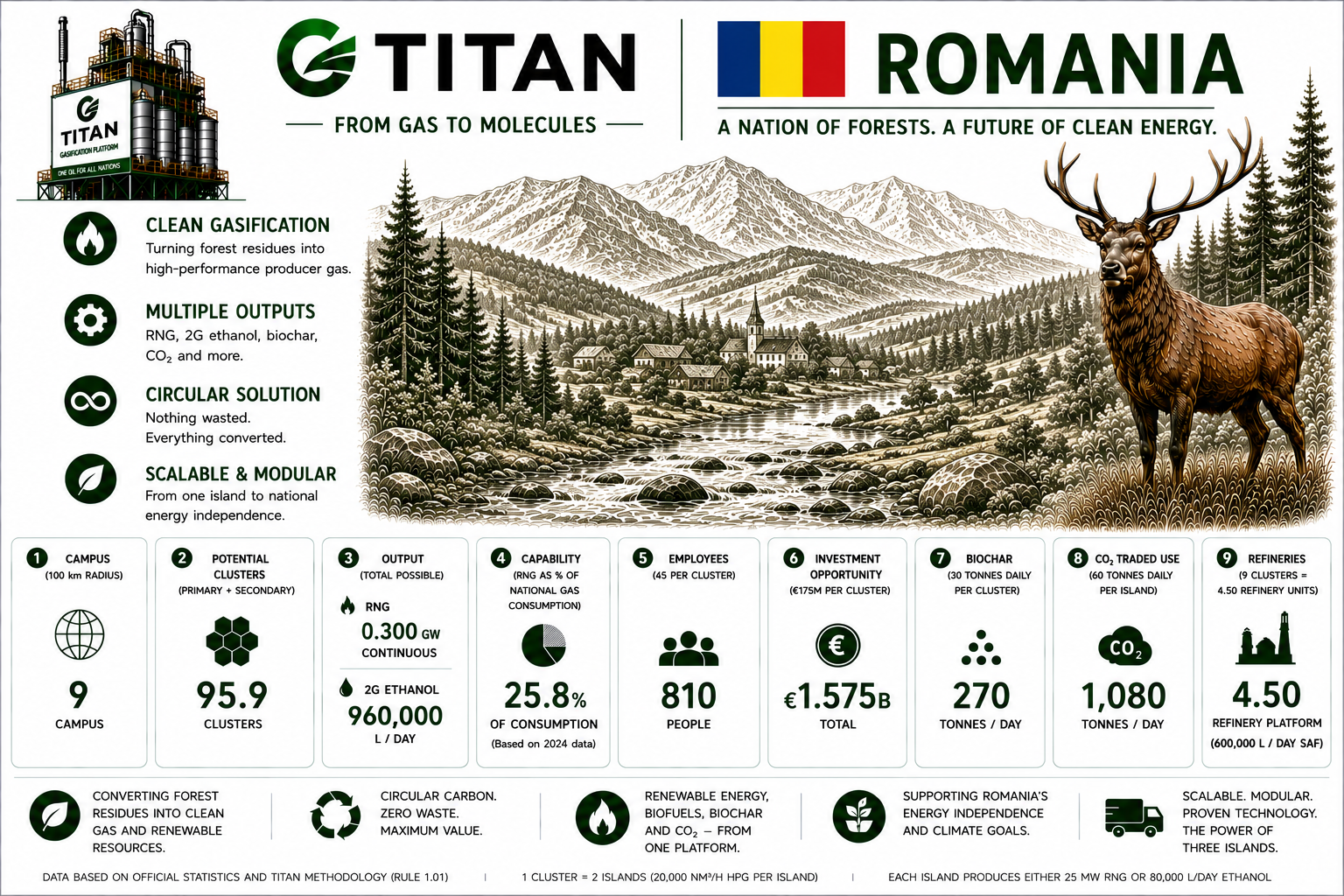
Romania has a geographical area of 238,398 km² and is an 8-CAMPUS country under the TITAN 100 km planning model. All eight CAMPUS are relevant to TITAN. Romania combines the forested Carpathian arc with the Transylvanian Plateau and extensive accessible plains surrounding the mountain system. The national forest estate has reached 6.61 million ha and supports 44.5 TITAN clusters from the primary forest resource alone. Official 2024 timber harvesting was 18.64 million m³, while the four secondary wood markets increase the total identified national opportunity to 136.5 TITAN clusters. Romania is therefore a major ★★★★★ TITAN market, with sufficient resource depth for a national multi-CAMPUS programme while maintaining strict exclusion of protected primary and old-growth forest.
| ROMANIA — INSTANT REVIEW | Resource | TITAN Clusters | Assessment |
| Public Forest | 64.7% of forest | 28.8 | Exceptional institutional market |
| Private Forest | 35.3% of forest | 15.7 | Major additional market |
| Primary Forest Resource | 6.61 million ha | 44.5 | Exceptional |
| Sawmill Residue | 5.592 Mt/year | 37.3 | Exceptional secondary market |
| Wood Manufacturing Residue | 2.610 Mt/year | 17.4 | Major industrial market |
| Park & Avenue | 1.864 Mt/year | 12.4 | Major distributed resource |
| Reclaimed Wood | 3.728 Mt/year | 24.9 | Exceptional circular resource |
| Secondary Resource | 13.794 Mt/year | 92.0 | Exceptional |
| Total Identified Opportunity | 20.404 Mt/year | 136.5 | ★★★★★ |
1. Country & CAMPUS Geography
Romania has a geographical area of:
238,398 km²
according to the European Union’s current country statistics.
Under the TITAN 100 km radius planning model:
ROMANIA = 8 CAMPUS
8 CAMPUS | 8 TITAN-RELEVANT CAMPUS
Romania’s geography is distinctive.
The Carpathian Mountains form an arc through the centre of the country, surrounded by the Transylvanian Plateau and the extensive lowlands of Wallachia, Moldavia and western Romania.
The mountain system contains a major part of Romania’s forest resource, but it does not make the CAMPUS inaccessible.
Instead, the TITAN development model should place CAMPUS infrastructure in the valleys, basins, plains and established logistics corridors surrounding the principal forestry regions.
Forest residues move out of the mountain resource toward accessible processing centres.
Romania’s national forest and timber economy is also geographically broad. In 2024, the largest timber-harvesting regions were the North-East with 28.4% of national volume and the Centre with 25.3%, followed by the West, North-West, South-Muntenia and other regions.
This distribution supports the conclusion that:
ALL 8 CAMPUS ARE RELEVANT TO TITAN
2. Primary Forest Opportunity
Romania’s forest area increased again in 2024 to:
6.61 MILLION ha OF FOREST
The national forest estate continues to expand gradually.
This resource supports:
44.5 TITAN CLUSTERS
Romania has a particularly attractive public-sector forestry position.
The established national ownership structure identifies 64.7% of wooded land within the public domain, with the remaining 35.3% privately owned.
For TITAN:
| Forest Ownership | Share | TITAN Clusters |
| Public Forest | 64.7% | 28.8 |
| Private Forest | 35.3% | 15.7 |
| Total | 100% | 44.5 |
The strategic institutional position is therefore:
28.8 CLUSTERS FROM PUBLIC FOREST
Romania’s National Forest Administration, Romsilva, is the principal manager of state forests, creating an important institutional route into the primary resource market.
The private forest estate provides another:
15.7 TITAN CLUSTERS
creating substantial additional resource depth.
For TITAN, however, one boundary must be absolute.
Romania contains some of Europe’s most important surviving primary and old-growth forests. More than 500,000 ha of potential primary and old-growth forest has been identified, including substantial Natura 2000 territory. These areas cannot form part of the TITAN supply proposition.
The target is therefore managed forest residues, thinning, forest maintenance, damaged material and other qualifying non-merchantable residues — not primary or old-growth forest.
3. Sawmill Residues
Romania has a major active timber economy.
The National Institute of Statistics reports:
18.64 MILLION m³ OF TIMBER HARVESTED IN 2024
This was 531,000 m³ below the 2023 volume.
Under the TITAN downstream methodology, the resulting sawmill residue market provides:
5.592 MILLION TONNES/YEAR
supporting:
37.3 TITAN CLUSTERS
This is an exceptional secondary market and approaches the size of Romania’s entire primary forest opportunity.
The sawmill sector therefore represents the first major contingency resource immediately below the forest floor.
Importantly, Romania already possesses substantial commercial timber-processing infrastructure, particularly across the Carpathian forestry regions.
TITAN can therefore connect into established forestry collection and haulage systems rather than creating an entirely new logistics network.
4. Wood Manufacturing Residues
Romania has a substantial downstream wood-products economy encompassing furniture, panels, flooring, construction products, joinery, pallets and other manufactured wood products.
The wood-manufacturing residue resource provides:
2.610 MILLION TONNES/YEAR
supporting:
17.4 TITAN CLUSTERS
This is a major industrial carbon resource.
The material is concentrated at industrial processing locations and therefore logistically attractive.
Competition increases substantially at the factory gate, so TITAN should establish a market position here without making manufacturing residue the foundation of the national programme.
The preferred hierarchy remains:
Forest floor → primary position
Sawmill → first contingency
Wood manufacturing → industrial contingency
5. Park & Avenue
Romania’s municipalities, roads, railway corridors, electricity networks, river corridors, public parks and other managed landscapes generate substantial non-forest woody residues.
The Park & Avenue market provides:
1.864 MILLION TONNES/YEAR
supporting:
12.4 TITAN CLUSTERS
Romania has an extensive national infrastructure network crossing both forested mountain areas and large agricultural plains.
Roadside vegetation, railway maintenance, utility corridors, municipal trees and storm-damaged material therefore provide a significant additional resource outside the formal forest estate.
This material is generated through necessary management rather than dedicated forestry.
It therefore represents a genuine additional carbon stream for the CAMPUS network.
6. Reclaimed Wood
Romania’s construction sector, furniture industry, pallets, packaging, building stock and demolition activity create a major end-of-life wood resource.
The reclaimed-wood market provides:
3.728 MILLION TONNES/YEAR
supporting:
24.9 TITAN CLUSTERS
This is Romania’s second-largest secondary TITAN market after sawmill residues.
The resource is particularly relevant because Romania has a substantial wood-products manufacturing economy.
Wood should remain within higher-value material cycles wherever practical.
The hierarchy therefore remains:
Reuse → recycling → TITAN carbon recovery
TITAN provides the final recovery pathway when wood can no longer economically remain within the material cycle.
7. Total TITAN Opportunity
Romania’s primary forest resource supports:
44.5 TITAN CLUSTERS
The four secondary markets provide:
| Secondary Market | TITAN Clusters |
| Sawmill Residues | 37.3 |
| Wood Manufacturing Residues | 17.4 |
| Park & Avenue | 12.4 |
| Reclaimed Wood | 24.9 |
| Total Secondary | 92.0 |
The combined identified Romanian resource therefore supports:
136.5 TITAN CLUSTERS
A national programme based on:
3 TITAN CLUSTERS PER CAMPUS
would require:
24 TITAN CLUSTERS
equal to:
17.6% OF THE IDENTIFIED ROMANIAN RESOURCE
This provides substantial resource headroom around an eight-CAMPUS national rollout.
Strategic Assessment
Romania is an:
8-CAMPUS COUNTRY
and all eight CAMPUS are relevant to TITAN.
Its 6.61 million ha forest estate supports 44.5 primary TITAN clusters, divided between:
28.8 public forest clusters
and
15.7 private forest clusters.
The strength of the public position is particularly important.
Official 2024 harvesting data show that 12.235 million m³ — 65.6% of all harvested timber — came from publicly owned forests, demonstrating the practical commercial importance of the public forestry sector rather than simply its ownership share.
The downstream markets add:
92.0 TITAN CLUSTERS
taking the total identified national opportunity to:
136.5 TITAN CLUSTERS
Romania also has substantial forest growth headroom. Current forestry-sector analysis based on National Forest Inventory data indicates harvesting at around 33% of gross forest growth, with more than 24 million m³/year of net unharvested accumulation.
This does not justify increasing extraction from protected forests.
It demonstrates that Romania possesses a deep managed forestry economy from which TITAN can target qualifying residues while explicitly excluding primary, old-growth and protected forest.
The development strategy should therefore establish eight regional CAMPUS around accessible Carpathian and lowland logistics nodes, prioritise institutional relationships with public forestry, progressively aggregate private forest residues, and integrate sawmill, manufacturing, Park & Avenue and reclaimed wood.
A 24-cluster national programme — three clusters per CAMPUS — requires only 17.6% of Romania’s identified resource opportunity.
ROMANIA — ★★★★★
8 CAMPUS | 8 TITAN-RELEVANT CAMPUS
44.5 PRIMARY CLUSTERS | 136.5 TOTAL IDENTIFIED CLUSTERS