
Warsaw 18:08:2026 Steve Walker
SITES 01 — MAŁASZEWICZE
TITAN ONE | POLAND
The first in our SITES series: the locations selected to build and scale the TITAN platform.
1. THE SITE — WHY MAŁASZEWICZE
TITAN One is planned at Małaszewicze in eastern Poland, on the European Union’s eastern border and at one of the most important rail-freight gateways between Europe and Asia.
Following our assessment of alternative Polish locations, Małaszewicze was selected as the best location in Poland for TITAN One.
The reason is the unusual concentration of forest resource, rail infrastructure, industrial land, logistics capability and expansion potential in one location.
THE NEW SILK ROAD
Małaszewicze sits on the principal Eurasian rail-freight corridor commonly known as the New Silk Road.
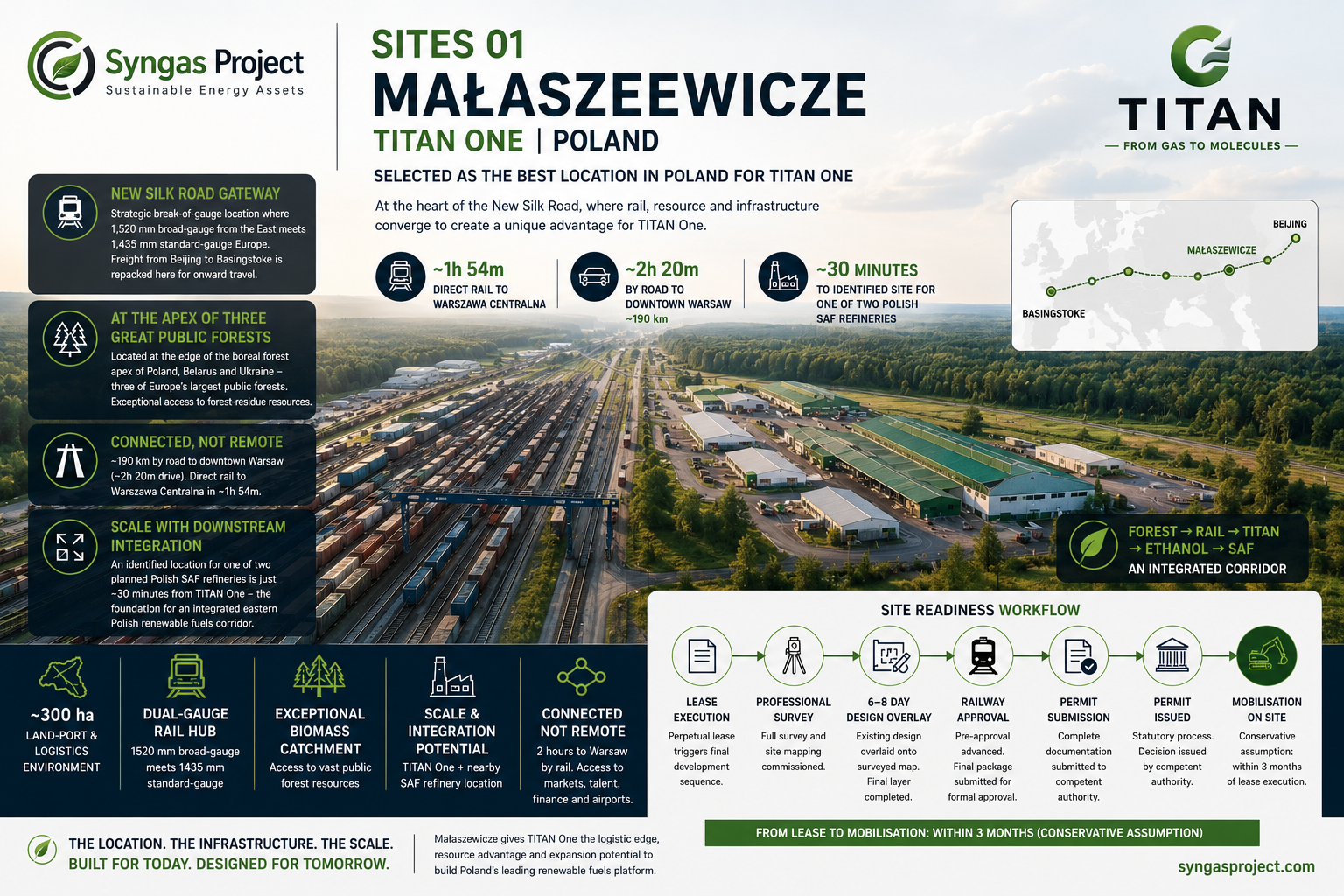
The wider Małaszewicze land-port and logistics environment extends across approximately 300 hectares, providing an established concentration of rail terminals, sidings, storage, customs, handling and transshipment infrastructure.
Most importantly, this is where two railway systems meet.
The 1,520 mm broad-gauge railway system from the East meets Europe’s 1,435 mm standard-gauge railway network.
The difference in gauge means that freight cannot simply remain on the same railway wagons and continue its journey. Małaszewicze has therefore developed as a major break-of-gauge and transshipment gateway, where freight is transferred between the eastern and European railway systems.
Put simply, goods travelling from Beijing to Basingstoke can arrive through the eastern railway network, be transferred at Małaszewicze and continue west across Europe.
For TITAN, this is exceptionally valuable infrastructure to have immediately around the first site.
AT THE APEX OF THREE MAJOR FOREST REGIONS
The railway is only half of the Małaszewicze story.
The location sits on the western edge of the great northern and eastern European forest belt, close to the convergence of Poland, Belarus and Ukraine and their extensive publicly managed forest resources.
For TITAN One, the committed resource strategy is based on Polish forest residues. Belarusian and Ukrainian resources are not required for the initial project.
Their geographical proximity nevertheless provides important long-term optionality.
Małaszewicze therefore sits at an unusual intersection:
FOREST RESOURCE → INTERNATIONAL RAIL → TRANSSHIPMENT → TITAN → EUROPEAN MARKETS
This is one of the principal reasons we consider Małaszewicze to be one of Central Europe’s strongest locations for a large-scale forest-residue project.
CONNECTED — NOT REMOTE
Despite its position on Poland’s eastern border, Małaszewicze is closely connected to the country’s economic and administrative centre.
Central Warsaw is approximately two hours away by direct rail, giving the project practical access to government, finance, engineering, professional services and international transport connections.
This combination matters.
TITAN One can benefit from the resource and logistics advantages of eastern Poland without becoming a remote industrial development.
A LOCATION THAT CAN ACHIEVE SCALE
TITAN One was not selected simply to accommodate the first plant.
Małaszewicze provides the logistics and infrastructure needed to support subsequent expansion.
Importantly, a location identified for one of the two planned Polish SAF refineries is approximately 30 minutes from TITAN One.
This creates the potential to develop an integrated eastern Polish renewable-fuels corridor in which forest residues are aggregated through the Małaszewicze logistics system, converted into 2G ethanol and supplied to a nearby Alcohol-to-Jet SAF refinery.
FOREST → RAIL → TITAN → 2G ETHANOL → SAF
The ability to combine feedstock, production and downstream refining within the same regional logistics corridor is a major strategic advantage.
This is why Małaszewicze was selected not merely as the home of TITAN One, but as the starting point from which TITAN can achieve industrial scale.
2. SITE READINESS
A great location has limited value if it requires years of development before construction can begin.
That is the second reason Małaszewicze stands out.
TITAN One is not a site-search proposition.
The site has been identified, assessed and developed through the project-preparation process. The principal land, regulatory, electrical, railway and design work is already advanced.
LONG-TERM LAND CONTROL
The site is being progressed through a perpetual lease structure, providing the long-term land position required for financing, construction, operation and future development.
Execution of the lease is the trigger for the final site-development sequence rather than the beginning of site selection.
URE
The TITAN One site has already progressed through the relevant URE approval process.
This provides an important part of the established regulatory position for Małaszewicze and materially differentiates TITAN One from a project that has simply identified a potentially suitable parcel of land.
20 MW ELECTRICAL CONNECTION
A 20 MW electrical connection is located at the top of the site.
The associated transformer infrastructure has already been designed and was approved for MV transmission.
Importantly, this infrastructure was designed for more than the first development.
The electrical architecture anticipates the subsequent addition of further TITAN clusters and other platform clusters, providing an infrastructure foundation for expansion rather than requiring the electrical strategy to be recreated as the site grows.
THE SITE LAYOUT ALREADY EXISTS
The existing TITAN One design has already been positioned using a manually measured map of the actual site.
We therefore already understand how the development fits.
The buildings, principal infrastructure, access and railway interface have been laid out against the site. Execution of the lease does not trigger a new design exercise.
It triggers the final verification process.
6–8 DAYS TO THE FINAL DESIGN LAYER
Immediately following execution of the perpetual lease, a new professional survey and site map will be commissioned.
Our architects will then take the existing TITAN One design and overlay it onto the professionally surveyed map.
This is not a redesign.
It is the final accurate design layer required to reconcile the existing layout with the surveyed boundaries, levels, access and infrastructure interfaces.
With advance notice, our architects expect this process to take approximately 6–8 days.
RAILWAY READY
Rail has been considered from the beginning rather than added to the project afterwards.
The railway interface is being progressed toward pre-approval, so that once the professional survey and final design layer are complete, the package can move directly into formal railway approval.
For a project whose long-term logistics strategy is built around rail, this is a critical element of site readiness.
PLANNING
There is no population-density restriction preventing development of the site.
The relevant site-planning requirement is a minimum 10% biologically active area, which can be incorporated within the development layout.
FROM LEASE TO MOBILISATION
The remaining process is therefore deliberately simple:
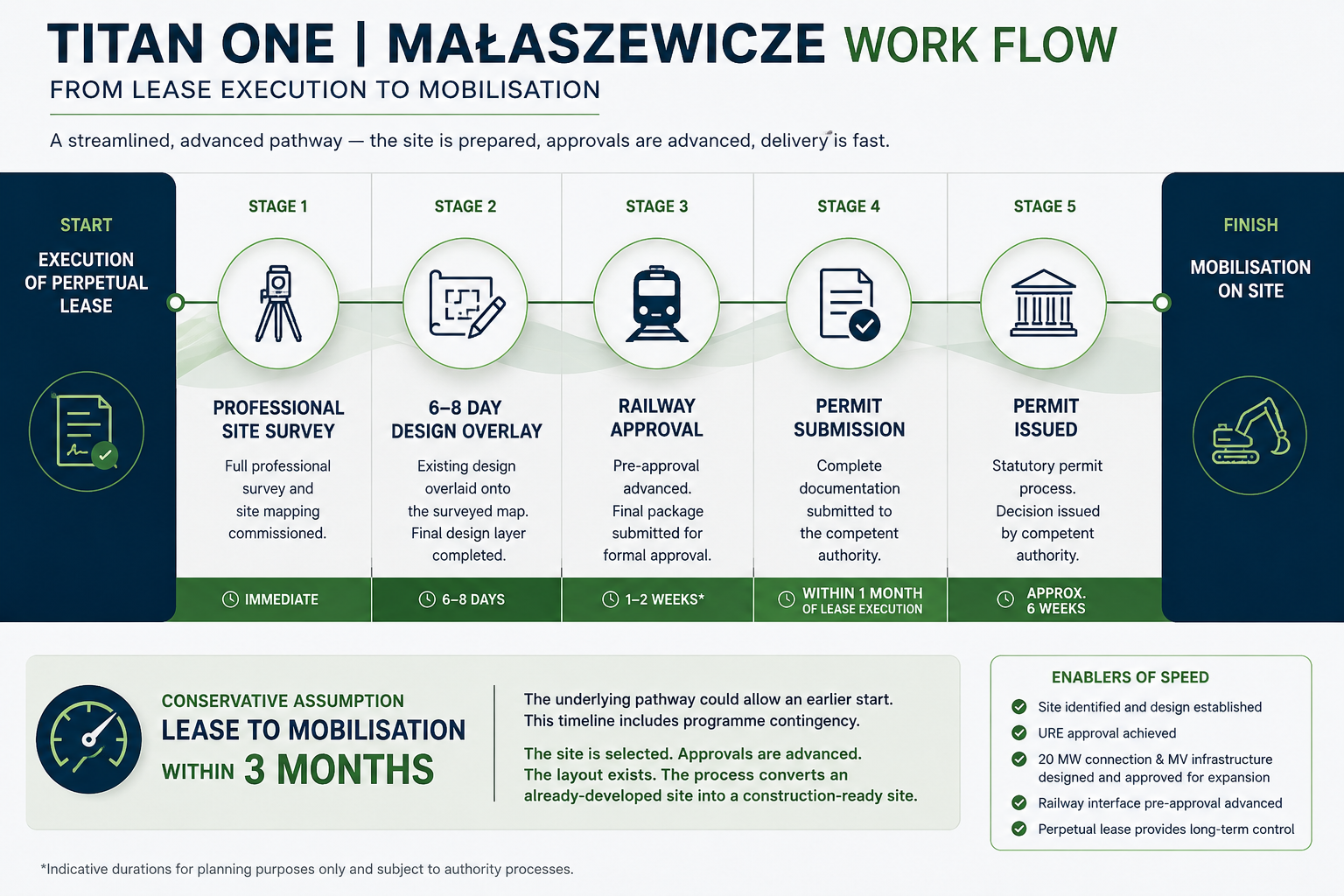
We expect to be in a position to submit the permit application within approximately one month of execution of the perpetual lease.
The applicable permitting pathway provides for a permit within approximately six weeks of submission, subject to the competent authority and a complete application.
We nevertheless prefer to programme conservatively.
LEASE TO MOBILISATION — WITHIN THREE MONTHS
That is our working site-readiness target for TITAN One.
The land is identified. The regulatory position is advanced. The electrical infrastructure has been designed for scale. The site layout exists. The railway interface is being advanced. The final professional survey and architectural overlay can be completed rapidly.
Małaszewicze gives TITAN One two things every infrastructure project needs: an exceptional location and a credible route to construction.
That is why it is SITES 01.