Warsaw 16:08:2026 Steve Walker
SLOVENIA
★★★★★
TITAN RESIDUE & BIOMASS DUE DILIGENCE
Investment Statement
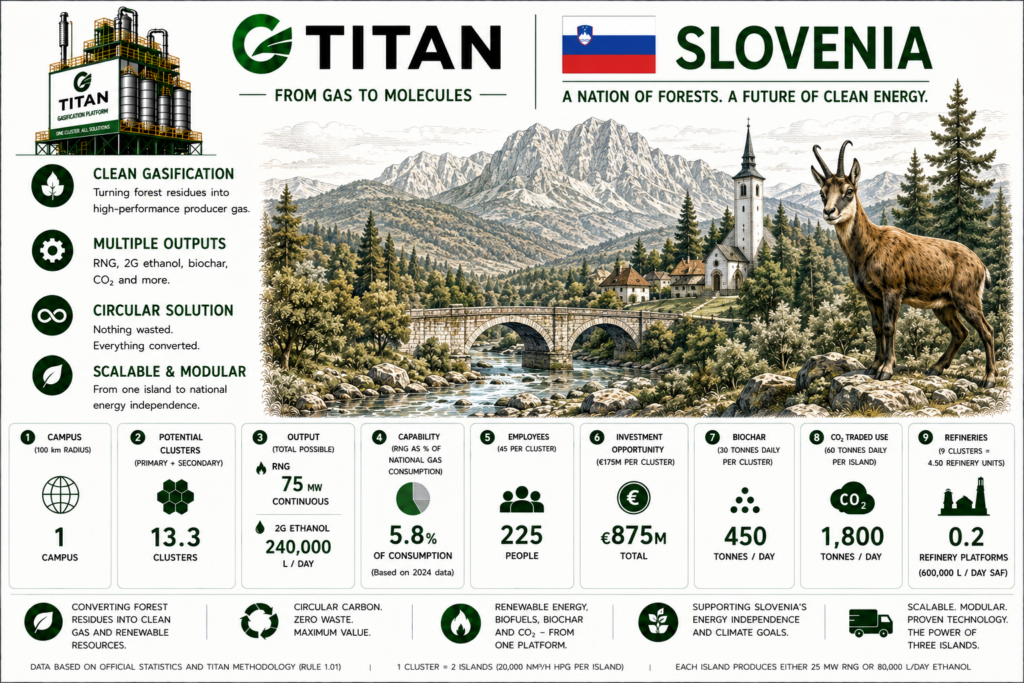
Slovenia is a five-star, single-CAMPUS TITAN opportunity.
Slovenia has approximately 1.177 million hectares of forest, covering 58% of the country. Its national area of approximately 20,300 km² is smaller than the nominal 31,416 km² reach of one TITAN-led CAMPUS operating within a 100 km radius. The Slovenian Forest Service reports annual forest increment of approximately 8.7 million m³and possible annual felling of approximately 7.17 million m³.
The assessed Primary managed-forest residue supports approximately 7.9 TITAN clusters. Slovenia can therefore support one fully developed three-cluster / six-island CAMPUS from Primary Resource alone, with substantial additional resilience from four Secondary Resource markets.
Instant Review
| Resource Market | Available Residue | TITAN Clusters |
| PRIMARY RESOURCE | ||
| State & Municipal Forest | 0.27 Mt/y | 1.8 |
| Private Forest | 0.92 Mt/y | 6.1 |
| Primary Total | 1.19 Mt/y | 7.9 |
| SECONDARY RESOURCE | ||
| Sawmill Residues | 1.38 Mt/y | 9.2 |
| Joinery & Carpentry Residues | 0.64 Mt/y | 4.3 |
| Park & Avenue / Non-Forest | 0.46 Mt/y | 3.1 |
| Reclaimed / Recovered Wood | 0.92 Mt/y | 6.1 |
| Secondary Total | 3.40 Mt/y | 22.7 |
| TOTAL IDENTIFIED RESOURCE | 4.59 Mt/y | 30.6 |
| National Classification | Single-CAMPUS Country | 1 CAMPUS |
| Recommended Deployment | 0.45 Mt/y | 3 clusters / 6 islands |
| Available for Duty | — | 100% |
National Materiality
| Measure | Slovenia |
| TITAN renewable methane capacity | 100 MW |
| Annual RNG / LRNG | ~0.88 TWh/y |
| Share of national gas consumption | ~8.7% |
1. Geography & CAMPUS Opportunity
Slovenia is a single-CAMPUS country.
At approximately 20,300 km², Slovenia represents only around 65% of the nominal geographic reach of one 100 km-radius CAMPUS. Its compact size means one strategically located TITAN-led CAMPUS can provide the basis for national resource coverage.
Geography nevertheless matters. Slovenia combines Alpine terrain with densely forested regions, so actual feedstock reach must be determined by journey time, road and rail connectivity and commercially accessible forest rather than radius alone.
This favours a CAMPUS + REACH + CACHE structure: one principal industrial CAMPUS supported by collection and logistics locations where geography requires them.
Every TITAN-led CAMPUS can become live with additional Syngas Project platforms according to the municipal, agricultural, water, gaseous-carbon and other opportunities identified within its national reach.
2. State & Municipal Forest
Public forest represents approximately 25% of Slovenia’s forest estate on the latest Slovenian Forest Service presentation basis: 21% state and 4% local-community ownership.
The assessed resource supports approximately:
1.8 TITAN clusters
This represents an important procurement anchor for the Slovenian CAMPUS.
State forest has an additional structural advantage: Slovenia has a dedicated State Forest Company and established mechanisms for managing and selling wood from state forests, including longer-term commercial arrangements.
Public forest should therefore form the first procurement workstream for a Slovenian TITAN development.
3. Private Forest
Approximately 75% of Slovenia’s forests are privately owned on the latest Forest Service presentation basis.
The assessed resource supports approximately:
6.1 TITAN clusters
This is Slovenia’s largest Primary Resource pool.
Private ownership is fragmented, making aggregation important. The Slovenian Forest Service nevertheless provides public forestry services across Slovenian forests irrespective of ownership and operates through 14 regional units, 69 local units and 396 forest districts.
The preferred procurement architecture is therefore:
Public forest anchor + organised private forest supply + Secondary Resource resilience.
4. Sawmill Residues
Slovenia has a substantial forestry and primary wood-processing economy relative to its population and geographic size.
The assessed sawmill residue market provides approximately:
1.38 Mt/year
equivalent to:
9.2 TITAN clusters
This is the largest individual Secondary Resource opportunity.
Detailed development DD should identify the principal sawmills within the selected CAMPUS reach, existing residue destinations, contractual commitments, moisture, pricing and competition from pellet, panel-board and existing energy markets.
The significance for TITAN is that the Slovenian base case does not depend upon winning this market. Sawmill residues can therefore be contracted selectively where their economics improve the CAMPUS supply portfolio.
5. Joinery & Carpentry
Slovenia’s downstream wood economy provides an additional concentrated industrial residue pool.
The assessed market provides approximately:
0.64 Mt/year
equivalent to:
4.3 TITAN clusters
The opportunity includes qualifying clean residues from joinery, carpentry, furniture, construction products and other wood manufacturing.
These materials can have attractive logistics because residues are already accumulated at industrial locations. Competition can, however, be stronger than at the forest floor.
The sector is therefore an important downstream supply and strategic relationship market, rather than a dependency of the Slovenian CAMPUS.
6. Park & Avenue / Non-Forest Woody Residues
The Park & Avenue market includes qualifying woody residues arising outside managed forests: municipal parks and avenues, urban tree management, road and railway corridors, utility corridors, airports, waterways and industrial estates.
The assessed Slovenian opportunity provides approximately:
0.46 Mt/year
equivalent to:
3.1 TITAN clusters
This resource extends TITAN beyond conventional forest procurement.
Its distributed nature makes it particularly suited to municipal, infrastructure and contractor relationships linked through the CAMPUS REACH network.
7. Reclaimed & Recovered Wood
The assessed reclaimed and recovered wood opportunity provides approximately:
0.92 Mt/year
equivalent to:
6.1 TITAN clusters
This represents a significant additional circular-carbon resource.
Recovered wood requires controlled chain of custody, classification and contamination testing. Material suitable for economically and environmentally preferable reuse or recycling remains within those markets; TITAN addresses qualifying residual fractions appropriate for conversion.
8. Resource Security
| Resource Position | TITAN Clusters |
| State & Municipal Primary | 1.8 |
| Private Primary | 6.1 |
| Total Primary | 7.9 |
| Sawmill | 9.2 |
| Joinery & Carpentry | 4.3 |
| Park & Avenue | 3.1 |
| Reclaimed & Recovered | 6.1 |
| Total Secondary | 22.7 |
| Total Identified Potential | 30.6 |
| Maximum Slovenian CAMPUS Requirement | 3.0 |
The maximum Slovenian CAMPUS requires approximately 38% of assessed Primary Resource.
Primary managed-forest residue alone therefore provides approximately 2.6 times the feedstock capacity required for full deployment.
Secondary markets provide additional procurement competition, redundancy and optimisation rather than being necessary to establish resource sufficiency.
9. National Materiality
A fully developed TITAN programme producing 100 MW of RNG/LRNG represents approximately:
0.88 TWh/year renewable methane
equivalent to approximately:
8.7% of Slovenian annual natural-gas consumption
This makes a single Slovenian CAMPUS material at national energy-system scale.
10. Market Assessment
Slovenia combines an unusually strong set of conditions for TITAN:
58% forest coverage.
Single-CAMPUS national geography.
7.9 clusters of Primary resource against only three required.
Public forest capable of anchoring procurement.
Substantial additional private forest capacity.
Four significant Secondary Resource markets.
100 MW renewable methane equivalent to approximately 8.7% of national gas consumption.
The principal development challenges are fragmented private ownership and mountainous terrain. These affect procurement structure and CAMPUS location, but do not undermine national resource sufficiency.
Slovenia therefore warrants a:
★★★★★
Five-Star TITAN Opportunity Rating
11. Deployment Recommendation
Syngas Project should proceed on the basis of:
1 TITAN-led CAMPUS
3 TITAN clusters
6 TITAN islands
450,000 tonnes/year maximum feedstock requirement
100% AVAILABLE FOR DUTY
The Primary managed-forest resource alone supports approximately 7.9 clusters, leaving substantial headroom after maximum CAMPUS deployment.
The next development stage should therefore concentrate on CAMPUS location, state/public procurement engagement, private forest aggregation and rail/logistics mapping, rather than further proof of national biomass sufficiency.
The preferred location should maximise access to forest and wood-processing resources while providing strong rail and road connectivity and the opportunity to activate the wider Syngas Project platform family.
Slovenia is small enough for one CAMPUS, sufficiently forested to fully load it, and sufficiently resource-rich to retain substantial feedstock resilience after full deployment.
SLOVENIA | ★★★★★ | 1 CAMPUS | 3 CLUSTERS | 6 ISLANDS | 100% AVAILABLE FOR DUTY