Warsaw 03:06:2026 04:30 PM Steve Walker
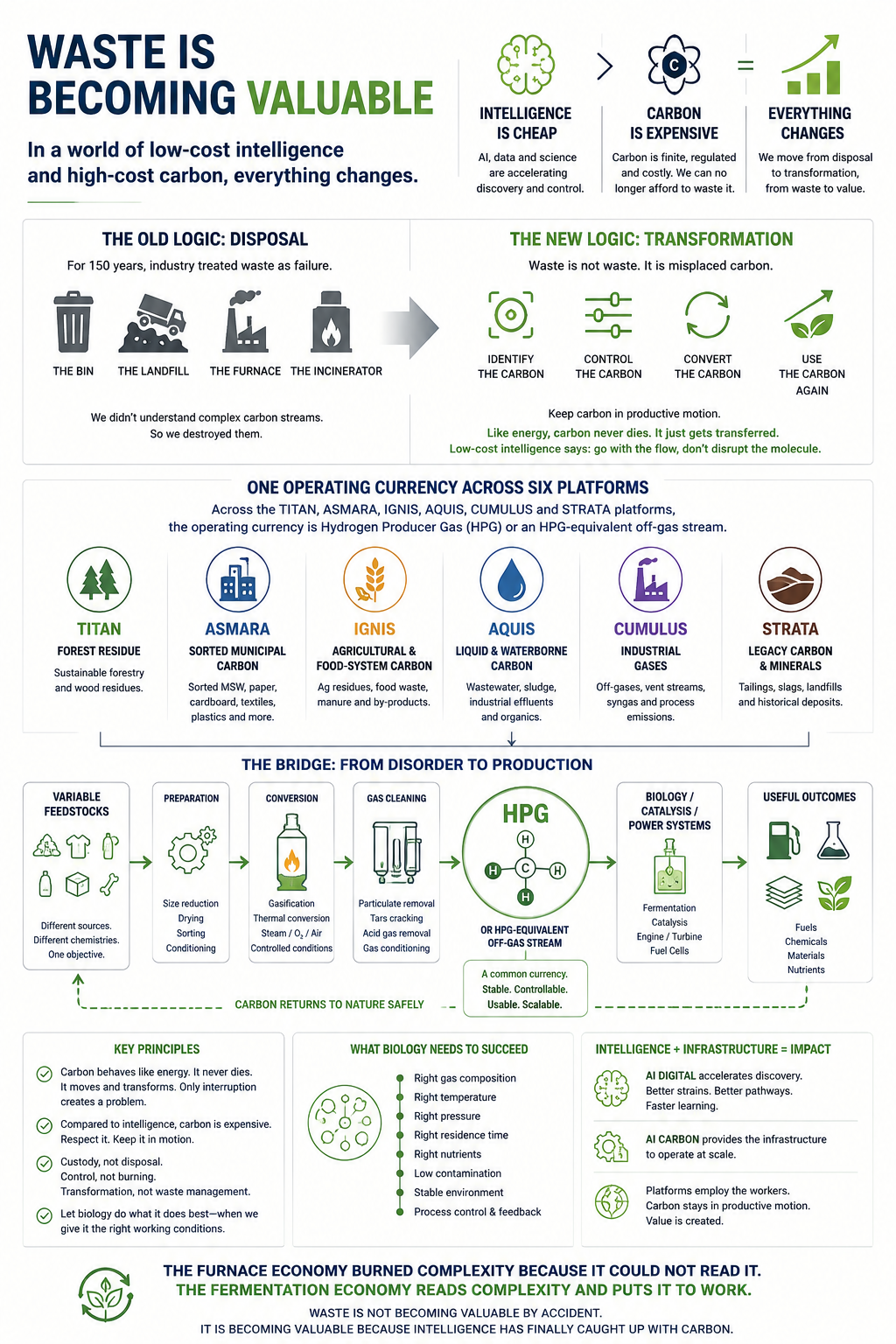
In a world of low-cost intelligence and high-cost carbon, everything changes.
For 150 years, industry treated waste as the failure point at the end of a process.
The bin.
The landfill.
The furnace.
The incinerator.
The problem was not only pollution. The deeper problem was that we did not understand complex carbon streams well enough to use them.
So we destroyed them.
Today, that logic is becoming obsolete.
What we used to call waste is not waste. It is misplaced carbon. It is carbon in the wrong place, in the wrong form, at the wrong time, without the right control system around it.
That distinction matters.
The value of what was once called waste behaves like energy. It does not simply disappear. It moves, changes form, transfers from one condition to another, and only becomes a problem when the flow is broken or deliberately interrupted. Low-cost intelligence tells us to stop fighting the molecule. Do not destroy it unless there is no better option. Understand it, guide it, and keep it moving. Like energy, carbon should go round and round, because compared to intelligence, carbon is expensive.
Once carbon can be identified, conditioned and converted into a common working currency, it stops being a disposal problem and becomes an industrial asset.
Across the TITAN, ASMARA, IGNIS, AQUIS, CUMULUS and STRATA platforms, that operating currency is Hydrogen Producer Gas, or an HPG-equivalent off-gas stream.
This is important because the front-end feedstock can change, while the back-end industrial logic remains consistent.
Forest residues.
Sorted municipal carbon.
Agricultural residues.
Wastewater carbon.
Industrial gases.
Tailings, slags and legacy deposits.
Each stream is different at the point of origin. Each has its own chemistry, moisture level, ash content, contaminants, logistics and regulatory context.
But the strategic objective is the same.
Convert disorder into a controllable carbon-rich gas stream.
Then feed that stream into biology, catalysis or power systems.
That is the bridge between waste management and carbon manufacturing.
For TITAN, forest residue is the starting point. For ASMARA, it is sorted municipal solid carbon. For IGNIS, it is agricultural and food-system carbon. For AQUIS, it is liquid and waterborne carbon. For CUMULUS, it is carbon already present in industrial gas streams. For STRATA, it is the legacy carbon and minerals left behind by the extraction age.
Different sources.
One operating principle.
Find the carbon.
Control the carbon.
Convert the carbon.
Use the carbon again.
This is why HPG matters.