
Warsaw 05:06:2026 6:04 Steve Walker
Why Fermentation Changes Everything
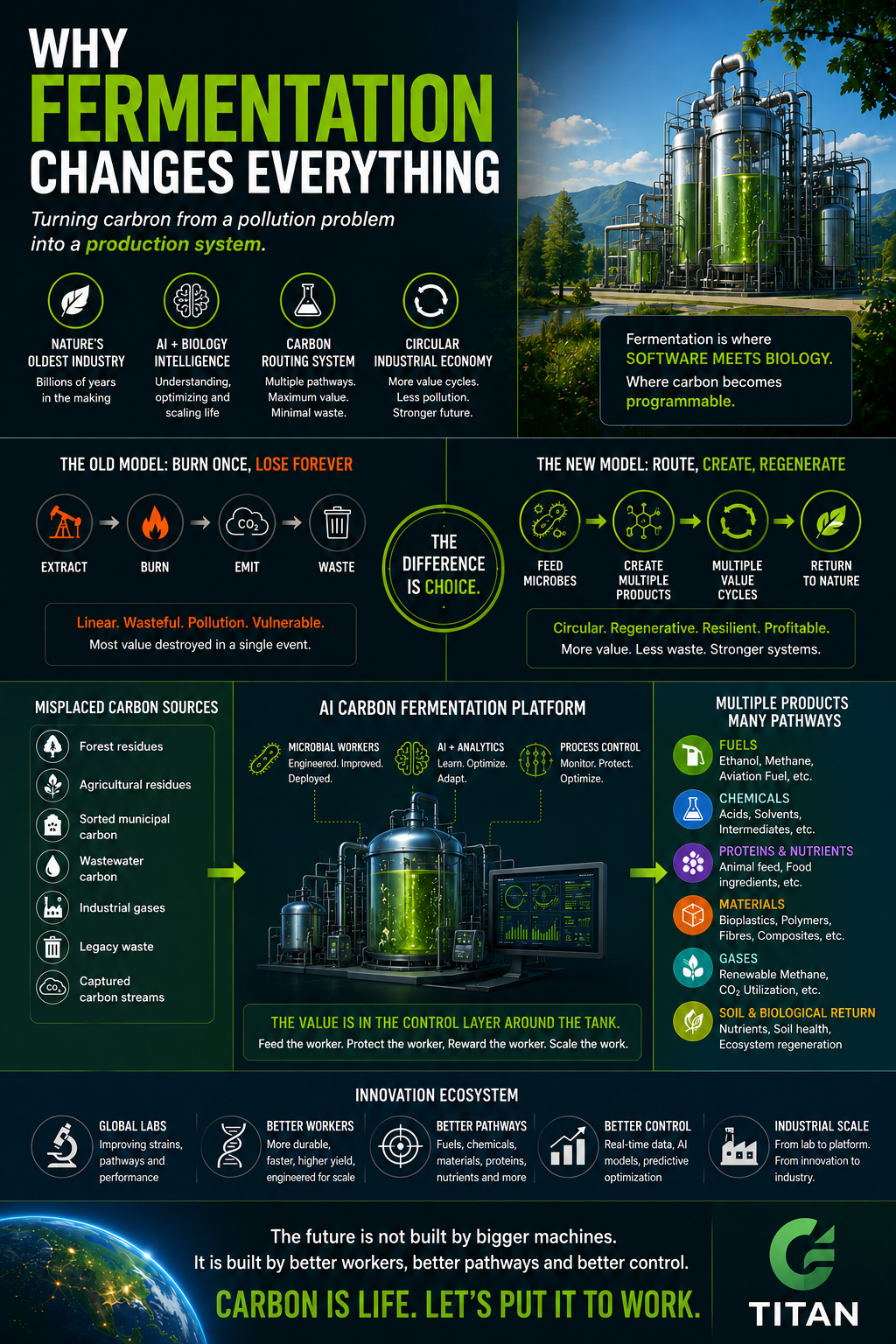
Fermentation changes everything because it moves carbon from destruction to production.
For most of the industrial age, we treated carbon as something to burn. We dug it up, cut it down, refined it, combusted it, consumed it and wasted it. That model created abundance, but it also created pollution, dependency and strategic weakness.
AI Carbon begins from a different idea.
Carbon is not the enemy.
Carbon is the working material of life.
The real question is whether we burn it once, or whether we learn to route it intelligently through fuels, chemicals, materials, nutrients, gases and recovery systems.
That is why fermentation matters.
Fermentation is not an old cottage industry. It is not only beer, bread, yoghurt or wine. Fermentation is one of nature’s oldest industrial systems. Microbes already know how to build, break, convert, repair and reorganise carbon. They have been doing it for billions of years.
The new step is control.
Artificial intelligence, gas analytics, microbial engineering, process monitoring and industrial platform design now allow us to understand what the microbial workers need, how they perform, how they can be improved, and how their work can be scaled.
That is the real change.
We are no longer only designing machines.
We are designing working environments for biology.
In the fossil economy, the refinery was the centre of value. Oil entered the refinery and was separated into fuels, chemicals, solvents, plastics, fibres and materials.
In the AI Carbon economy, fermentation platforms can begin to take over that role.
Instead of crude oil, the feedstock can be misplaced carbon: forest residues, sorted municipal carbon, agricultural residues, wastewater carbon, industrial gases, legacy waste and captured carbon streams.
Instead of only combustion, the platform creates pathways.
Acetogenic microbes can convert carbon monoxide, carbon dioxide and hydrogen into ethanol and other chemical building blocks. Methanogenic microbes can convert carbon gases into renewable methane. Aerobic systems can support proteins, nutrients and biological products. Other pathways can support acids, solvents, polymers, fibres and new materials.