From Manual Recovery to Biological Recovery
The scrap industry has already passed through several major stages of development.
The first stage was physical recovery: collection, sorting and resale.
The second stage was mechanical recovery: shredding, cutting, crushing, baling, granulating and separating.
The third stage was industrial recovery: furnace feed, refinery supply, cable processing, vehicle depollution, e-waste dismantling and high-volume logistics.
The fourth stage is now emerging.
Biological recovery.
Read: The Targeted Microbial Fermantation Supply Chain
This does not replace the scrap industry. It strengthens it.
Microbial systems can help recover value from streams that are too fine, too diluted, too contaminated or too complex for conventional methods alone. These include e-waste residues, metal-bearing dusts, slags, ashes, tailings, water treatment sludges and other stranded materials.
The important point is simple: biology does not belong outside the recovery business. Biology belongs inside it.
Why E-Waste Comes First
Electronic waste is one of the clearest early opportunities.
E-waste contains metals, rare earth elements, precious metals, plastics, ceramics and complex assemblies. Conventional processing already recovers significant value, but many residues remain difficult. Small fractions, mixed powders, fine particles and low-concentration materials can still carry recoverable value.
Biological extraction offers a new route for these difficult fractions.
Microbes can help mobilise metals, support selective recovery and improve the economics of streams that are currently treated as low-grade residues. This is not about replacing established e-waste recyclers. It is about giving them another recovery tool.
The scrap business has always adopted tools that improve yield. Biology is simply the next tool.
The Real Opportunity Is Wider Than E-Waste
E-waste is the beginning, not the limit.
The same logic applies across other stranded resources:
Mining tailings.
Slag.
Ash.
Industrial residues.
Water treatment sludges.
Low-grade mineral streams.
Legacy contaminated land.
Metal-bearing dusts.
Complex carbon-rich waste.
These materials often contain recoverable minerals, metals, rare earth elements and carbon. The problem is not always absence of value. The problem is access to value.
Biology helps unlock access.
The recovery industry already knows how to manage difficult materials. It already has yards, logistics, customers, permits, trading relationships and commercial discipline. That makes the scrap sector a natural early adopter of biological recovery.
AI Digital Is Accelerating AI Carbon
One of the reasons this matters now is the speed of microbial improvement.
Digital tools, AI-supported strain development and advanced biological screening are increasing the pace at which microbial workers can be discovered, improved and applied. In other industrial pathways, microbial performance has already improved from early low-yield wild strains to much higher-performing commercial strains.
That lesson matters.
A strain that performs at level one today does not remain at level one forever. With the right originators, handlers, biofoundries and platforms, microbial consortia improve. They become faster, stronger, more tolerant and more selective.
This is the bridge from AI Digital to AI Carbon.
AI Digital improves the design, selection and optimisation of biological workers. AI Carbon applies those workers to misplaced carbon, minerals and metals in the physical world.
The recovery industry sits directly in that opportunity.
The TMF Supply Chain
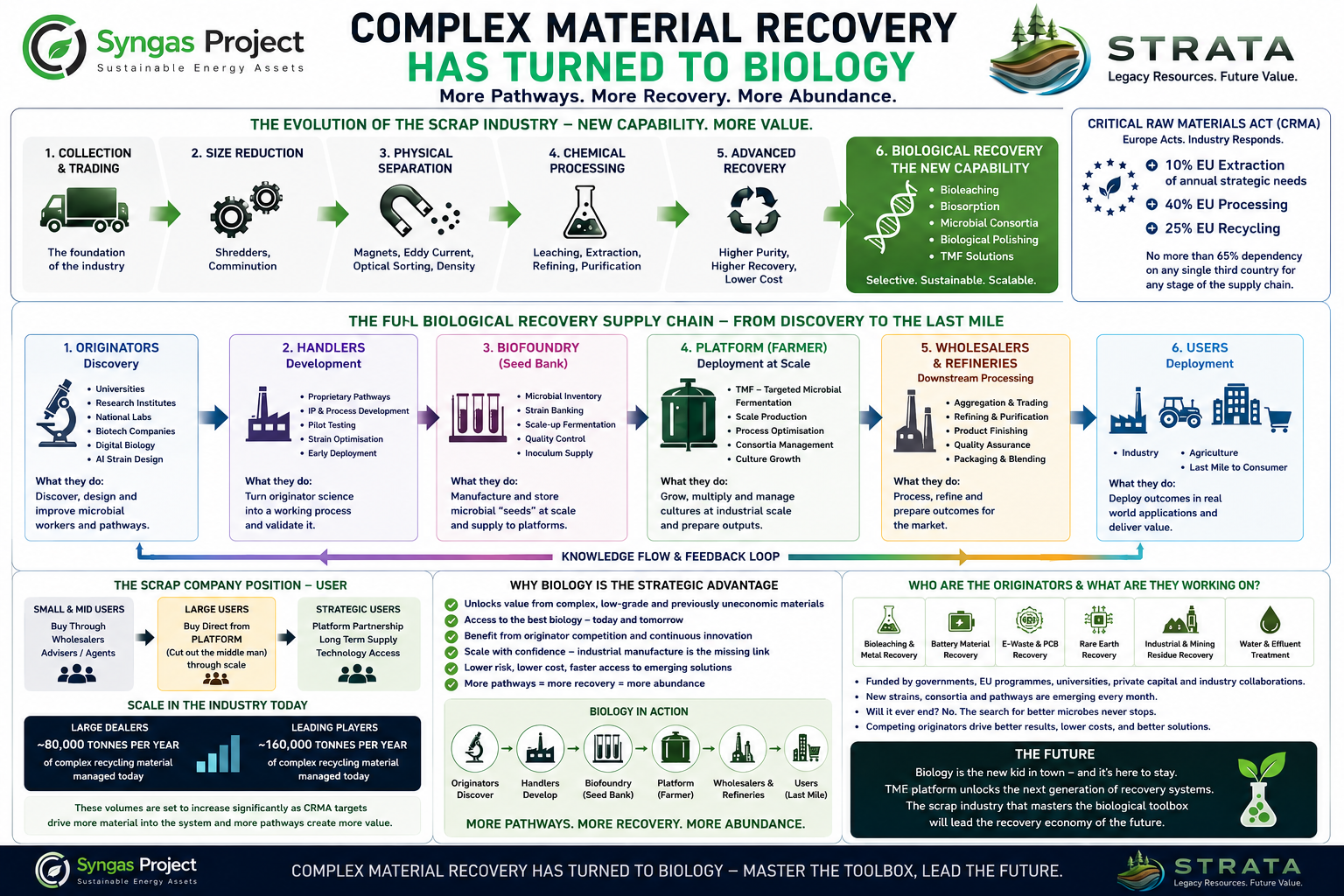
The TMF (Targeted Microbial Fermentation) Supply chain and in turn the emerging biological recovery supply chain have several clear roles.
Originators discover organisms, pathways and biological mechanisms.
Handlers develop, engineer and optimise microbial strains and consortia.
Biofoundries manufacture microbial inventory and prepare biological tools for deployment.
Platforms apply those tools at industrial scale.
Wholesalers and refineries handle the recovered outcomes.
Users buy the final fuels, chemicals, materials, minerals and metals.
The scrap industry has a natural role in this chain.
Scrap companies are not only material suppliers. Early adopters can become platform partners, service providers, wholesalers and even specialist refiners for recovered outcomes. The companies that understand difficult materials first are often the companies that control the next layer of value.
Linked Article: How the TMF Supply Chain works
STRATA: Biology for Legacy Materials
STRATA is the platform concept designed for this new recovery layer.
It is built around the idea that many valuable resources are stranded above ground. Tailings, slag, ash, residues and contaminated industrial materials are not simply waste. They are misplaced resources.
STRATA applies microbial consortia to help recover minerals, metals, rare earth elements and carbon from those materials.
The concept is practical. A TITAN campus provides the fermentation capacity to manufacture microbial inventory. STRATA then applies that biological capacity to specific recovery problems in the field. This may include e-waste fractions, scrap residues, tailings, slag, ash, water treatment sludges and other complex streams.
The important point is capacity.
Without fermentation capacity, biology remains laboratory promise. With fermentation capacity, biology becomes an industrial service.
Microbes as a Service
The next commercial step is simple.
Microbes as a Service.
A scrap company does not need to become a biotech company. It needs access to biological tools that improve recovery. That means tested consortia, reliable supply, field support, process design, offtake routes and measurable outcomes.
This creates a new service model.
A recovery company provides the material stream.
The biofoundry provides the microbial workers.
The platform applies the process.
The market buys the recovered outputs.
This is how biology becomes investable, scalable and useful.
Why the Scrap Industry Is Ready
The scrap industry is ready because it already thinks like a recovery industry.
It knows that value changes with technology.
It knows that small improvements in yield can change profitability.
It knows that difficult materials become valuable when the right process appears.
It knows that logistics, trust and execution matter as much as invention.
Biology does not ask the scrap industry to become something else.
It allows the scrap industry to become more of what it already is: the master of recovery.
The Message to Early Adopters
The early adopters in scrap are not simply customers. They are the companies that can shape the market.
They can identify the best streams.
They can host pilot recovery work.
They can provide logistics and material knowledge.
They can develop specialist recovery services.
They can become wholesalers for recovered biological outcomes.
They can prepare the industry for the next generation of material recovery.
The companies that move first build knowledge, relationships and proprietary operating experience. In recovery markets, that matters.
Conclusion
Scrap is turning to biology because recovery is becoming more intelligent.
The industry has already mastered the physical recovery of complex materials. Biology adds a new capability: the ability to recover value from fine, mixed, diluted and stranded streams that conventional methods struggle to reach.
E-waste is the first obvious entry point. Tailings, slag, ash, water treatment sludges and legacy industrial residues follow.
This is not a departure from the scrap industry’s identity. It is the next expression of it.
The recovery business has always evolved by adding better tools.
Biology is the next tool.
And the companies that understand this early are positioned to lead the next recovery market.