
Warsaw 14:08:2026 Steve Walker
POLAND
★★★★★
TITAN RESIDUE & BIOMASS DUE DILIGENCE
Investment Statement
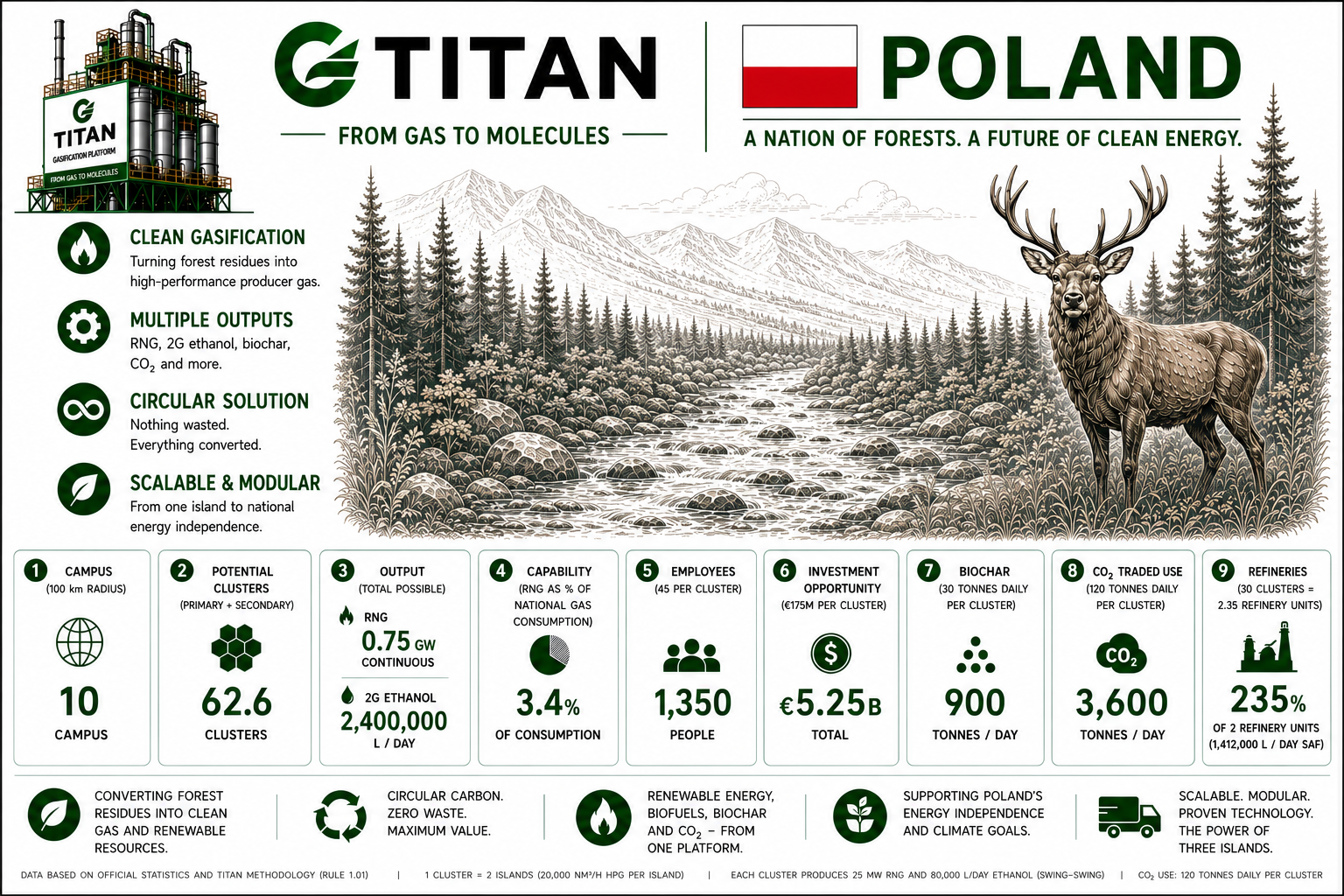
Poland is a five-star, ten-CAMPUS TITAN opportunity and the reference market for the first national-scale deployment of the platform.
Poland has approximately 9.289 million hectares of forest, representing 29.6% of the country. Statistics Poland recorded approximately 41.22 million m³ of total wood removals in 2024.
Poland’s approximately 313,000 km² national geography corresponds closely to the combined nominal reach of ten 100 km-radius TITAN-led CAMPUS. Unlike countries with large areas of tundra, high mountains or inland water, the great majority of Poland can participate in the CAMPUS network.
The assessed Primary managed-forest resource supports approximately 62.5 TITAN clusters. This alone is more than twice the 30 clusters required for the proposed ten-CAMPUS Polish programme.
Instant Review
| Resource Market | Available Residue | TITAN Clusters |
| PRIMARY RESOURCE | ||
| State / Public Forest | 7.59 Mt/y | 50.6 |
| Private Forest | 1.79 Mt/y | 11.9 |
| Primary Total | 9.38 Mt/y | 62.5 |
| SECONDARY RESOURCE | ||
| Sawmill Residues | 12.37 Mt/y | 82.4 |
| Joinery & Carpentry Residues | 5.77 Mt/y | 38.5 |
| Park & Avenue / Non-Forest | 4.12 Mt/y | 27.5 |
| Reclaimed / Recovered Wood | 8.24 Mt/y | 55.0 |
| Secondary Total | 30.50 Mt/y | 203.4 |
| TOTAL IDENTIFIED RESOURCE | 39.89 Mt/y | 265.9 |
| National Classification | Ten-CAMPUS Country | 10 CAMPUS |
| Proposed Deployment | 4.50 Mt/y | 30 clusters / 60 islands |
| Available for Duty | — | 10 of 10 CAMPUS — 100% |
National Materiality
| Measure | Poland |
| Full 10-CAMPUS renewable methane capacity | 1 GW |
| Annual RNG / LRNG | ~8.76 TWh/y |
| Polish natural-gas consumption, 2024 | ~192 TWh/y |
| Share of national gas consumption | ~4.6% |
Statistics Poland reports natural-gas consumption of 691.1 PJ in 2024, equivalent to approximately 192 TWh.
1. Geography & CAMPUS Opportunity
Poland is a ten-CAMPUS country.
Ten nominal 100 km-radius CAMPUS reaches represent approximately 314,160 km², almost equivalent to Poland’s national area.
This does not imply ten perfect circles without overlap. It establishes the scale of the national network. Actual CAMPUS positions must respond to resource density, State Forest geography, rail freight, roads, industrial land and downstream infrastructure.
Syngas Project intends to select the best ten locations from approximately 25 major Polish rail, freight and industrial logistics nodes.
The result is not ten independent plants.
It is an interconnected national system:
10 CAMPUS → up to 15 REACH/CACHE → national rail and road network
Each TITAN-led CAMPUS can ultimately accommodate:
3 TITAN clusters
6 TITAN islands
The complete Polish programme therefore represents:
10 CAMPUS | 30 clusters | 60 islands
Every CAMPUS can subsequently become live with additional Syngas Project platforms according to the municipal, agricultural, water, gaseous-carbon and other opportunities within its reach.
2. State & Public Forest
Poland’s greatest structural advantage is the scale and concentration of its publicly controlled forestry resource.
More than 80% of Polish forests are publicly owned, with the State Forests National Forest Holding managing the overwhelming majority of this resource. Private forest totals approximately 1.78 million hectares.
The assessed State/Public Primary Resource provides:
7.59 Mt/year
supporting approximately:
50.6 TITAN clusters
This is one of the most important findings in the entire Polish DD.
The proposed national programme requires only 30 clusters.
Therefore:
Poland’s proposed ten-CAMPUS / 30-cluster programme can be supported by the State/Public Primary Resource alone.
The programme would require approximately 59% of the assessed State/Public Primary pool, before private forest or any Secondary Resource is required.
This creates a strong basis for long-term framework procurement, chain of custody and national-scale feedstock planning.
3. Private Forest
Poland has approximately 1.78 million hectares of private forest. The Forest Data Bank reports standing timber of approximately 487 million m³and average stand age of around 55 years.
The assessed Private Primary Resource provides approximately:
1.79 Mt/year
supporting:
11.9 TITAN clusters
Private forest therefore represents a substantial additional Primary Resource but is not required to establish the base Polish programme.
This gives Syngas Project considerable procurement flexibility.
Private forest can be progressively incorporated where geography, pricing and local aggregation make it advantageous rather than becoming a prerequisite for FID.
4. Sawmill Residues
Poland has one of Europe’s largest forestry and wood-processing economies.
Statistics Poland recorded approximately 41.22 million m³ of total removals in 2024, providing a substantial flow of material through the Polish primary wood-processing industry.
The assessed sawmill residue market provides approximately:
12.37 Mt/year
equivalent to:
82.4 TITAN clusters
This is the largest Secondary Resource market.
Poland’s sawmill sector therefore represents an enormous contingency and expansion resource for TITAN.
Competition will be materially higher than at the forest floor because sawdust, chips, bark and other residues already feed pellet, board, energy and industrial markets.
Syngas Project does not need to compete aggressively for this material. The State/Public Primary Resource establishes the programme independently.
The sawmill market can instead be approached selectively where location, price and long-term contractual availability strengthen individual CAMPUS supply portfolios.
5. Joinery & Carpentry
Poland has a major downstream wood-manufacturing economy encompassing furniture, joinery, carpentry, flooring, construction products, profiles and other manufactured wood products.
The assessed residue opportunity provides approximately:
5.77 Mt/year
equivalent to:
38.5 TITAN clusters
This market moves TITAN further downstream into the Polish wood economy.
Clean manufacturing residues are generally concentrated at industrial sites, providing favourable collection characteristics. However, they also have established competing uses and can command higher prices.
For TITAN this is therefore primarily a strategic downstream market and resilience resource, rather than a base-load dependency.
6. Park & Avenue / Non-Forest Woody Residues
Poland has an extensive additional woody-carbon resource outside managed forests.
The market includes parks and avenues, municipal tree management, roads and motorways, railway corridors, utility and power-line corridors, airports, waterways and industrial estates.
The assessed opportunity provides approximately:
4.12 Mt/year
equivalent to:
27.5 TITAN clusters
This category is particularly relevant to the national CAMPUS architecture because these residues occur throughout Poland.
They can be aggregated through local authorities, infrastructure operators, maintenance contractors and REACH locations rather than transported over excessive distances to a central facility.
It also expands TITAN’s resource position beyond conventional forestry and industrial wood processing.
7. Reclaimed & Recovered Wood
Poland’s large population, construction sector and wood economy create a substantial flow of post-use wood.
The assessed Reclaimed and Recovered Resource provides approximately:
8.24 Mt/year
equivalent to:
55.0 TITAN clusters
This resource requires disciplined chain of custody, classification and contaminant control.
Material capable of economically and environmentally preferable reuse and recycling remains within those markets. TITAN addresses qualifying residual material suitable for conversion.
This category is particularly important longer term because it positions TITAN not only within forestry but within the wider circular wood-carbon economy.
8. Resource Security
| Resource Position | TITAN Clusters |
| State / Public Primary | 50.6 |
| Private Primary | 11.9 |
| Total Primary | 62.5 |
| Sawmill | 82.4 |
| Joinery & Carpentry | 38.5 |
| Park & Avenue | 27.5 |
| Reclaimed & Recovered | 55.0 |
| Total Secondary | 203.4 |
| Total Identified Potential | 265.9 |
| Proposed Polish Deployment | 30.0 |
The proposed 30-cluster national programme requires approximately:
48% of the assessed Primary Resource
and only approximately:
11% of the total screened Primary + Secondary resource
Most importantly, State/Public Primary Resource alone supports approximately 50.6 clusters against only 30 proposed.
The Polish programme therefore does not depend upon private forest, sawmills, manufacturing residues, Park & Avenue material or reclaimed wood to demonstrate national resource sufficiency.
Those markets provide competition between supply sources, resilience, geographic optimisation and expansion capacity.
9. National Materiality
Statistics Poland reports Polish natural-gas consumption of 691.1 PJ in 2024, equivalent to approximately 192 TWh/year.
A fully developed ten-CAMPUS programme producing 1 GW of RNG/LRNG represents approximately:
8.76 TWh/year renewable methane
equivalent to approximately:
4.6% of Poland’s annual natural-gas consumption
At national scale, the programme is therefore material while remaining small enough relative to the Polish gas market to provide substantial room for further deployment.
10. Market Assessment
Poland combines the characteristics required for a ★★★★★ TITAN opportunity.
Large national forest resource. Approximately 9.289 million hectares of forest.
Highly concentrated public ownership. This provides a strong foundation for national-scale procurement.
Ten-CAMPUS geography. Poland’s national scale aligns closely with ten nominal 100 km CAMPUS reaches.
Primary Resource security. Approximately 62.5 clusters supported against 30 proposed.
State/Public Resource security. Approximately 50.6 clusters supported before private forestry is required.
Exceptional Secondary Resource depth. More than 200 additional cluster-equivalents across four downstream and non-forest markets.
Strong logistics. Poland’s national rail and road network allows CAMPUS, REACH and CACHE locations to operate as an interconnected system.
National energy materiality. A 1 GW renewable-methane programme represents approximately 4.6% of current Polish natural-gas consumption.
The result is not simply sufficient biomass for the first TITAN.
It is sufficient resource and geography to support a national replicated CAMPUS programme.
★★★★★
Five-Star TITAN Opportunity Rating
11. Deployment Recommendation
POLAND — ★★★★★ PRIME TEN-CAMPUS MARKET
Syngas Project should proceed on the basis of:
10 TITAN-led CAMPUS
30 TITAN clusters
60 TITAN islands
4.5 million tonnes/year maximum programme feedstock requirement
100% AVAILABLE FOR DUTY
The ten CAMPUS should be selected from Poland’s strongest rail, logistics and resource locations and supported by up to 15 REACH and CACHE locations.
Primary managed-forest resource alone supports approximately 62.5 clusters.
State/Public Primary Resource alone supports approximately 50.6 clusters.
The national development task is therefore not to prove that Poland possesses sufficient woody residue.
It is to select the optimum ten CAMPUS locations, establish the State/Public procurement framework, map the strongest secondary supply markets and connect the network through Poland’s rail and logistics infrastructure.
Poland combines national scale, concentrated public forestry, substantial Primary resource, deep Secondary markets and a geography capable of supporting a ten-CAMPUS network.
POLAND | ★★★★★ | 10 CAMPUS | 30 CLUSTERS | 60 ISLANDS | 100% AVAILABLE FOR DUTY