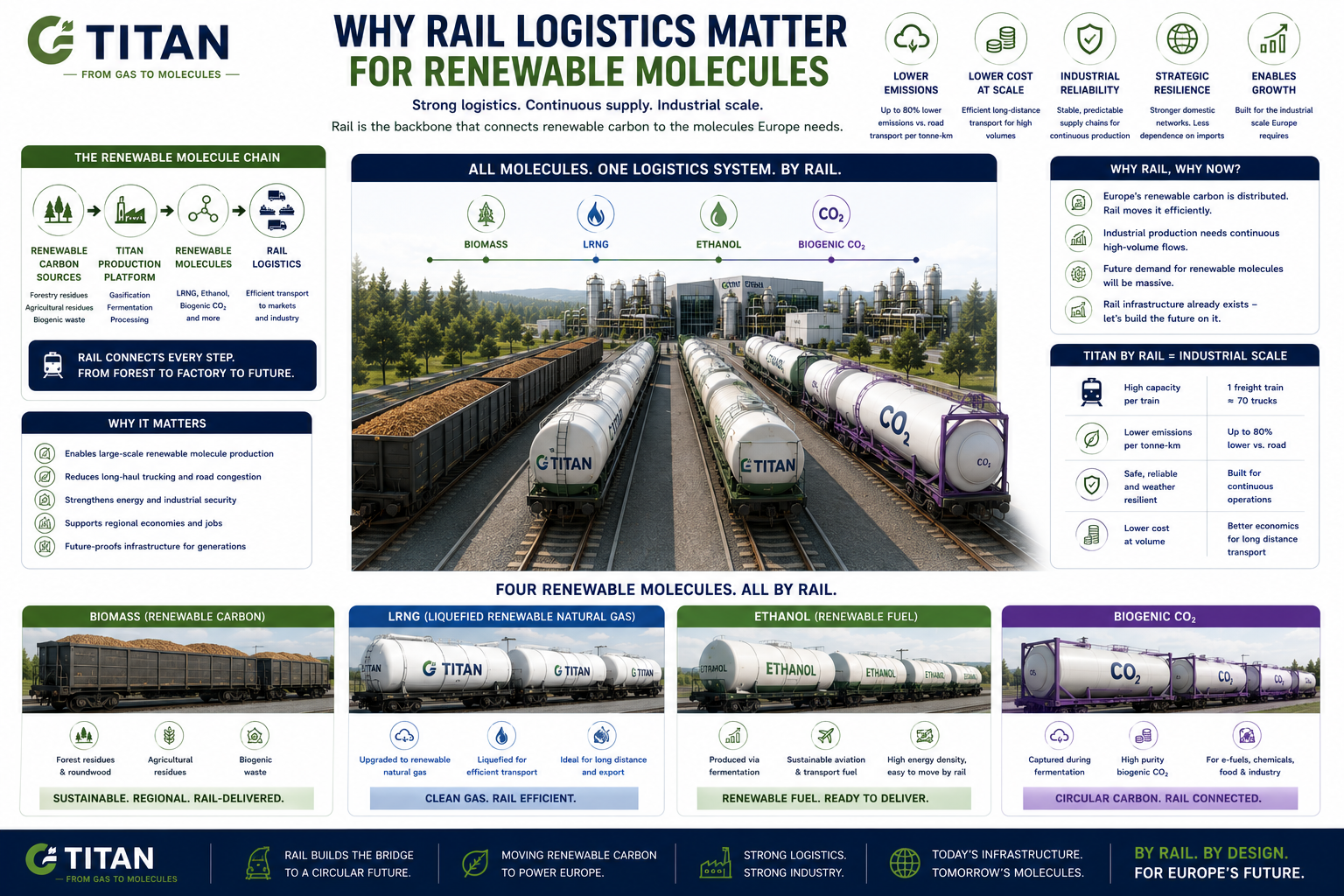
Why Rail Logistics Matter for Renewable Molecules

Publish date 29 April 2026

(Przewiń w dół, aby zobaczyć wersję polską.)

The renewable molecule economy will not succeed on chemistry alone.

It will succeed on logistics.

One of the largest mistakes in modern energy planning is the assumption that low-carbon systems can simply replace fossil systems without rebuilding the underlying industrial transport infrastructure. In reality, renewable molecules require an entirely different logistical approach.

This is especially true at industrial scale.

Renewable carbon is more distributed than fossil carbon. Biomass is regional. Residues are seasonal. Industrial fermentation requires continuous feedstock flow. Renewable gases and fuels must move efficiently between production, storage and end markets.

That means logistics become strategic infrastructure.

This is one of the reasons TITAN was designed around rail.

Rail is not simply a transport option.

It is one of the core foundations of industrial-scale renewable molecule production.

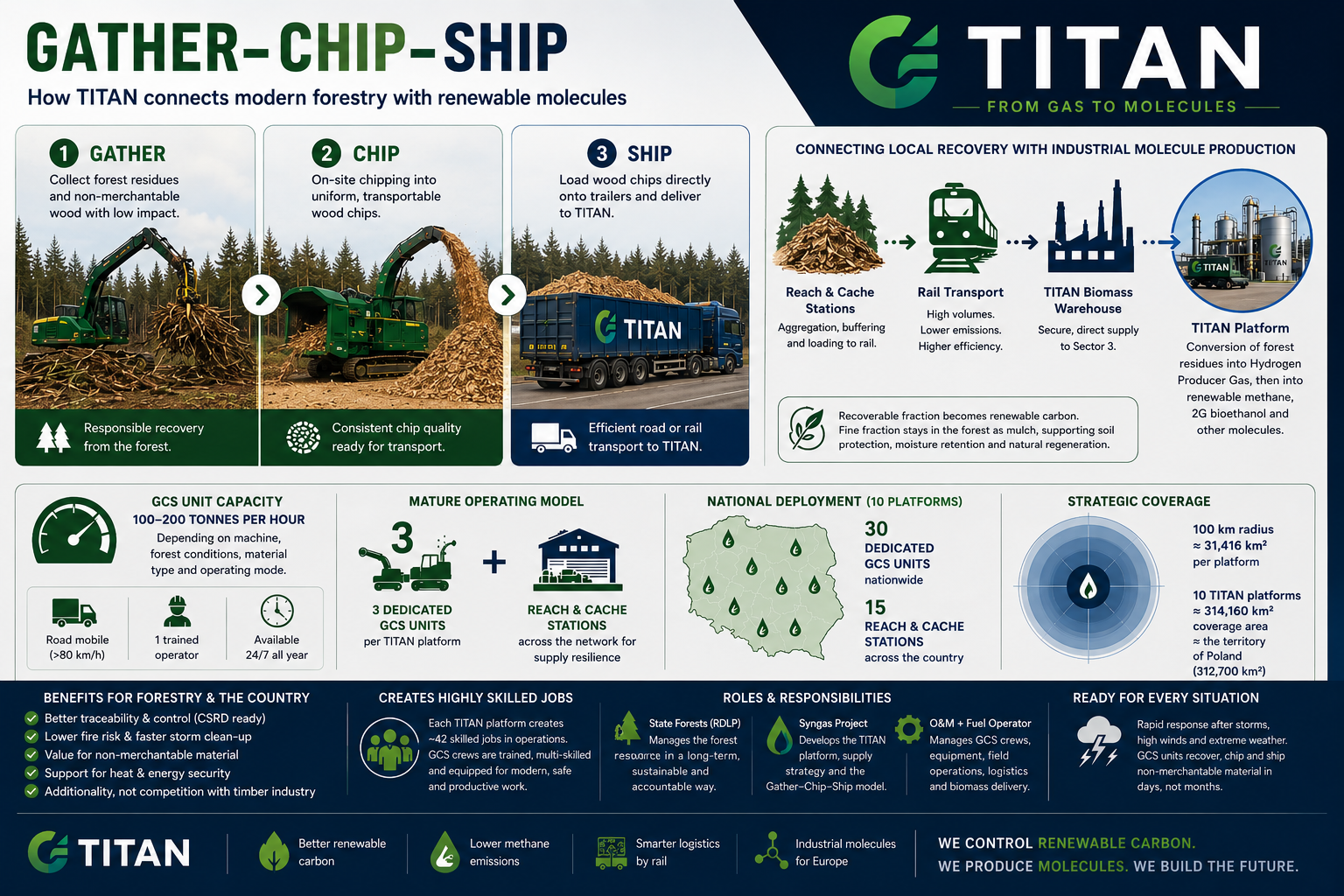
Gather–Chip–Ship: How TITAN Connects Modern Forestry to Renewable Molecules

(Przewiń w dół, aby zobaczyć wersję polską.)

Published February 28 2026

Forestry is often misunderstood.

Many people imagine forest residues as a random, scattered and uncertain resource. They picture a loose biomass market, occasional availability and a feedstock supply chain that is difficult to control.

Nothing could be further from the real position in Poland.

Poland’s State Forests are one of the country’s great strategic assets. They are organised through 17 Regional Directorates of State Forests, known as RDLPs. Across more than 9 million hectares of forest, the system is planned, measured and managed over long biological cycles. Forest stands mature over 40 years and longer. Harvesting, replanting, thinning, species management and timber classification are not accidental. They are known, recorded and managed.

This matters for TITAN.

It also matters for the long-term CSRD logic of forestry.

A platform that converts forest residue into renewable molecules cannot depend on guesswork. It must understand where material is available, when it will be available, what quality it has and how much can be responsibly recovered.

The Polish forestry system already contains much of that knowledge.

The RDLP structure knows its forests. It knows stand maturity, species composition, harvest planning, merchantable timber availability and non-merchantable material potential. It understands where forest residues arise, where windthrow or disease has affected stands, and where clean-up work is required after harvesting.

This means the non-merchantable resource can be accounted for down to the tonne.

That changes its status.

Instead of being treated as a low-value residue, unmanaged by-product or potential liability, it becomes an auditable renewable carbon resource. It can be measured, recovered, priced and reported. For forestry, this is important. CSRD requires better evidence, better inventory logic and better explanation of how environmental resources and impacts are managed.

TITAN helps make that possible.

TITAN is not only a plant waiting at the end of a supply chain. It is active at the front end. The platform is designed around its own Gather–Chip–Ship capability, known as GCS. This means dedicated mobile machinery, trained operators and a controlled recovery system located around the regional forest base.


Amidst the Threat of War: “Polands SAF Urgency is Overshadowed by NATO Front-Line Energy Security”

Ask AI No.3: Syngas Projects  AI-Driven “Executive Strategy”: Shouldn’t we be Accelerating TITAN Deployment Amid Geopolitical Pressures and the threat of war? 

TITAN, developed by Syngas Project, stands at the forefront of a strategic energy shift, playing a pivotal role in addressing Poland’s future energy needs and fortifying NATO’s eastern flank amid escalating geopolitical pressures. TITAN, a groundbreaking platform, converts forest and wood waste through Hydrogen Producers Gas + Microbial Fermentation, on one platform to produce Second Generation Ethanol (2G EtOH). The platform’s innovative approach, replacing outdated Fischer-Tropsch technology, aligns with modern environmental standards. The decision to expedite TITAN’s deployment, driven by AI’s counsel, reflects a commitment to meet Poland’s 2030 REpowerEU, Sustainable Aviation Fuel (SAF) requirements and secure energy independence, simultaneously contributing to NATO’s regional security objectives. The pursuit of 40 TITAN units ensures a resilient, decarbonised aviation future for Poland and a strategic response to evolving geopolitical challenges.

The way AI is transforming our business is how we are transforming our industry

Ammonia Apocalypse: “Tackling Looming Crisis Amidst EU Farmer Strikes”

Syngas AI Series No. 2: Fixing the Ammonia Dilemma Amidst Geo-Political Turmoil

As global tensions rise with Russia’s invasion of Ukraine, the repercussions have extended beyond geopolitical borders, impacting the delicate balance of resource supply and demand. One significant casualty has been the supply of natural gas, a lifeline for many nations, particularly affecting the agricultural sector in Poland and its reliance on ammonia for food production. In this edition, we explore how the Syngas Project’s TITAN platform, coupled with microbial fermentation of nitrogen-fixing bacteria, can offer a sustainable solution to the ammonia dilemma.

The Struggle for Ammonia Supply

The conflict’s ripple effect has been felt keenly in Poland, where sanctions have constrained the supply of natural gas, subsequently affecting ammonia availability for farmers. Ammonia is a vital component for fertiliser production, crucial for sustaining scaled agricultural productivity and ensuring food security.

The way AI is transforming our business is how we are transforming our industry

Resilient Landscapes: Navigating National Forest Reserves

Steve Walker 23.10.2023

In the ever-evolving narrative of climate change, Poland’s National Forest Reserves stand as vital guardians of biodiversity and sustainable resource utilisation. Within this intricate tapestry, Syngas Project, through its visionary initiatives “Reach” and “Cache”, is orchestrating a symphony of resilience. This extended exploration uncovers the strategic dance between Syngas Project and Poland’s National Forest Reserves, highlighting the symbiosis between forest management and climate-induced events.

Poland’s National Forest Reserves: Balancing Conservation and Utilization

Before we delve into the intricate strategies of “Reach” and “Cache,” it’s crucial to appreciate the unique character of Poland’s National Forest Reserves. These reserves, vital for preserving biodiversity, are also strategic sources of forest products. Yet, the delicate equilibrium between conservation and utilisation requires careful consideration, especially in the face of temporary disruptions caused by severe weather events.

Understanding Delayed Clear-Cutting: A Balanced Perspective

In the grand scheme of forest management, the delayed clear-cutting dilemma is not a norm but a calculated response to the temporary impact of severe weather events. This delayed harvesting, often prompted by storms, is a risk-mitigation strategy. It allows forest management authorities to adapt and preserve the resilience of the National Forest Reserves, recognizing that these weather events are temporary disruptions rather than perpetual obstacles.

Reach: Extending Syngas Project’s Influence Beyond Boundaries

Within this nuanced context, the Reach initiative becomes a strategic tool for Syngas Project. By harnessing Poland’s extensive electric railway infrastructure and TITAN’s capacity to generate extra carbon-positive electricity on demand, Reach facilitates the acquisition of biomass from various National Forest Reserves. The delayed clear-cutting in one reserve, resulting from a storm, transforms into an opportunity for Syngas Project to strategically acquire biomass from another reserve, thus aligning forest management practices with transient climate-induced events.