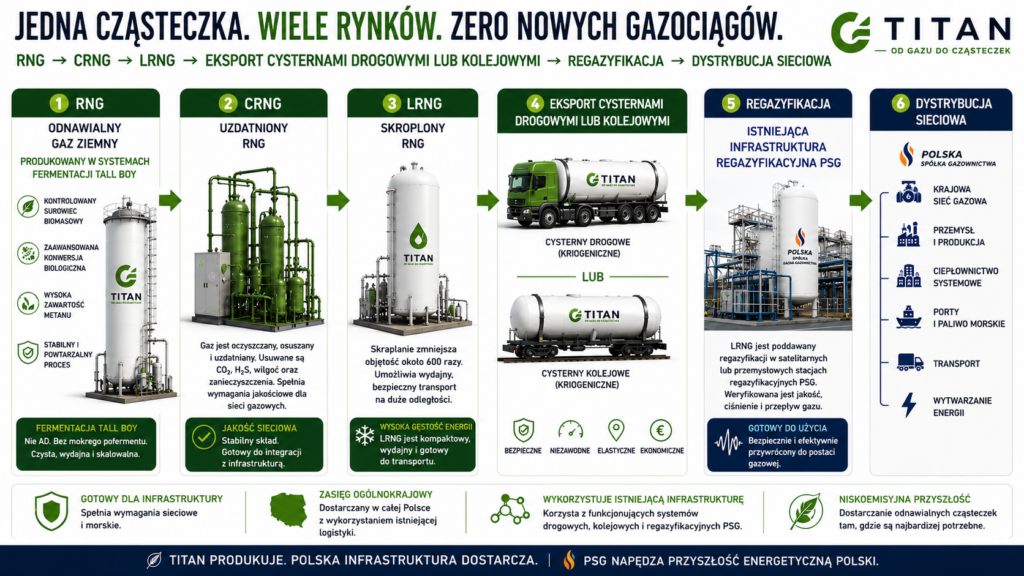
One of the greatest risks in the future molecule economy is not production.
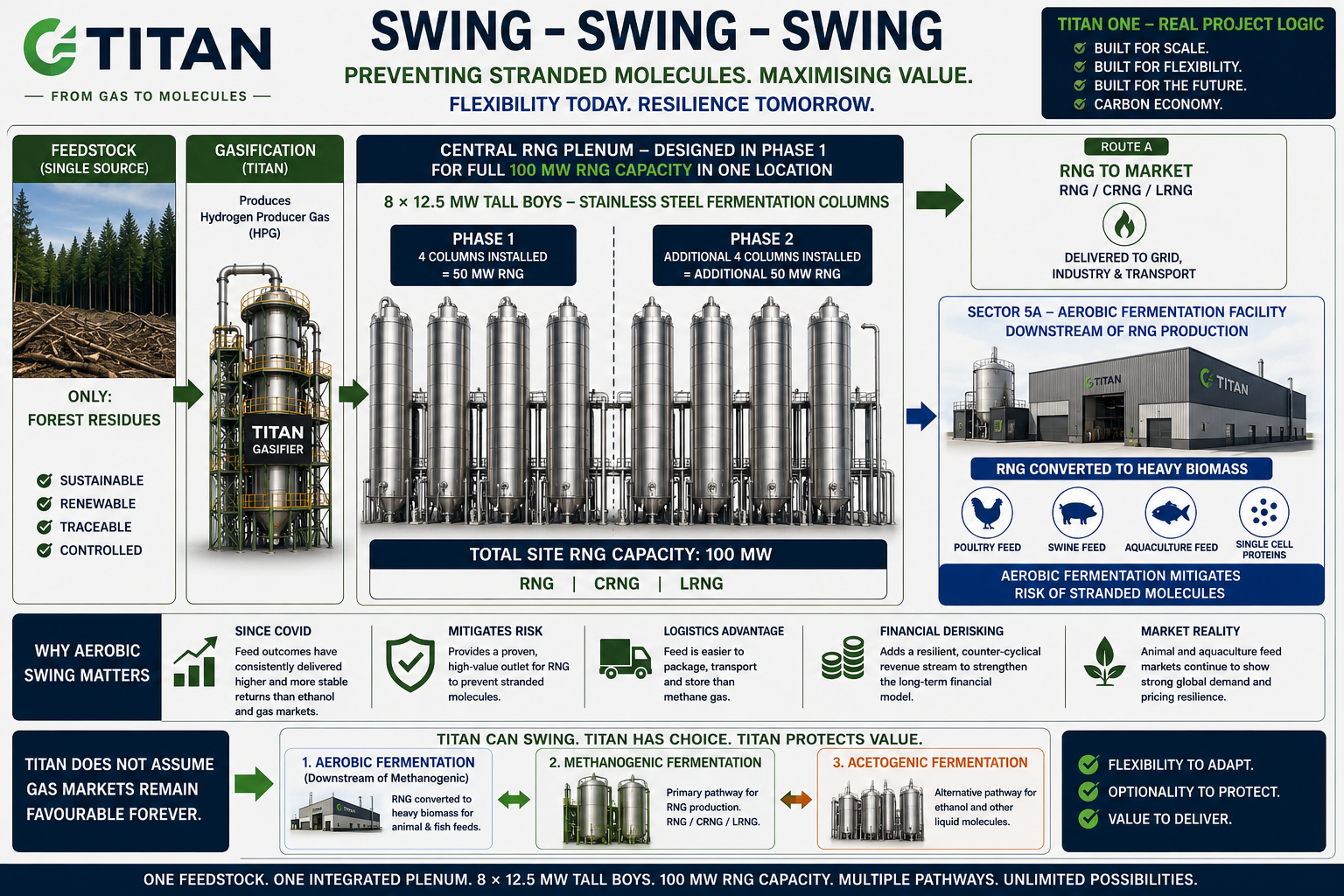
It is stranded molecules.
History repeatedly shows that energy markets move in cycles. Periods of high gas pricing are often followed by oversupply, infrastructure expansion and eventual price collapse. LNG markets have historically demonstrated this pattern many times.
Renewable molecules will not be immune from volatility simply because they are renewable.
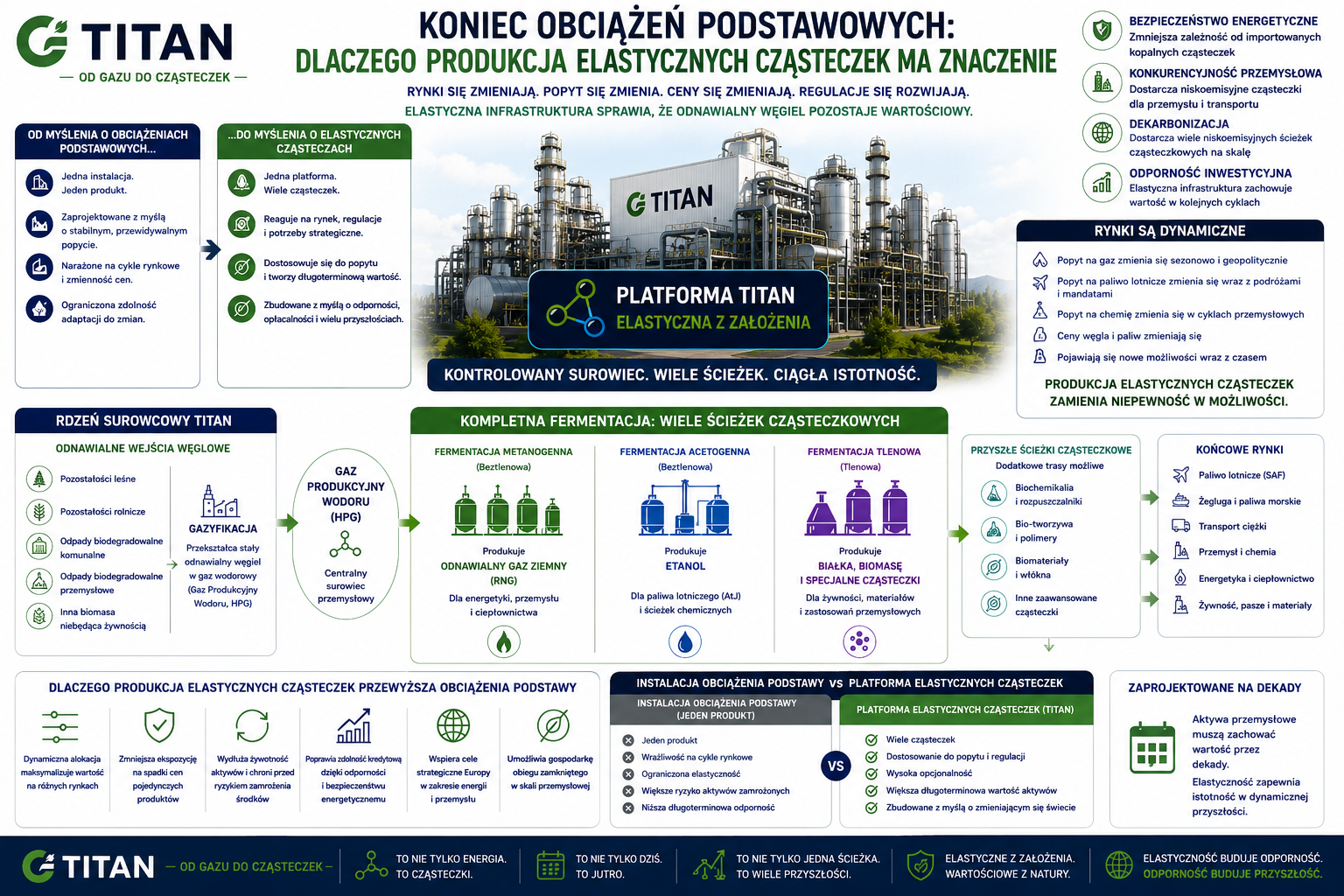
This is one of the reasons TITAN was never designed as a single-pathway platform.
It was designed around optionality.
The platform already operates at industrial scale between methanogenic and acetogenic fermentation pathways. TITAN can dynamically allocate Hydrogen Producer Gas between Renewable Natural Gas production and ethanol production depending on market conditions, infrastructure demand and industrial pricing.
This is the first Swing–Swing capability.
But the long-term strategic opportunity may be even larger.
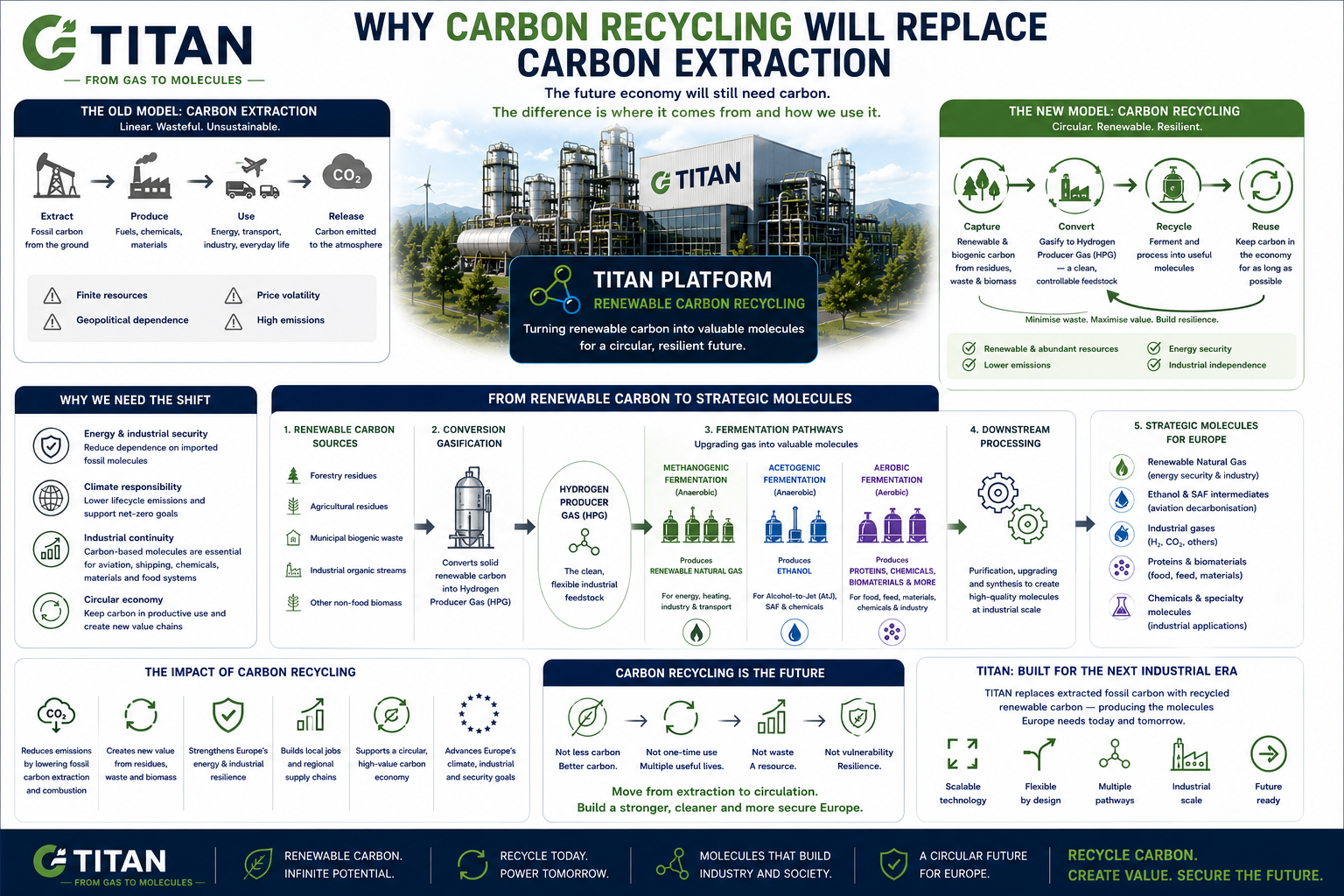
For more than a century, industrial growth has depended on carbon extraction.
Coal, oil and natural gas were taken from the ground, refined, transported and converted into energy, fuels, chemicals and materials. This model powered the modern economy. It created mobility, manufacturing, aviation, plastics, fertilisers and global trade.
But it also created a structural problem.
The industrial economy became dependent on fossil carbon.
Carbon was extracted once, used briefly, and then released into the atmosphere. This linear model was efficient during the age of cheap fossil resources, but it is no longer compatible with Europe’s long-term climate, industrial and security objectives.
The next industrial era will require a different model.
Carbon cannot simply be treated as something to extract, burn and discard.
It must be treated as something to recover, recycle and reuse.
This is the logic of carbon recycling.
Carbon recycling does not mean stopping the use of carbon. That would be impossible for many parts of the economy. Aviation, shipping, chemicals, materials, agriculture, food systems and industrial manufacturing all depend on carbon-based molecules.
The real question is not whether society will use carbon.
The question is where that carbon comes from.
In the old model, carbon came from fossil extraction.
The renewable molecule economy will not succeed on chemistry alone.
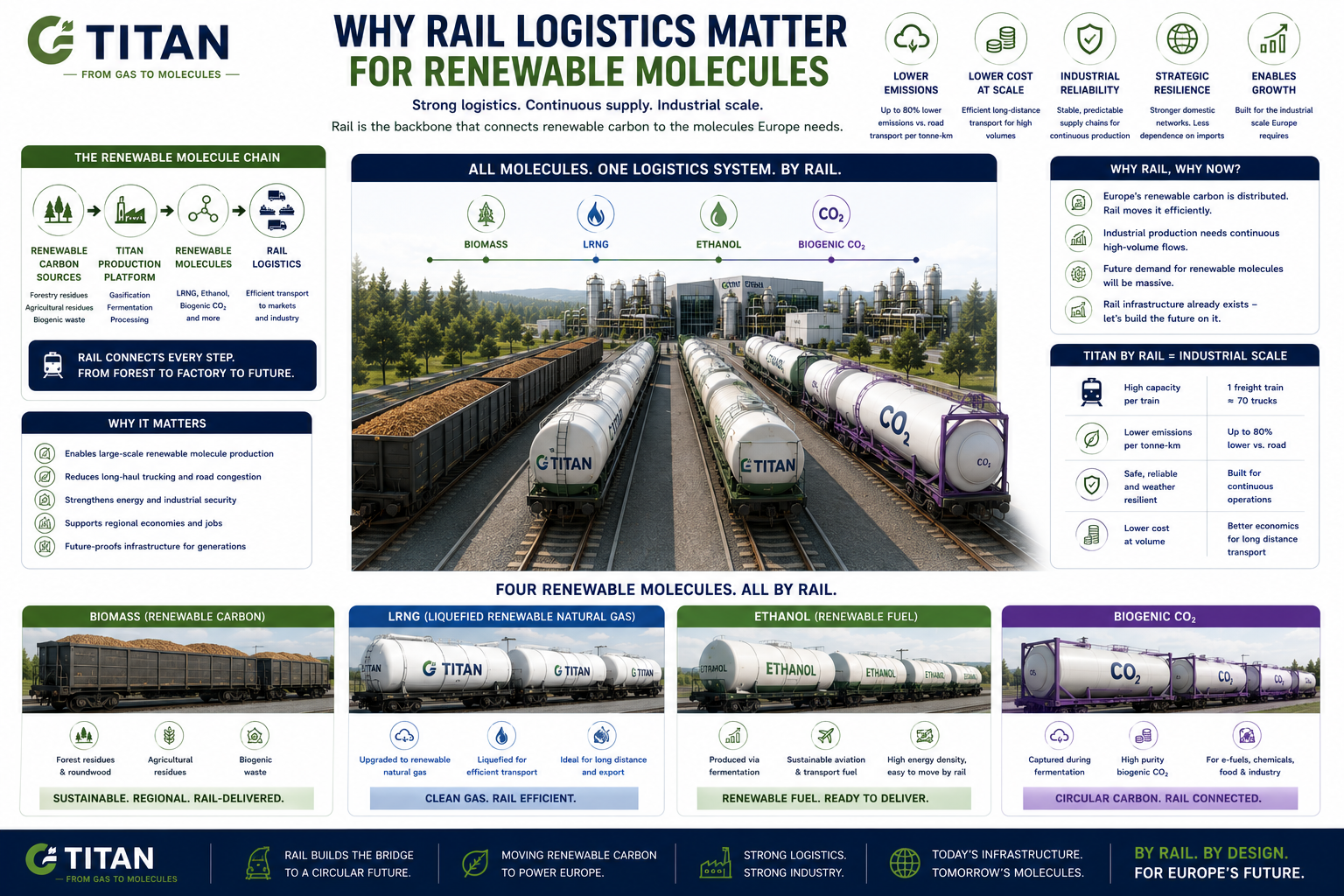
It will succeed on logistics.
One of the largest mistakes in modern energy planning is the assumption that low-carbon systems can simply replace fossil systems without rebuilding the underlying industrial transport infrastructure. In reality, renewable molecules require an entirely different logistical approach.
This is especially true at industrial scale.
Renewable carbon is more distributed than fossil carbon. Biomass is regional. Residues are seasonal. Industrial fermentation requires continuous feedstock flow. Renewable gases and fuels must move efficiently between production, storage and end markets.
That means logistics become strategic infrastructure.
This is one of the reasons TITAN was designed around rail.
Rail is not simply a transport option.
It is one of the core foundations of industrial-scale renewable molecule production.
One of the biggest challenges in industrial decarbonisation is not technology.
It is replication.
Many energy and industrial projects work only under highly specific local conditions. They rely on unusual feedstocks, unique permitting structures, customised engineering or isolated infrastructure advantages. This makes scaling difficult, expensive and slow.
Europe does not only need successful demonstration projects.
Europe needs repeatable industrial platforms.
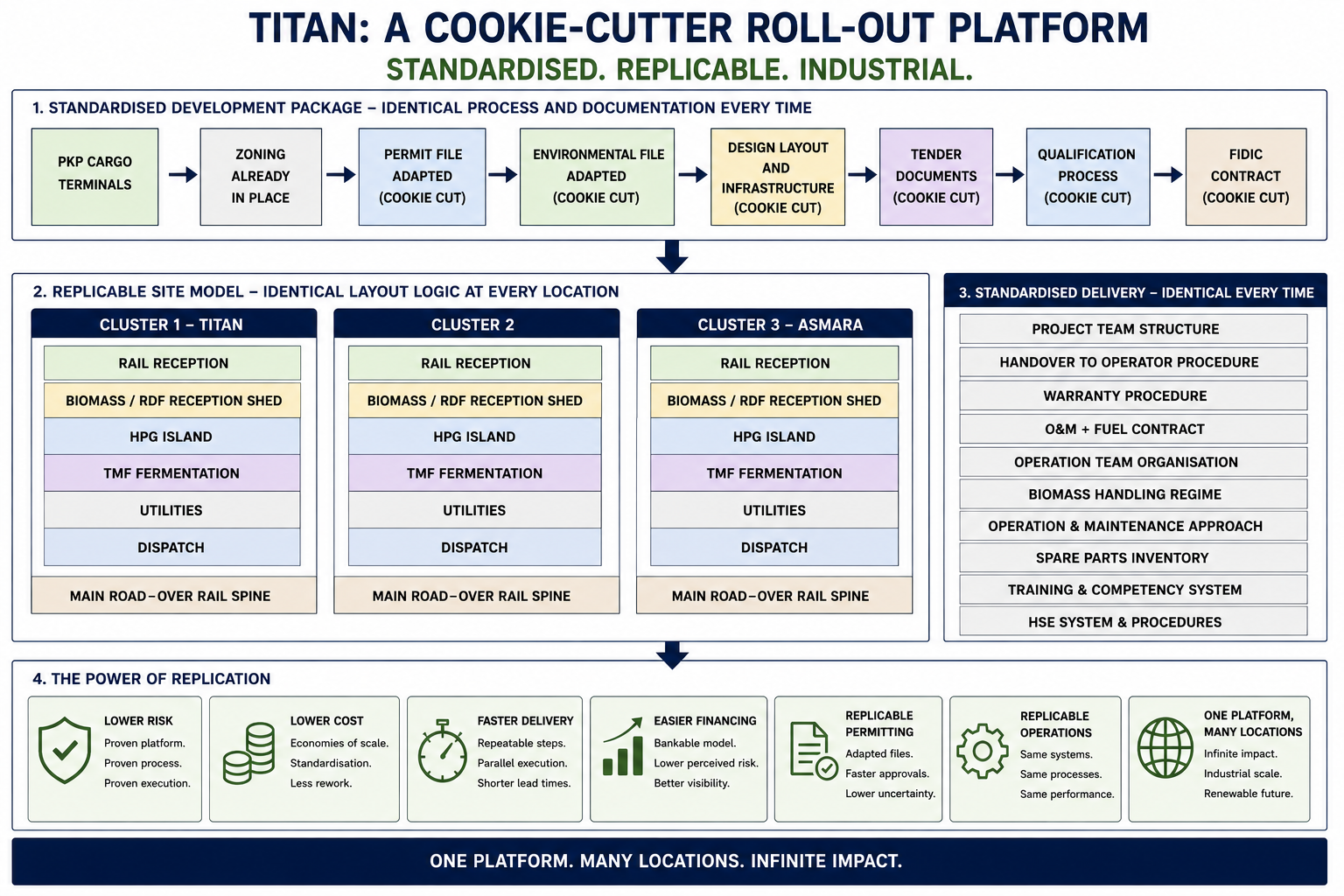
This is one of the core principles behind TITAN.
TITAN was not designed as a one-off installation.
It was designed as a cookie-cutter roll-out platform.
The objective is simple:
Standardise as much of the industrial system as possible while allowing limited adaptation to local site conditions.
This approach changes the economics and deployment logic of renewable molecule infrastructure.
In traditional industrial development, every project often starts from the beginning. Engineering teams redesign systems repeatedly. Procurement chains change. Operational training changes. Construction sequencing changes. Financing becomes more difficult because each installation appears unique.
TITAN approaches this differently.
The platform is modular, repeatable and structurally standardised.
Core systems remain consistent across deployments: gasification architecture, Hydrogen Producer Gas production, fermentation pathways, logistics logic, control philosophy and industrial workflow. This allows engineering knowledge, operational experience and supply-chain learning to accumulate over time rather than restarting for every site.
This is how industrial scaling historically succeeds.
The automotive industry did not scale through handcrafted prototypes.
Container shipping did not scale through unique containers.
Rail systems did not scale through custom track gauges for every city.
Industrial systems become powerful when they become repeatable.
TITAN applies the same principle to renewable molecule infrastructure.
Each TITAN deployment is designed around a familiar industrial structure: renewable carbon intake, gasification, controlled Hydrogen Producer Gas production, fermentation pathways, molecule upgrading, logistics integration and dispatch.
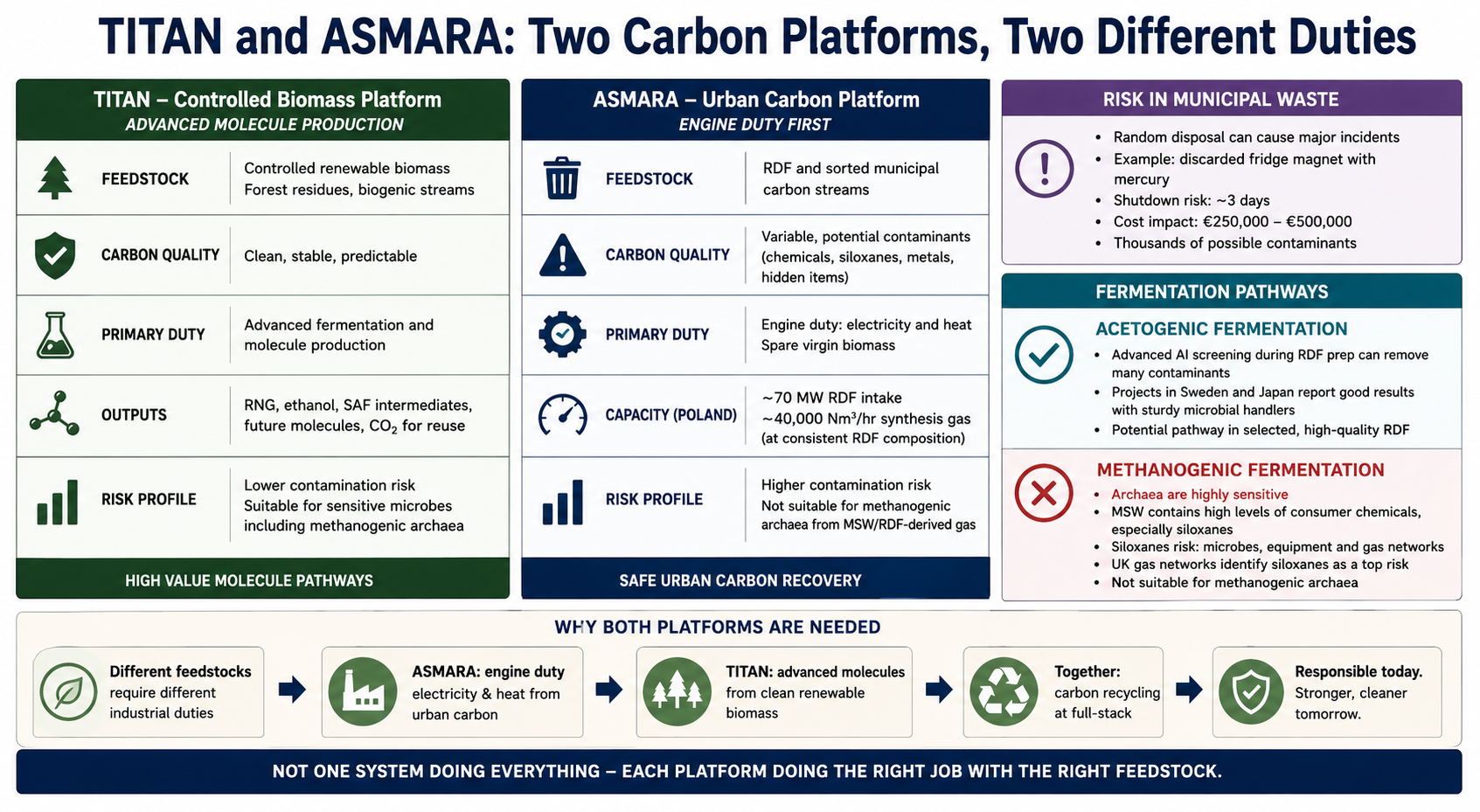
TITAN and ASMARA are sister platforms, but they do not perform the same industrial duty.
This distinction is extremely important.
Both systems are built around Hydrogen Producer Gas and carbon recycling. Both convert difficult carbon streams into useful industrial outputs. Both are designed to support Europe’s transition away from fossil carbon extraction.
But the feedstocks are fundamentally different.
And that changes everything.
TITAN is designed primarily around controlled renewable biomass, especially forest residues and other biogenic carbon streams. The feedstock is cleaner, more stable and more predictable. This allows TITAN to support advanced fermentation pathways including Renewable Natural Gas, ethanol, future SAF intermediates and wider industrial molecule production.
ASMARA is different.
ASMARA is designed around RDF and sorted municipal carbon streams.
That creates opportunity.
But it also creates risk.
Modern cities contain enormous quantities of recoverable carbon. Even after conventional recycling, large amounts of carbon-rich material remain inside municipal waste streams. If these streams can be processed safely, they represent an important industrial resource.
ASMARA is designed to recover value from this urban carbon.
At industrial scale, ASMARA can process approximately 70 MW of RDF feedstock to produce around 40,000 Nm³/hr of synthesis gas when RDF composition remains sufficiently consistent.
That is a very significant urban carbon recovery platform.
However, municipal carbon is not the same as controlled biomass.
Municipal waste streams contain uncertainty.
Even in highly disciplined waste economies such as Sweden and Japan, random disposal events still occur. Consumer products, household chemicals, solvents, oils, silicones, heavy metals and hidden contaminants can enter the waste stream unexpectedly.
Many people imagine forest residues as a random, scattered and uncertain resource. They picture a loose biomass market, occasional availability and a feedstock supply chain that is difficult to control.
Nothing could be further from the real position in Poland.
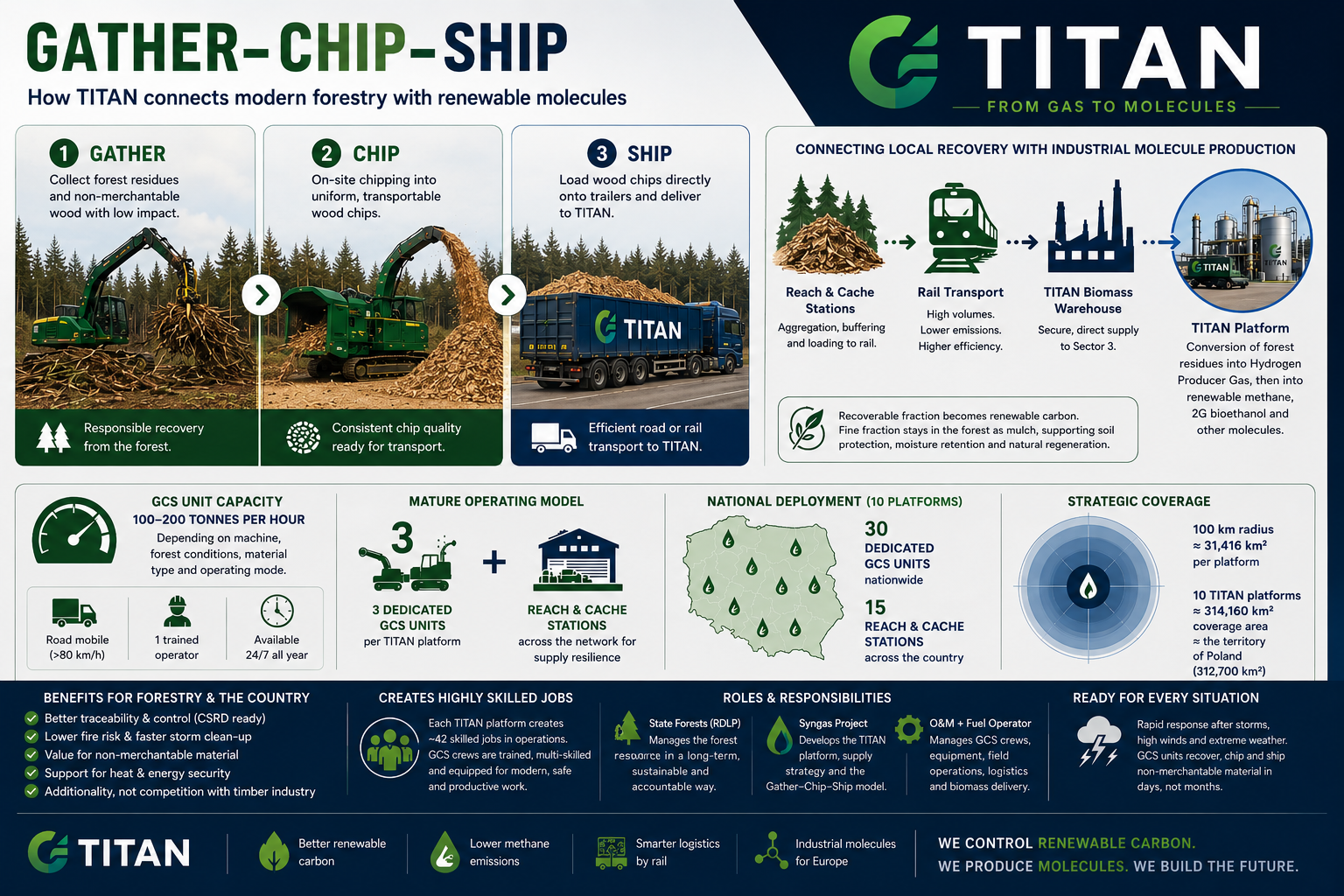
Poland’s State Forests are one of the country’s great strategic assets. They are organised through 17 Regional Directorates of State Forests, known as RDLPs. Across more than 9 million hectares of forest, the system is planned, measured and managed over long biological cycles. Forest stands mature over 40 years and longer. Harvesting, replanting, thinning, species management and timber classification are not accidental. They are known, recorded and managed.
This matters for TITAN.
It also matters for the long-term CSRD logic of forestry.
A platform that converts forest residue into renewable molecules cannot depend on guesswork. It must understand where material is available, when it will be available, what quality it has and how much can be responsibly recovered.
The Polish forestry system already contains much of that knowledge.
The RDLP structure knows its forests. It knows stand maturity, species composition, harvest planning, merchantable timber availability and non-merchantable material potential. It understands where forest residues arise, where windthrow or disease has affected stands, and where clean-up work is required after harvesting.
This means the non-merchantable resource can be accounted for down to the tonne.
That changes its status.
Instead of being treated as a low-value residue, unmanaged by-product or potential liability, it becomes an auditable renewable carbon resource. It can be measured, recovered, priced and reported. For forestry, this is important. CSRD requires better evidence, better inventory logic and better explanation of how environmental resources and impacts are managed.
TITAN helps make that possible.
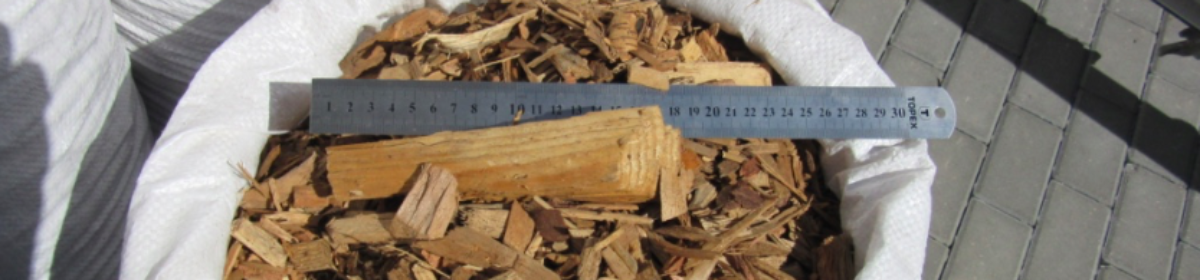
TITAN is not only a plant waiting at the end of a supply chain. It is active at the front end. The platform is designed around its own Gather–Chip–Ship capability, known as GCS. This means dedicated mobile machinery, trained operators and a controlled recovery system located around the regional forest base.
“The all-renewable Hotel Bristol (1901) – Powered by linseed oil, it was Warsaw’s first smoke-free luxury landmark. Over the decades, it hosted dignitaries including John F. Kennedy, Margaret Thatcher, Richard Nixon, Queen Elizabeth II, Charles de Gaulle, and Pablo Picasso.”
March 8th 2025 Warsaw
The technology behind today’s TITAN Project owes much to a quiet lineage of innovators who came long before the era of climate targets and carbon markets. Inspired by these early industrialists, TITAN builds upon a legacy where electricity was local, independent, and renewable by necessity, not marketing. We inherit that history with humility and pride.
In the late 19th century, long before municipal power grids were laid, Warsaw quietly switched on — not from coal, but from wood gas, plant oils, and German-built engines. Electricity in Poland did not arrive with smoke and ceremony. It arrived with intention, resilience, and a clear grasp of available resources.
The first confirmed electric lights in Warsaw came on in 1888, inside the military fortress at Żoliborz. A Deutz gasifier engine, burning wood chips and coke, provided a smokeless, off-grid supply of electricity to illuminate tunnels, barracks, and secure magazines. This was Poland’s first renewable electrification, and it was powered by wood — not wires.
That same year, a second Deutz unit was installed at the Towarowa freight yard, where the Vienna–Warsaw Railway extended eastward via the Warsaw–Terespol line. Contrary to common retellings, the Warsaw–Terespol Railway was laid in standard European gauge, only transitioning to Russian broad gauge at the border town of Terespol. In Warsaw, Towarowa had become one of the busiest and most sensitive freight depots in the region — and its electric lights, powered by a local wood gas engine, served a strategic purpose. On dark winter nights, those lights allowed the military to deter undesirables, track movements, and maintain order amid the chaos of the city’s growing trade and customs corridor.
Then, in 1889, Austrian engineer Marschel & Co. delivered Warsaw’s first commercial electric lighting system to the woollen hand-finishing workshops of Praga, not far from where the vodka factory would soon be built. These workshops, connected to the rising Brühl textile estate, operated without chimneys, without soot — and without interruption. Their Deutz generator lit the benches of men and women who worked wool into fine garments for markets east and west. And they did so two full years before the first coal-fired generator ever arrived at the much-acclaimed vodka distillery.
This was decentralised electricity. It was locally fuelled. It was renewable.
The Machines That Heal—and the Circular Economy They’re Building
She looks almost human. Porcelain skin, careful eyes, anatomical symmetry—delicate, not threatening. A beautiful contradiction. The image evokes a future we’ve long imagined: robots that walk beside us, feel with us, care for us.
But this isn’t the warm robot we meant.
Because the real warm robots—ours—don’t smile or stand. They don’t blink, speak, or age. They are microbes. Alive, invisible, programmable.
They live in tanks. They breathe carbon. They manufacture the building blocks of the post-pollution world: fuels, chemicals, nutrients, and materials. And now, aided by generative AI, they are evolving—stacking complexity, mimicking natural processes, and operating with the efficiency of the human brain and the regenerative elegance of skin and bone.
We call this new capability Industrial Lifestacking. It’s not robotics. It’s regeneration. Not imitation—but biological infrastructure, scaled.
The Living Stack
Long before artificial intelligence could speak, microbes were building. While generative models were still learning language, fermentation vessels were already producing ethanol, biodegradable polymers, and essential proteins from nothing more than carbon waste and biological design.
What makes this possible is a structure we call the Living Stack—a three-layered system that turns industrial chaos into organic precision:
AI serves as the design layer, where biological systems are mapped, metabolic pathways are simulated, and yield efficiency is optimised. Gene Editing functions as the software layer, rewriting microbial DNA to perform intentional functions—from synthesising alcohols to building amino acid chains. Targeted Microbial Fermentation (TMF) forms the hardware layer, where gas-fed microbes in controlled environments transform design and code into physical product.
This stack doesn’t run on electricity alone. It runs on carbon. It doesn’t output noise or abstraction. It outputs life.
The “new green hydrogen” is “dark bio-hydrogen”, so called after the dark fermentation bio-manufacturing process which creates it green because its manufacture and existence are entirely organic, renewable and waterless.
60 years on from JFK moonshot speech
One small step ahead of carbon capture and storage CCS replacing it instead with capture and transformation CCT, thus taking the capture and recycling of waste carbon to the next level is a giant leap for mankind. 60 years on from JFK’s moonshot speech and on its anniversary Joe Biden announced the cure for cancer is the new moonshot and its through bio-technology transformation that will get us there.
TITAN and ASMARA incorporate two technologies on one platform, waste to hydrogen producer gas + microbial fermentation to manufacture fuel, chemical and material products. CCT is a well-proven process for recycling both the carbon at the smoke stack, in the waste we produce and in the waste we throw away as it is for the carbon we have already produced. We are presented with a truly value-added proposition because recycling the carbon we already have obviates the need to dig up more carbon. Through converting solid waste into producer’s gas and CCT emission technology to recycle carbon in the producer’s gas through, microbial fermentation, we can reproduce all of the products we currently manufacture from oil and gas, where the likes of transport fuels, plastics and fertilisers are produced with far less environmental impact. In manufacturing, this great array of products as an added bonus, large quantities of waterless green hydrogen is recovered as a byproduct.
Dark bio-hydrogen presents a disruptive edge to the idea of hydrogen as an energy carrier because it does not burden our ever-depleting water supply, instead, hydrogen is recovered from changing the state of organic feedstock through a proprietary, bio-manufacturing process where carbon-rich waste biomass or bio-waste is transformed from solid state to a gaseous state and as a feedstock for fermentation.