Warsaw 31:12:07 07:34 AM Steve Walker
The Mining Boom Starts Above Ground
Across Central Europe, an extraordinary opportunity sits in plain sight.
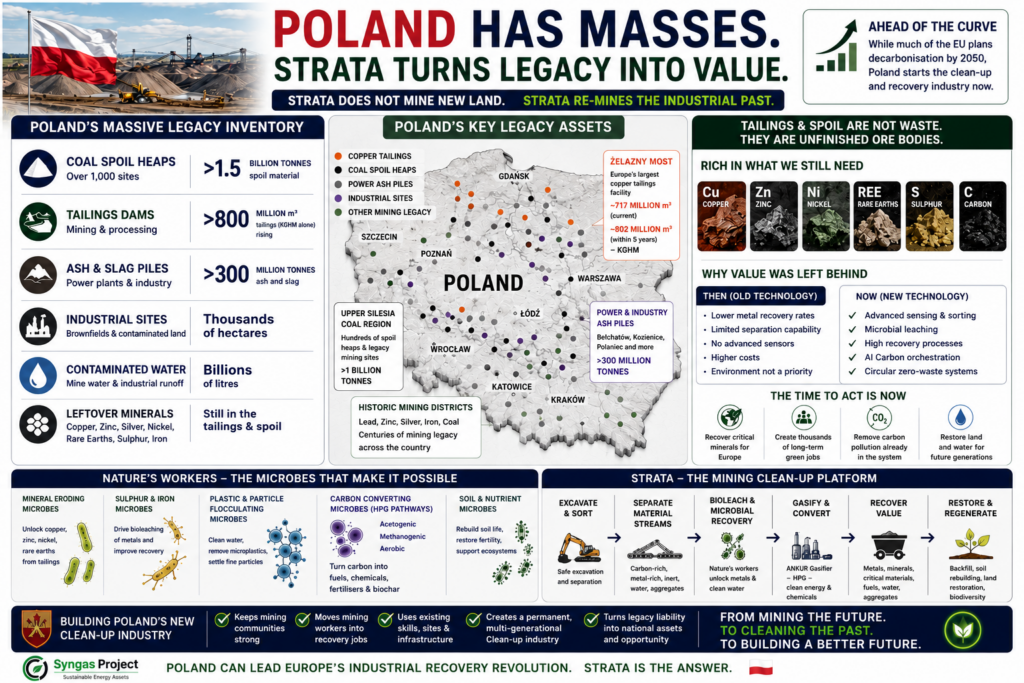
It dominates skylines, fills valleys, surrounds former industrial towns and stretches across landscapes shaped by generations of mining and heavy industry. Tailings, spoil heaps, ash lagoons, slag mountains, industrial residues and contaminated land are often viewed as scars of the past. Too often they simply spoil the view.
Yet those same landscapes represent one of Europe’s largest untapped resource inventories.
The value has never disappeared.
It simply waits for better tools.
For decades, the economics of mining ended when the primary commodity had been extracted. Copper mines recovered copper. Coal mines recovered coal. Smelters produced metals while everything else became waste. What earlier generations discarded was not worthless—it was simply beyond the reach of the technology and economics of the day.
Today that equation changes.
Across Poland, Germany, Czechia, Belgium, France, Denmark, Sweden, the Netherlands, Luxembourg and the United Kingdom, an entirely new industrial sector is emerging. It does not begin with new mines or deeper shafts. It begins with recovering the wealth already sitting above ground.
The next mining boom starts where the last one ended.
From Scrap Dealers to Materials Recovery Companies
The companies best placed to lead this transformation are not necessarily traditional mining companies.
They are today’s materials recovery businesses.
What once began as local scrap merchants has evolved into one of Europe’s most sophisticated industrial sectors. Over decades these companies learned to sort, shred, classify, recover and refine increasingly complex material streams.
Mechanical recovery became an industry.
Digital sorting transformed productivity.
Chemical recovery unlocked new value.
Now biology joins the toolkit.
This is not a replacement for existing technologies.
It is the next industrial discipline.
Mechanical systems expose materials.
Chemical systems separate them.
Biological systems recover what both leave behind.
Together they create a far more powerful recovery platform than any single technology alone.
The recovery industry has already mastered logistics, industrial processing, commodity markets and recycling infrastructure. Adding biology is not a revolution in business—it is the natural evolution of a business that has always recovered value from complex materials.