Iceland — AQUIS AD Market Due Diligence
1. Executive Summary
Iceland is a small but strategically interesting anaerobic-digestion and organic-waste market. Its opportunity is not based on a large installed fleet. It comes from the concentration of people and waste around Reykjavík, nationwide separate collection of biowaste, insufficient domestic biowaste-treatment capacity, an important fisheries sector and growing pressure to improve wastewater and contaminant management.
Iceland has one documented central anaerobic-digestion installation: SORPA’s GAJA gas and composting facility at Álfsnes. GAJA began operating in the second half of 2020 and processes organic material from the Capital Region. Iceland’s environmental inventory describes it as the only installation of its kind in the country. It has also reported that the facility has not consistently operated at full capacity and that complete national AD activity data remain unavailable. Icelandic Environment Agency — Informative Inventory Report 2024
Iceland therefore represents a focused development market rather than an established fleet market.
The immediate AQUIS proposition is:
- Stabilise and characterise the existing GAJA material and soil-amendment streams.
- Measure microplastics, nanoplastics, PFAS and other persistent contaminants before further land application.
- Support gas-quality, methane-loss and end-use verification.
- Investigate additional treatment capacity for separately collected biowaste.
- Develop regional opportunities around fisheries, food processing, aquaculture and municipal organic waste.
- Treat the Greater Reykjavík Area as the first Icelandic AQUIS CAMPUS opportunity.
Current assessment: 3.4/5 — Focused Strategic Development Market.
The score recognises strong environmental need and concentrated decision-making, but also the very small installed AD fleet, incomplete operational data and the competitive disadvantage of producing electricity or heat in a country already supplied by inexpensive hydropower and geothermal energy.
2. How to Interpret the Model
The Iceland assessment separates four different measures that must not be confused:
- Operating installations — documented anaerobic-digestion facilities.
- Methane output — annual methane energy expressed as continuous MW.
- AQUIS commercial accounts — facilities or organisations that may purchase Services or Active EPS.
- AQUIS Islands — calculated only from a documented physical stream of conditioned material at no more than 20% moisture.
The country wheel represents national methane energy by destination. It does not represent plant numbers.
The fixed wheel categories remain:
- Green — engine, CHP, heat or unupgraded gas use.
- Blue — grid injection.
- White — verified CRNG or transport use.
- Yellow — verified LRNG, BioLNG or marine use.
- Red — verified direct industrial use.
For Iceland, government reporting confirms that methane has mainly been directed to vehicle fuel, with possible industrial use in asphalt production and coffee roasting. However, it does not publish a complete, metered national allocation by destination.
Accordingly, the Iceland wheel cannot yet be completed responsibly:
- Centre output: Incomplete data.
- Green share: Incomplete data.
- Blue share: Incomplete data.
- White share: verified as the principal route, but percentage Incomplete data.
- Yellow share: Incomplete data.
- Red share: potential or planned use identified, but operating percentage Incomplete data.
No percentage should be invented merely to force the wheel to 100%. The eventual hero requires operator sales and consumption data that reconcile the full national methane output.
3. Market Definition
The Icelandic market includes:
- Purpose-built anaerobic digestion of separately collected organic waste.
- Upgrading and use of biomethane as transport or industrial fuel.
- Legacy landfill-gas capture and upgrading where it affects the national renewable-methane market.
- Municipal food and garden waste.
- Food manufacturing and hospitality waste.
- Fish-processing and aquaculture residues.
- Slaughterhouse and agricultural residues where collection and animal-by-product rules permit.
- Wastewater sludge where physical sludge production can be documented.
- Soil amendment, compost and digestate quality.
- Microplastic, nanoplastic, PFAS and persistent-pollutant management.
- New decentralised or regional bioenergy facilities.
Landfill-gas recovery is commercially relevant, but it is not counted as a purpose-built AD installation in the plant-density comparison.
4. National Market Scale
Statistics Iceland recorded a population of 394,530 at the end of the fourth quarter of 2025. Of these, 252,080 people lived in the Capital Region and 142,450 elsewhere. Approximately 63.9% of the population is therefore concentrated around Reykjavík. Statistics Iceland — Population at the end of Q4 2025
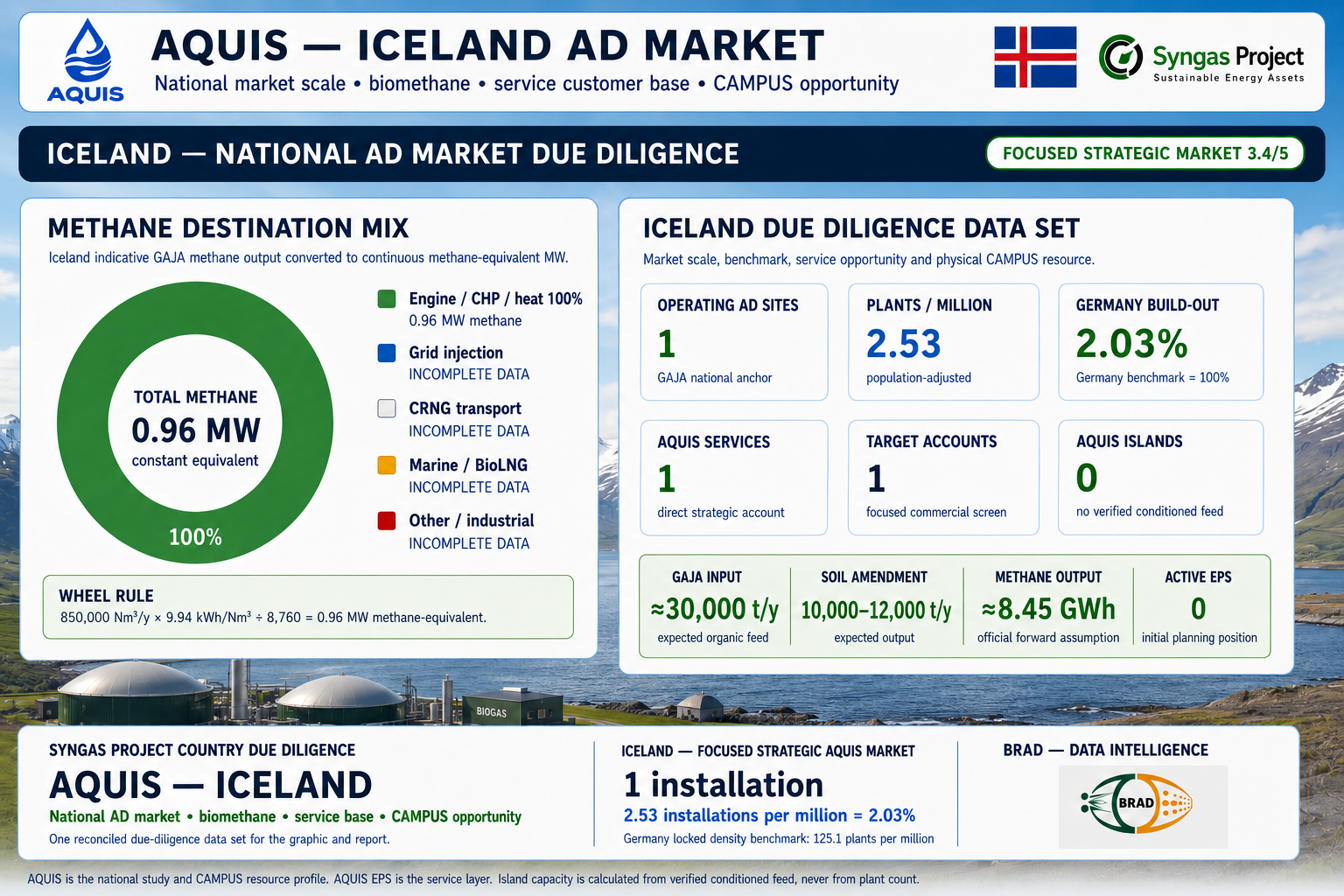
Documented central AD installations: 1
Plant density:
1 ÷ 0.39453 million = 2.53 installations per million inhabitants
This is a very small installed market, but the concentration of population and municipal infrastructure makes the principal opportunity more accessible than the national plant count suggests.
GAJA is the national anchor. Regional development beyond GAJA is still a project-development and feedstock-aggregation opportunity rather than an established fleet-sales opportunity.
5. Germany Benchmark
The locked German comparison remains:
- Germany: 10,455 plants.
- Germany population: 83.60 million.
- Germany density: 125.1 plants per million inhabitants.
Iceland’s comparison is:
- Iceland: 1 documented central AD installation.
- Population: 0.39453 million.
- Density: 2.53 plants per million.
- Plant-density position relative to Germany: 2.03%
- Absolute plant-stock position relative to Germany: 0.0096%
- Population position relative to Germany: 0.472%
Iceland therefore has substantially fewer AD installations than its population-normalised German equivalent.
If Iceland matched the German plant density, it would have approximately:
0.39453 × 125.1 = 49 installations
This is a benchmark, not a forecast. Iceland’s geography, feedstock distribution, inexpensive renewable electricity and small settlements mean that a German-style plant count is neither necessary nor commercially realistic. Iceland is more likely to support a limited number of strategically located municipal, fisheries and food-industry facilities.
6. Renewable Methane Position
GAJA is designed to turn organic waste from the Capital Region into methane and soil amendment. The most recent Icelandic reporting used an operating expectation of approximately:
- 30,000 tonnes of organic waste per year.
- 10,000–12,000 tonnes of compost or soil amendment.
- 850,000 Nm³ of methane per year.
Using an explicitly stated conversion factor of 9.94 kWh per Nm³ of methane:
850,000 × 9.94 = approximately 8.45 GWh per year
8.45 GWh ÷ 8,760 hours = approximately 0.96 MW continuous
This is an official forward operating assumption, not a verified national production total. Iceland’s 2026 inventory still reports that relevant AD activity data are unavailable. It must therefore not be presented as audited current national gas output. Iceland’s First Biennial Transparency Report
The methane has principally been intended for transport. Electricity production was trialled but was reported as unable to compete with Iceland’s lower-cost geothermal and hydropower generation. Government energy information states that almost all Icelandic electricity comes from renewable sources, approximately 73% hydropower and 27% geothermal. Government of Iceland — Energy
This makes renewable methane most valuable where it replaces imported liquid fuel, provides industrial process energy or treats an environmental liability—not where it competes with Icelandic electricity.
7. Market Direction
The market is moving towards greater source separation and biological treatment.
Act No. 103/2021 introduced separate collection requirements for paper and cardboard, metal, plastic, glass, biowaste, textiles and hazardous materials from 1 January 2023. Door-to-door collection of municipal biowaste, plastic, paper and cardboard has subsequently been implemented across urban areas covering approximately 94% of Iceland’s population. EFTA Surveillance Authority — Early Warning Report
The Capital Region stopped landfilling most non-inert waste during 2023, with mixed residual waste exported for incineration. A national ban on landfilling biodegradable waste is planned for 2028.
These changes create three pressures:
- More separately collected biowaste requiring treatment.
- Greater need for reliable compost and digestate quality.
- A capacity gap outside or beyond the existing GAJA installation.
The EFTA Surveillance Authority found Iceland’s municipal biowaste-treatment capacity to be below 80% of generated municipal biowaste and recommended that Iceland precisely assess the need for additional treatment facilities.
8. Plant and Feedstock Structure
GAJA is currently the central physical anchor.
Its principal characteristics are:
- Location at Álfsnes in the Greater Reykjavík Area.
- Municipal ownership through SORPA.
- Organic household and municipal feedstock.
- Anaerobic gas production followed by production of soil amendment.
- Nominal permitted waste capacity of approximately 30,000–40,000 tonnes per year.
- Earlier design expectations as high as 3 million Nm³ of methane, but more recent government projections using 850,000 Nm³ per year.
- Documented periods below full operating capacity.
The large difference between the earlier design expectation and the later official methane assumption reinforces the need for current metered operating data.
National feedstock opportunities extend beyond GAJA:
- Household food waste.
- Hotels, restaurants and tourism.
- Fish processing.
- Aquaculture.
- Slaughterhouses and meat production.
- Dairy and food manufacturing.
- Municipal green waste.
- Suitable industrial process water.
- Agricultural manure in areas where collection density supports treatment.
Iceland landed approximately 995,000 tonnes of wild fish in 2024 and produced nearly 54,800 tonnes of aquaculture products. These figures demonstrate the scale of the seafood economy but do not establish the quantity of recoverable AD feedstock. Statistics Iceland — Catch in 2024, Aquaculture in 2024
9. Digestate and Water Exposure
GAJA’s expected 10,000–12,000 tonnes of soil amendment is an important environmental interface.
The material cannot be assumed to be uncontaminated merely because its carbon content is biological. Source-separated household waste can contain:
- Plastic-film fragments.
- Packaging particles.
- Synthetic fibres.
- PFAS-bearing food-contact materials.
- Cleaning chemicals.
- Metals and glass.
- Persistent organic compounds.
- Contaminated liquids introduced during collection.
AQUIS should treat the output as a product requiring demonstrated quality rather than as an automatically acceptable fertiliser.
The priority programme should include:
- Inlet-feed characterisation.
- Microplastic and nanoplastic aggregation.
- PFAS and total-organic-fluorine screening.
- Heavy-metal testing.
- Physical contaminant measurement.
- Water-balance analysis.
- Digestate or soil-amendment dewatering trials.
- Contaminant mass accounting between solid, liquid, gas-treatment and reject streams.
- Land-application risk assessment.
10. Municipal Organic-Waste and Sludge Exposure
Iceland generated an estimated 60,300 tonnes of food waste in 2022, equivalent to 160 kg per inhabitant.
The reported distribution was:
- Primary production: 29,130 tonnes.
- Households: 23,781 tonnes.
- Restaurants and food services: 3,856 tonnes.
- Retail and distribution: 1,927 tonnes.
- Processing and manufacturing: 1,596 tonnes.
Fish production accounted for approximately 27,700 tonnes of the primary-production estimate. The national study excluded liquid food waste discharged with wastewater and acknowledged gaps in aquaculture data. Icelandic Environment Agency — Food Waste in Iceland 2022
Wastewater represents a separate problem. Iceland reports that wastewater treatment remains predominantly basic treatment followed by marine discharge. More advanced treatment accounts for no more than approximately 2% of domestic wastewater and 9% of industrial wastewater systems. Iceland — Report on Policies, Measures and Projections 2025
Consequently:
- A national sewage-sludge AD fleet does not currently exist.
- Audited annual dry-sludge production is incomplete.
- No AQUIS Island can be calculated from wastewater sludge at this stage.
- Wastewater improvement could create future sludge-treatment and contaminant-removal opportunities.
11. Microplastic and Nanoplastic Position
Microplastic exposure is commercially relevant because Iceland’s waste, wastewater and marine systems intersect closely.
Important pathways include:
- Plastic contamination in household biowaste.
- Synthetic fibres in wastewater.
- Tyre and road-wear particles entering drainage.
- Packaging fragments.
- Fishing nets, ropes and gear.
- Marine litter.
- Plastic material passing into compost or soil amendment.
The Marine and Freshwater Research Institute reports that fragments of fishing gear continue to accumulate along Iceland’s coastline and that lost gear contributes to microplastic pollution. It also identifies weaknesses in reported gear-loss volumes and the absence of coordinated national retrieval operations. Marine and Freshwater Research Institute — Fishing-Gear Waste Management
Iceland is expanding microplastic research, but national operational datasets linking feedstock, wastewater, compost and receiving environments remain incomplete.
This is an appropriate market for AQUIS to establish a defensible inlet-to-output microplastic mass balance.
12. PFAS Position
Iceland applies EEA chemical controls, including relevant REACH and persistent-organic-pollutant restrictions.
The Icelandic environmental authority identifies PFAS use in textiles, cosmetics, food packaging, outdoor equipment and firefighting foams. It also emphasises their persistence, mobility and ability to accumulate in humans and other organisms. Icelandic Environment Agency — PFAS
For AQUIS, PFAS claims must be based on analytical evidence. A credible Iceland programme requires:
- Feedstock inlet testing.
- Individual PFAS and precursor analysis.
- Total-organic-fluorine accounting.
- Transformation-product testing.
- Separate analysis of solids and process water.
- Condensate, filter, adsorbent and reject-stream analysis.
- No unsupported claim that digestion destroys PFAS.
The commercial proposition is contaminant control, separation and documented risk reduction—not an unverified destruction claim.
13. AQUIS Services
The initial Iceland Services package should contain:
- GAJA technical and environmental baseline.
- Feedstock composition and seasonal-variation study.
- Soil-amendment and process-water analysis.
- Microplastic and nanoplastic aggregation assessment.
- PFAS and total-organic-fluorine investigation.
- Methane-production and methane-loss reconciliation.
- Gas-destination and customer-meter reconciliation.
- Gas-cleaning and compression review.
- Additional municipal biowaste-capacity study.
- Fisheries and food-industry feedstock mapping.
- Wastewater and future sludge opportunity assessment.
- Greater Reykjavík CAMPUS development plan.
The first commercial objective should be a measured baseline. Iceland’s principal weakness is not an absence of organic material; it is the absence of sufficiently reconciled operational data.
14. AQUIS Active EPS
The documented operating fleet contains one central AD facility.
Initial fleet targeting therefore becomes:
- Initial target accounts: 1
- Direct AQUIS Services accounts: 1
- Initial Active EPS accounts: 0
GAJA/SORPA should be treated as a direct strategic account because it is the national anchor and requires detailed technical, contaminant and output verification.
Active EPS becomes relevant as additional regional facilities, food-industry sites or municipal projects move from feasibility into operation. No fractional or invented account allocation should be used merely to preserve a percentage split.
15. AQUIS Island Opportunity
The locked Island benchmark is:
- 109,500 tonnes per year of conditioned material.
- Maximum 20% moisture.
- Approximately 35 MW feed-energy input.
- Whole Islands only.
- No upward rounding.
Iceland currently has no documented qualifying conditioned stream at this specification.
Available evidence includes:
- 60,300 tonnes per year of national food waste, with moisture and recoverable conditioned mass not established.
- Approximately 30,000 tonnes per year expected GAJA input.
- 10,000–12,000 tonnes per year of soil amendment.
- Approximately 27,700 tonnes per year of estimated primary fish-production waste.
None of these figures represents audited material conditioned to no more than 20% moisture.
Therefore:
- Verified conditioned material: Incomplete data
- Verified Island-equivalents: Incomplete data
- Full bankable AQUIS Islands: 0
- Potential Islands: not yet authorised by evidence
Zero verified Islands does not mean zero Icelandic potential. It means that Iceland must complete physical sampling, moisture measurement, contaminant removal, mass-yield testing and feedstock contracting before an Island can be claimed.
16. Cluster and CAMPUS Position
The Greater Reykjavík Area is the natural first AQUIS CAMPUS.
It combines:
- Nearly 64% of Iceland’s population.
- SORPA and GAJA.
- Municipal biowaste.
- Major hospitality and food-service activity.
- Wastewater infrastructure.
- Existing methane upgrading and transport-fuel experience.
- Ports, transport operators and industrial fuel users.
- Regulatory and technical decision-makers.
The first CAMPUS does not require an immediate full Island. It can begin as a coordinated network of Services, Active EPS preparation, feedstock characterisation, contaminant control and CUMULUS gas treatment.
Secondary development areas include:
- Akureyri and northern Iceland.
- South Iceland’s agriculture, food production and tourism corridor.
- Reykjanes and the airport-industrial region.
- Westfjords fisheries and aquaculture.
- East Iceland aquaculture and food-processing locations.
These must be screened individually because transport distances, settlement size and seasonal production can destroy otherwise attractive project economics.
17. LRNG Equivalent
One verified full AQUIS Island may support the standard alternative configuration of approximately:
25 MW LRNG output
Iceland currently supports:
- Verified full Islands: 0
- Bankable LRNG equivalent: 0 MW
This is an evidence position, not a final potential estimate.
LRNG could ultimately be strategically valuable in Iceland because maritime activity, heavy transport and imported liquid fuels offer higher-value displacement opportunities than electricity generation.
No yellow marine allocation should appear in the national wheel until actual LRNG or BioLNG production and consumption are documented.
18. Alternative 2G Ethanol Equivalent
The alternative standard configuration for one full Island is approximately:
80,000 litres per day of second-generation ethanol
The LRNG and ethanol configurations use the same underlying HPG capacity and must never be added together as simultaneous outputs.
Because Iceland currently has zero verified full Islands:
- Bankable 2G ethanol output: 0 litres per day
- Development potential: Incomplete data pending feed qualification
A future Iceland assessment should compare LRNG, ethanol and other high-value fuels against the country’s transport, marine and aviation decarbonisation requirements.
19. CUMULUS Gas Treatment
CUMULUS is particularly relevant to Iceland because methane value depends on reaching a stable transport or industrial specification.
The treatment scope should examine:
- Hydrogen sulphide.
- Moisture and condensate.
- Carbon dioxide.
- Oxygen and nitrogen ingress.
- Siloxanes and volatile organic compounds.
- Compression.
- Methane slip.
- Odour compounds.
- Corrosion risk.
- Vehicle-fuel specification.
- Industrial-burner compatibility.
- Liquefaction pretreatment if a future marine route is developed.
The immediate opportunity is not merely to make more gas. It is to reconcile how much methane is produced, how much is lost, what quality is achieved and where every unit of saleable gas is used.
20. Commercial Entry Model
The recommended entry sequence is:
Stage 1 — National anchor
Engage SORPA/GAJA as the principal technical and commercial reference account.
Stage 2 — Evidence programme
Complete material, water, contaminant, methane-output and destination balances.
Stage 3 — Greater Reykjavík CAMPUS
Connect municipal biowaste, hospitality, wastewater, transport and industrial off-takers.
Stage 4 — Regional feedstock screen
Assess fisheries, aquaculture, food manufacturing, slaughterhouse and agricultural streams.
Stage 5 — Demonstration treatment
Deploy AQUIS separation, Active EPS preparation and CUMULUS treatment against a measured Icelandic stream.
Stage 6 — Replication
Develop only those regional sites with sufficient contracted material and economically manageable transport distances.
This market should be entered through evidence and a nationally visible reference project—not through a broad, plant-count-based sales campaign.
21. Priority Assessment
Iceland is a priority for strategic development, but not yet for large-volume equipment deployment.
Strengths include:
- Highly concentrated principal market.
- One identifiable national AD anchor.
- Nationwide biowaste separation.
- Recognised shortage of biowaste-treatment capacity.
- Strong fisheries and food-production sectors.
- Imported transport and marine fuels that renewable methane could displace.
- Increasing regulatory attention to waste, water and persistent pollutants.
- Manageable stakeholder landscape.
Constraints include:
- Only one documented central AD facility.
- Incomplete audited AD activity data.
- Cheap hydropower and geothermal electricity.
- No verified national methane destination split.
- No qualified Island-scale conditioned material.
- Small and geographically dispersed settlements outside Reykjavík.
- Potentially high collection and transport costs.
- Sensitive land-application and marine environments.
Priority classification: Focused strategic market with one immediate anchor account and a credible cluster-development pathway.
22. Risks and Limitations
The principal risks are:
- Treating design capacity as actual production.
- Treating “mostly transport” as a complete wheel allocation.
- Counting landfill-gas recovery as an additional purpose-built digester.
- Assuming all reported food or fish waste is technically available.
- Ignoring moisture, salts, contaminants and animal-by-product restrictions.
- Confusing compost or soil-amendment tonnage with dry conditioned AQUIS feed.
- Assuming digestion removes PFAS or microplastics.
- Overestimating electricity and heat revenues.
- Underestimating transport distances and winter operating requirements.
- Developing regional plants without contracted feedstock.
- Claiming an Island from national waste statistics rather than a physical qualified stream.
- Relying on projections where current metered data are unavailable.
Every commercial model must distinguish measured operation, permitted capacity, projected production and theoretical feedstock potential.
23. Recommended Next Actions and Sources
Immediate actions:
- Obtain GAJA’s 2024–2026 monthly input, methane-production and soil-amendment records.
- Reconcile methane produced, flared, lost, compressed and sold.
- Obtain annual customer sales by transport, industrial and any engine use.
- Complete a GAJA inlet-to-output contaminant mass balance.
- Measure moisture and dry solids in all candidate Icelandic streams.
- Test soil amendment for microplastics, nanoplastics, PFAS, fluorine and metals.
- Map separately collected biowaste by municipality.
- Identify fisheries and aquaculture residues by physical location and current use.
- Obtain wastewater-flow, sludge-production and treatment data from principal municipal operators.
- Prepare the Greater Reykjavík AQUIS CAMPUS concept.
- Keep the Island count at zero until qualifying conditioned material is documented.
- Build the Iceland hero only after the national methane destination balance can total 100%.
Principal sources:
- Statistics Iceland — Population at the end of Q4 2025
- Icelandic Environment Agency — Informative Inventory Report 2024
- Icelandic Environment and Energy Agency — Informative Inventory Report 2026
- Iceland’s First Biennial Transparency Report
- Iceland — Policies, Measures and Projections 2025
- Food Waste in Iceland 2022
- EFTA Surveillance Authority — Early Warning Report
- Government of Iceland — Energy
- Icelandic River Basin Management Plan 2022–2027
- Marine and Freshwater Research Institute — Fishing-Gear Waste Management