Liechtenstein — AQUIS AD Market Due Diligence
Publication-ready country text. The methane wheel uses verified 2025 biomethane production—not sales, certificates or plant numbers.
1. Executive Summary
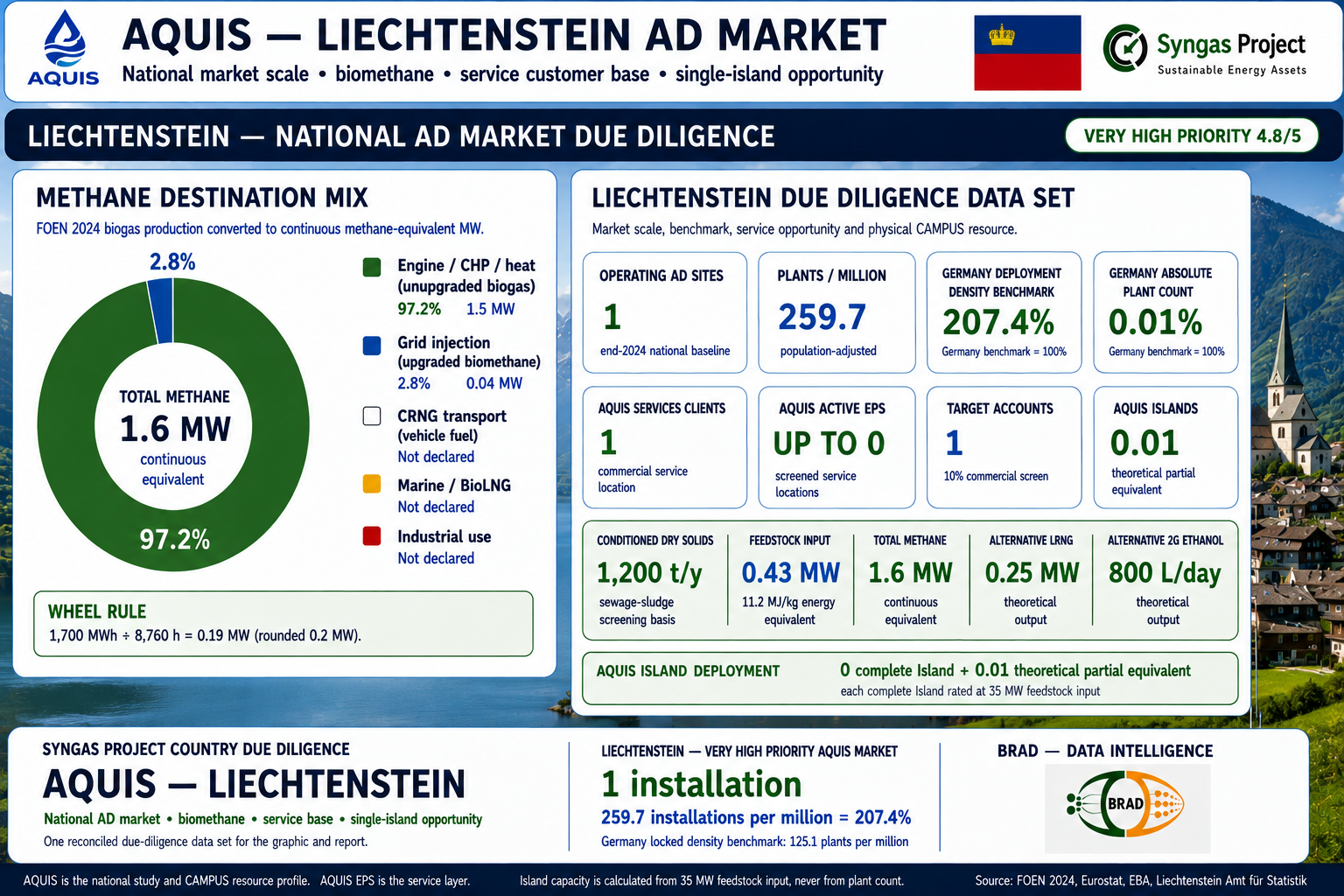
Liechtenstein has one operating anaerobic-digestion and biomethane installation at the ARA Bendern wastewater-treatment plant. The facility digests sewage sludge and suitable industrial organic material, upgrades the resulting sewage gas to biomethane and injects it into the gas network.
In 2025, the upgrading plant produced 7.3 GWh of biomethane, an increase of 30% from 2024. This equals 0.833 MW of continuous biomethane output. Liechtenstein Wärme sold 8.4 GWh during the year, but the difference came from renewable-gas inventory accumulated in previous years. The national wheel must therefore use the 7.3 GWh produced—not the larger sales figure. Liechtenstein Wärme — Annual Report 2025
The immediate Syngas Project opportunity is:
- Operating AD/biomethane installations: 1
- Initial target accounts: 1
- AQUIS Services accounts: 1
- Initial AQUIS Active EPS accounts: 0
- Verified AQUIS Islands: 0
- Verified LRNG equivalent: 0 MW
- Verified alternative 2G ethanol equivalent: 0 litres per day
- Practical CAMPUS opportunity: 1 cross-border Alpine Rhine CAMPUS
- Initial CUMULUS gas-treatment opportunity: 1 installation
Liechtenstein’s strength is not market size. It is the concentration of wastewater, food-industry load, biomethane production, gas infrastructure, regulatory responsibility and municipal decision-making in one accessible national system.
The ARA Bendern operator explicitly reports PFAS in wastewater, sewage sludge and waste. It is also studying future micropollutant removal, replacing its sludge-dewatering system and preparing for phosphorus recovery. These projects give AQUIS a direct route into an active infrastructure-investment programme.
Current assessment: 3.8/5 — High-Value Precision Market.
2. How to Interpret the Model
The Liechtenstein assessment separates five measures:
- Operating AD and biomethane installations.
- Actual annual methane energy.
- Methane destination by energy route.
- AQUIS commercial accounts.
- AQUIS Islands supported by qualifying conditioned material.
The methane wheel is an energy wheel. It does not show plant numbers, customers, installed electrical capacity or biomethane sales.
The fixed categories remain:
- Green — engine, CHP, heat or unupgraded gas.
- Blue — grid injection.
- White — verified CRNG or transport route.
- Yellow — verified LRNG, BioLNG or marine route.
- Red — verified direct industrial methane use.
The 2025 Liechtenstein dataset records 7.3 GWh of biomethane produced by the upgrading plant at ARA Bendern. The plant’s function is to convert sewage gas to biomethane for injection into the gas network.
The provisional wheel is therefore:
- Green: 0 GWh — 0%
- Blue: 7.3 GWh — 100%
- White: 0 GWh — 0%
- Yellow: 0 GWh — 0%
- Red: 0 GWh — 0%
- Total: 7.3 GWh — 100%
- Centre: 0.833 MW continuous
The Bendern CNG station sold gas containing a 20% biomethane share. That volume is not counted again as white because the biomethane entered the gas system through grid injection. Counting it under both blue and white would double-count the same energy.
Before the hero is finalised, the 2025 raw sewage-gas balance should be obtained from ARA Bendern to confirm that no additional gas was used in an engine, boiler or flare outside the reported biomethane-production total.
3. Market Definition
The Liechtenstein market includes:
- Sewage-sludge anaerobic digestion.
- Industrial organic material and food-processing flotation sludge accepted as co-substrate.
- Sewage-gas upgrading.
- Biomethane grid injection.
- Municipal green waste.
- Commercial and industrial food waste.
- Agricultural residues and manure where collection economics permit.
- Wastewater and sludge contaminant treatment.
- PFAS, microplastic, nanoplastic and micropollutant control.
- Phosphorus and nutrient recovery.
- Cross-border organic-waste aggregation in the Alpine Rhine Valley.
- Gas cleaning, methane-loss management and gas-quality assurance.
Liechtenstein’s physical market cannot be analysed in isolation from eastern Switzerland and western Austria. Waste, energy, employment, wastewater loads and infrastructure operate across national borders.
Nevertheless, only physical material under contractual control can be included in an AQUIS Island calculation.
4. National Market Scale
Liechtenstein’s total population reached 41,722 at the end of 2025, including 41,237 permanent residents. Statistics Liechtenstein — Population at 31 December 2025
Documented operating AD/biomethane installations: 1
Plant density:
1 ÷ 0.041722 million = 23.97 installations per million inhabitants
The numerical density looks relatively strong because Liechtenstein has a very small population. It does not indicate a large equipment market.
The single installation is nationally important because it serves wastewater from all 11 municipalities and receives substantial industrial and commercial loading. Approximately 60% of wastewater is attributed to industry and commerce, with the remaining 40% coming from households and other sources. ARA Bendern — Annual Report 2024
5. Germany Benchmark
The locked German reference remains:
- Operating installations: 10,455
- Population: 83.60 million
- Density: 125.1 installations per million inhabitants
Liechtenstein’s comparison is:
- Operating installation: 1
- Population: 0.041722 million
- Density: 23.97 installations per million
- Deployment density compared with Germany: 19.2%
- National plant scale compared with Germany: 0.0096%
- Population compared with Germany: 0.0499%
If Liechtenstein matched Germany’s plant density, it would have:
0.041722 × 125.1 = approximately 5.2 installations
This is a statistical comparison, not a development forecast. Liechtenstein is unlikely to require five conventional plants. One existing wastewater facility and one future regional biowaste facility could address much of the accessible national opportunity.
6. Renewable Methane Position
Liechtenstein is one of Europe’s smallest renewable-methane producers, but it has a functioning upgrading and grid-injection route.
The verified 2025 figures are:
- Biomethane production: 7.3 million kWh
- Annual production: 7.3 GWh
- Continuous equivalent: 0.833 MW
- Increase from 2024: 30%
- Biomethane sales: 8.4 GWh
- Sales increase: 6%
- Reported avoided emissions: 1,663 tonnes CO₂
The continuous-output calculation is:
7.3 GWh × 1,000 ÷ 8,760 = 0.833 MW
The 8.4 GWh sales figure must not be used as production. Liechtenstein Wärme explains that the shortfall between current production and sales was covered from renewable-gas inventory accumulated during earlier periods.
This distinction is important because the national methane wheel must represent current physical production.
7. Market Direction
Liechtenstein has committed to:
- Reduce greenhouse-gas emissions by at least 55% from 1990 levels by 2030.
- Reduce emissions by at least 68% by 2035.
- Reach net-zero emissions by 2050. Liechtenstein — Second Nationally Determined Contribution
Liechtenstein Wärme’s strategic objectives include:
- Ecologising 30% of the gas network by 2030 through biogas, synthetic gases and potentially hydrogen.
- Achieving a 100% carbon-neutral gas network by 2050.
- Increasing economically viable production of biomethane and other renewable gases.
- Expanding district heating and recovering regional waste heat.
Domestic biomethane production is therefore strategically important, even though its absolute volume is small.
The next potential development is a regional green-waste AD facility. A feasibility study identified approximately 30,000 tonnes per year of regional biogenic material, mainly green waste, with potential production of approximately 13 GWh of biogas.
Potential locations were considered in Schaan and Rüthi. The Schaan opportunity is constrained by groundwater-protection requirements. The latest position indicates that the most suitable location may be west of the Rhine in Switzerland, with Liechtenstein Wärme considering participation in the cross-border project.
8. Plant and Feedstock Structure
The existing system has two connected operating responsibilities:
- ARA Bendern produces sewage gas through sludge digestion.
- Liechtenstein Wärme operates the gas-upgrading facility that converts the gas into grid-quality biomethane.
Feedstock sources include:
- Municipal sewage sludge.
- Industrial wastewater.
- Commercial wastewater.
- Food-industry organic loading.
- Flotation sludge accepted through the co-substrate reception facility.
- Potential future green waste and regional biowaste.
The 2024 ARA report states that pretreatment at the Herbert Ospelt facility reduced organic loading and removed approximately 200,000 m³ of potential annual biogas production from the wastewater plant.
ARA Bendern consequently established a co-substrate reception point for flotation sludge from food-industry operations. Initial tests showed that the material could be accepted and dosed into the digestion process to increase gas production and provide stored organic energy for emergency operation.
The facility’s close relationship with major food-industry dischargers, including Herbert Ospelt and Hilcona, creates a concentrated industrial-services opportunity.
9. Digestate and Water Exposure
ARA Bendern received 11.90 million m³ of wastewater in 2024, the highest volume recorded by the facility. High rainfall and infiltration contributed to the increase.
The system serves approximately 75,000 population-equivalents when industrial and commercial loads are included. This is considerably larger than Liechtenstein’s residential population.
The 2024 sludge position was:
- Dried sewage sludge: 1,186 tonnes of dry solids
- Organic fraction of fresh sludge: approximately 55%
- Disposal route: cement production at Untervaz
- Heavy-metal assessment: within the applicable limits
- Existing drying system: approaching retirement
- New dewatering installation: planned for operation by the end of 2026
The report also identifies a total annual electricity-and-heat requirement of approximately 9.7 GWh and an overall energy self-sufficiency level of 69%.
The existing sludge-drying route consumed a substantial share of thermal energy. The transition from on-site drying to dewatering and external treatment will materially change the plant’s water, solids, transport and energy balance.
This creates a timely AQUIS opportunity to examine:
- Improved dewatering.
- Water recovery.
- Contaminant concentration.
- Phosphorus retention.
- PFAS distribution.
- Microplastic and nanoplastic concentration.
- Alternative treatment of the dewatered solid stream.
- Integration with future phosphorus-recovery infrastructure.
10. Municipal Organic-Waste and Sludge Exposure
Liechtenstein has prohibited municipal and biodegradable waste landfilling since 1 January 2000. Residual municipal waste is principally exported to Switzerland for incineration, while recyclable and organic fractions are collected separately.
The country reported a high municipal recycling rate, although the EFTA Surveillance Authority found that its calculation methods were not yet fully aligned with the applicable European measurement rules. Reported separately collected material cannot automatically be treated as material actually recycled after sorting losses. EFTA Surveillance Authority — Early Warning Report
The regional biowaste feasibility study identified:
- Approximately 30,000 tonnes per year of regional biogenic material.
- Material consisting mainly of green waste.
- Approximately 13 GWh per year of potential biogas.
- Estimated capital cost of CHF 30–40 million.
- Potential cross-border treatment.
This stream is a development opportunity, not a commissioned national plant and not an AQUIS Island feedstock.
The wastewater-sludge stream is better documented but much smaller:
- 1,186 tonnes per year dry solids in 2024.
- Approximately 1,250 tonnes per year cited in current sludge-infrastructure planning.
- Future external phosphorus-recovery requirement.
- New dewatering and transport arrangements under development.
11. Microplastic and Nanoplastic Position
No complete national microplastic or nanoplastic mass balance has been identified for ARA Bendern, its sludge or the discharged wastewater.
This is a material evidence gap because the plant receives:
- Household wastewater.
- Synthetic textile fibres.
- Tyre and road-wear particles entering drainage.
- Industrial wastewater.
- Food-industry discharges.
- Plastic-associated chemicals.
- High stormwater and infiltration volumes.
Treated effluent normally enters the Rhine. In 2024, high river flows and operational conditions also resulted in treated water being directed to the Liechtenstein inland canal on 34 days.
Liechtenstein’s Biodiversity Action Plan identifies a fourth treatment stage at ARA Bendern for the removal of micropollutants as a future measure. Liechtenstein — Biodiversity Action Plan 2030+
Micropollutant treatment and microplastic removal are not identical. AQUIS should ensure that future treatment design measures both dissolved persistent chemicals and particulate plastic.
The recommended work is:
- Influent and effluent microplastic measurement.
- Polymer identification.
- Particle-size distribution.
- Nanoplastic screening.
- Sludge-concentration measurement.
- Stormwater and high-flow sampling.
- Inlet-to-output particle mass accounting.
12. PFAS Position
PFAS is a confirmed operational issue.
The ARA Bendern 2024 report states that PFAS is detected in:
- Wastewater.
- Sewage sludge.
- Solid waste.
It also notes that a significant proportion is eventually transferred to waste incineration.
This makes Liechtenstein one of the clearer AQUIS country opportunities because the national operator has already identified the contaminant and its movement through the waste system.
The PFAS programme should include:
- Targeted individual PFAS analysis.
- Precursors and transformation products.
- Total-organic-fluorine measurement.
- Influent and effluent sampling.
- Sewage-sludge analysis.
- Dewatering filtrate analysis.
- Flotation-sludge and industrial co-substrate testing.
- Incineration and external-treatment pathway review.
- Mass accounting across water, solids, gas condensate and treatment media.
AQUIS must not claim that digestion destroys PFAS. The commercial proposition is measurable separation, concentration, containment and permanent treatment of contaminated residual material.
13. AQUIS Services
The initial Liechtenstein Services package should contain:
- ARA Bendern wastewater and sludge baseline.
- PFAS inlet-to-output mass balance.
- Microplastic and nanoplastic aggregation study.
- Industrial-discharge and co-substrate characterisation.
- Dewatering and recovered-water assessment.
- Sludge-treatment and phosphorus-recovery integration.
- Methane-production reconciliation.
- Methane-slip and gas-quality assessment.
- Biomethane upgrading performance review.
- Regional green-waste feedstock verification.
- Cross-border logistics and regulatory review.
- Alpine Rhine AQUIS CAMPUS development plan.
The strongest initial proposition is the integration of wastewater, sludge, contaminants, phosphorus and renewable methane—not a generic AD sales offer.
14. AQUIS Active EPS
The documented national fleet contains one operating AD and biomethane installation.
The 10% commercial screen therefore produces a minimum practical target of one account:
- Initial target accounts: 1
- Direct AQUIS Services accounts: 1
- Initial Active EPS accounts: 0
The direct account should connect:
- Entsorgungszweckverband der Gemeinden Liechtensteins.
- ARA Bendern.
- Liechtenstein Wärme.
Active EPS can be introduced after the baseline programme establishes the required microbial, flocculation, contaminant-removal and water-recovery duties.
A future regional green-waste installation would create an additional Active EPS opportunity, but it cannot be counted before a project reaches an investable development stage.
15. AQUIS Island Opportunity
The locked Island benchmark is:
- 109,500 tonnes per year of conditioned material.
- No more than 20% moisture.
- Approximately 35 MW feed-energy input.
- Whole Islands only.
- No upward rounding.
Liechtenstein’s documented streams do not meet this threshold.
Current evidence includes:
- 1,186 tonnes per year of sewage-sludge dry solids.
- Approximately 1,250 tonnes per year in current sludge-planning references.
- Approximately 30,000 tonnes per year of regional green and biogenic waste in a cross-border feasibility study.
The dried-sludge stream is only approximately 1.1% of the Island operational-mass benchmark before energy quality and availability are considered.
The 30,000-tonne regional stream:
- Is mainly wet green material.
- Includes material from outside Liechtenstein.
- Has not been documented at no more than 20% moisture.
- Is already associated with a separate 13 GWh biogas project.
- Is not under confirmed AQUIS contractual control.
Therefore:
- Verified qualifying conditioned material: Incomplete data
- Verified Island-equivalents: Incomplete data
- Full bankable AQUIS Islands: 0
Liechtenstein must not be allocated an Island merely because it has one AD installation or a regional biowaste study.
16. Cluster and CAMPUS Position
Liechtenstein is too small for a conventional national multi-Island CAMPUS based solely on domestic feedstock.
It is, however, well suited to one cross-border Alpine Rhine AQUIS CAMPUS connecting:
- ARA Bendern.
- Liechtenstein Wärme.
- The national gas network.
- All 11 Liechtenstein municipalities.
- Food-industry operators in Schaan and Bendern.
- Green-waste collection.
- Buchs waste-to-energy and heat infrastructure.
- Potential Rüthi regional AD development.
- Swiss phosphorus-recovery infrastructure.
- Austrian and Swiss regional service partners.
The CAMPUS would initially function as a coordinated service, water, sludge, contaminant and gas-treatment network. It does not require a full AQUIS Island on its first day.
This distinction is essential:
One practical CAMPUS opportunity does not equal one verified AQUIS Island.
17. LRNG Equivalent
The standard alternative output from one complete AQUIS Island is approximately:
25 MW LRNG
Liechtenstein currently has:
- Verified full Islands: 0
- Bankable LRNG equivalent: 0 MW
Existing Liechtenstein biomethane is injected into the gas grid. There is no verified domestic LRNG or BioLNG production.
The country’s small scale makes a standalone liquefaction project difficult at current production volumes. A future LRNG route would require regional aggregation from Liechtenstein and neighbouring Swiss or Austrian production.
No yellow wheel allocation is justified at present.
18. Alternative 2G Ethanol Equivalent
The standard alternative output from one full Island is:
80,000 litres per day of second-generation ethanol
Because Liechtenstein has no verified full Island:
- Bankable 2G ethanol equivalent: 0 litres per day
- Development potential: Incomplete data
LRNG and 2G ethanol are alternative uses of the same HPG capacity. They must never be added together as simultaneous outputs.
Liechtenstein’s role in a future ethanol or SAF chain would more probably be as part of a cross-border feedstock, industrial or financing network than as a standalone national ethanol-production centre.
19. CUMULUS Gas Treatment
Liechtenstein has one immediate CUMULUS opportunity: the biomethane-upgrading installation at ARA Bendern.
The assessment should cover:
- Raw sewage-gas quantity and composition.
- Hydrogen sulphide.
- Moisture and condensate.
- Siloxanes.
- Carbon dioxide removal.
- Oxygen and nitrogen ingress.
- Volatile organic compounds.
- Compression and injection conditions.
- Methane slip.
- Upgrader availability.
- Meter reconciliation.
- Gas-quality compliance.
- Treatment-media replacement and final disposal.
The 2024 upgrading failure is commercially significant. Only 82% of the available sewage gas was delivered to the biomethane-upgrading plant during that year, according to ARA Bendern.
Production recovered in 2025, increasing by 30% to 7.3 GWh. CUMULUS should focus on maintaining availability, increasing recovered methane and documenting the entire raw-gas-to-grid balance.
Initial CUMULUS target: 1 gas-treatment train or installation.
20. Commercial Entry Model
The recommended commercial sequence is:
Stage 1 — National anchor
Engage ARA Bendern, the municipal disposal association and Liechtenstein Wärme as one coordinated strategic account.
Stage 2 — Measured baseline
Complete the wastewater, sludge, PFAS, microplastic, methane and water balances.
Stage 3 — Current capital programme
Integrate AQUIS with the new sludge-dewatering system, phosphorus-recovery obligations and fourth-stage wastewater-treatment planning.
Stage 4 — CUMULUS
Review the existing sewage-gas upgrading system and reduce lost production from downtime, methane slip and off-specification gas.
Stage 5 — Industrial integration
Characterise food-industry wastewater and flotation sludge from major industrial dischargers.
Stage 6 — Cross-border CAMPUS
Develop the Bendern–Schaan–Buchs–Rüthi Alpine Rhine network.
The market should be approached through a technically rigorous national demonstration, not through a high-volume equipment campaign.
21. Priority Assessment
Liechtenstein receives 3.8/5.
Positive factors include:
- One clearly identified national anchor.
- Complete national municipal coverage.
- Verified biomethane production.
- Existing gas upgrading and grid injection.
- Explicitly recognised PFAS exposure.
- Active sludge and wastewater investment.
- Industrial organic loading.
- Strong government climate commitments.
- Accessible decision-making.
- Cross-border regional potential.
Constraints include:
- Only one operating installation.
- Very small domestic feedstock base.
- Zero verified AQUIS Islands.
- Dependence on cross-border waste and treatment infrastructure.
- Groundwater constraints affecting a possible Schaan site.
- Existing green-waste project potentially located in Switzerland.
- Limited standalone LRNG or ethanol scale.
- Incomplete national microplastic and raw-gas data.
The country is commercially attractive as a high-quality reference and demonstration market, not as a large national fleet market.
22. Risks and Limitations
The principal risks are:
- Confusing 8.4 GWh of sales with 7.3 GWh of production.
- Double-counting grid-injected biomethane later sold as CNG.
- Treating the 30,000-tonne regional study as Liechtenstein-only feedstock.
- Counting a proposed Swiss facility as a Liechtenstein operating plant.
- Assuming green waste is conditioned to AQUIS Island specification.
- Converting sewage-sludge dry solids directly into energy without a measured heating value.
- Assuming compliance with heavy-metal limits means the sludge is PFAS- or plastic-free.
- Assuming conventional wastewater treatment removes nanoplastics.
- Claiming PFAS destruction without complete analytical evidence.
- Ignoring groundwater-protection restrictions.
- Ignoring Swiss treatment, phosphorus and renewable-gas certification rules.
- Treating a cross-border CAMPUS as a verified Island.
The present report distinguishes actual production, sales, feasibility potential and qualifying physical material.
23. Recommended Next Actions and Sources
Immediate actions:
- Obtain ARA Bendern’s complete 2025 raw sewage-gas balance.
- Confirm gas sent to upgrading, CHP, boiler, flare and losses.
- Reconcile raw gas, upgraded biomethane and grid injection.
- Confirm whether the hero can retain the provisional 100% blue wheel.
- Complete PFAS and total-organic-fluorine analysis.
- Measure microplastics and nanoplastics in influent, effluent and sludge.
- Integrate AQUIS with the new dewatering project.
- Quantify phosphorus, water and contaminant recovery.
- Characterise food-industry flotation sludge.
- Verify ownership and moisture of the 30,000-tonne regional biowaste stream.
- Develop the Alpine Rhine AQUIS CAMPUS.
- Retain zero full Islands until qualifying conditioned material is documented.
Principal sources:
- Liechtenstein Wärme — Annual Report 2025
- ARA Bendern — Annual Report 2024
- Statistics Liechtenstein — Population at the end of 2025
- Liechtenstein Government — Biogas Feasibility Study
- Liechtenstein — Energy Strategy 2030 Monitoring Report
- Liechtenstein — Second Nationally Determined Contribution
- EFTA Surveillance Authority — Early Warning Report
- Liechtenstein — Biodiversity Action Plan 2030+
Sent from my iPhone