From that foundation, Syngas Project will continue the TITAN rollout and introduce additional ethanol pathways only when they satisfy the required eligibility, lifecycle-emissions, sustainability, traceability and product-quality criteria.
The national objective is clear: more than 1.6 million litres of renewable ethanol, more than one million litres of Polish SAF, approximately 200,000 litres of renewable diesel and additional renewable refinery products every day.
One rollout creates two strategic industries
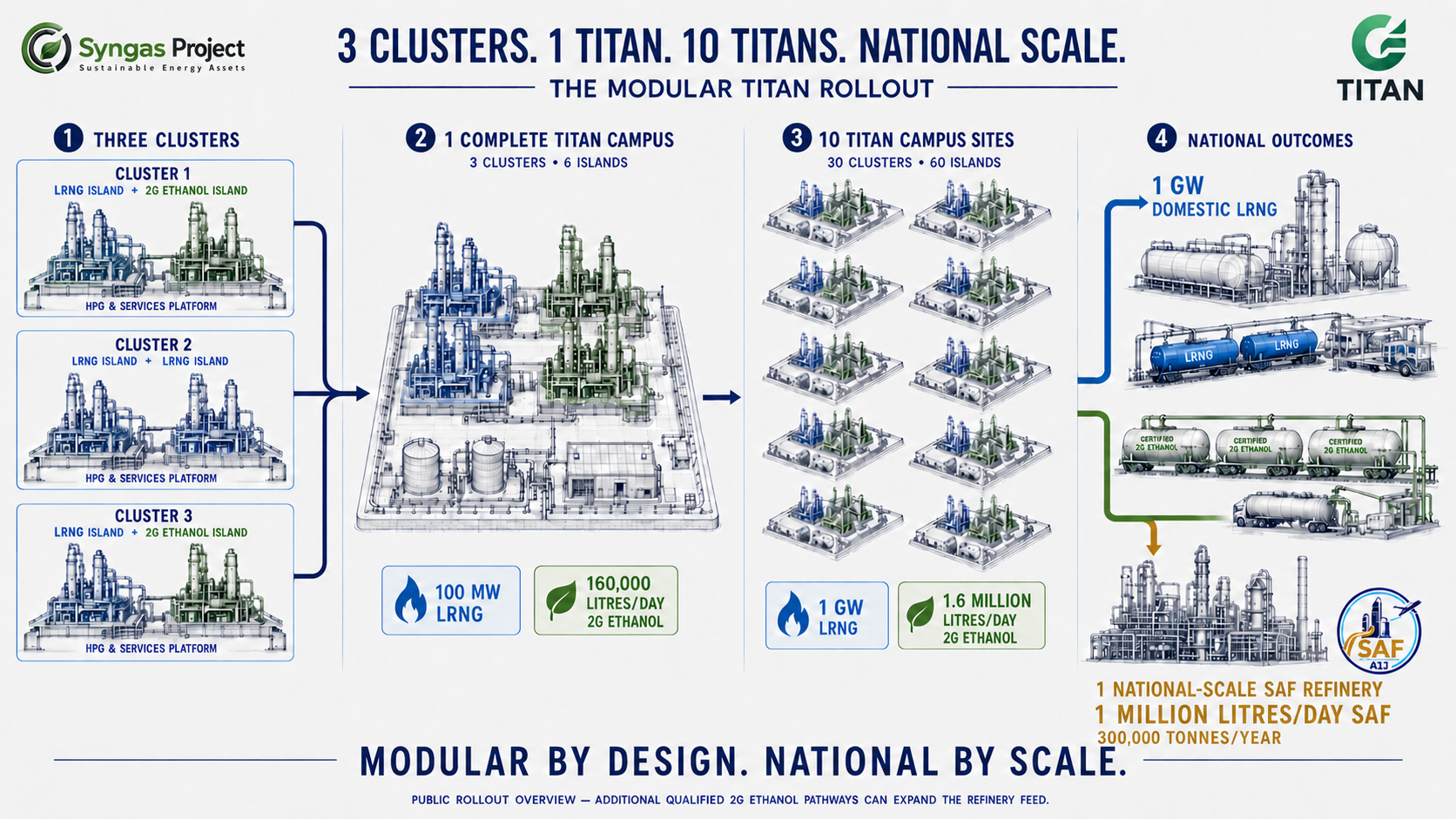
At full build-out, each TITAN Fermentation CAMPUS contains six principal conversion islands. Four Methanogenic islands produce renewable methane, while two Acetogenic islands produce 2G ethanol.
| TITAN production system | One completed TITAN CAMPUS | First ten TITAN sites |
| Methanogenic islands | 4 | 40 |
| Renewable methane | 100 MW constant capacity | 1 GW constant capacity |
| Acetogenic islands | 2 | 20 |
| 2G ethanol | 160,000 litres per day | 1,600,000 litres per day |
These are not competing targets. They are created by the same platform rollout.
The Methanogenic side produces renewable gas for energy security, industrial fuel, dispatchable power and resilient gas logistics. The Acetogenic side produces the renewable alcohol required by the Alcohol-to-Jet pathway.
One rollout creates two strategic molecules.
This is the strength of Swing–Swing.
TITAN can direct Hydrogen Producer Gas towards renewable methane or renewable ethanol. As the complete fermentation stack develops, the platform can also support a growing portfolio of fuels, chemicals, materials and nutrients.
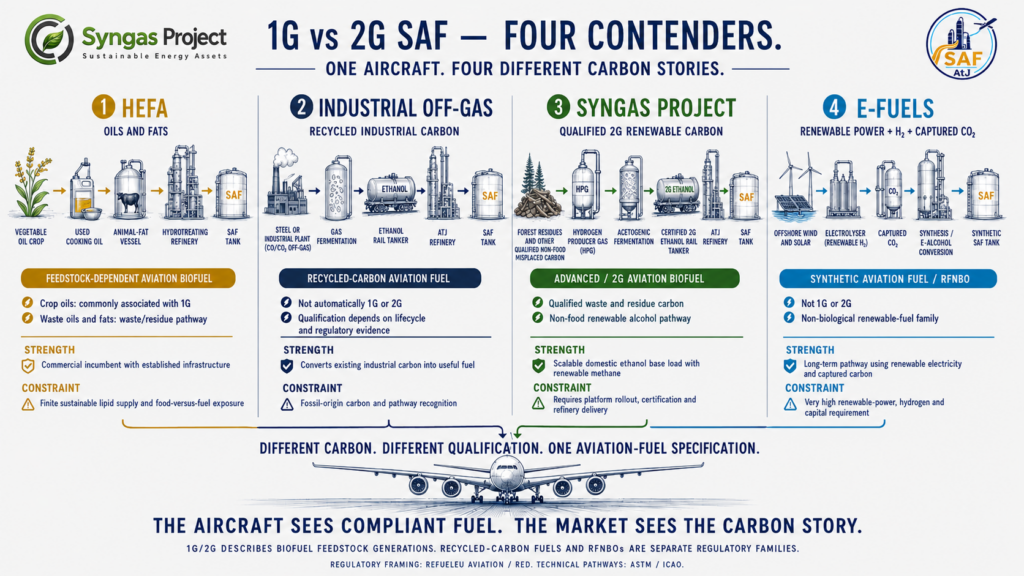
Four SAF contenders—and four different carbon stories
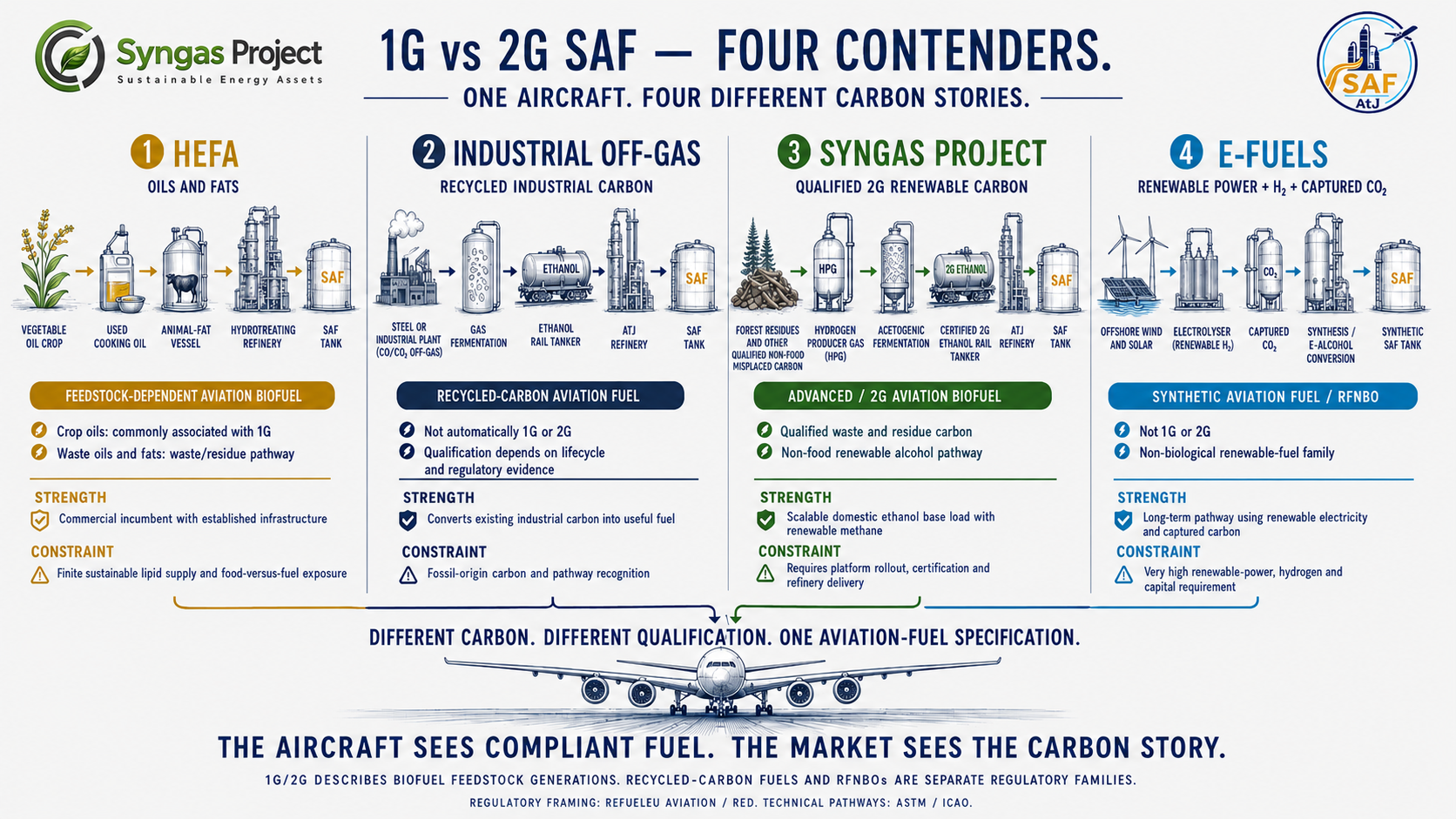
The aircraft ultimately receives specification-compliant aviation fuel. The market, however, examines the complete carbon story behind that fuel.
Simple 1G and 2G terminology does not describe every SAF pathway. It primarily distinguishes generations of biological feedstock. Industrial off-gas and e-fuels belong to different regulatory families.
| SAF contender | Principal carbon source | Regulatory position | Principal strength | Principal constraint |
| HEFA | Vegetable oils, used cooking oils and animal fats | Feedstock-dependent aviation biofuel | Established commercial infrastructure | Finite sustainable lipid supply and possible food-versus-fuel exposure |
| Industrial off-gas | CO and CO₂ from industrial processes | Potential recycled-carbon aviation fuel when qualifying | Converts existing industrial carbon into useful fuel | Fossil-carbon origin and pathway-recognition requirements |
| Syngas Project | Qualified forest residues and other non-food renewable carbon | Advanced or 2G aviation-biofuel pathway when qualifying | Scalable domestic ethanol base load alongside renewable methane | Requires platform rollout, certification and refinery delivery |
| E-fuels | Renewable electricity, hydrogen and captured CO₂ | Synthetic aviation fuel or RFNBO | Long-term pathway using renewable power and captured carbon | Very high renewable-electricity, hydrogen and capital requirements |
Under ReFuelEU Aviation, SAF can include aviation biofuels, synthetic aviation fuels and recycled-carbon aviation fuels. Each pathway remains subject to its applicable sustainability, lifecycle-emissions and certification requirements. European Commission: ReFuelEU Aviation
Different carbon. Different qualification. One aviation-fuel specification.
Why 2G ethanol supports premium SAF positioning
The key to the Syngas Project programme is the quality and origin of the ethanol.
TITAN does not depend upon food crops, sugar or first-generation agricultural alcohol. It produces second-generation ethanol from forest residues and other qualified forms of non-food renewable carbon.
That distinction creates potential premium value.
Once the finished aviation fuel has passed the required technical controls, the aircraft receives specification-compliant fuel. The physical safety and performance requirements do not change according to the origin of the carbon.
The premium positioning comes from the evidence behind the molecule.
| Source of premium value | What must be demonstrated |
| Non-food carbon | Eligible renewable or recovered feedstock |
| Lifecycle performance | Measured greenhouse-gas result across the complete pathway |
| Transparent origin | Identified source, collection method and production batch |
| Chain of custody | Verifiable movement of carbon and ethanol through the supply system |
| Carbon accounting | Consistent and auditable calculation methodology |
| Sustainability | Compliance with applicable European and voluntary certification criteria |
| Food-system protection | Reduced exposure to food-versus-fuel concerns |
| Domestic supply security | Scalable Polish and European production and logistics |
The refinery does not improve a weak carbon origin after the ethanol arrives.
The premium begins upstream.
It begins with the correct carbon and continues through controlled Hydrogen Producer Gas production, Acetogenic fermentation, ethanol recovery, certification and rail delivery. The AtJ refinery then protects that value while converting the alcohol into aviation fuel.
Premium SAF positioning begins with premium certified 2G ethanol.
TITAN produces the renewable alcohol upon which that position is built.
Where the SAF margin begins
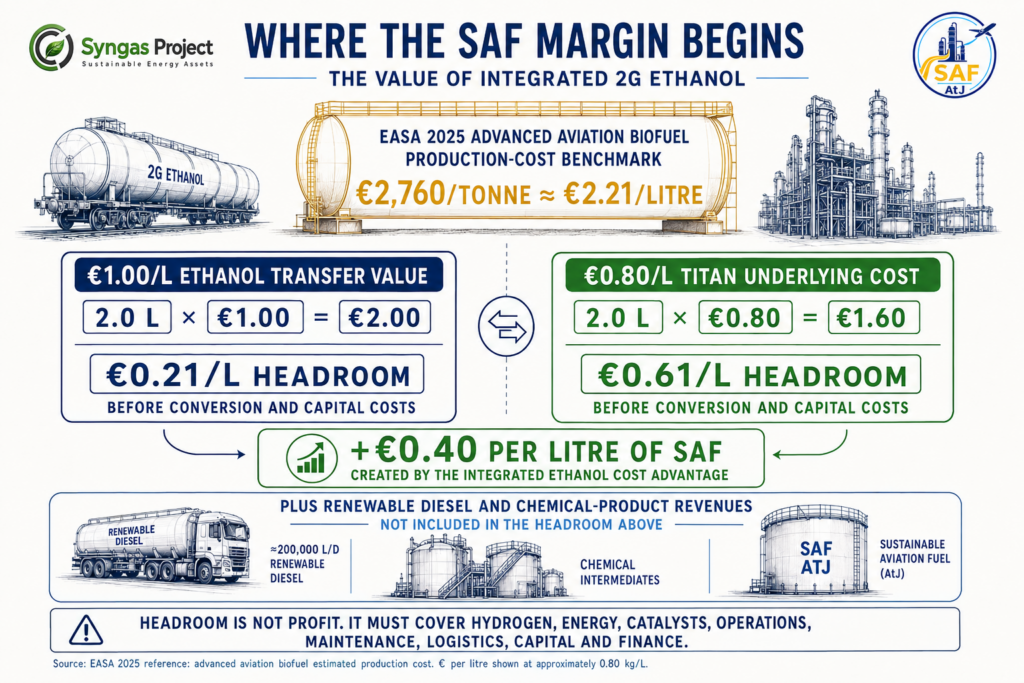
An integrated ethanol platform can create a stronger refinery position than a refinery purchasing all its ethanol at an external market price.
This advantage must be described carefully. A potential margin is not the same as profit.
| Potential value driver | Costs still requiring deduction |
| Integrated 2G ethanol production | Hydrogen |
| Transfer value below external ethanol price | Electricity and process heat |
| SAF production | Catalysts and consumables |
| Renewable-diesel co-product | Operations and maintenance |
| Renewable naphtha and chemical products | Logistics and storage |
| Carbon and sustainability value | Capital, financing and technology-licence costs |
The final refinery economics will be established during technology selection, FEED, commercial contracting and financing. The purpose of the integrated model is to create a strong starting position—not to claim a guaranteed margin before those costs are known.
Designed to conform
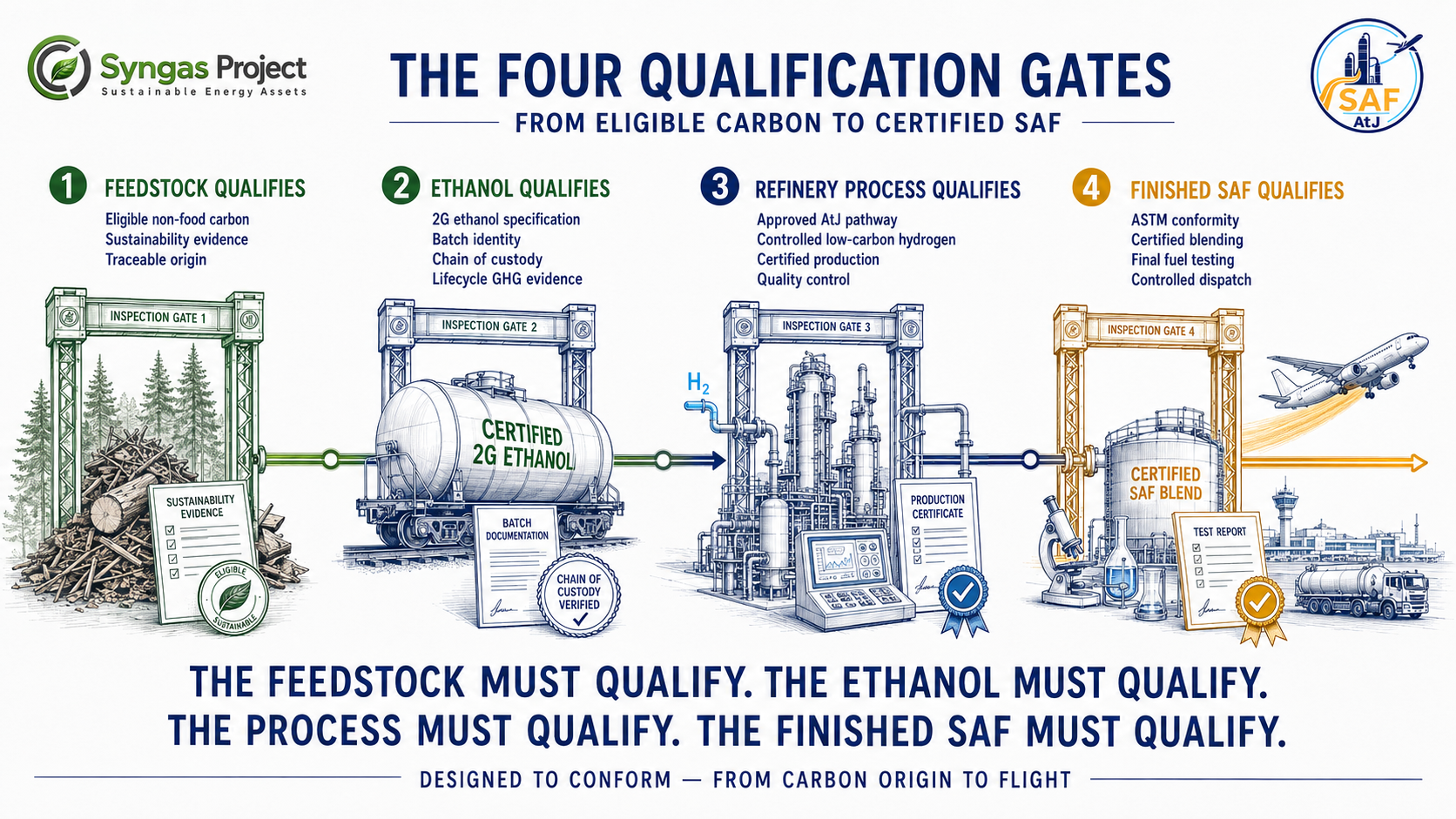
Aviation is one of the most tightly controlled industries in the world. SAF must satisfy technical fuel specifications, but physical fuel quality is only one part of the qualification process.
| Qualification gate | Principal evidence |
| Feedstock | Eligibility, non-food status, origin, collection method and sustainability evidence |
| Ethanol | Specification, batch identity, lifecycle result and chain of custody |
| Refinery process | Approved pathway, controlled hydrogen and energy inputs, operating records and quality control |
| Finished SAF | ASTM conformity, blending control, final fuel testing and controlled dispatch |
A technically effective carbon pathway may still fail to receive regulatory or commercial recognition if its origin, classification, lifecycle result or chain of custody cannot be demonstrated.
Syngas Project must therefore design for the market as it exists—not only for the market as we believe it should become.
Forest residues and other qualifying non-food carbon streams provide the clearest foundation for the initial SAF programme. They allow the carbon journey to be measured from collection through Hydrogen Producer Gas, Acetogenic fermentation, ethanol recovery, refinery conversion and final certification.
Additional carbon pathways will be admitted only when they demonstrate the required eligibility, lifecycle performance, traceability and product quality.
We do not ask aviation regulators, airlines or fuel suppliers to lower their standards.
We build the platform to meet them.
The feedstock must qualify. The ethanol must qualify. The refinery process must qualify. The finished SAF must qualify.
That discipline protects the value of TITAN 2G ethanol and the credibility of the complete Polish SAF programme.
Why ethanol comes before the refinery
TITAN completes the difficult upstream conversion close to the source of the renewable carbon.
Forest residues are collected and prepared. Gasification converts the prepared carbon into Hydrogen Producer Gas. Acetogenic microbial workers then convert that gas into 2G ethanol.
The AtJ refinery does not need to receive forest residues or Hydrogen Producer Gas. It receives a stable, measurable, certifiable and transportable renewable molecule.
This separation is fundamental to the programme.
It allows distributed TITAN sites to remain close to regional carbon supplies while refinery capacity is located around the infrastructure required for continuous aviation-fuel production.
| Refinery-location requirement | Why it matters |
| National and international rail logistics | Ethanol aggregation and finished-product dispatch |
| Low-carbon hydrogen | Hydrogenation and final fuel stability |
| Renewable electricity | Lifecycle performance and refinery operation |
| Process heat and cooling | Continuous catalytic conversion |
| Water and wastewater systems | Process-water management and recovery |
| Product storage | Ethanol, intermediates, SAF and co-products |
| Certified blending | Conversion of the AtJ component into dispatchable aviation fuel |
| Aviation-fuel offtake | Access to Polish and European markets |
| Specialist workforce | Refinery operations, laboratories, maintenance and management |
| Expandable industrial land | Additional storage, refinery trains and future products |
The result is a hub-and-spoke SAF system:
Distributed renewable-carbon conversion. Centralised aviation-fuel refining.
One national refinery or two complementary hubs
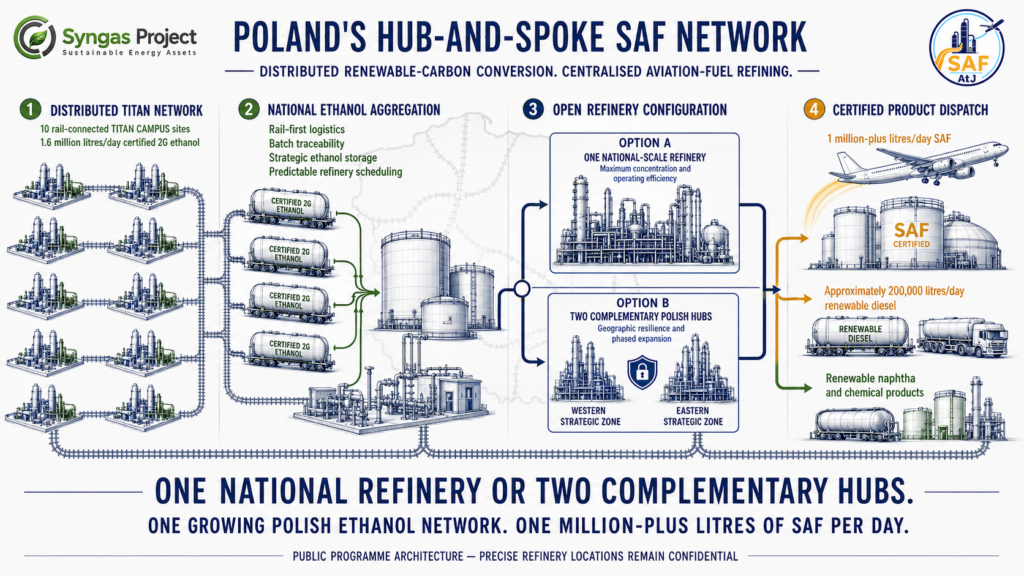
Syngas Project is evaluating two possible configurations for the Polish AtJ programme.
The first is one national-scale, expandable refinery capable of producing more than one million litres of SAF per day. The second is two complementary refinery hubs whose combined production crosses the same national threshold.
| Decision factor | One national-scale refinery | Two complementary Polish hubs |
| Operating efficiency | Maximum concentration of equipment and personnel | Some infrastructure and personnel duplication |
| Operational resilience | One principal production centre | Geographic and operating resilience |
| Ethanol transport | National aggregation to one destination | Shorter average transport distances |
| Capital deployment | Larger initial refinery investment | Potential phased investment |
| Technical workforce | One concentrated specialist team | Two specialist operating organisations |
| Laboratories and certification | One central system | Two coordinated systems |
| Maintenance and spares | Centralised | Duplicated or shared between hubs |
| Future expansion | One expandable refinery complex | Two directions for future TITAN and refinery growth |
| Product dispatch | One principal dispatch centre | Two distribution directions |
| Long-term capacity | Concentrated expansion | Additional resilience and growth capacity |
The final decision will depend upon secure land control, planning, utilities, rail logistics, hydrogen availability, workforce, refinery economics and long-term expansion capacity.
The precise locations and their individual advantages will remain confidential until the necessary land and commercial arrangements have been secured.
Returning aviation industry to its historic regions
Syngas Project is evaluating a small number of legacy industrial locations for the AtJ programme.
Each shortlisted region has a meaningful connection with important chapters in Polish or regional aviation history. That history matters, but it must be treated carefully.
We are not using the past as decoration.
We are building the next chapter.
Our intention is to return advanced aviation industry to regions that helped shape its development—this time through renewable carbon, biotechnology and Sustainable Aviation Fuel.
The shortlisted areas also offer the industrial space and rail connectivity required to aggregate ethanol from the expanding TITAN network and distribute certified aviation fuel towards Polish and European markets.
Their individual histories will be presented only when the sites can be publicly disclosed.
For now, we disclose the industrial ambition—not the addresses.
The history belongs to aviation.
The next chapter belongs to SAF.
Alcohol-to-Jet: established chemistry, new carbon
Alcohol-to-Jet is not based upon one new chemical reaction. It combines established refinery and petrochemical processes into a renewable aviation-fuel pathway.
What changes is the source of the carbon.
Instead of beginning with fossil crude oil, the Syngas Project pathway begins with renewable alcohol produced from qualified non-food carbon.
| Principal chemical stage | Function |
| Alcohol dehydration | Converts ethanol into ethylene and reaction water |
| Ethylene purification | Removes water, unconverted ethanol and trace impurities |
| Oligomerisation | Joins small ethylene molecules into longer aviation-range olefins |
| Hydrogenation | Converts reactive olefins into stable saturated hydrocarbons |
| Fractionation | Separates aviation fuel, renewable diesel, naphtha and lighter products |
| Certification and blending | Confirms product quality and prepares the fuel for aviation logistics |
Ethanol is an approved feedstock for AtJ-SPK under ASTM D7566 Annex A5. ICAO currently lists a maximum blend ratio of 50% for this pathway. ICAO: SAF conversion processes
The chemistry is established.
The industrial challenge is producing sufficient quantities of correctly certified, low-carbon ethanol and constructing refinery capacity capable of processing it continuously.
That is the purpose of the TITAN rollout.
How the AtJ refinery works
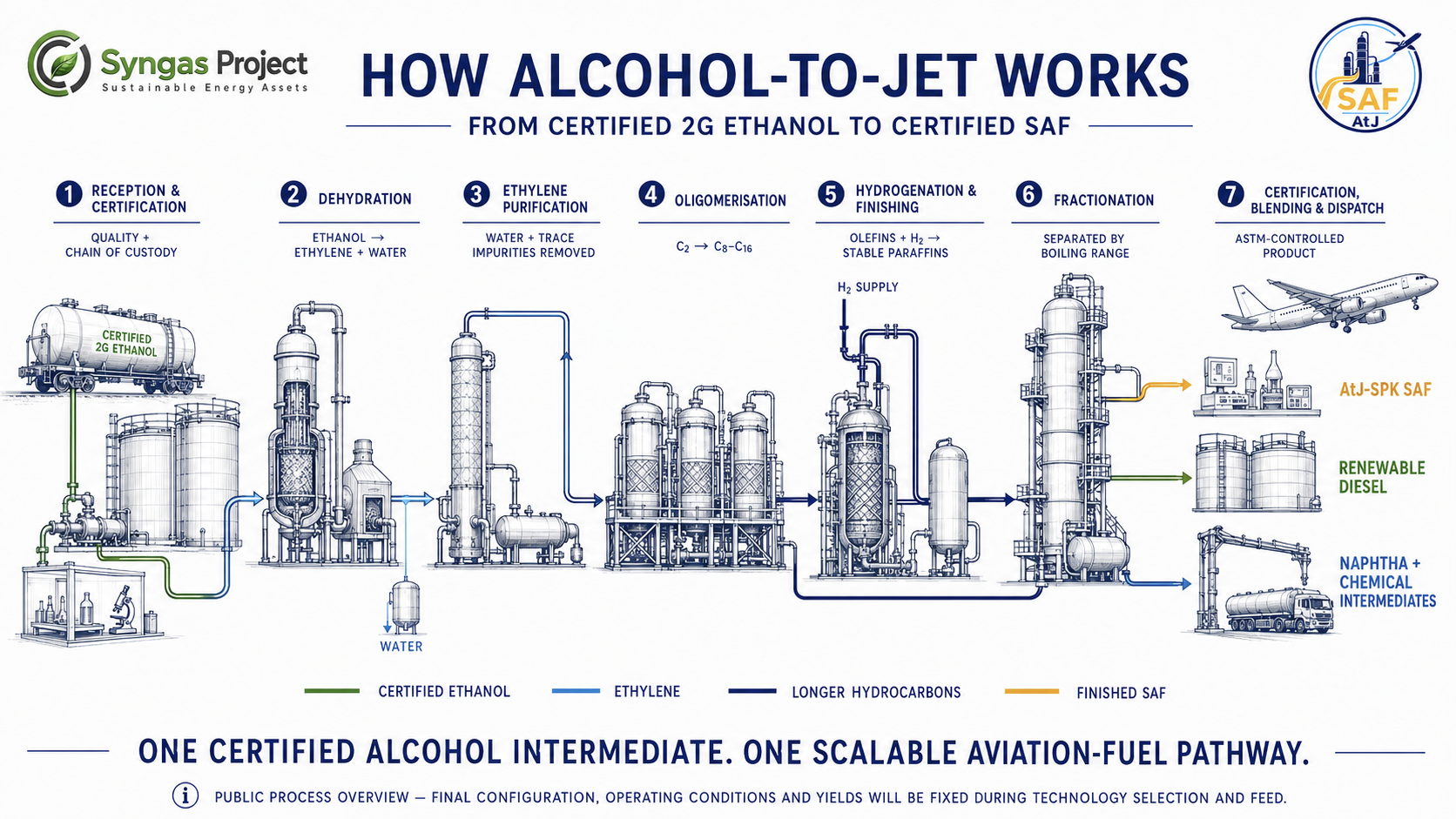
The complete public process description can be understood through seven controlled stages.
1. Ethanol reception and certification control
Certified 2G ethanol arrives from TITAN and other qualified platforms by rail tanker. Every delivery remains connected to its production batch and sustainability evidence.
| Reception control | Purpose |
| Ethanol concentration | Confirms the principal feedstock specification |
| Water content | Protects downstream conversion |
| Acidity | Confirms chemical stability |
| Trace contaminants | Protects refinery catalysts |
| Batch documentation | Connects the physical delivery to production records |
| Sustainability certification | Demonstrates the applicable carbon and sustainability position |
| Chain of custody | Preserves traceability from carbon source to refinery |
Accepted ethanol is transferred into segregated storage tanks.
The refinery receives a molecule, but it also receives the evidence demonstrating where that molecule came from.
2. Ethanol dehydration
Ethanol passes across a catalyst at a controlled temperature. The process removes water from the ethanol molecule and produces ethylene:
Ethanol → Ethylene + Water
This is why ethanol does not become jet fuel litre for litre. The oxygen contained in the ethanol leaves the process as water before the remaining carbon is assembled into hydrocarbon fuel.
The reaction water is recovered and treated within the refinery water system.
3. Ethylene purification
The ethylene stream is conditioned before entering the next catalytic stage.
Water, unconverted ethanol and trace impurities are removed or returned to the appropriate process stage. Consistent ethylene quality protects downstream catalysts and supports stable refinery operation.
4. Oligomerisation
Ethylene contains two carbon atoms. Aviation-fuel molecules require substantially longer hydrocarbon chains.
During oligomerisation, ethylene molecules are joined to create larger olefins within the required fuel range. Catalyst selection and operating conditions influence the balance between aviation fuel, renewable diesel, naphtha and lighter products.
This is the principal carbon-building stage of the AtJ refinery.
5. Hydrogenation and finishing
The longer olefin molecules react with hydrogen.
Hydrogenation removes their remaining chemical instability and produces saturated hydrocarbons suitable for final refining.
The Polish refinery programme will therefore require dependable low-carbon hydrogen alongside renewable electricity, process heat, cooling and water. Hydrogen demand, recovery and process integration will be fixed during technology selection and Front-End Engineering Design.
6. Fractionation
The finished hydrocarbon mixture is separated according to boiling range.
The refinery will be configured to maximise the aviation-fuel fraction while preserving the value of every co-product.
| Refinery product | Programme-level objective | Final determination |
| AtJ-SPK aviation component | More than 1,000,000 litres per day | Technology selection, guaranteed yield and FEED |
| Renewable diesel | Approximately 200,000 litres per day | Catalyst and fractionation strategy |
| Renewable naphtha | Quantity determined during FEED | Final product balance |
| Lighter hydrocarbons | Recovered for fuel or further processing | Refinery configuration |
| Chemical intermediates | Additional value stream | Technology and market demand |
The renewable-diesel figure is a programme-level planning objective. The final product balance will depend upon the licensed AtJ technology, catalyst system, hydrogen use, process recycling and selected fractionation strategy.
The refinery is therefore not designed to create only one product. It is designed to preserve the value of every renewable hydrocarbon fraction.
7. Certification, blending and dispatch
The AtJ-SPK component must satisfy the applicable requirements of ASTM D7566 Annex A5 and the associated aviation-fuel quality controls.
After certified blending and confirmation that the final fuel meets the applicable conventional aviation-fuel specification, it can enter established airport and fuel-terminal logistics.
| Final refinery capability | Function |
| Certified laboratories | Test feedstock, intermediates and final products |
| Product-quality control | Protect fuel specification and operating consistency |
| Sustainability documentation | Preserve the regulatory carbon position |
| Chain-of-custody management | Connect finished fuel with its qualifying inputs |
| Blending infrastructure | Prepare the AtJ component for aviation use |
| Finished-fuel storage | Segregate and protect certified product |
| Rail or pipeline dispatch | Connect the refinery with fuel terminals and aviation markets |
From 1.7 million litres of ethanol to one million litres of SAF
The refinery mass balance must be presented carefully.
Ethanol cannot convert into SAF on a one-for-one volume basis because oxygen is removed from the alcohol as water. The refinery also produces several valuable liquid-hydrocarbon fractions.
| Final mass-balance factor | Why it matters |
| Selected AtJ technology | Determines the licensed process configuration |
| Catalyst system | Influences conversion and product selectivity |
| Hydrogen consumption | Supports finishing and affects operating cost |
| Process recycling | Returns unconverted material to the appropriate stage |
| Oligomerisation conditions | Influence hydrocarbon chain length |
| Fractionation design | Determines the separation of SAF and co-products |
| Final product specifications | Establish marketable product boundaries |
| SAF versus co-product strategy | Determines the commercial product balance |
The guaranteed conversion yield and final ethanol requirement will be established during technology selection and FEED.
The first ten TITAN sites provide the initial 1.7-million-litre-per-day ethanol base load. They do not define the final limit of the refinery system.
The TITAN rollout continues beyond the first ten sites. Additional certified ethanol can also become available from other qualified Syngas Project platforms.
The national targets are therefore expressed as thresholds: 1.7 million litres-plus of 2G ethanol and one million litres-plus of SAF.
Carbon security through platform diversity
Syngas Project developed a family of platform options so that the refinery system does not remain permanently dependent upon one form of carbon.
| Platform | Carbon family | Potential SAF-network role |
| TITAN | Forest Carbon | Principal certified 2G ethanol base load |
| ASMARA | Municipal Carbon | Second-tier pathway subject to recycled-carbon eligibility |
| IGNIS | Agricultural Carbon | Qualified non-food agricultural-residue pathway |
| AQUIS | Water Carbon | Recovery of misplaced carbon and additional qualified ethanol potential |
| CUMULUS | Gaseous Carbon | Industrial and recycled-carbon pathway |
| STRATA | Legacy Carbon and Minerals | Supporting recovery platform; no automatic SAF qualification |
| Renewable e-fuels (see saw partners) | Renewable electricity, hydrogen and qualified carbon | Synthetic fuel or renewable-alcohol pathway |
Together, these platforms address the Misplaced Carbon Spectrum.
This diversity creates carbon security. If one carbon stream becomes constrained by season, geography, regulation, price or availability, the wider platform family can continue developing other qualified routes.
The refinery is therefore not tied permanently to one forest, one region, one residue or one carbon market.
More sources of renewable, recycled and recovered carbon are becoming aligned with fermentation and SAF production. This does not mean that every carbon source automatically qualifies.
| Requirement for admission to the SAF network | Evidence required |
| Feedstock eligibility | Applicable European regulatory classification |
| Lifecycle performance | Verified greenhouse-gas calculation |
| Sustainability compliance | Applicable certification and audit evidence |
| Chain of custody | Traceable batches and controlled transfers |
| Ethanol quality | Compliance with refinery-feedstock specification |
| AtJ compatibility | Confirmation against the selected licensed process |
As certification systems, carbon accounting and conversion technologies develop, the portfolio of qualified carbon should expand.
Syngas Project has designed for that future.
We do not depend upon one form of carbon. We build platforms capable of aligning more carbon with productive use.
More qualified carbon means greater refinery security, greater flexibility and more SAF.
First-Tier and Second-Tier SAF supply
The two supply tiers do not describe different final fuel specifications. They describe the planned order in which Syngas Project develops additional certified alcohol supply.
| Supply tier | Principal pathways | Programme role | Admission condition |
| First Tier | TITAN, AQUIS, IGNIS and qualified renewable e-fuel pathways | Establish the initial certified ethanol network | Eligibility, lifecycle performance, ethanol quality, certification and chain of custody |
| Second Tier | ASMARA, CUMULUS and qualified industrial or recycled-carbon streams | Expand and diversify refinery supply | Applicable regulatory recognition, lifecycle result, sustainability evidence and product quality |
TITAN provides the principal first-tier base load.
AQUIS and IGNIS extend the range of renewable carbon that can be recovered and directed towards the refinery system. Qualified e-fuel pathways can contribute additional alcohol produced through renewable electricity, hydrogen and carbon routes.
ASMARA and CUMULUS extend the Misplaced Carbon Spectrum through municipal, industrial and recycled-carbon pathways. Their inclusion depends upon the applicable regulatory treatment and complete qualification evidence.
Both tiers supply the same refinery system.
Different misplaced carbon. One certified alcohol intermediate. One aviation-fuel pathway.
Why rail matters
The renewable-molecule economy will not succeed through chemistry alone. It also depends upon logistics.
| Rail-system function | Programme benefit |
| Ethanol aggregation | Combines distributed production into refinery-scale supply |
| Batch traceability | Maintains control over each certified delivery |
| Reduced road transport | Limits dependence upon large road-tanker fleets |
| Predictable scheduling | Supports continuous refinery operation |
| Strategic storage | Balances production and refinery demand |
| Finished-fuel dispatch | Connects the refinery with terminals and markets |
| European connectivity | Provides access to Polish and international aviation-fuel logistics |
Rail connectivity is not a secondary site-selection consideration.
It is part of the SAF production system.
The refinery must be able to receive certified renewable alcohol from several directions and dispatch finished fuel into the wider European market.
Why methane and SAF belong together
The TITAN rollout is sometimes described only as a SAF programme. It is larger than that.
| Methanogenic side | Acetogenic side |
| 1 GW initial renewable-methane capacity | 1.7 million litres/day initial 2G ethanol capacity |
| Energy security | Polish SAF production |
| Industrial gas substitution | Aviation-fuel security |
| Dispatchable electricity | Renewable diesel and naphtha |
| Heavy transport | Renewable chemical intermediates |
| Resilient fuel logistics | New refinery investment |
| Strong renewable-energy business | Strategic renewable-refinery business |
The methane creates a strong energy business. The ethanol creates a strategic refinery business.
Together, they strengthen the resilience, flexibility and bankability of the complete platform.
Swing. Swing. Swing.
The carbon can move towards renewable gas, renewable alcohol or other fuels, chemicals and materials as markets develop.
Our delivery sequence
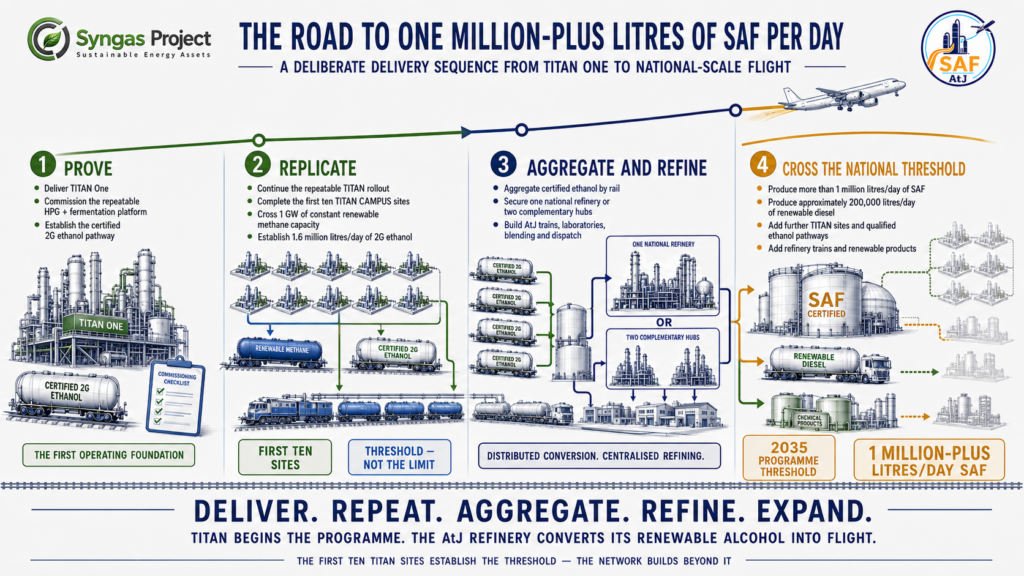
Syngas Project intends to build the upstream carbon, fermentation, logistics and refinery infrastructure required to establish a Polish SAF industry.
| Delivery phase | Principal outcome |
| Prove | Deliver TITAN One and establish the first operating foundation |
| Repeat | Continue the repeatable TITAN rollout |
| Establish national scale | Complete the first ten TITAN sites, cross 1 GW of renewable methane and establish 1.6 million litres/day of 2G ethanol |
| Aggregate | Connect certified ethanol through rail-based logistics and storage |
| Configure refining | Secure one national refinery or two complementary Polish hubs |
| Build | Deliver AtJ trains, laboratories, certified blending, storage and dispatch |
| Cross the national threshold | Produce more than one million litres/day of SAF and approximately 200,000 litres/day of renewable diesel |
| Expand | Add further TITAN sites, qualified carbon pathways, refinery trains and renewable products |
The refinery system will not depend upon one forest, one feedstock or one production location. It will be supplied by a growing network of renewable-carbon platforms.
TITAN begins the programme.
The AtJ refinery converts its renewable alcohol into flight.
The wider Syngas Project platform family builds out from there.
This is our destiny project
Europe has invested heavily in producing renewable electrons.
It must now build the infrastructure required to produce renewable molecules.
Aircraft cannot operate at industrial scale using electrons alone. They require energy-dense liquid fuel.
Poland has the renewable carbon, industrial capability, rail infrastructure, engineering knowledge and strategic position required to manufacture that fuel.
TITAN produces premium certified 2G ethanol. The AtJ refinery converts it into SAF, renewable diesel and additional renewable products. The wider platform family expands and protects the available carbon supply.
This is not a demonstration programme.
It is the beginning of a new Polish refinery industry with a constant 1GW of LRNG on the side.
The first ten TITAN sites establish the scale required to begin. Then the network grows: more TITAN sites, more qualified ethanol pathways, more refinery trains and more Polish renewable molecules converted into European aviation fuel.
From Forest Carbon to Hydrogen Producer Gas.
From Hydrogen Producer Gas to premium 2G ethanol.