

AQUIS — SPAIN AD MARKET DUE DILIGENCE
AQUIS Services, AQUIS Active EPS, CUMULUS and CAMPUS market-entry assessment
Assessment date: 31 July 2026
Priority: 4.8/5 — Strategic Priority Market
Status: Text approval copy — hero not yet created
Master format: Poland 23-section country standard
Controlling-data notice
This report replaces the previous Spain sheet and its unsupported headline figures.
The earlier sheet incorrectly presented:
- Approximately 1,230 operating AD installations
- 228 operating biomethane plants
- 152 grid-connected biomethane plants
- 21,800 GWh/year of renewable-methane grid injection
- Approximately 650 MW of current output
These figures combined existing assets, administrative registrations and future projects:
- 228 was the number of entities registered in Spain’s Guarantees of Origin system in 2025—not the number of biomethane plants.
- Approximately 22 TWh/year was the conditional capacity represented by 256 technically enabled connection requests—not operating production.
- Actual Spanish biomethane injected into the gas system during 2025 was 428.6 GWh, equivalent to 48.93 MW.
- Enagás recorded 19 operating biomethane plants in the Guarantees of Origin system, plus three injecting plants outside that register: a controlled total of 22 operating biomethane facilities.
- The wider active Spanish biogas market is approximately 250 plants, with wastewater-treatment plants representing the largest category. This remains the best available wider service-market baseline.
- Spain’s official Biogas Roadmap separately identified 146 electricity-registered biogas installations, 130 of which reported biogas consumption in 2020. This narrower register produced approximately 2.74 TWh/year.
The corrected market position is therefore substantial, but Spain is a rapidly emerging biomethane market, not yet a mature 21.8 TWh grid-injection market.
1. Executive Summary
Spain is one of the most important future AQUIS markets in Europe. It combines a large agricultural and food-processing economy, approximately 250 active biogas installations, extensive wastewater infrastructure, substantial municipal organic waste, approximately 3.5 million tonnes/year of wet sewage and industrial sludge, and one of Europe’s largest undeveloped biomethane resource bases.
The immediate AQUIS service market is approximately:
- 250 operating biogas and AD installations
- 25 initial target accounts at 10% penetration
- 22 identified operating biomethane facilities
- 20 identified grid-injection facilities
- One identified off-grid BioLNG facility
- One biomethane self-consumption facility
- 35 biogas facilities registered under the national Guarantees of Origin system, principally for self-consumption
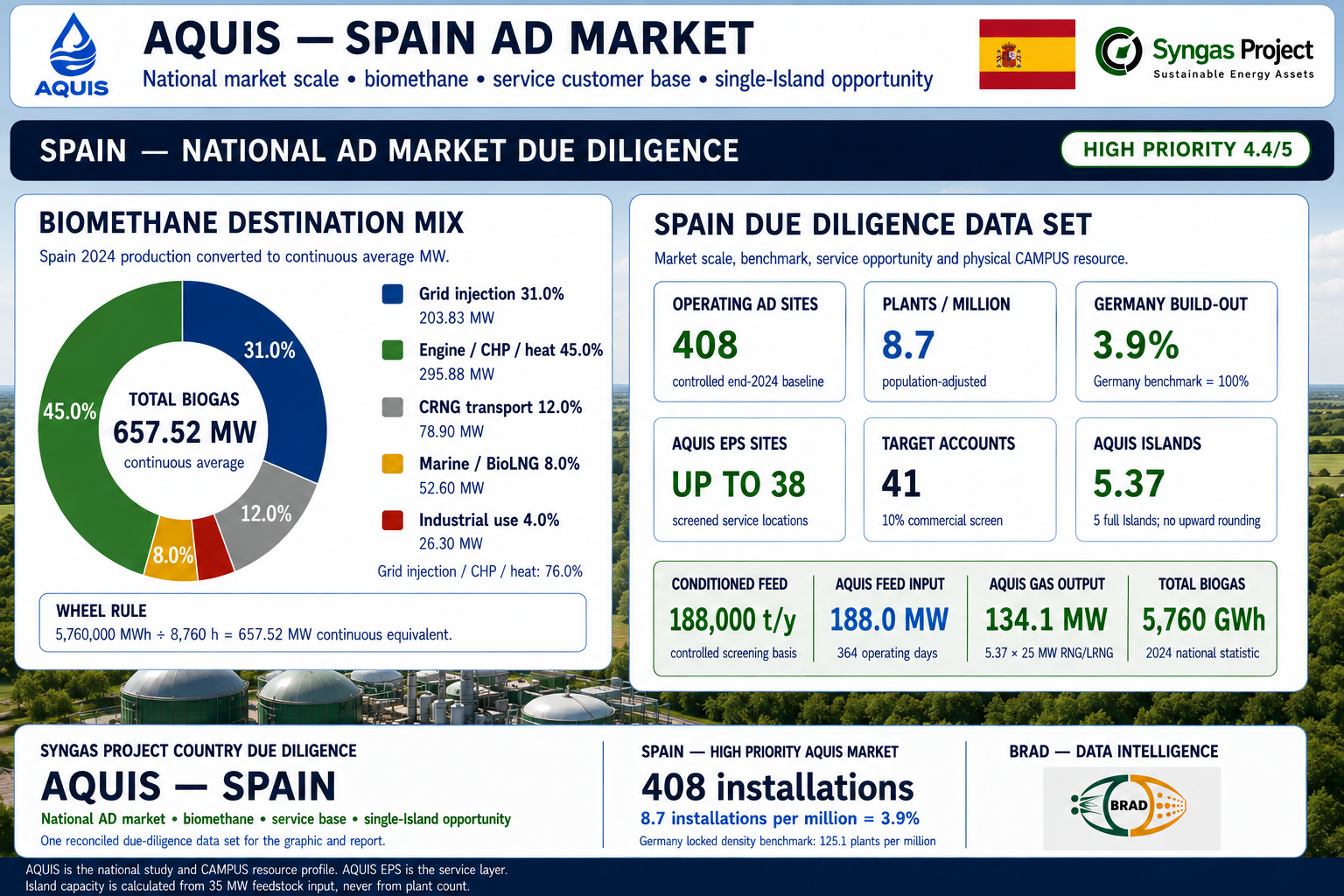
The official historic electricity-register baseline was 2,740 GWh/year of biogas, equivalent to 312.79 MW of continuous biogas energy. A broader 2021 sector assessment placed Spanish production at approximately 8,079 GWh, equivalent to 922.26 MW, but the corresponding destination split has not been published with sufficient detail for use in the controlled hero wheel.
The biomethane transition is now accelerating. In 2025:
- 428.6 GWh was injected into Spain’s gas networks.
- Operating injection capacity was 1,119.6 GWh/year.
- Enagás managed 487 connection requests.
- 256 requests, representing up to 22 TWh/year, were technically enabled.
- Developers expected as many as 46 plants to be operating by the end of 2026, with 4.6 TWh/year of production capacity.
These are different measurements and must not be combined.
Spain is a strategic priority because AQUIS addresses the issue most likely to determine whether the biomethane expansion remains socially, environmentally and politically acceptable: the management of digestate, nutrients, wastewater, microplastics, PFAS, odour, sludge and contaminant transfer.
2. How to Interpret the Model
The Spain assessment separates four fundamentally different market measurements.
Plant count
Plant count measures the number of potential AQUIS Services and AQUIS Active EPS accounts. It does not determine how many AQUIS Islands Spain can support.
National gas output
Gas output measures the energy already produced by the industry. It can be converted into MW for market comparison, but it does not prove that the equivalent quantity of feedstock is contractually available to Syngas Project.
Conditioned-feed capacity
Physical AQUIS Islands can be calculated only from verified conditioned feed:
- 35 MW feed input per Island
- 364 operating days per year
- 11.2 MJ/kg conditioned feed
- Approximately 98,280 tonnes/year of conditioned feed
- Approximately 25 MW RNG/LRNG output
- Or approximately 80,000 litres/day of 2G ethanol
RNG/LRNG and 2G ethanol are alternative outputs and must never be added together.
Methane destination
The wheel shows where measured methane goes:
- Green: engine, CHP, heat or unupgraded gas
- Blue: grid injection
- White: CBG/CRNG transport
- Yellow: LBG/BioLNG or marine-capable fuel
- Red: direct industrial use
Missing route quantities must be marked Incomplete data, never silently treated as zero.
3. Market Definition
The Spanish AD market includes:
- Agricultural biogas
- Pig and cattle slurry digestion
- Manure and livestock residues
- Agro-industrial residues
- Olive-processing residues
- Winery and distillery residues
- Dairy and slaughterhouse residues
- Fruit and vegetable processing waste
- Source-separated municipal biowaste
- Wastewater-treatment sludge
- Industrial wastewater
- Landfill gas
- Existing CHP installations
- Biomethane-upgrading plants
- Grid-injection facilities
- Off-grid compressed biomethane
- BioLNG production
- Digestate treatment
- Nutrient recovery
- Process-water separation and reuse
Landfill-gas sites remain part of the gas market but are not automatically physical AQUIS Island opportunities. Landfill gas does not create a conventional post-digestion feed-and-digestate circuit.
The strongest AQUIS opportunities are installations treating controllable wet organic streams and producing digestate, sludge, filtrate, centrate or contaminated process water.
4. National Market Scale
| Measurement | Controlled Spain position |
| Population, 1 January 2026 | 49,570,725 |
| Wider active biogas-plant baseline | Approximately 250 |
| Narrow PRETOR electricity register | 146 installations |
| PRETOR plants reporting biogas use in 2020 | 130 |
| Operating biomethane facilities, 2025 | 22 |
| Grid-injecting biomethane facilities | 20 |
| Off-grid BioLNG facilities | 1 |
| Biomethane self-consumption facilities | 1 |
| Active plants per million residents | 5.04 |
| Initial 10% AQUIS target accounts | 25 |
| Official 2020 registered biogas production | 2,740 GWh |
| Continuous equivalent | 312.79 MW |
| Broader 2021 biogas production | 8,079 GWh |
| Broader continuous equivalent | 922.26 MW |
| Biomethane injected in 2025 | 428.6 GWh |
| Injected continuous equivalent | 48.93 MW |
| Nominal injection capacity in 2025 | 1,119.6 GWh/year |
| Nominal continuous capacity | 127.81 MW |
| Technically enabled project pipeline | Up to 22 TWh/year |
| Physical AQUIS Islands | Incomplete data |
Spain’s population reached 49,570,725 on 1 January 2026. INE population statistics
The active-plant and production boundaries differ:
- Spain’s Biogas Roadmap counted electricity-registered installations.
- The wider estimate includes wastewater, waste and other biogas installations that do not all appear in the electricity register.
- Enagás’ current register covers renewable-gas facilities registered for certification or gas-system access; it is not a complete register of every Spanish digester.
5. Germany Benchmark
The controlled Germany benchmark remains:
- 10,455 operating installations
- 83.60 million residents
- 125.1 plants per million residents
Using Spain’s wider 250-plant service-market baseline:
| Comparison | Spain |
| Operating plants | Approximately 250 |
| Population | 49.57 million |
| Plants per million residents | 5.04 |
| Germany density benchmark | 125.1 |
| Spanish deployment density versus Germany | 4.03% |
| Spanish absolute plant scale versus Germany | 2.39% |
Spain has a much lower installed AD density than Germany but a very large undeveloped resource base.
This is commercially important. Spain’s low current density is not evidence of weak long-term opportunity. It demonstrates the size of the development gap between available organic resources and installed processing infrastructure.
The German comparison therefore positions Spain as an expansion and environmental-infrastructure market, rather than a saturated services-only market.
6. Renewable Methane Position
Controlled national wheel
The only national production dataset with a sufficiently clear and internally consistent perimeter for a 100% wheel is Spain’s official 2020 electricity-register dataset.
The registered plants produced approximately 2,740 GWh of biogas, of which approximately 2,450 GWh was consumed in electricity and cogeneration facilities. This included approximately 2,290 GWh attributable to electricity generation and 160 GWh attributable to heat.
Because this dataset covers electricity-registered biogas installations and does not establish a separate grid-injected biomethane quantity within its perimeter, the controlled wheel remains entirely green.
| Route | Colour | Annual energy | Continuous output | Share |
| Engine, CHP, heat and unupgraded gas | Green | 2,740 GWh | 312.79 MW | 100% |
| Grid-injected biomethane | Blue | Outside this historic perimeter | — | — |
| CBG/CRNG transport | White | Incomplete data | — | — |
| BioLNG/marine-capable route | Yellow | Incomplete data | — | — |
| Direct industrial biomethane | Red | Incomplete data | — | — |
Wheel centre:
NATIONAL AD OUTPUT
312.79 MW
Current biomethane transition overlay
The following data must be shown outside the historic wheel until a current national total and complete destination allocation are reconciled:
| 2025 biomethane measurement | Energy | MW equivalent |
| Nominal injection capacity | 1,119.6 GWh/year | 127.81 MW |
| Actual biomethane injected | 428.6 GWh/year | 48.93 MW |
| Biomethane GdOs transferred | 254.9 GWh/year | 29.10 MW |
Actual physical injection, nominal capacity and transferred certificates are different measurements. They must not be added.
The 2025 evidence is provided by the Enagás Spanish Gas System Report.
7. Market Direction
Spain is changing from an underdeveloped biogas market into one of Europe’s largest biomethane development markets.
The progression is clear:
- Spain had approximately five operating biomethane plants in 2022.
- The European Biogas Association reported 14 plants in 2024.
- Enagás identified 22 operating biomethane facilities in 2025.
- Developers expected up to 46 operational plants by the end of 2026.
- Expected end-2026 production capacity was approximately 4.6 TWh/year, equivalent to 525.11 MW.
- Enagás’ 2027 scenarios indicated 11–14 TWh/year of conditional capacity.
- The updated 2030 national biogas objective is 20 TWh/year.
- The technically enabled biomethane pipeline could reach approximately 22 TWh/year if projects are completed.
- Spain has attracted approximately €4.8 billion of announced biomethane investment to 2030, the largest national total identified in the EBA investment outlook.
Spain’s official 2022 Biogas Roadmap originally established a minimum 2030 production objective of 10.41 TWh/year. The updated national planning position has subsequently increased the target to 20 TWh/year. Spanish Biogas Roadmap
The Spanish market is therefore moving faster than the old AQUIS sheet indicated in some respects, but its current production remains far below the incorrectly reported 21.8 TWh of grid injection.
8. Plant and Feedstock Structure
Spain has one of Europe’s most diverse potential AD feedstock bases.
Livestock residues
Major streams include:
- Pig slurry in Catalonia, Aragón, Castilla y León and Murcia
- Cattle manure in Castilla y León, Galicia, Asturias and Cantabria
- Poultry residues
- Dairy waste
- Slaughterhouse and meat-processing residues
Pig slurry is particularly important because it combines methane-emission reduction, nutrient management and groundwater-protection requirements.
Crop and agro-industrial residues
Important resources include:
- Olive-mill residues
- Winery and distillery residues
- Fruit and vegetable processing waste
- Citrus waste
- Sugar and starch residues
- Dairy residues
- Brewery waste
- Horticultural residues
- Intermediate crops
- Straw and other agricultural residues requiring appropriate preparation
Municipal organic waste
The separate collection of municipal biowaste creates a growing feedstock route, particularly around Madrid, Barcelona, Valencia, Seville, Málaga and other large urban areas.
Wastewater and sludge
Wastewater-treatment plants form the largest established group within Spain’s wider active biogas fleet. Sludge digestion is therefore a central—not secondary—part of the Spanish AQUIS opportunity.
Landfill gas
Spain’s legacy landfill-gas sector contributes to biogas production but has a different service profile. Gas cleaning may create a CUMULUS opportunity, while the absence of conventional digestate limits the corresponding AQUIS Island case.
9. Digestate and Water Exposure
Spain’s biomethane expansion will produce large quantities of digestate. This is both a resource opportunity and the principal environmental risk to market growth.
Spain’s Biogas Roadmap requires projects to address:
- The type and quantity of feedstock
- Mass balance
- Nitrogen balance
- Digestate treatment
- Final digestate destination
- Suitable agronomic application periods
- Storage
- Odour
- Transport
- Potential contaminants
The key Spanish exposures are:
- Nitrate loading in livestock-intensive regions
- Ammonia emissions
- Phosphorus accumulation
- Seasonal land-application restrictions
- Soil and groundwater vulnerability
- Salinity
- Heavy metals
- Packaging-derived plastics
- Microplastic and nanoplastic transfer
- PFAS and other persistent pollutants
- Veterinary and pharmaceutical residues
- Pathogens
- Odour
- Long-distance digestate transport
- Public opposition to poorly located projects
AQUIS should make digestate management part of the project design from the beginning. It must not be treated as a secondary issue to be resolved after gas production has been approved.
10. Municipal Organic-Waste and Sludge Exposure
Spain collected approximately 22.4 million tonnes of urban waste in 2023, equivalent to approximately 464 kg per resident. Around 43.3%of collected municipal waste was recycled. INE Spain in Figures 2026
The volume of separately collected animal and vegetable waste is increasing, but much of Spain’s municipal waste remains mixed. This creates two different responsibilities:
- ASMARA: dry municipal, wet municipal, dirty wet municipal and foul municipal feed preparation.
- AQUIS: wastewater, sewage sludge, digestate separation, contaminated water and final polishing.
Spain’s new State Waste Framework Plan reports approximately:
- 700,000 tonnes/year of sewage and industrial sludge on a dry-solids basis
- Approximately 3.5 million tonnes/year on an indicative wet basis
- Approximately 78% from urban wastewater
- Approximately 22% from agro-industrial wastewater
- More than 86% applied to agricultural soils or landscaping in 2023
- Approximately 7% incinerated or co-incinerated
- Approximately 4% landfilled
- Approximately 3% directed to other treatments
Anaerobic digestion is already the most widely applied intermediate sludge-treatment method. PEMAR 2025–2035
This is a major AQUIS exposure. Agricultural reuse transfers responsibility for contaminants from the wastewater plant to soil, crops, groundwater and the wider food system unless those contaminants are removed.
11. Microplastic and Nanoplastic Position
Spain’s wastewater and municipal-biowaste systems collect plastic contamination from:
- Synthetic textiles
- Tyre and road abrasion
- Cosmetics and cleaning products
- Food packaging
- Agricultural films
- Industrial wastewater
- Urban runoff
- Tourism and coastal activity
- Fragmented consumer plastics
- Contaminated sewage sludge
MITECO’s marine strategies include specific work to:
- Quantify marine litter and microplastics discharged from wastewater-treatment plants.
- Identify measures for incorporation into river-basin plans.
- Quantify the principal sources of microplastics.
- Develop measures for source reduction.
MITECO marine-strategy measures
AD does not reliably destroy plastic particles. Digestion can remove organic material surrounding the particles while leaving them in:
- Digestate solids
- Separated liquid
- Centrate
- Filtrate
- Sludge
- Recovered fertiliser products
The AQUIS position remains:
AQUIS does not manage microplastics. It removes them permanently from the water system.
Captured particles must be placed in a controlled final route. Returning them through agricultural digestate would merely move the pollution from water into soil.
12. PFAS Position
PFAS exposure in Spain must be addressed through evidence and sampling rather than generalised assumptions.
Relevant entry routes include:
- Municipal wastewater
- Industrial wastewater
- Food packaging
- Firefighting foams
- Landfill leachate
- Contaminated sludge
- Textile processing
- Surface-treatment industries
- Chemical manufacturing
- Urban runoff
PFAS has been identified as a European surface-water and groundwater concern. Spain is included in European monitoring and human-exposure assessments, while published Spanish research has identified PFAS in urban groundwater and wastewater-related environments.
AQUIS should establish a site-specific PFAS protocol:
- Identify likely feedstock sources.
- Sample incoming feed, digestate solids, separated water and sludge.
- Establish a compound-specific baseline.
- Prevent dilution being presented as removal.
- Concentrate and capture the contaminated fraction.
- Record the final destruction or controlled disposal route.
- Maintain an auditable chain of custody.
The recast EU Urban Wastewater Treatment Directive strengthens advanced-treatment requirements for micropollutants.
Spain’s water-reuse regulation also increases the need for reliable polishing. Royal Decree 1085/2024 regulates reclaimed water from urban and industrial wastewater plants across urban, agricultural, industrial and other uses, with quality requirements linked to the intended destination. MITECO reclaimed-water regulation
13. AQUIS Services
The Spanish AQUIS Services package should include:
| Service | Spanish application |
| Plant audit | Existing AD, wastewater, waste and biomethane facilities |
| Feedstock audit | Manure, sludge, municipal organics and industrial residues |
| Digestate characterisation | Nutrients, solids, plastics, metals and emerging contaminants |
| Water separation | Centrate, filtrate and process-water recovery |
| Biological flocculation | Improved capture of fine suspended solids |
| Microplastic removal | Prevent transfer to soil and reclaimed water |
| PFAS screening | Identify high-risk feed and water routes |
| Nutrient recovery | Nitrogen, phosphorus and mineral recovery |
| Siloxane control | Protection of engines and gas-treatment systems |
| Ammonia management | Reduce water, odour and emissions exposure |
| Water polishing | Reuse in water-stressed regions |
| Odour assessment | Improve planning and public acceptance |
| Methane-loss review | Reduce fugitive emissions |
| Environmental reporting | Create a defensible operating record |
Spain should be treated as both an existing service market and a project-development market. AQUIS should be introduced before final design and permitting on new biomethane projects, not only retrofitted after problems arise.
14. AQUIS Active EPS
AQUIS Active EPS provides a targeted biological layer across the AD and water-management system.
The service sequence remains:
- EXTRACT — recovery of minerals, metals, rare earths and phosphorus
- FLOCC — flocculation and separation of microplastic and nanoplastic particles
- GUARD — fermentation conditioning, anti-scale support and siloxane control
- PFAS — capture support for persistent surfactants and related compounds
- POLISH — ammonia, nitrate and phosphate removal
Spanish applications include:
- Pig-slurry digestate
- Cattle-manure digestate
- Municipal organic-waste digestate
- Sewage sludge
- Agro-industrial wastewater
- Olive and winery residues
- Food-processing effluent
- Reclaimed-water systems
- Coastal and island wastewater systems
The modular AQUIS filter-and-packet model is particularly suitable for Spain because most plants will not require a permanent large AQUIS team. Filters can be dispatched, installed, monitored and returned through a controlled service network.
15. AQUIS Island Opportunity
Spain clearly possesses enough organic resources to support multiple AQUIS Islands. However, the number of physical Islands cannot yet be approved.
The present evidence establishes:
- Approximately 250 active biogas plants
- Approximately 3.5 million tonnes/year of wet sludge
- Major livestock-manure resources
- Substantial food-processing residues
- Large municipal organic-waste streams
- A 20 TWh national 2030 biogas objective
- Up to 22 TWh/year of enabled biomethane connection capacity
- An industry estimate of 163 TWh/year of accessible biomethane potential
None of these figures, by itself, provides the controlled conditioned-feed mass balance required for physical Island approval.
| AQUIS Island parameter | Requirement |
| Conditioned-feed input | 35 MW |
| Operating period | 364 days/year |
| Conditioned-feed energy | 11.2 MJ/kg |
| Conditioned-feed mass | Approximately 98,280 t/year |
| RNG/LRNG output | Approximately 25 MW |
| Alternative 2G ethanol output | Approximately 80,000 L/day |
| Verified Spanish conditioned feed | Incomplete data |
| Approved physical Spanish Islands | Incomplete data |
The 3.5 million tonnes of reported wet sludge cannot be divided by 98,280 tonnes to create an Island count. Wet sludge is not automatically conditioned feed at 11.2 MJ/kg.
The correct next step is regional feedstock screening followed by site-specific conditioning and energy analysis.
16. Cluster and CAMPUS Position
Spain is too large for one national CAMPUS. It should be approached through regional resource and logistics corridors.
Castilla y León
Principal opportunities:
- Pig and cattle manure
- Crop residues
- Food processing
- Large rural collection areas
- Strong biomethane-project pipeline
This is a leading candidate for a full regional feedstock and CAMPUS assessment.
Catalonia and Aragón
Principal opportunities:
- Intensive pig production
- Slurry and nitrate pressure
- Food and beverage industries
- Tarragona and Barcelona industrial demand
- Gas-network access
- BioLNG and transport-fuel markets
Castilla-La Mancha
Principal opportunities:
- Livestock residues
- Winery and distillery waste
- Olive residues
- Agricultural processing
- Central access to Madrid and southern industrial markets
Andalusia
Principal opportunities:
- Olive-processing residues
- Horticultural waste
- Livestock
- Food-processing industries
- Municipal organic waste
- Huelva and Algeciras port and industrial corridors
- SAF and maritime-fuel demand
Galicia and the north coast
Principal opportunities:
- Dairy and cattle residues
- Food processing
- Municipal wastewater
- Existing off-grid BioLNG capability
- Port access
Madrid and central metropolitan region
Principal opportunities:
- Valdemingómez
- Municipal biowaste
- Sewage sludge
- High-volume wastewater
- Concentrated transport and industrial demand
- Demonstration and institutional visibility
Valencia and Murcia
Principal opportunities:
- Horticulture
- Food processing
- Pig residues
- Municipal waste
- Severe water-management requirements
- High-value reclaimed-water use
These regions should be screened individually. CAMPUS numbers must follow verified Island capacity rather than being imposed from national plant totals.
17. LRNG Equivalent
Spain’s official 2020 registered biogas production of 2,740 GWh/year is equivalent to:
- 312.79 MW continuous biogas energy
- 12.51 standard AQUIS Island RNG-output equivalents
This is an output comparison—not a physical Island count.
Spain’s 2025 grid-injected biomethane of 428.6 GWh is equivalent to:
- 48.93 MW continuous biomethane
- 1.96 standard Island RNG-output equivalents
The 2030 national objective of 20 TWh/year would be equivalent to:
- 2,283.11 MW continuous renewable-gas output
- 91.32 standard Island RNG-output equivalents
The technically enabled 22 TWh/year pipeline would be equivalent to approximately:
- 2,511.42 MW
- 100.46 standard Island RNG-output equivalents
These comparisons do not prove feedstock availability, financing, construction or commercial operation.
Spain is already identified by the European Biogas Association as a BioLNG-producing country. However, Enagás reported only one registered off-grid BioLNG facility in 2025. Its actual annual output is Incomplete data.
18. Alternative 2G Ethanol Equivalent
Using the standard AQUIS relationship:
- 25 MW RNG/LRNG output
- Or 80,000 litres/day of 2G ethanol
Spain’s official 2020 biogas-output baseline of 312.79 MW corresponds arithmetically to approximately:
1,000,900 litres/day of alternative 2G ethanol
Spain’s 2030 target of 2,283.11 MW corresponds arithmetically to approximately:
7.31 million litres/day of alternative 2G ethanol
These figures are energy-equivalent comparisons only. They do not represent approved ethanol projects.
Actual production would depend on:
- Qualified conditioned feed
- Carbon conversion
- Gasification efficiency
- Hydrogen producer-gas composition
- Microbial capability
- Fermentation yield
- Plant availability
- Product recovery
- Water balance
- Feedstock contracts
The ethanol and RNG/LRNG routes are alternatives, not simultaneous products from the same feed.
Spain is nevertheless strategically important to Syngas Project because of its existing refinery, port, aviation, tourism and maritime-fuel markets.
19. CUMULUS Gas Treatment
Spain represents a significant CUMULUS opportunity because its biomethane market is moving rapidly from a handful of plants to a large grid-connection pipeline.
CUMULUS applications include:
- Hydrogen-sulphide removal
- Moisture control
- Siloxane removal
- Carbon-dioxide separation
- Methane-slip management
- Compression preparation
- Grid-quality monitoring
- Bio-CNG treatment
- BioLNG pre-treatment
- Gas polishing for industrial customers
- Biogenic carbon-dioxide recovery
The immediate addressable group includes:
- 20 identified grid-injection facilities
- One BioLNG facility
- One self-consumption biomethane facility
- New plants expected to increase the operating fleet to as many as 46 by the end of 2026
This does not mean that 22 or 46 identical CUMULUS trains should be assumed. Each project requires a gas-flow, raw-gas composition and existing-equipment review.
The best commercial offer is an integrated package:
- AQUIS: feed, digestate and water
- CUMULUS: gas cleaning and upgrading support
- STRATA: recovered solids, minerals and contaminant residues
- BRAD: performance, materials and environmental reporting
20. Commercial Entry Model
Spain requires a regional and partner-led entry model rather than a single national sales approach.
Stage one — controlled market register
Build a verified register covering:
- Approximately 250 active biogas sites
- 22 operating biomethane sites
- 46 expected end-2026 biomethane sites
- 256 technically enabled connection projects
- Major wastewater digesters
- Major livestock and food-processing clusters
- Ownership, operator, feedstock, output, water and digestate route
Stage two — first 25 target accounts
The 10% target market is 25 operating accounts, without upward rounding.
Prioritise:
- Operating biomethane plants
- Major wastewater digesters
- Pig-slurry and manure projects
- Municipal organic-waste plants
- Food and beverage industrial digesters
- Projects facing digestate, odour or local-permitting opposition
Stage three — Spanish reference projects
Secure reference projects in three different conditions:
- Agricultural manure and digestate
- Municipal wastewater and sludge
- Biomethane upgrading and grid injection
Stage four — regional service capability
Establish service coverage around:
- Madrid
- Barcelona/Tarragona
- Castilla y León
- Aragón
- Valencia/Murcia
- Andalusia
- Galicia
AQUIS should operate as a biotechnology and environmental-control supplier in partnership with plant operators, laboratories, engineering companies and water-service providers.
21. Priority Assessment
Overall score: 4.8/5 — Strategic Priority Market
| Assessment factor | Spain position |
| Current absolute plant base | Significant |
| Plant density | Low relative to Germany |
| Development headroom | Exceptional |
| Biomethane growth | Very strong |
| Grid-injection pipeline | Very strong |
| Agricultural residues | Exceptional |
| Wastewater and sludge | Exceptional |
| Municipal organic waste | Very strong |
| Digestate exposure | Very high |
| Water-reuse value | Very high |
| PFAS and microplastic relevance | High and increasing |
| BioLNG and transport opportunity | High |
| CAMPUS potential | Strong but not yet quantified |
| Public-acceptance risk | High |
| Data reconciliation requirement | High |
Spain is one of AQUIS’s principal markets alongside Poland, Sweden, Portugal and Switzerland.
Its significance does not come from current plant density. It comes from the combination of:
- Large undeveloped resource potential
- Rapidly expanding biomethane infrastructure
- Water scarcity
- Agricultural nutrient pressure
- Extensive sludge reuse on land
- Major industrial and transport demand
- Strong port and refinery infrastructure
- Increasing scrutiny of project location and digestate management
22. Risks and Limitations
The principal risks are:
- No single register captures every Spanish AD installation.
- The 250-plant figure is a wider sector estimate rather than a single audited 2026 register.
- The 146-plant PRETOR figure covers a narrower electricity-production perimeter.
- Historic production figures use different reporting boundaries.
- The current national CHP and heat output has not been reconciled with 2025 biomethane production.
- The BioLNG plant’s output is not disclosed.
- The destination of the self-consumed biomethane is not sufficiently defined.
- Connection requests are not operating plants.
- Conditional capacity is not guaranteed production.
- The 163 TWh accessible-potential estimate includes assumptions beyond the official national target.
- Regional permitting differs across autonomous communities.
- Digestate and nitrate concerns can delay or stop projects.
- Odour and truck movements can create serious opposition.
- Municipal feedstocks can contain plastics and persistent contaminants.
- Agricultural land application does not constitute contaminant removal.
- Water availability and discharge conditions vary materially by region.
- Physical AQUIS Islands cannot be approved without conditioned-feed evidence.
- Existing energy output cannot be converted directly into buildable AQUIS Islands.
- 2G ethanol and LRNG are alternative pathways.
Spain’s growth could be constrained by social acceptance if developers treat digestate, odour, traffic and water as secondary matters. This strengthens the AQUIS proposition but also raises the performance standard required.
23. Recommended Next Actions and Sources
Immediate actions
- Replace every earlier Spain figure with the controlled dataset in this report.
- Remove the incorrect 1,230-plant claim.
- Remove the incorrect 228-biomethane-plant claim.
- Remove the incorrect 21,800 GWh current grid-injection claim.
- Establish approximately 250 plants as the provisional wider service-market base.
- Establish 22 operating biomethane facilities as the controlled 2025 base.
- Establish 428.6 GWh and 48.93 MW as actual 2025 grid injection.
- Keep 22 TWh clearly labelled as enabled future pipeline capacity.
- Build a site-by-site operating register.
- Select the first 25 target accounts.
- Begin with Castilla y León, Catalonia/Aragón, Madrid and Andalusia.
- Secure one agricultural, one wastewater and one biomethane reference project.
- Quantify conditioned feed region by region.
- Do not calculate physical Islands until the feed mass, moisture and energy basis is verified.
- Retain 312.79 MW as the controlled historic wheel centre unless a complete current national destination dataset is obtained.
- Create the Spain hero only after the text and wheel basis are approved.
Principal sources
- Enagás — Spanish Gas System Report 2025
- MITECO — Spanish Biogas Roadmap
- European Biogas Association — Statistical Report 2025
- IEA Bioenergy Task 37 — Spain market summary
- INE — population on 1 January 2026
- INE — Spain in Figures 2026
- MITECO — State Waste Framework Plan 2025–2035
- Sedigas — Spanish biomethane-production potential
- MITECO — reclaimed-water regulation
- European Commission — assessment of Spain’s water management
- European Environment Agency — PFAS in European waters
- Directive (EU) 2024/3019 — urban wastewater treatment