
Warsaw 01:06:2026: Steve Walker
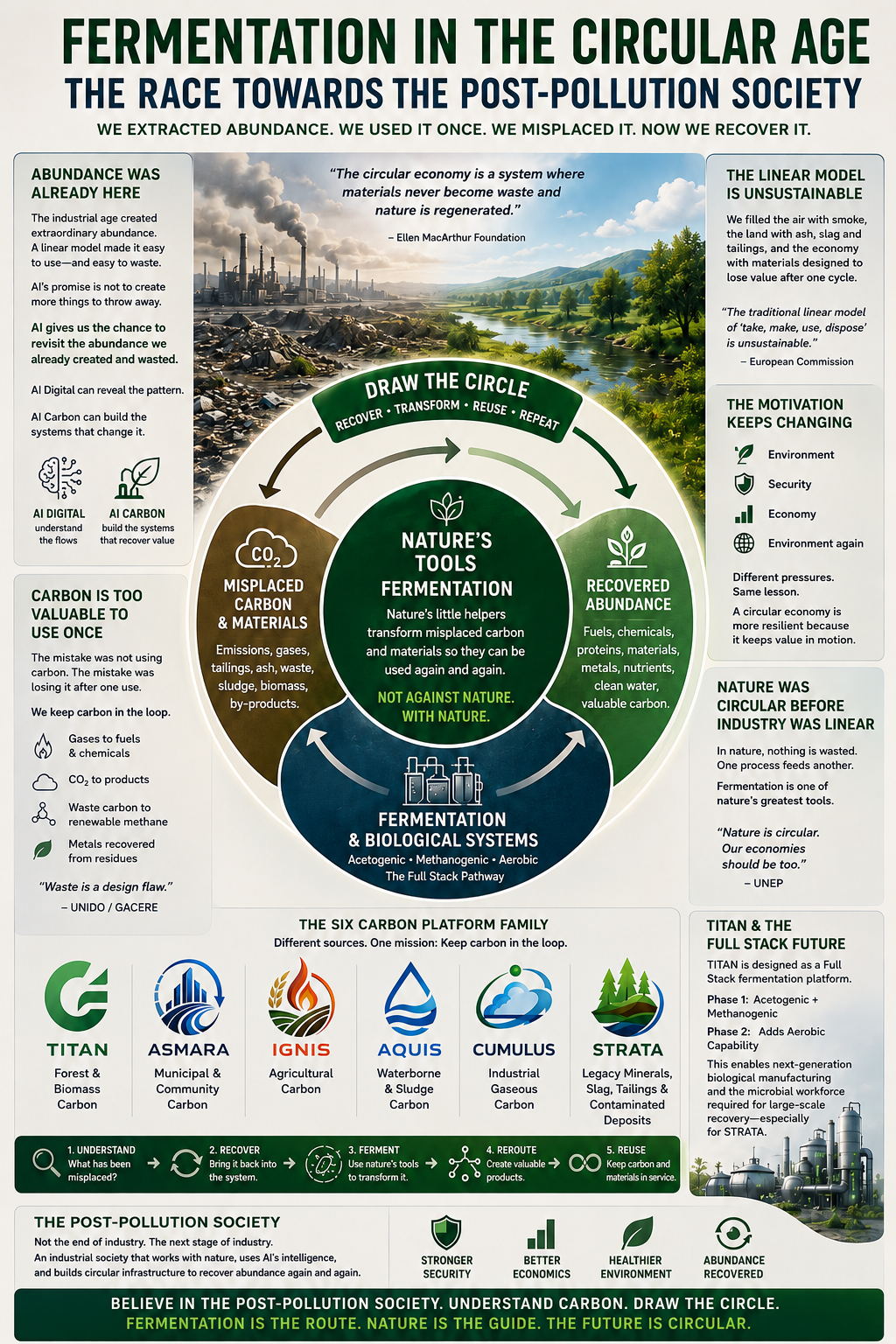
Fermentation in the Circular Age
The Race Towards the Post-Pollution Economy
“The circular economy is a system where materials never become waste and nature is regenerated.”
— Ellen MacArthur Foundation
The industrial age delivered prosperity, infrastructure and employment on a scale humanity had never seen before.
It was abundance.
So much abundance that we built a linear model around it and convinced ourselves it could last forever.
Extract.
Use.
Discard.
Repeat.
For a time, that looked like progress. Coal powered cities. Oil powered transport. Steel built nations. Chemistry transformed agriculture, medicine and manufacturing. The modern world was built from this abundance.
But the workflow was wrong.
We filled the air with smoke, the land with ash, slag and tailings, and the economy with materials designed to lose value after one cycle. Carbon became emissions. Minerals became waste. Industrial gases became pollution.
The abundance was real.
The mistake was misplacing it.
The race now underway is not simply an energy transition. It is the race towards the post-pollution society: an industrial society that stops treating pollution as the endpoint of production and starts treating it as misplaced material waiting to be understood, recovered and put back to work.
Abundance Was Already Here
“Technology is a resource-liberating mechanism. It can make the once scarce the now abundant.”
— Peter H. Diamandis
AI and technology leaders often speak about abundance as though it is something the future will create.
That is only partly true.
The industrial age already created abundance. It extracted enormous quantities of carbon, minerals, metals, chemicals and materials from the earth. It moved them across continents. It turned them into buildings, vehicles, machines, fuels, fibres, plastics, fertilisers, cities and industrial systems.
Then the linear economy misplaced much of that abundance.
The next abundance revolution is not about using AI to design more things we consume once and throw away. If artificial intelligence merely accelerates a new linear economy, it will multiply the old mistake. It will make us faster at wasting.