
Warsaw 08:04:2026 8:53 AM Steve Walker
For more than a century, industrial gas distribution has been dominated by fixed pipeline infrastructure.
Pipelines transformed economies because they allowed large volumes of energy molecules to move continuously between production centres and industrial demand zones. Entire industries were built around this logic. Heavy industry, fertiliser production, chemicals, district heating, shipping and power generation all evolved around the assumption that gas infrastructure would remain centralised, fixed and geographically constrained.
The problem is that Europe’s energy geography has changed faster than its infrastructure.
The European Union now faces a structural challenge that cannot be solved using electricity alone. Europe may increasingly produce its own electrons, but it still imports a large proportion of its critical molecules. Natural gas, LNG, methanol, ammonia, aviation fuels and chemical feedstocks remain deeply exposed to external supply chains and geopolitical instability.
This is where the virtual pipeline economy begins.
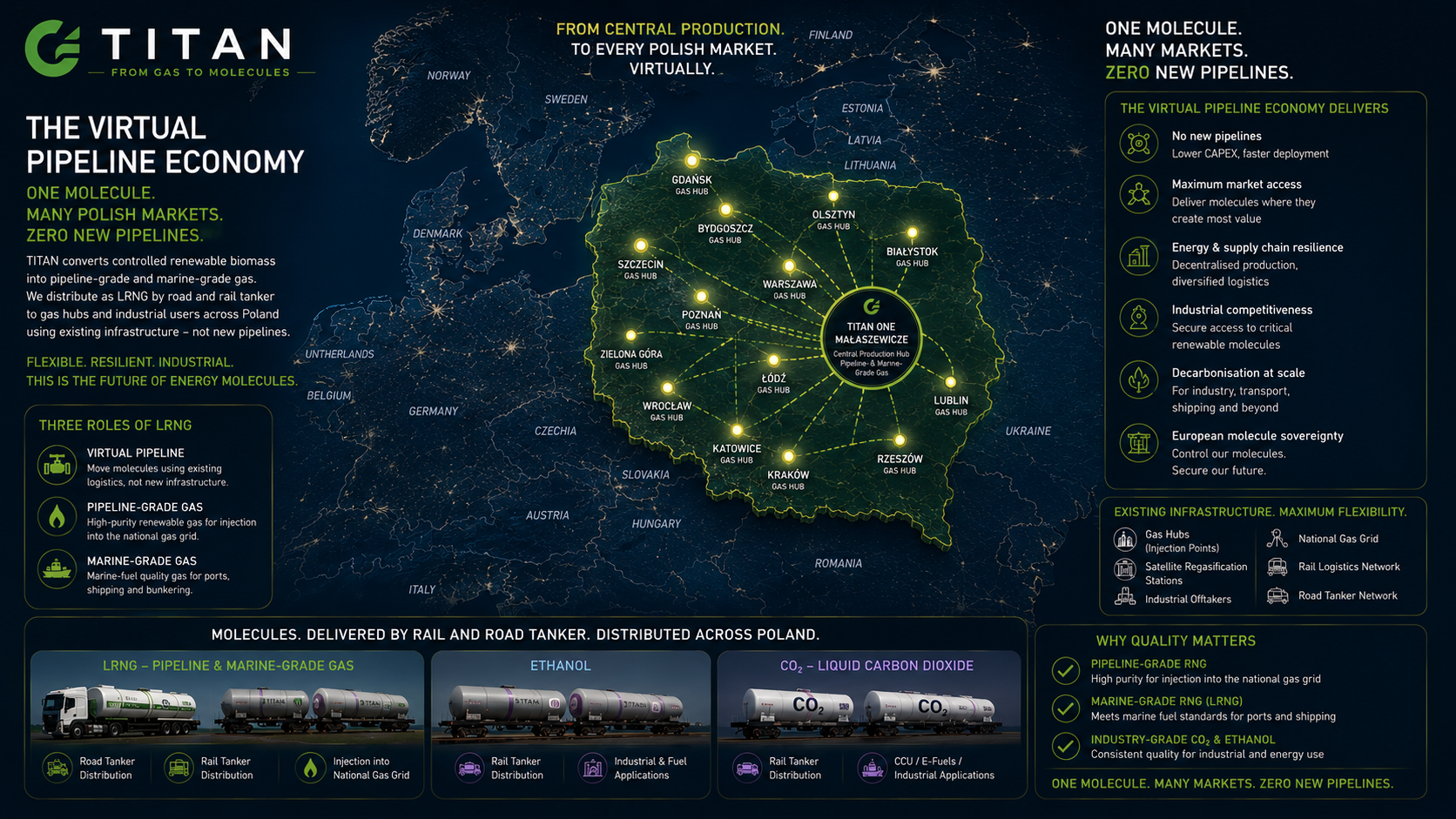
TITAN is designed around the idea that renewable molecules should move through Europe using flexible logistics infrastructure instead of relying exclusively on fixed pipeline systems.
The concept is simple.
Instead of transporting low-density biomass over very long distances, TITAN converts regional biomass into high-density renewable gas molecules close to the feedstock source. Those molecules are then distributed through existing road, rail, marine and regasification infrastructure using LRNG logistics.
LRNG — Liquefied Renewable Natural Gas — allows renewable methane to be transported at approximately 1/600th of its gaseous volume. This transforms renewable gas from a geographically trapped energy source into a mobile industrial commodity capable of serving national markets.
The result is a virtual pipeline.
The molecule moves without requiring a physical transmission pipe between origin and destination.
This is not a theoretical concept. Europe already operates major LNG logistics infrastructure across ports, storage facilities, satellite regasification terminals, rail systems and tanker fleets. TITAN simply adapts this proven infrastructure for renewable molecule distribution.