
Publish date: 25 March 2026
(Polska wersja poniżej.)
For more than a century, industrial gas distribution has depended on fixed pipeline systems.
Pipelines transformed economies because they allowed energy molecules to move continuously between production centres and industrial users. Heavy industry, chemicals, district heating, shipping and manufacturing all developed around this infrastructure model.
But building entirely new national pipeline systems is slow, expensive and politically difficult.
At the same time, Poland faces a growing challenge.
The country requires increasing volumes of renewable molecules for industry, transport, chemicals, heating and future fuel systems, while much of the existing renewable energy discussion remains focused almost entirely on electricity.
Electricity matters.
But molecules matter too.
Factories require molecules.
High-temperature industrial heat requires molecules.
Shipping requires molecules.
Chemicals require molecules.
Future aviation fuels require molecules.
The question is not simply how to produce renewable molecules.
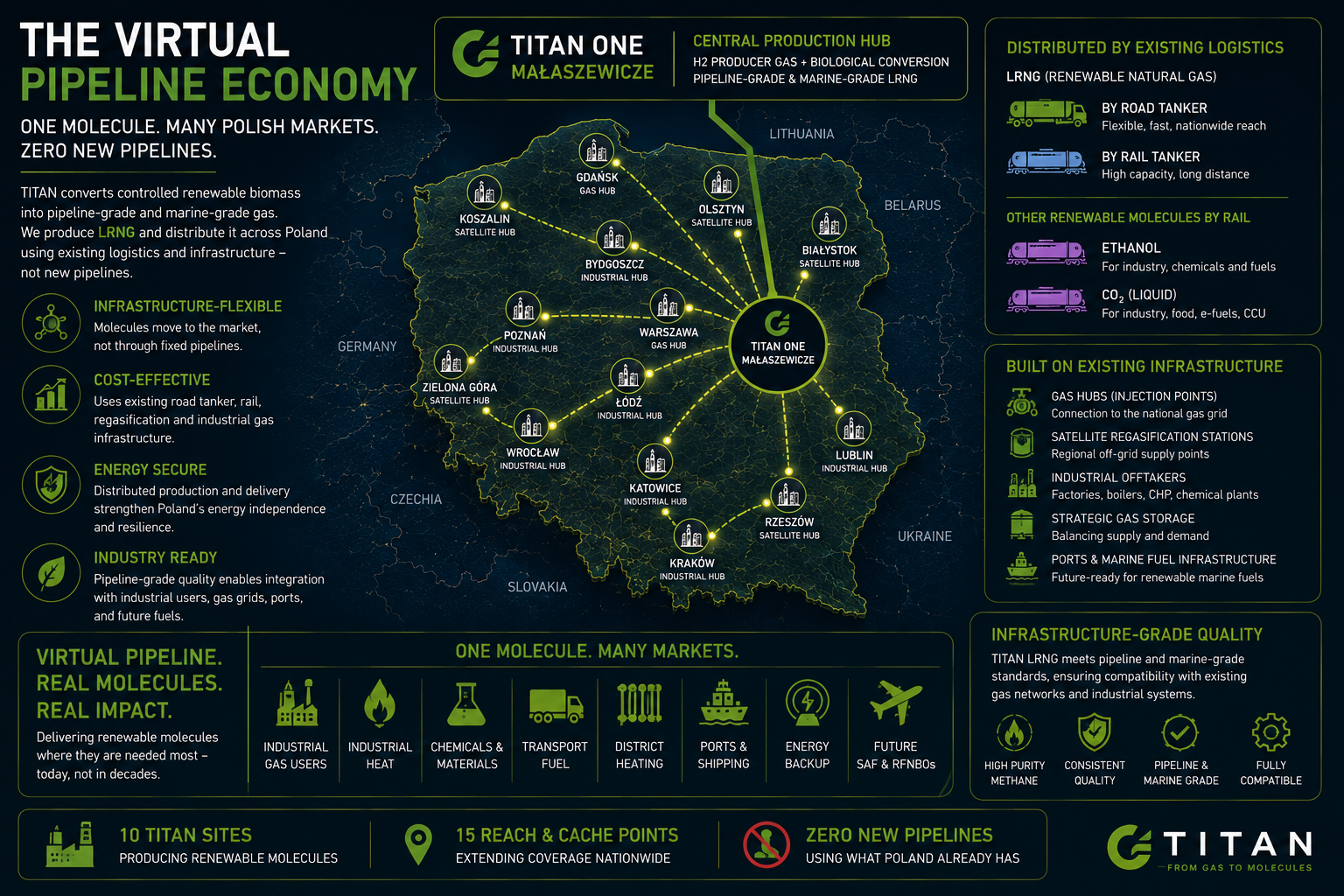
The question is how to distribute them efficiently across the country without waiting decades for entirely new infrastructure to be built.
This is where the virtual pipeline economy begins.