Insights

Wspinaczka po Drabinie Wartości Biowęgla

Od trwałego węgla do certyfikowanej wartości strategicznej

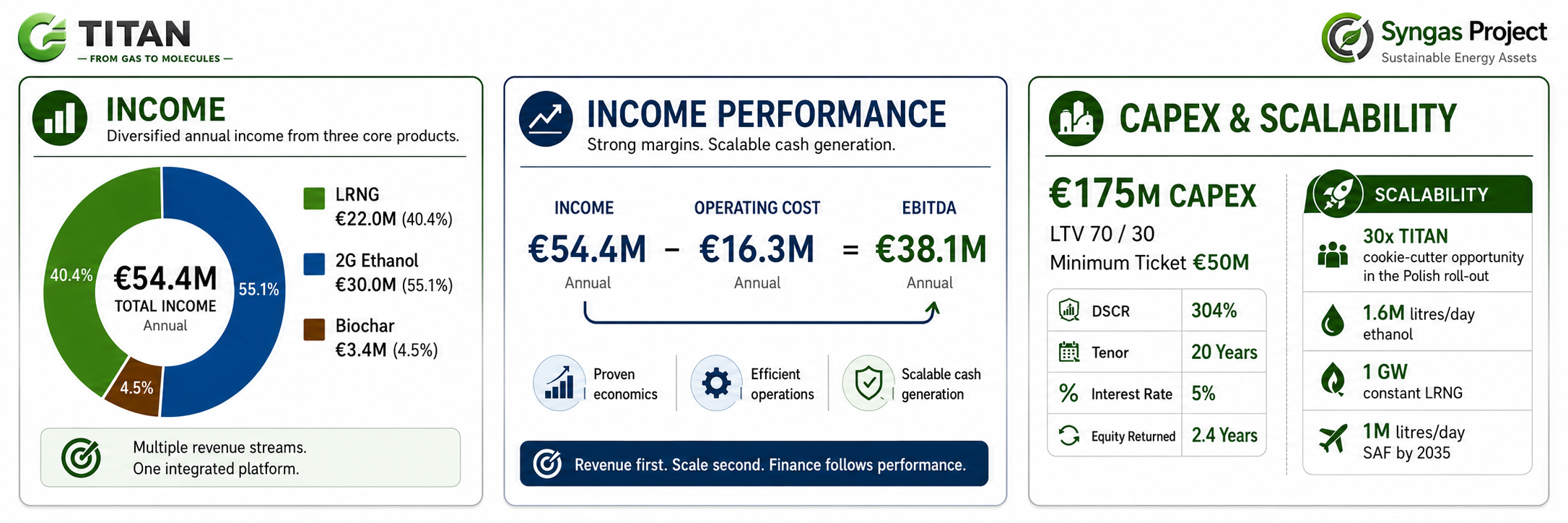
Biowęgiel nie opuszcza platformy TITAN jako gotowy produkt o wartości 2 400 euro za tonę.

Powstaje jako trwały węgiel podczas zgazowania zrównoważonych pozostałości leśnych w procesie produkcji Gazu Producentowego Bogatego w Wodór (HPG). Jego wartość następnie rośnie dzięki kontrolowanemu przetwarzaniu, rozwojowi produktu, certyfikacji oraz potwierdzonym zastosowaniom.

Drabina wartości nie jest więc zwykłym cennikiem. Jest uporządkowanym programem rozwoju produktu.

Na każdym etapie Syngas Project musi odpowiedzieć na cztery podstawowe pytania:

  • Z jakiego surowca został wyprodukowany biowęgiel?
  • W jaki sposób został wyprodukowany?
  • Czy każda partia produkcyjna jest bezpieczna i powtarzalna?
  • Jakie certyfikowane zastosowanie będzie pełnił?

Im lepsze są dowody jakości, powtarzalność procesu oraz potwierdzona skuteczność produktu, tym wyżej biowęgiel może awansować na Drabinie Wartości.

Należy podkreślić, że jest to komercyjna drabina wartości, a nie formalny system klasyfikacji prawnej. Klasy certyfikacyjne potwierdzają przydatność biowęgla do określonych zastosowań, lecz nie oznaczają automatycznie, że jeden produkt jest „lepszy” od drugiego. Jedna dobrze kontrolowana partia produkcyjna może kwalifikować się do wielu różnych zastosowań, pod warunkiem że zostanie odpowiednio przebadana, udokumentowana i wprowadzona na rynek.


Fundament – Kontrolowana Produkcja Biowęgla

Drabina rozpoczyna się wewnątrz TITAN.

Pozostałości leśne są przekształcane w procesie zgazowania w Gaz Producentowy Bogaty w Wodór (HPG), odnawialne cząsteczki oraz trwałą frakcję węglową. Zanim stanie się ona wartościowym produktem, musi zostać przekształcona w powtarzalny produkt przemysłowy.

Platforma TITAN musi zapewnić:

  • zatwierdzone i identyfikowalne źródła pozostałości leśnych,
  • określone wymagania dotyczące przygotowania surowca i jego wilgotności,
  • kontrolowaną temperaturę zgazowania oraz czas przebywania materiału w reaktorze,
  • ściśle kontrolowane warunki ograniczonego dostępu tlenu,
  • wychwytywanie lub zniszczenie metanu oraz innych emisji procesowych,
  • kontrolowane chłodzenie, transport i magazynowanie,
  • podział produkcji na jednoznacznie identyfikowalne partie,
  • reprezentatywne pobieranie próbek wraz z przechowywaniem próbek referencyjnych,
  • badania laboratoryjne każdej zdefiniowanej partii produkcyjnej.

Zgodnie z nową unijną metodyką Biochar Carbon Removal, kwalifikująca się produkcja musi ogrzewać biomasę do temperatury co najmniej 350°C, wychwytywać lub eliminować metan powstający podczas procesu oraz produktywnie wykorzystywać ciepło współprodukowane podczas zgazowania. Każda partia musi być powiązana z jednoznacznie określonym surowcem oraz stabilnymi parametrami pracy instalacji.

Ta dyscyplina produkcyjna stanowi fundament wszystkich kolejnych rynków i zastosowań.

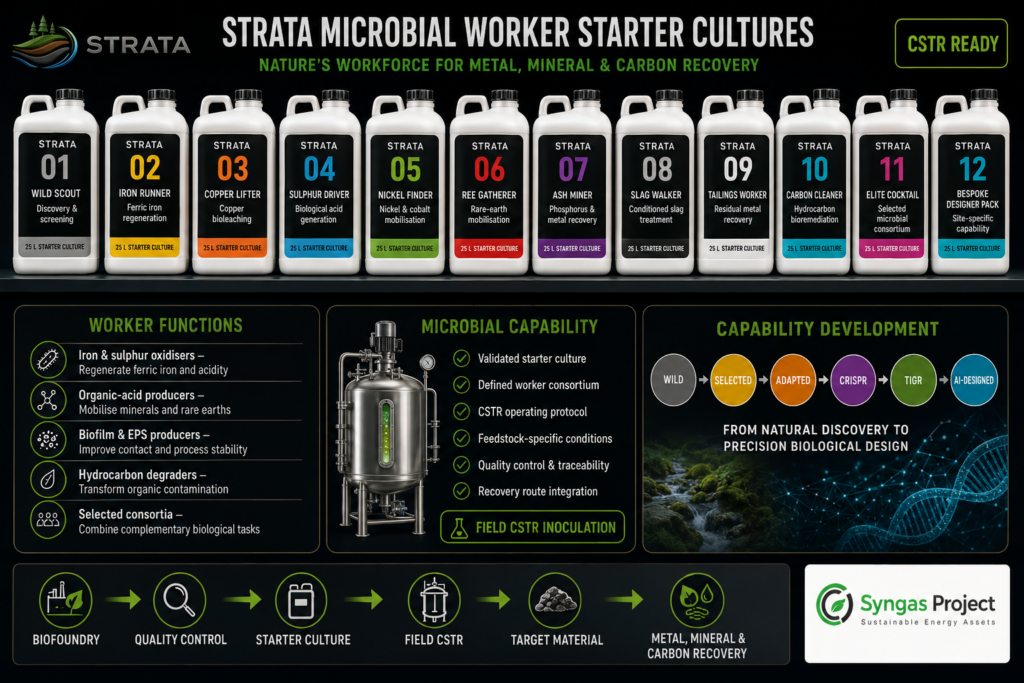
Nature’s Workforce for Metal, Mineral and Carbon Recovery

The 25-litre carboys contain validated starter cultures. They are the beginning of the deployment process—not the final field volume. At site, Field CSTRs proliferate the selected workers and progressively supply the PowerCan slurry tanks required for full execution.

From Wild Discovery to AI-Designed Microbial Capability

The materials required for the energy transition are not found only in new mines. Enormous quantities of metals, minerals and useful carbon remain trapped in historic tailings, industrial slag, ash, low-grade ores, contaminated land and other materials that industry has placed outside the productive economy.

STRATA approaches these materials as misplaced resources.

Syngas Project is not a university laboratory, nor do we claim to originate every microbial strain. We are engineers, platform developers, operators and service providers.

Our task is to identify a real industrial problem, define the biological work required and assemble the workers, vessels, power, utilities, controls and recovery systems needed to solve it.

This is where BRAD, our AI Carbon Orchestrator, enters the process.

BRAD connects the scientific originator field with practical industrial applications. It follows advances in microbial discovery, biomining, gene editing, metabolic engineering and artificial intelligence, translating them into capabilities that can be engineered, powered, deployed and measured.

BRAD takes the guesswork out of recovery.

It combines material data, microbial performance, originator progress, field requirements and recovery economics to determine:

  • What can be recovered.
  • Which microbial workers are most suitable.
  • What additional evidence is required.
  • How the field system should be configured.
  • What the likely operating range will be.
  • When the project should proceed.

BRAD has already participated in numerous workshops with stakeholders examining specific applications. These discussions extend from the mineralogy and chemistry of the target material to the microorganisms, Field CSTRs, slurry tanks, power, fuel, oxygen, water, monitoring and downstream recovery systems required in the field.

BRAD also monitors what microbial originators are working on now and how their development programmes are likely to advance. This includes the expected evolution of the next strains, consortia, enzymes and biological tools—not simply the capabilities already described in published research.

BRAD is already following more than 60 microbial workers and candidate capabilities. As industrial biology expands, this is likely to develop into hundreds of specialist workers addressing increasingly precise materials-recovery and remediation tasks.
Aerobic Microbes

Aerobic Microbes — The Bridge

Aerobic fermentation is installed during TITAN Phase 2 in Sector 5a.

We call it The Bridge because it connects TITAN with the wider SOLIDEA platform family: ASMARA, AQUIS, STRATA and IGNIS.

Methanogenic fermentation gives TITAN its renewable methane pathway.

Acetogenic fermentation gives TITAN its ethanol, chemicals and materials pathway.

Aerobic fermentation completes the full fermentation stack.

It creates products within the Fermentation CAMPUS, prepares specialist microbial workers for deployment beyond the CAMPUS and connects prepared carbon with a much wider range of biological outcomes.

The Oxygen Side

Aerobic Microbes work in the presence of oxygen.

They use controlled carbon, nutrients and oxygen to grow rapidly and produce substantial microbial biomass.

This distinguishes them from the Methanogenic and Acetogenic families.

Methanogenic Microbes primarily produce methane.

Acetogenic Microbes primarily produce alcohols, acids and chemical intermediates.

With Aerobic Microbes, the microbial biomass itself may become the commercial product or perform the required biological task.

This is why Aerobic fermentation produces the heavy-biomass outcomes within the full fermentation stack.

The biomass can be harvested, separated, washed, dried and formulated into useful products.

It can also be maintained as a living Microbial Capability and deployed into treatment, recovery, extraction and remediation systems.

Fermentacja Tlenowa

Mikroorganizmy Tlenowe — Most

Fermentacja tlenowa zostaje wdrożona podczas Fazy 2 TITAN, w Sektorze 5a.

Nazywamy ją Mostem, ponieważ łączy TITAN z szerszą rodziną platform SOLIDEAASMARA, AQUIS, STRATA oraz IGNIS.

Fermentacja metanogenna zapewnia TITAN ścieżkę produkcji odnawialnego metanu.

Fermentacja acetogeniczna zapewnia TITAN ścieżkę produkcji bioetanolu, chemikaliów i materiałów.

Fermentacja tlenowa dopełnia cały stos technologii fermentacyjnych.

Wytwarza produkty w obrębie CAMPUSU Fermentacyjnego, przygotowuje wyspecjalizowanych Pracowników Mikrobiologicznych do wdrożenia poza CAMPUSEM oraz łączy przygotowany węgiel z znacznie szerszym zakresem zastosowań biologicznych.

Strona Tlenowa

Mikroorganizmy tlenowe pracują w obecności tlenu.

Wykorzystują kontrolowane źródło węgla, składniki odżywcze oraz tlen, aby szybko się namnażać i wytwarzać znaczną ilość biomasy mikrobiologicznej.

To właśnie odróżnia je od rodzin mikroorganizmów metanogennych i acetogenicznych.

Mikroorganizmy metanogenne produkują przede wszystkim metan.

Mikroorganizmy acetogeniczne produkują przede wszystkim alkohole, kwasy oraz chemiczne związki pośrednie.

W przypadku mikroorganizmów tlenowych sama biomasa mikrobiologiczna może stać się produktem handlowym lub wykonywać określone zadanie biologiczne.

Dlatego fermentacja tlenowa odpowiada za produkcję wysokobiomasowych produktów w ramach pełnego stosu technologii fermentacyjnych.

Biomasa może zostać odzyskana, oddzielona, przepłukana, wysuszona i przygotowana jako gotowy produkt.

Może również pozostać żywą Zdolnością Mikrobiologiczną, gotową do wdrożenia w systemach oczyszczania, odzysku surowców, ekstrakcji oraz remediacji środowiska.

TITAN Teaser

TITAN: The Commercial Backbone of the CAMPUS

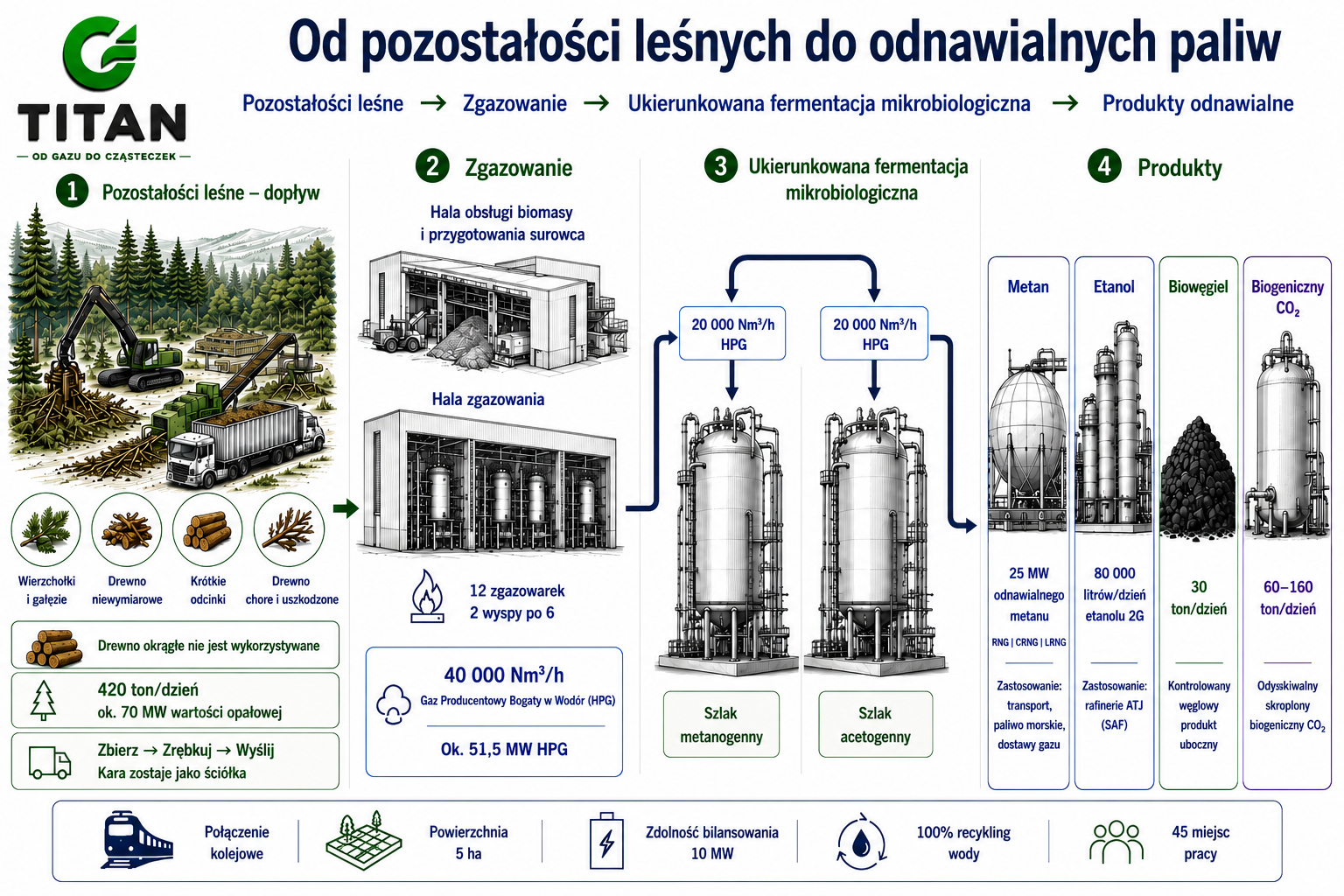
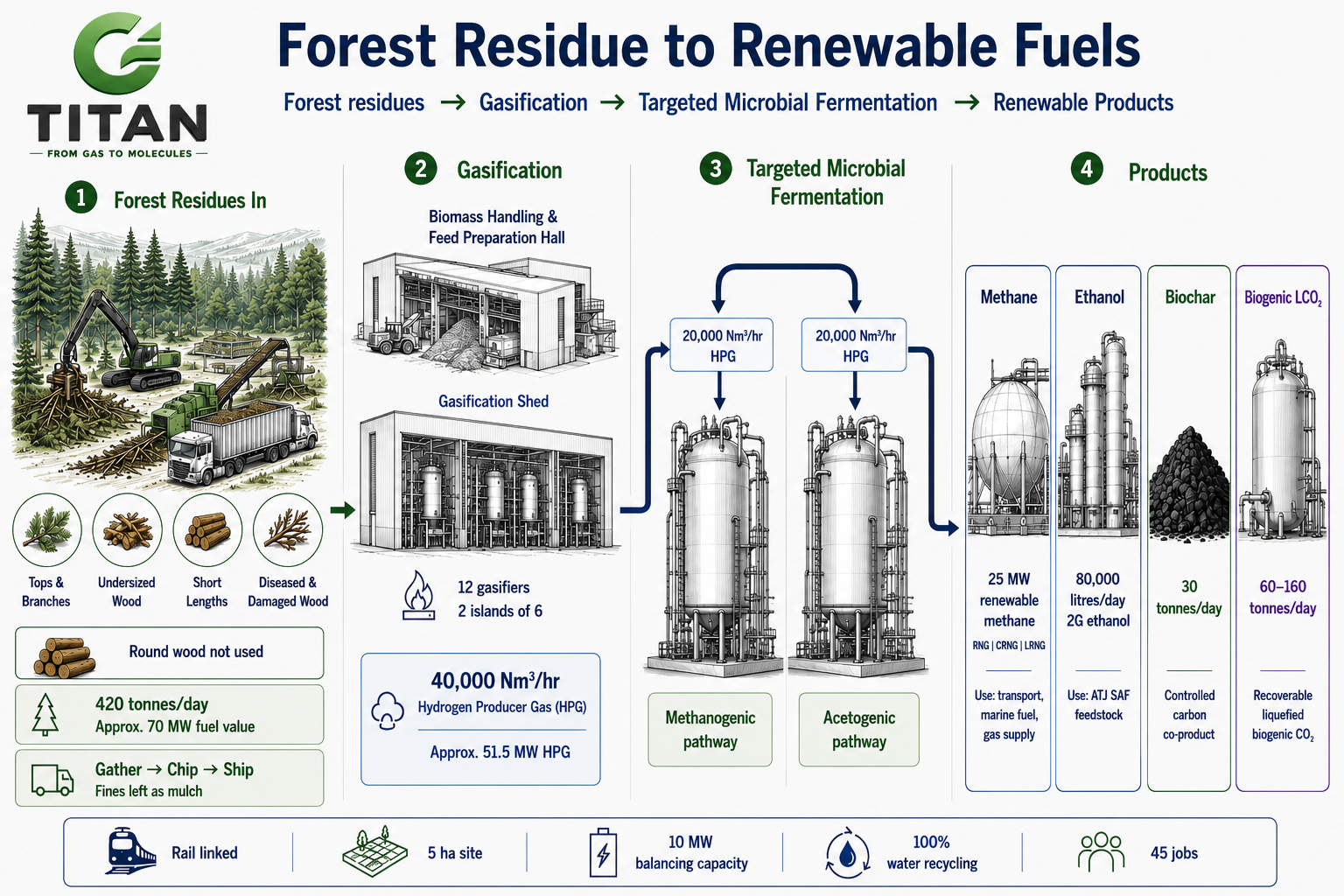
TITAN leverages gasification, biotechnology and Targeted Microbial Fermentation to convert misplaced carbon in forest residues into renewable fuels, materials and commercial value at scale.

Gasification converts forest residues into hydrogen producer gas—HPG—the common currency of the platform. Targeted Microbial Fermentation then directs HPG through the complete fermentation stack: methanogenic, acetogenic and aerobic Microbial Workers.

Swing, Swing, Swing. TITAN can direct HPG between fermentation pathways to produce LRNG, 2G ethanol, proteins, polymers and other valuable products in response to market demand.

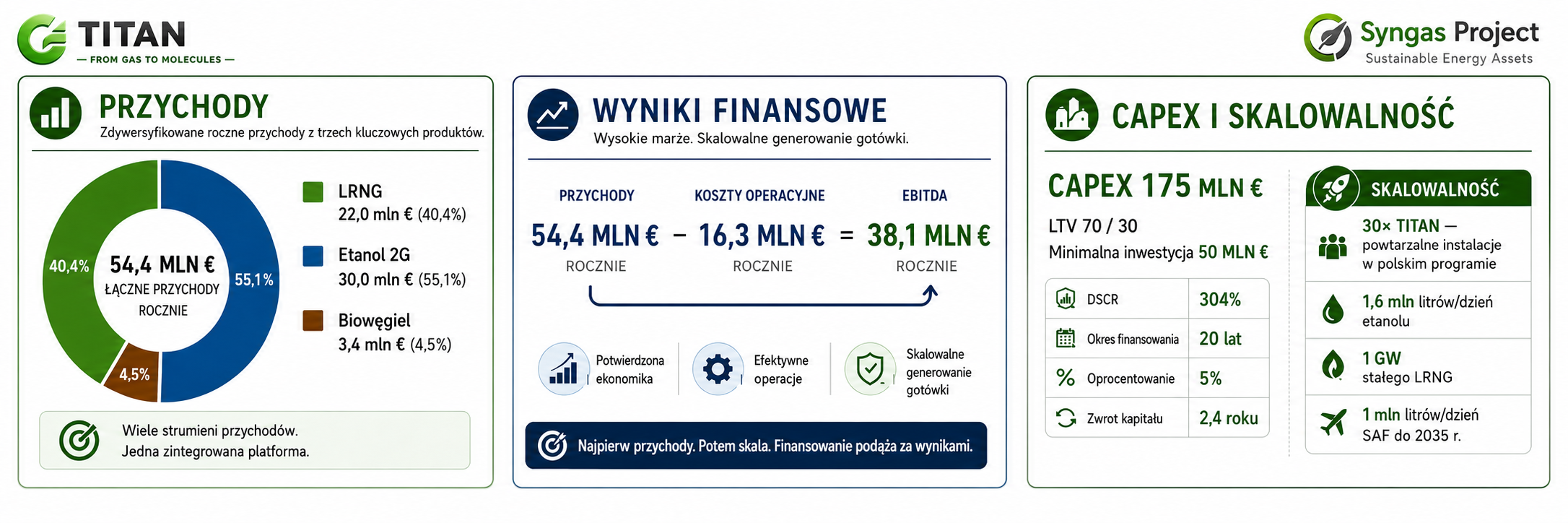
Our priority is to build the first ten TITAN locations in Poland. This roll-out is designed to cross three strategic production thresholds by 2035: 1 GW of constant LRNG, 1.6 million litres of 2G ethanol per day and, through the Alcohol-to-Jet pathway, 1 million litres of SAF per day.

Each TITAN is a repeatable, cookie-cutter platform and the commercial backbone of its CAMPUS. Sister platforms can be added in response to local conditions, extending the Misplaced Carbon Spectrum through shared HPG, utility and fermentation infrastructure—without changing the core TITAN model.

TITAN – Teaser Inwestycyjny

TITAN: Komercyjny kręgosłup CAMPUSU

TITAN wykorzystuje gazyfikację, biotechnologię oraz Ukierunkowaną Fermentację Mikrobiologiczną, aby przekształcać niewłaściwie ulokowany węgiel zawarty w pozostałościach leśnych w odnawialne paliwa, materiały i wartość komercyjną na skalę przemysłową.

Gazyfikacja przekształca pozostałości leśne w wodorowy gaz generatorowy — HPG — będący wspólną walutą platformy. Ukierunkowana Fermentacja Mikrobiologiczna kieruje następnie HPG do pełnego stosu fermentacyjnego: metanogennych, acetogennych i aerobowych Mikrobiologicznych Pracowników.

Swing, Swing, Swing. TITAN może kierować HPG pomiędzy ścieżkami fermentacyjnymi, aby produkować LRNG, etanol 2G, białka, polimery i inne wartościowe produkty zgodnie z zapotrzebowaniem rynku.

Naszym priorytetem jest budowa pierwszych dziesięciu lokalizacji TITAN w Polsce. Program ten został zaprojektowany tak, aby do 2035 roku przekroczyć trzy strategiczne progi produkcyjne: 1 GW stałego LRNG, 1,6 mln litrów etanolu 2G dziennie oraz — poprzez ścieżkę Alcohol-to-Jet — 1 mln litrów SAF dziennie.

Każdy TITAN jest powtarzalną platformą typu cookie-cutter oraz komercyjnym kręgosłupem swojego CAMPUSU. Platformy siostrzane mogą być dodawane odpowiednio do lokalnych warunków, rozszerzając Spektrum Niewłaściwie Ulokowanego Węgla poprzez wspólną infrastrukturę HPG, mediów i fermentacji — bez zmiany podstawowego modelu TITAN.

CUMULUS On Site — Managing the CAMPUS Gas Portfolio

CUMULUS On Site

Our Business Is Gas and Microbes

Every successful industrial company is organised around the capabilities that define its business. Steel companies organise themselves around steel. Chemical companies organise themselves around chemistry. Semiconductor manufacturers organise themselves around silicon.

Syngas Project is no different.

Our business is industrial gases and microbes.

Everything else exists to support those two capabilities.

CUMULUS has two connected roles within the Syngas Project family. It is the platform for gaseous misplaced carbon, and it is the specialist service team responsible for managing industrial gases across every CAMPUS.

This article focuses on the second role: the people, standards and intelligence that protect the common gas system serving all six platforms.

The separate CUMULUS industrial off-gas article explains how external gaseous carbon can enter the wider platform system.

Hydrogen Producer Gas: The Common Currency

Across the Syngas Project portfolio, misplaced carbon is directed towards gasification, gas recovery and Targeted Microbial Fermentation.

Forest residues, municipal resources, agricultural residues, water-treatment materials, industrial gases and legacy carbon may enter the system through different platforms, but they are connected by one common industrial currency:

Meet the AQUIS Team

The AQUIS Team

A Career with a Mission: Making Microplastics, Nanoplastics and PFAS Extinct

Some careers provide employment. Others provide the opportunity to build an industry and confront a problem that humanity cannot afford to ignore.

AQUIS offers both.

We are bringing together water professionals, microbiologists, engineers, laboratory specialists, environmental-service providers and commercial leaders around one clear mission:

To remove microplastics, nanoplastics and PFAS from the public water cycle—making water safer for people and for the microbial systems on which our future will depend.

This is a worthy calling and an expanding business opportunity.

AQUIS will begin by protecting the water and fermentation biology within TITAN. With every new TITAN cluster, the AQUIS water jurisdiction expands. The knowledge, microbial products, filtration systems and trained teams developed at home can then be deployed across regional public-water, wastewater, sludge and anaerobic-digestion markets.

Three major threats

The AQUIS Team is organised around three persistent threats:

  • Microplastics
  • Nanoplastics
  • PFAS

These pollutants are different, but they share one dangerous characteristic: capturing them does not automatically make them disappear.

When they are removed from water, they become concentrated in another material—sewage sludge, AD digestate, spent filtration media, activated carbon or another treatment residue.

If that material is landfilled or spread on land, the contamination has been moved—not eliminated.

AQUIS is being built to complete the entire chain.

The journey from microplastic to nanoplastic

Microplastics do not remain the same size forever.

As plastic particles travel through water, wastewater, biological treatment, pumping, mixing, digestion and the wider environment, they can weather, weaken and fragment. Larger particles become microplastics. Microplastics can then fragment further into nanoplastics.

Nanoplastics are not a separate problem appearing from nowhere. They can be the next stage in the continuing breakdown of plastic already travelling through the system.

Premium SAF Begins with Premium Ethanol

Building Poland’s One-Million-Litre-Plus SAF Industry

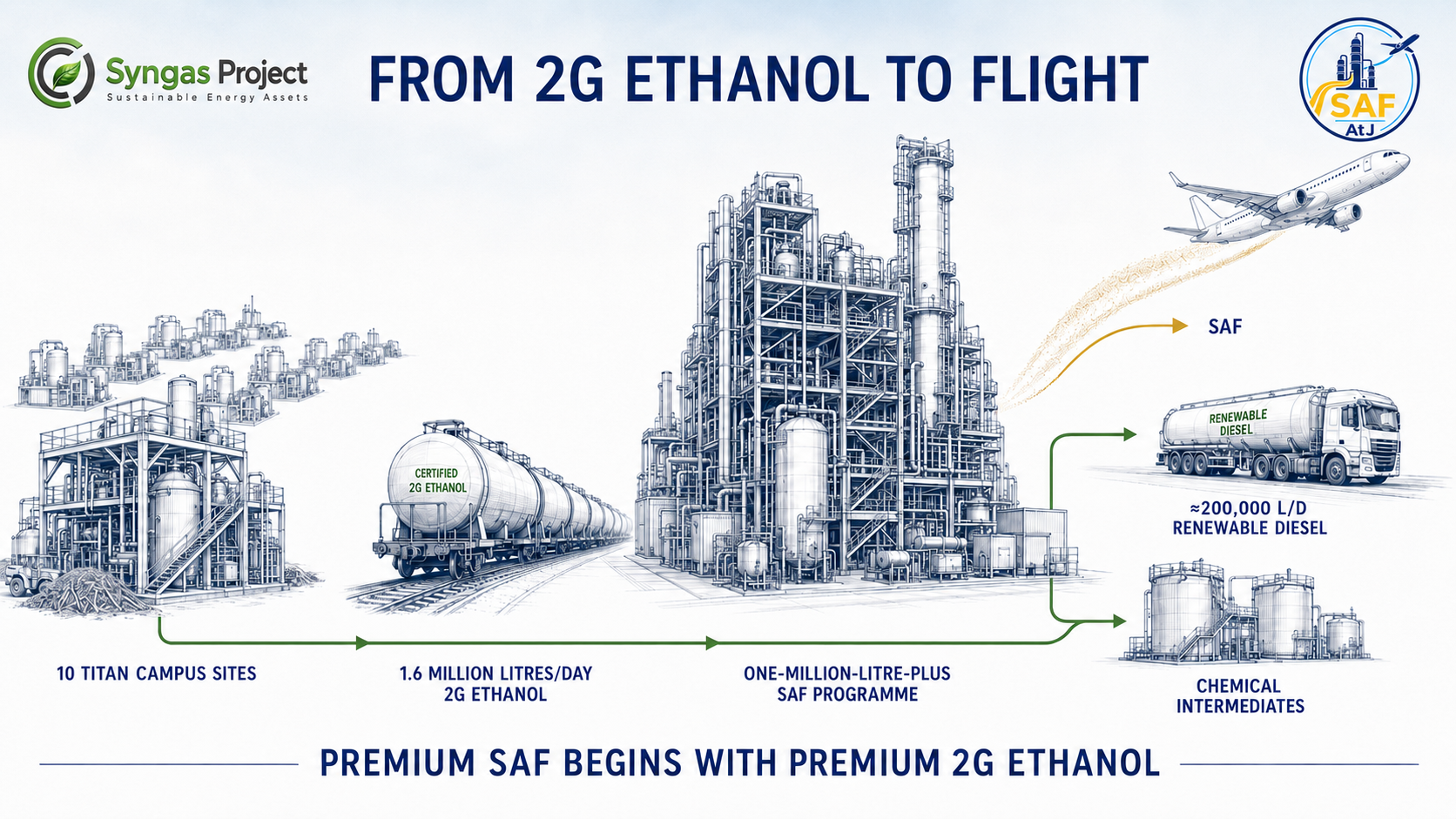
The first ten TITAN Fermentation CAMPUS sites establish two strategic production thresholds: 1 GW of constant renewable methane capacity and 1.6 million litres of second-generation ethanol every day.

The network then grows beyond those first ten sites. Additional TITAN capacity and other qualified ethanol pathways will supply one national-scale Alcohol-to-Jet refinery—or two complementary Polish refinery hubs—producing more than one million litres of Sustainable Aviation Fuel per day.

For Syngas Project, SAF is not an additional product line.

It is our destiny project.

TITAN is being rolled out to create the renewable-carbon, Hydrogen Producer Gas and fermentation infrastructure required to establish a new Polish SAF industry.

National programme targets

National programmeInitial production thresholdExpansion position
Renewable methane1 GW constant capacityExpanded through continued TITAN deployment
2G ethanol from the first ten TITAN sites1,600,000 litres per dayPrincipal AtJ refinery base load
Expanded certified ethanol networkMore than 1,600,000 litres per dayFurther TITAN sites and other qualified pathways
Sustainable Aviation FuelMore than 1,000,000 litres per dayAdditional refinery trains as supply grows
Renewable dieselApproximately 200,000 litres per dayFinal balance determined during technology selection and FEED
Additional productsRenewable naphtha, lighter hydrocarbons and chemical intermediatesFinal quantities determined by the selected refinery configuration

The first ten TITAN sites are the threshold—not the limit.