Warsaw 29:01:2023: 08:16 AM Steve Walker
Coming Soon……..

Warsaw 29:01:2023: 08:16 AM Steve Walker
Coming Soon……..

Warsaw 28:01:2023 8:16 AM Steve Walker
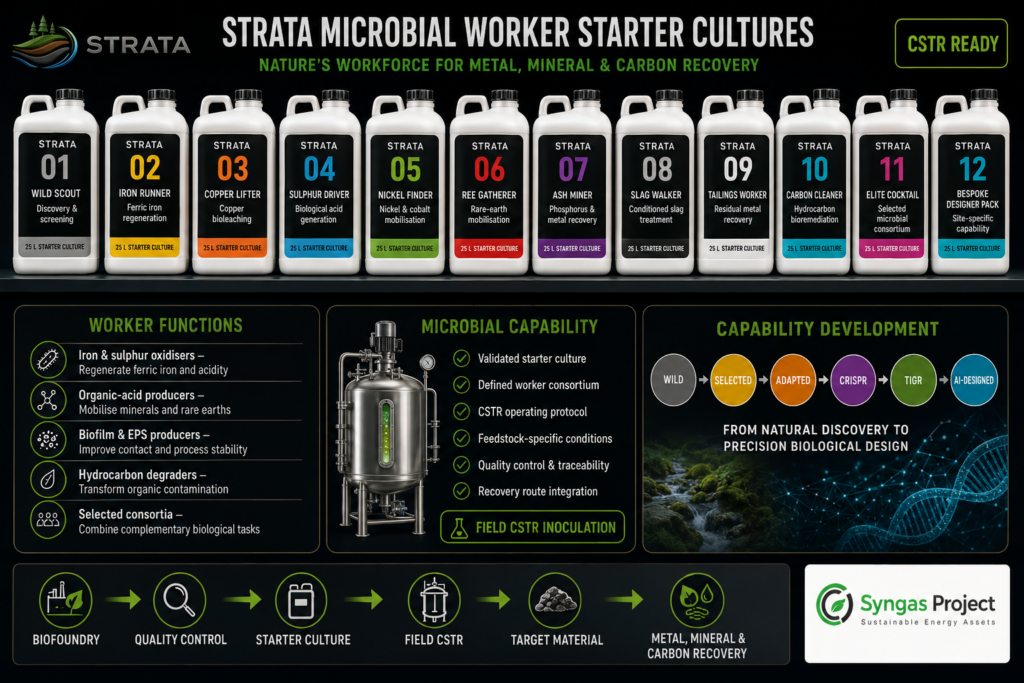
The 25-litre carboys contain validated starter cultures. They are the beginning of the deployment process—not the final field volume. At site, Field CSTRs proliferate the selected workers and progressively supply the PowerCan slurry tanks required for full execution.
From Wild Discovery to AI-Designed Microbial Capability
The materials required for the energy transition are not found only in new mines. Enormous quantities of metals, minerals and useful carbon remain trapped in historic tailings, industrial slag, ash, low-grade ores, contaminated land and other materials that industry has placed outside the productive economy.
STRATA approaches these materials as misplaced resources.
Syngas Project is not a university laboratory, nor do we claim to originate every microbial strain. We are engineers, platform developers, operators and service providers.
Our task is to identify a real industrial problem, define the biological work required and assemble the workers, vessels, power, utilities, controls and recovery systems needed to solve it.
This is where BRAD, our AI Carbon Orchestrator, enters the process.
BRAD connects the scientific originator field with practical industrial applications. It follows advances in microbial discovery, biomining, gene editing, metabolic engineering and artificial intelligence, translating them into capabilities that can be engineered, powered, deployed and measured.
BRAD takes the guesswork out of recovery.
It combines material data, microbial performance, originator progress, field requirements and recovery economics to determine:
BRAD has already participated in numerous workshops with stakeholders examining specific applications. These discussions extend from the mineralogy and chemistry of the target material to the microorganisms, Field CSTRs, slurry tanks, power, fuel, oxygen, water, monitoring and downstream recovery systems required in the field.
BRAD also monitors what microbial originators are working on now and how their development programmes are likely to advance. This includes the expected evolution of the next strains, consortia, enzymes and biological tools—not simply the capabilities already described in published research.
BRAD is already following more than 60 microbial workers and candidate capabilities. As industrial biology expands, this is likely to develop into hundreds of specialist workers addressing increasingly precise materials-recovery and remediation tasks.
Warsaw 21:01:2022 08:16 AM Steve Walker
TITAN: The Commercial Backbone of the CAMPUS
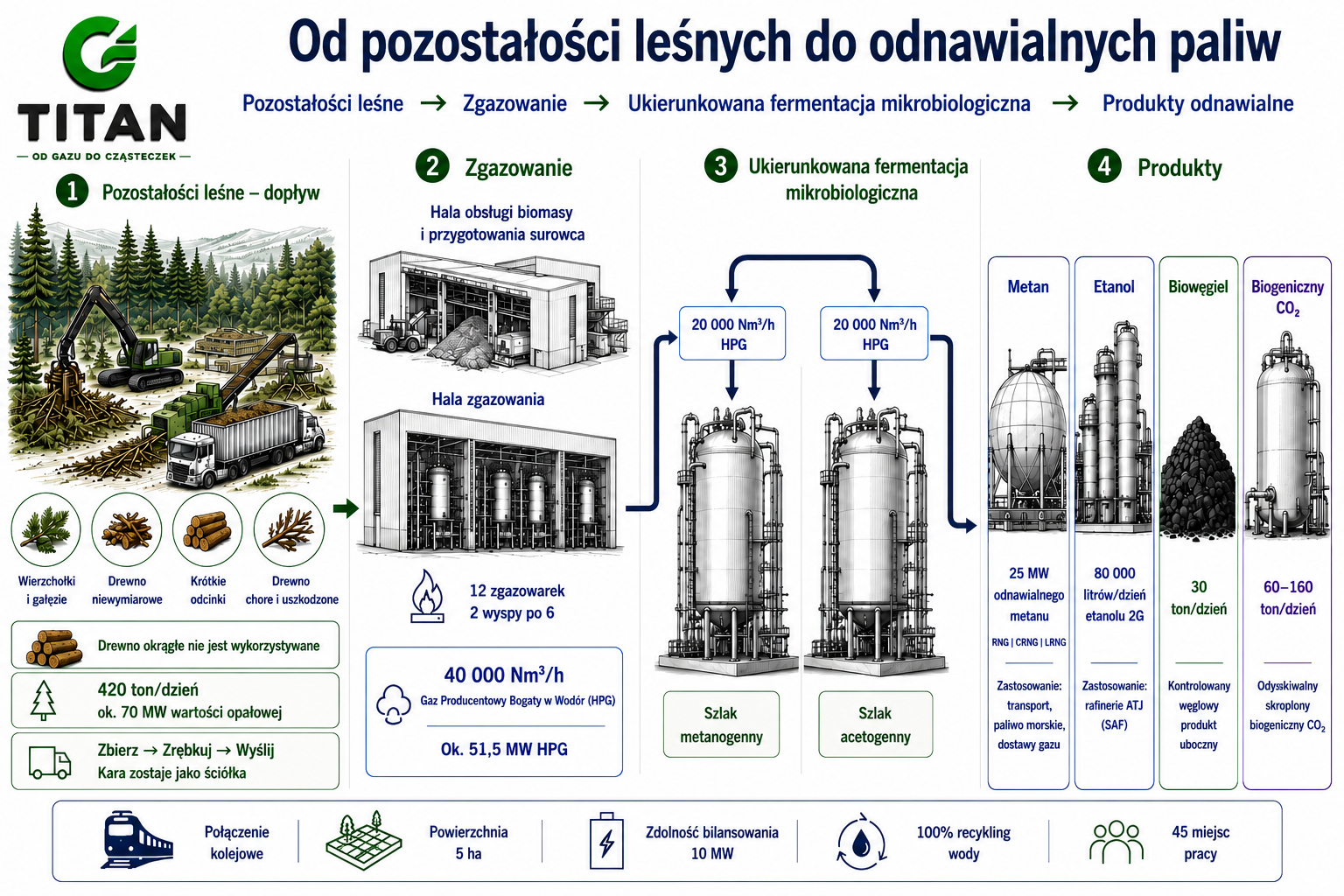
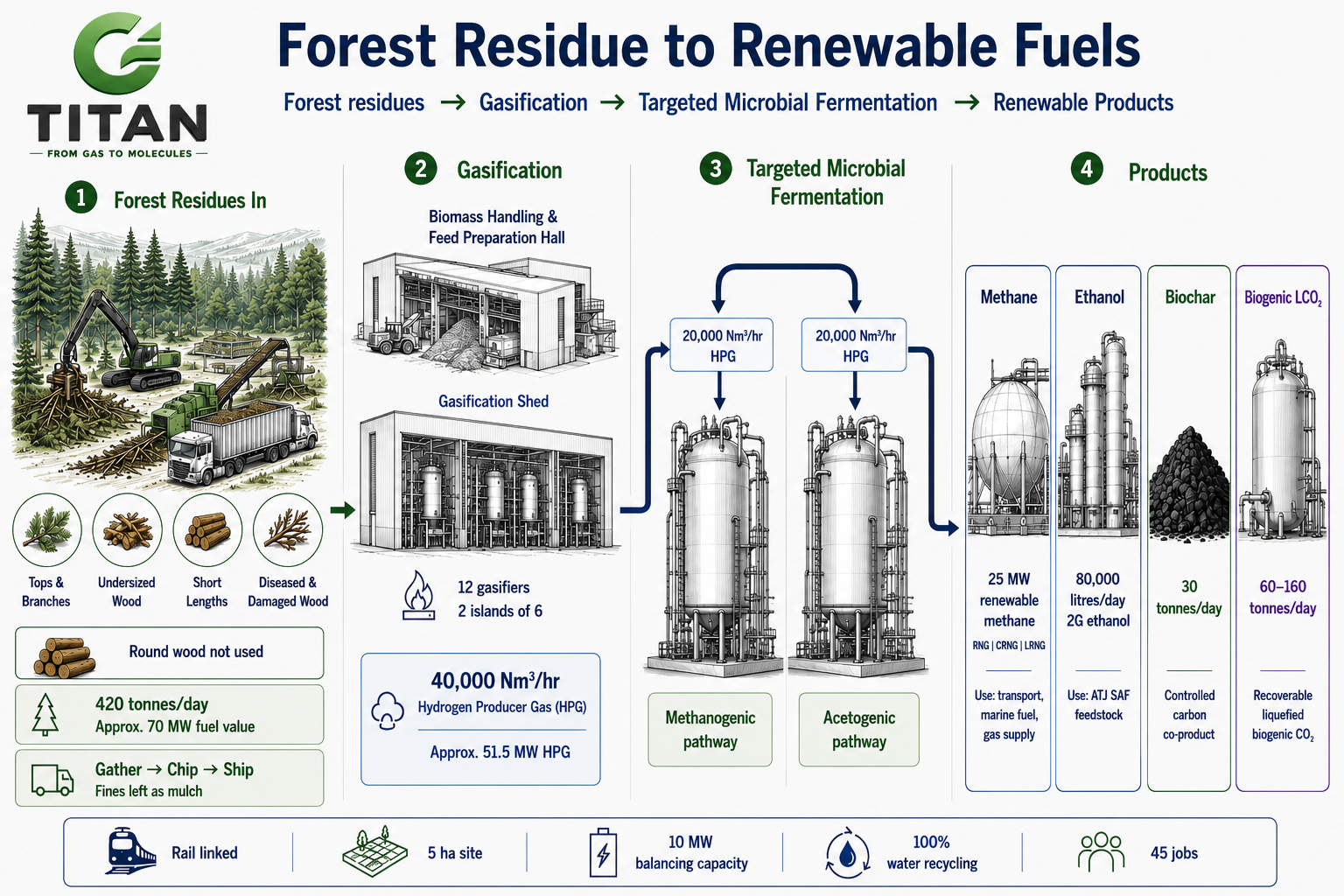
TITAN leverages gasification, biotechnology and Targeted Microbial Fermentation to convert misplaced carbon in forest residues into renewable fuels, materials and commercial value at scale.
Gasification converts forest residues into hydrogen producer gas—HPG—the common currency of the platform. Targeted Microbial Fermentation then directs HPG through the complete fermentation stack: methanogenic, acetogenic and aerobic Microbial Workers.
Swing, Swing, Swing. TITAN can direct HPG between fermentation pathways to produce LRNG, 2G ethanol, proteins, polymers and other valuable products in response to market demand.
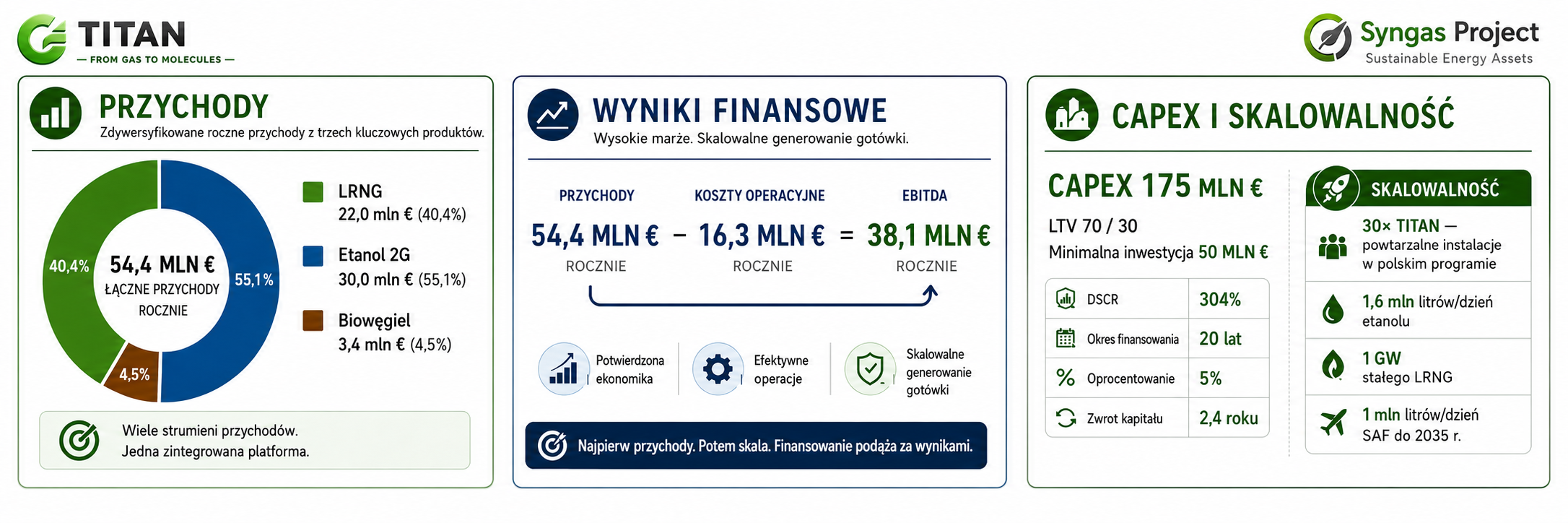
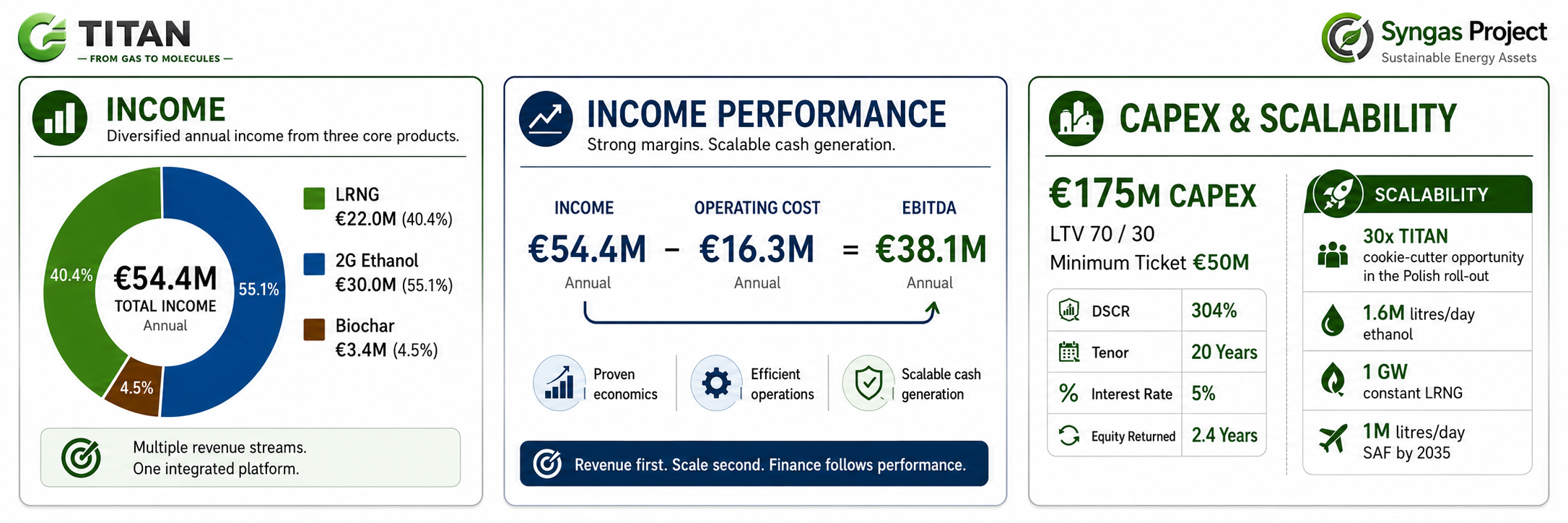
Our priority is to build the first ten TITAN locations in Poland. This roll-out is designed to cross three strategic production thresholds by 2035: 1 GW of constant LRNG, 1.6 million litres of 2G ethanol per day and, through the Alcohol-to-Jet pathway, 1 million litres of SAF per day.
Each TITAN is a repeatable, cookie-cutter platform and the commercial backbone of its CAMPUS. Sister platforms can be added in response to local conditions, extending the Misplaced Carbon Spectrum through shared HPG, utility and fermentation infrastructure—without changing the core TITAN model.

www.solideagrouptitan.com

Warsaw 21:01:2022 08:12 AM Steve Walker
TITAN: Komercyjny kręgosłup CAMPUSU
TITAN wykorzystuje gazyfikację, biotechnologię oraz Ukierunkowaną Fermentację Mikrobiologiczną, aby przekształcać niewłaściwie ulokowany węgiel zawarty w pozostałościach leśnych w odnawialne paliwa, materiały i wartość komercyjną na skalę przemysłową.
Gazyfikacja przekształca pozostałości leśne w wodorowy gaz generatorowy — HPG — będący wspólną walutą platformy. Ukierunkowana Fermentacja Mikrobiologiczna kieruje następnie HPG do pełnego stosu fermentacyjnego: metanogennych, acetogennych i aerobowych Mikrobiologicznych Pracowników.
Swing, Swing, Swing. TITAN może kierować HPG pomiędzy ścieżkami fermentacyjnymi, aby produkować LRNG, etanol 2G, białka, polimery i inne wartościowe produkty zgodnie z zapotrzebowaniem rynku.
Naszym priorytetem jest budowa pierwszych dziesięciu lokalizacji TITAN w Polsce. Program ten został zaprojektowany tak, aby do 2035 roku przekroczyć trzy strategiczne progi produkcyjne: 1 GW stałego LRNG, 1,6 mln litrów etanolu 2G dziennie oraz — poprzez ścieżkę Alcohol-to-Jet — 1 mln litrów SAF dziennie.
Każdy TITAN jest powtarzalną platformą typu cookie-cutter oraz komercyjnym kręgosłupem swojego CAMPUSU. Platformy siostrzane mogą być dodawane odpowiednio do lokalnych warunków, rozszerzając Spektrum Niewłaściwie Ulokowanego Węgla poprzez wspólną infrastrukturę HPG, mediów i fermentacji — bez zmiany podstawowego modelu TITAN.

www.solideagrouptitan.com

Warsaw 18:06:2021 08:16 AM Steve Walker (Revised 2026)
CUMULUS On Site
Our Business Is Gas and Microbes
Every successful industrial company is organised around the capabilities that define its business. Steel companies organise themselves around steel. Chemical companies organise themselves around chemistry. Semiconductor manufacturers organise themselves around silicon.
Syngas Project is no different.
Our business is industrial gases and microbes.
Everything else exists to support those two capabilities.
CUMULUS has two connected roles within the Syngas Project family. It is the platform for gaseous misplaced carbon, and it is the specialist service team responsible for managing industrial gases across every CAMPUS.
This article focuses on the second role: the people, standards and intelligence that protect the common gas system serving all six platforms.
The separate CUMULUS industrial off-gas article explains how external gaseous carbon can enter the wider platform system.
Hydrogen Producer Gas: The Common Currency
Across the Syngas Project portfolio, misplaced carbon is directed towards gasification, gas recovery and Targeted Microbial Fermentation.
Forest residues, municipal resources, agricultural residues, water-treatment materials, industrial gases and legacy carbon may enter the system through different platforms, but they are connected by one common industrial currency:

Warsaw 02:02:2020 08:16 AM Steve Walker (Revised 2026)
Building Poland’s One-Million-Litre-Plus SAF Industry
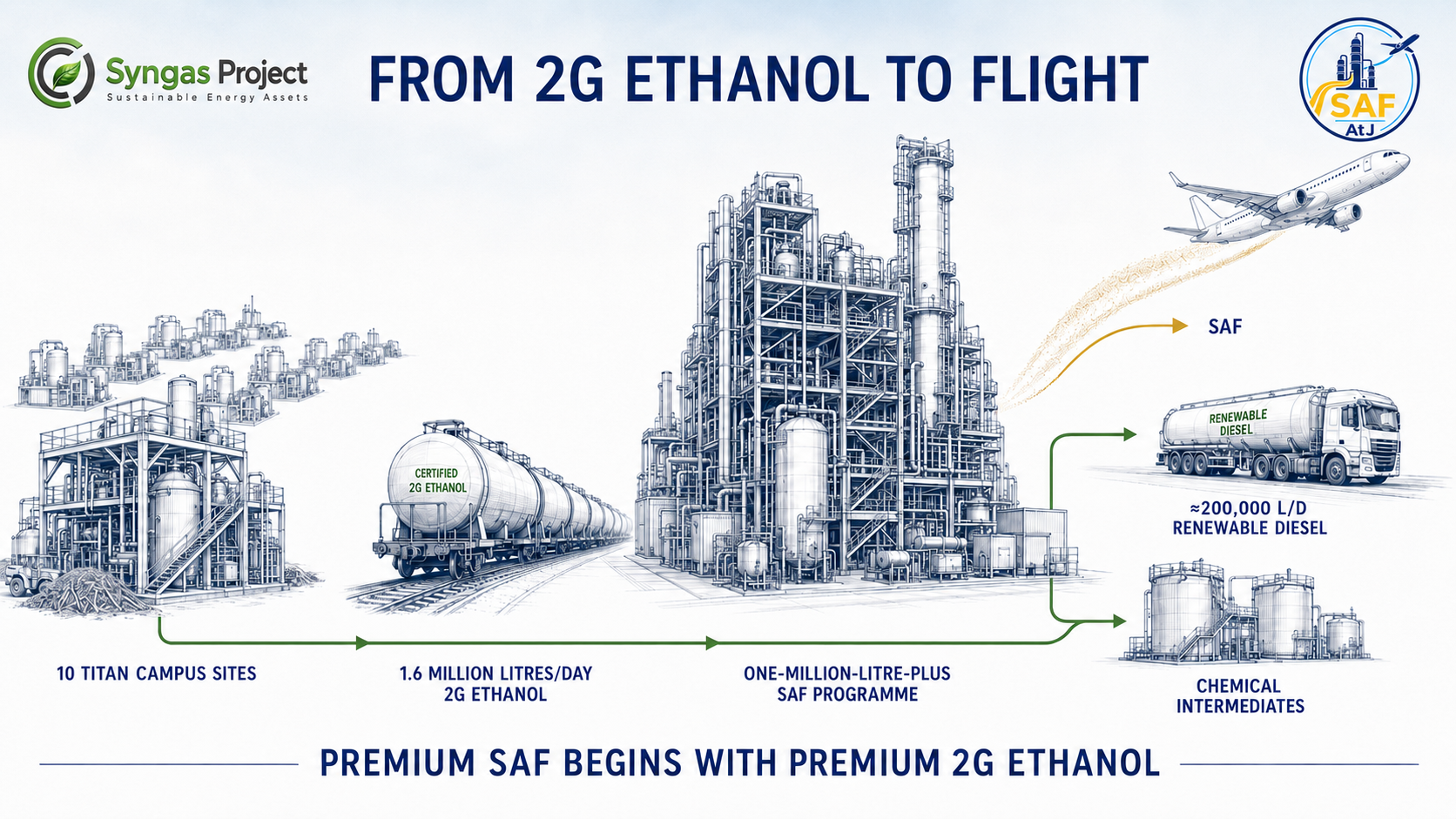
The first ten TITAN Fermentation CAMPUS sites establish two strategic production thresholds: 1 GW of constant renewable methane capacity and 1.6 million litres of second-generation ethanol every day.
The network then grows beyond those first ten sites. Additional TITAN capacity and other qualified ethanol pathways will supply one national-scale Alcohol-to-Jet refinery—or two complementary Polish refinery hubs—producing more than one million litres of Sustainable Aviation Fuel per day.
For Syngas Project, SAF is not an additional product line.
It is our destiny project.
TITAN is being rolled out to create the renewable-carbon, Hydrogen Producer Gas and fermentation infrastructure required to establish a new Polish SAF industry.
National programme targets
| National programme | Initial production threshold | Expansion position |
| Renewable methane | 1 GW constant capacity | Expanded through continued TITAN deployment |
| 2G ethanol from the first ten TITAN sites | 1,600,000 litres per day | Principal AtJ refinery base load |
| Expanded certified ethanol network | More than 1,600,000 litres per day | Further TITAN sites and other qualified pathways |
| Sustainable Aviation Fuel | More than 1,000,000 litres per day | Additional refinery trains as supply grows |
| Renewable diesel | Approximately 200,000 litres per day | Final balance determined during technology selection and FEED |
| Additional products | Renewable naphtha, lighter hydrocarbons and chemical intermediates | Final quantities determined by the selected refinery configuration |
The first ten TITAN sites are the threshold—not the limit.