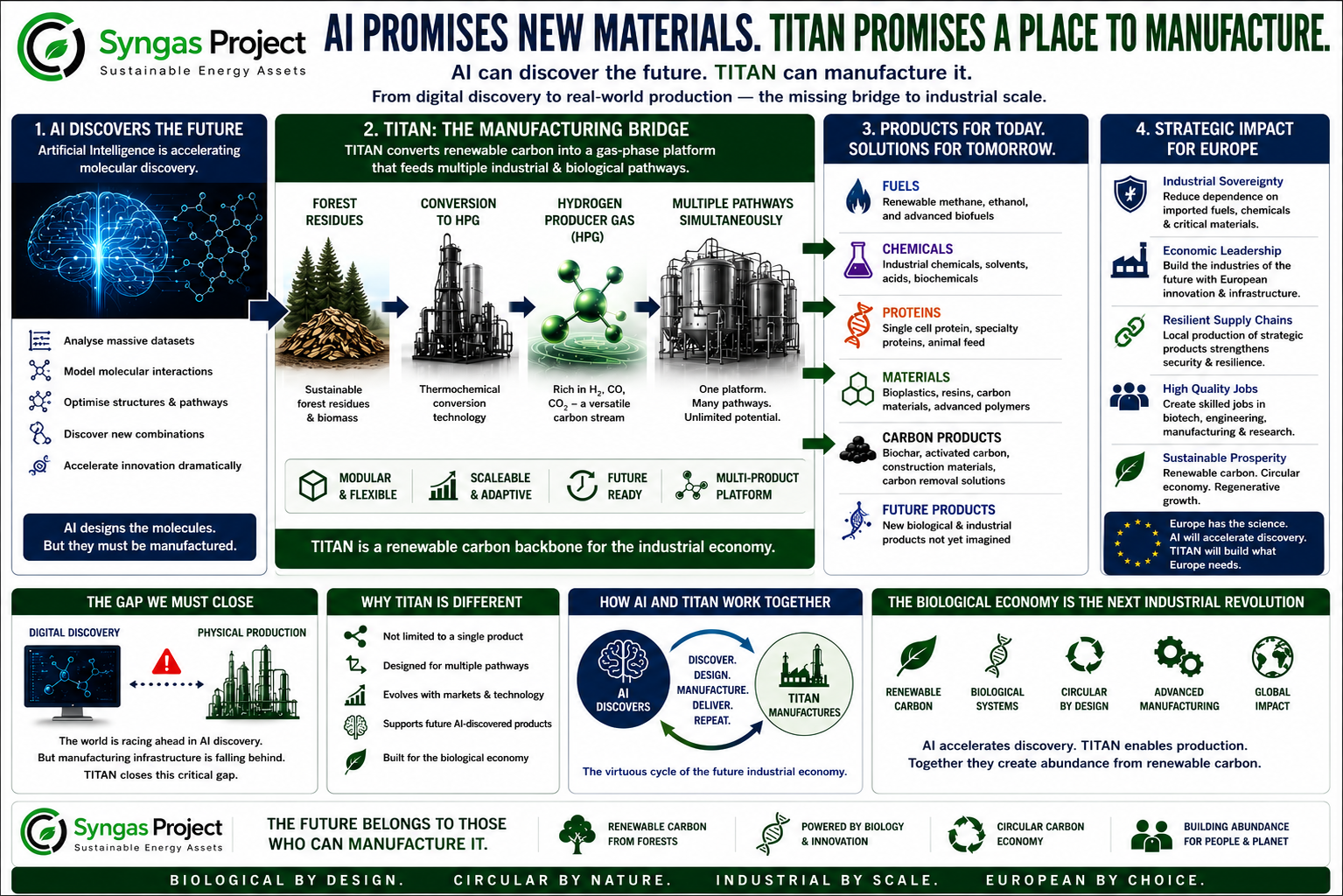
AI Promises New Materials. TITAN Promises a Place to Manufacture Them

Publish Date: 2 May 2026

(Przewiń w dół, aby zobaczyć wersję polską.)

Artificial intelligence is beginning to change chemistry faster than most people realise.

For decades, discovering new materials, biological pathways and industrial compounds was slow, expensive and uncertain. Research teams could spend years testing molecules, enzymes and formulations with limited success.

That is changing rapidly.

Artificial intelligence can now analyse enormous quantities of chemical, biological and material data simultaneously. It can model interactions, optimise molecular structures and identify entirely new combinations far faster than traditional research methods.

The implications are enormous.

AI may help discover:

New fuels.
New plastics.
New proteins.
New medicines.
New industrial chemicals.
New biological materials.
New agricultural systems.
New carbon products.

Governments and technology companies are investing billions into this transition because whoever controls the next generation of materials and molecules may help define the next industrial economy.

But there is a problem.

Discovery alone does not create industry.

A molecule discovered by artificial intelligence still needs to be manufactured physically, economically and at scale.

This is where the conversation becomes industrial rather than digital.

The world is rapidly building artificial intelligence systems capable of designing future products. But the physical infrastructure capable of manufacturing those products is developing far more slowly.

This creates a growing gap between digital discovery and real-world production.
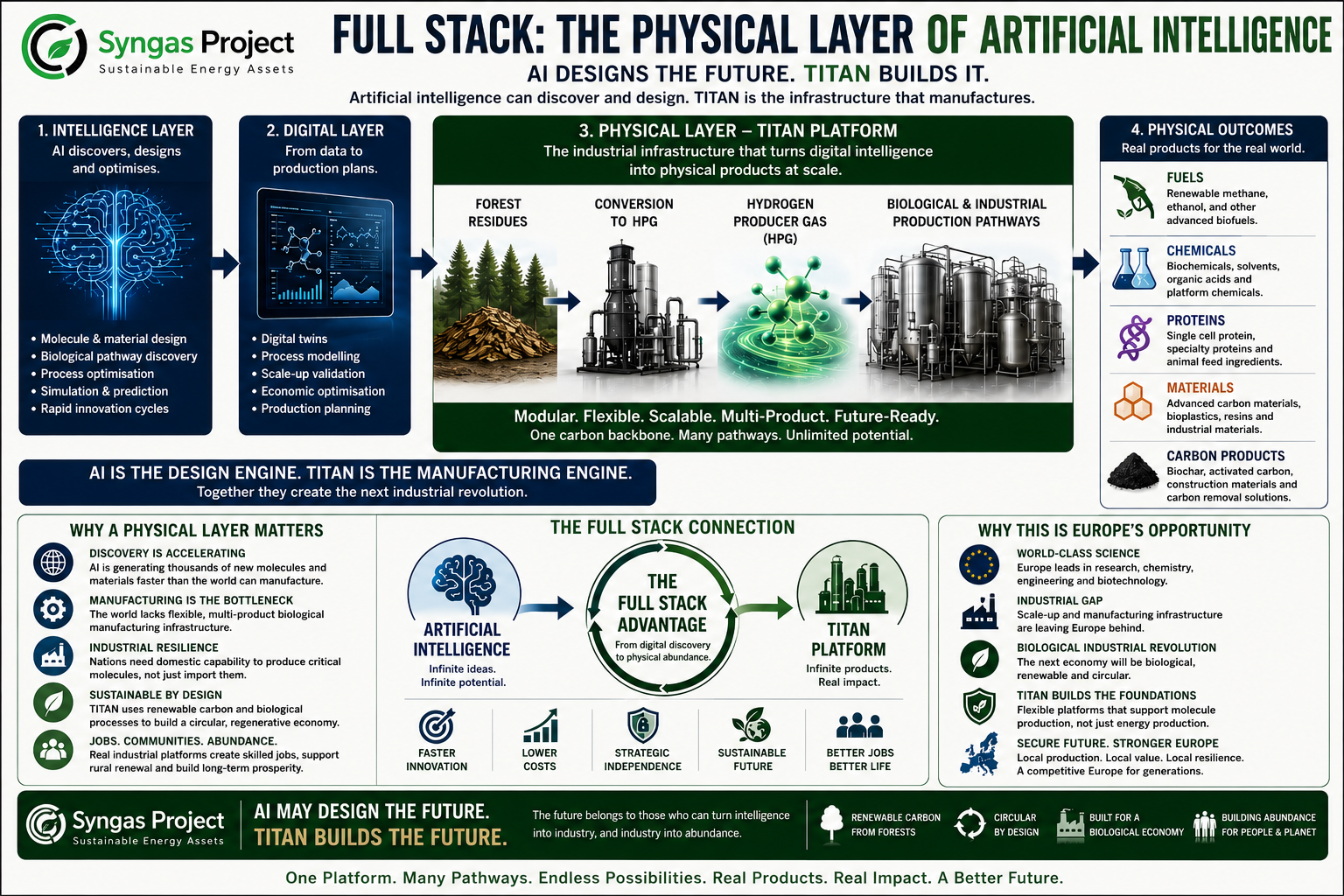
Full Stack: The Physical Layer of Artificial Intelligence

Publish Date: 2 May 2026

(Przewiń w dół, aby zobaczyć wersję polską.)

Artificial intelligence is rapidly becoming the defining technology race of the 21st century.

Every week brings announcements about larger models, faster processors, more capable software agents and increasingly advanced machine reasoning systems. Governments are investing billions. Technology companies are competing for dominance. Data centres are expanding across the world at extraordinary speed.

Most discussion focuses on computation.

But very little discussion focuses on what artificial intelligence ultimately needs in the physical world.

Because intelligence alone does not manufacture anything.

Artificial intelligence can design molecules.
It can optimise biological pathways.
It can simulate new materials.
It can improve industrial systems.
It can accelerate chemistry and biotechnology research.

But eventually, something physical must manufacture the result.

This is where the next industrial bottleneck may emerge.

The future may not belong only to countries that control computation.

It may also belong to countries that control biological manufacturing platforms capable of turning digital intelligence into physical products.

That distinction is becoming increasingly important.

Artificial intelligence is already beginning to transform chemistry, material science, pharmaceutical research, biological engineering and industrial process optimisation. The speed of discovery is accelerating dramatically. New materials, proteins, enzymes, carbon structures and biological production pathways are being identified faster than traditional industrial systems can adapt.

But discovery is only one half of the equation.

Manufacturing remains the other half.

TITAN next generation ethanol and the decarbonisation of our skies

Revised: Steve Walker 20.04.2025

TITAN: Next-Generation Ethanol and the Decarbonisation of Our Skies

As aviation and transport fuel regulations tighten across Europe, second-generation ethanol (2G EtOH) has emerged as a cornerstone in the EU’s clean fuel strategy. At the heart of this transition is TITAN, a bio-engineering platform that transforms forest waste into renewable fuel, replacing petroleum-based inputs with high-value, low-emission alternatives.

TITAN is not just a plant — it is a statement of intent. It reflects a deep commitment to energy sovereignty, local feedstock utilisation, and a truly circular economy. It also represents a strategic leap forward for Poland’s aviation sector, offering a domestic solution to one of Europe’s most urgent climate compliance challenges.

2G Ethanol: The Core of TITAN’s Mission

TITAN’s primary objective is the production of advanced, non-food-based 2G EtOH, sourced entirely from waste forest biomass. This includes residues left on the forest floor, non-virgin woody biomass, and materials historically destined for landfilling or low-grade combustion.

Using a proprietary Hydrogen Producer Gas (HPG) to Targeted Microbial Fermentation (TMF) process, TITAN extracts renewable carbon and hydrogen from biomass, converting it into 2G EtOH with near-zero refinery emissions and no fossil fuel input. The platform’s dual HPG island architecture ensures continuous and decentralised gas supply for both electricity/heat and fermentation feedstock.

This modular structure allows TITAN to function as a standalone, grid-independent, smoke-free, zero-coal facility, setting a new benchmark for carbon-negative industrial energy systems.

SAF Rollout and the Alcohol-to-Jet Pathway

The second phase of TITAN’s rollout will focus on producing Sustainable Aviation Fuel (SAF) through the Alcohol-to-Jet (AtJ) pathway. The AtJ process refines TITAN’s 2G ethanol into Jet-A1 compliant, drop-in aviation fuel, ready to blend at refuelling depots across Europe. The first ten TITAN installations produce enough 2G EtOH to supply an AtJ refinery producing Jet-A1 and Biodeisel

This development is perfectly aligned with the ReFuelEU Aviation Regulation, which mandates all EU airports begin blending sustainable aviation fuels starting at 2% in 2025, rising to 6% in 2030, 20% by 2035, and 28% by 2050. Airlines that do not comply must pay penalties.

TITAN’s SAF production will therefore not only enable Polish airlines to comply — it will allow them to lead. By producing SAF locally, Poland can secure its own fuel supply, reduce its carbon intensity per flight, and offer intercontinental connections from a net-zero baseline.