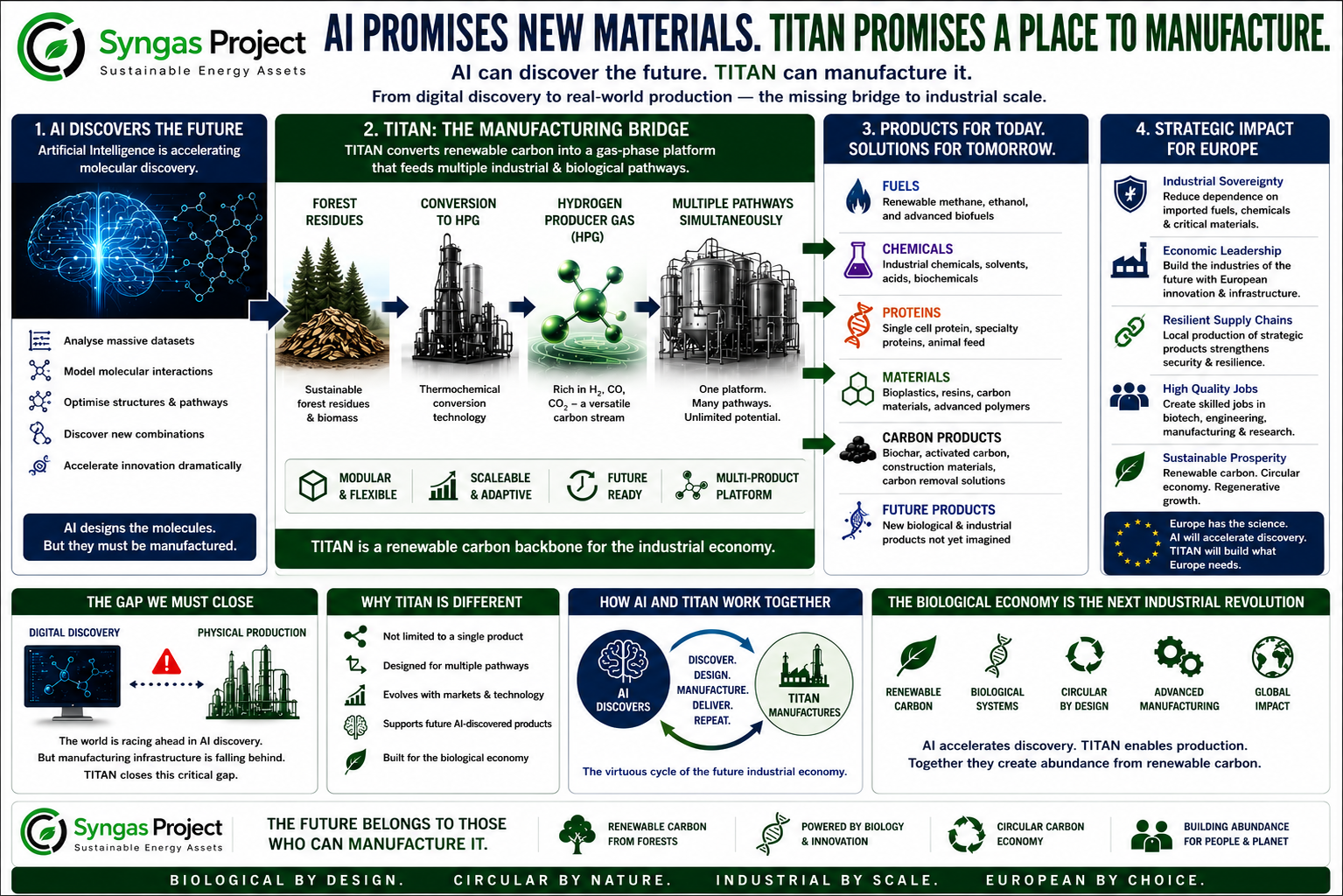
AI Promises New Materials. TITAN Promises a Place to Manufacture Them

Artificial intelligence is beginning to change chemistry faster than most people realise.

For decades, discovering new materials, biological pathways and industrial compounds was slow, expensive and uncertain. Research teams could spend years testing molecules, enzymes and formulations with limited success.

That is changing rapidly.

Artificial intelligence can now analyse enormous quantities of chemical, biological and material data simultaneously. It can model interactions, optimise molecular structures and identify entirely new combinations far faster than traditional research methods.

The implications are enormous.

AI may help discover:

New fuels.
New plastics.
New proteins.
New medicines.
New industrial chemicals.
New biological materials.
New agricultural systems.
New carbon products.

Governments and technology companies are investing billions into this transition because whoever controls the next generation of materials and molecules may help define the next industrial economy.

But there is a problem.

Discovery alone does not create industry.

A molecule discovered by artificial intelligence still needs to be manufactured physically, economically and at scale.

This is where the conversation becomes industrial rather than digital.

The world is rapidly building artificial intelligence systems capable of designing future products. But the physical infrastructure capable of manufacturing those products is developing far more slowly.

This creates a growing gap between digital discovery and real-world production.
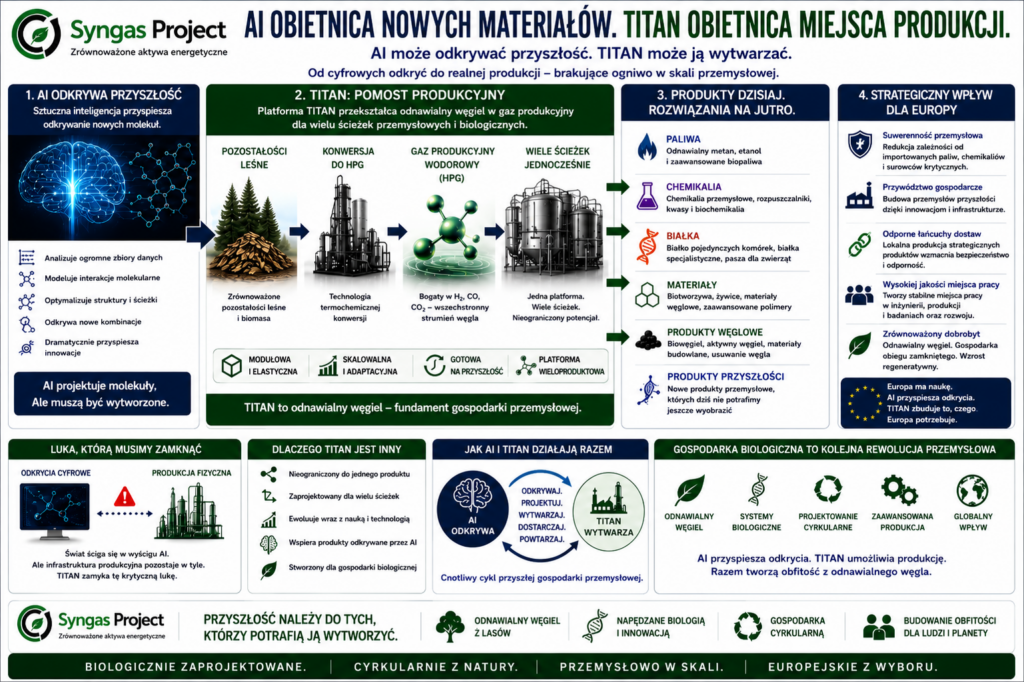
AI Obiecuje Nowe Materiały. TITAN Oferuje Miejsce do Ich Produkcji

Sztuczna inteligencja zaczyna zmieniać chemię szybciej, niż większość ludzi zdaje sobie z tego sprawę.

Przez dekady odkrywanie nowych materiałów, ścieżek biologicznych i związków przemysłowych było powolne, kosztowne i niepewne. Zespoły badawcze mogły spędzać lata na testowaniu molekuł, enzymów i formulacji z ograniczonym powodzeniem.

To szybko się zmienia.

Sztuczna inteligencja potrafi dziś analizować ogromne ilości danych chemicznych, biologicznych i materiałowych jednocześnie. Może modelować interakcje, optymalizować struktury molekularne i identyfikować zupełnie nowe kombinacje znacznie szybciej niż tradycyjne metody badawcze.

Konsekwencje są ogromne.

AI może pomóc odkrywać:

Nowe paliwa.
Nowe tworzywa sztuczne.
Nowe białka.
Nowe leki.
Nowe chemikalia przemysłowe.
Nowe materiały biologiczne.
Nowe systemy rolnicze.
Nowe produkty węglowe.

Rządy i firmy technologiczne inwestują miliardy w tę transformację, ponieważ ci, którzy będą kontrolować następną generację materiałów i molekuł, mogą współtworzyć następną gospodarkę przemysłową.

Ale istnieje problem.

Samo odkrycie nie tworzy przemysłu.

Molekuła odkryta przez sztuczną inteligencję nadal musi zostać wyprodukowana fizycznie, ekonomicznie i w dużej skali.

W tym miejscu rozmowa staje się przemysłowa, a nie cyfrowa.

Świat bardzo szybko buduje systemy sztucznej inteligencji zdolne projektować produkty przyszłości. Jednak fizyczna infrastruktura zdolna do ich produkcji rozwija się znacznie wolniej.

Tworzy to rosnącą lukę pomiędzy cyfrowym odkrywaniem a rzeczywistą produkcją.

Syngas Project uważa, że ta luka może stać się jedną z najważniejszych szans przemysłowych następnego pokolenia.

Ponieważ TITAN nie jest wyłącznie platformą energetyczną.

Jest platformą odnawialnej produkcji węglowej.

Proces TITAN rozpoczyna się od konwersji pozostałości leśnych w Hydrogen Producer Gas (HPG). Tworzy to stabilny gazowy strumień węgla bogaty w wodór, tlenek węgla i dwutlenek węgla. Ten strumień może następnie jednocześnie zasilać wiele ścieżek przemysłowych i biologicznych.

Dziś ścieżki te koncentrują się głównie na produkcji odnawialnego metanu i etanolu.

Jutro te same ścieżki mogą wspierać całkowicie nowe klasy produktów biologicznych i przemysłowych.

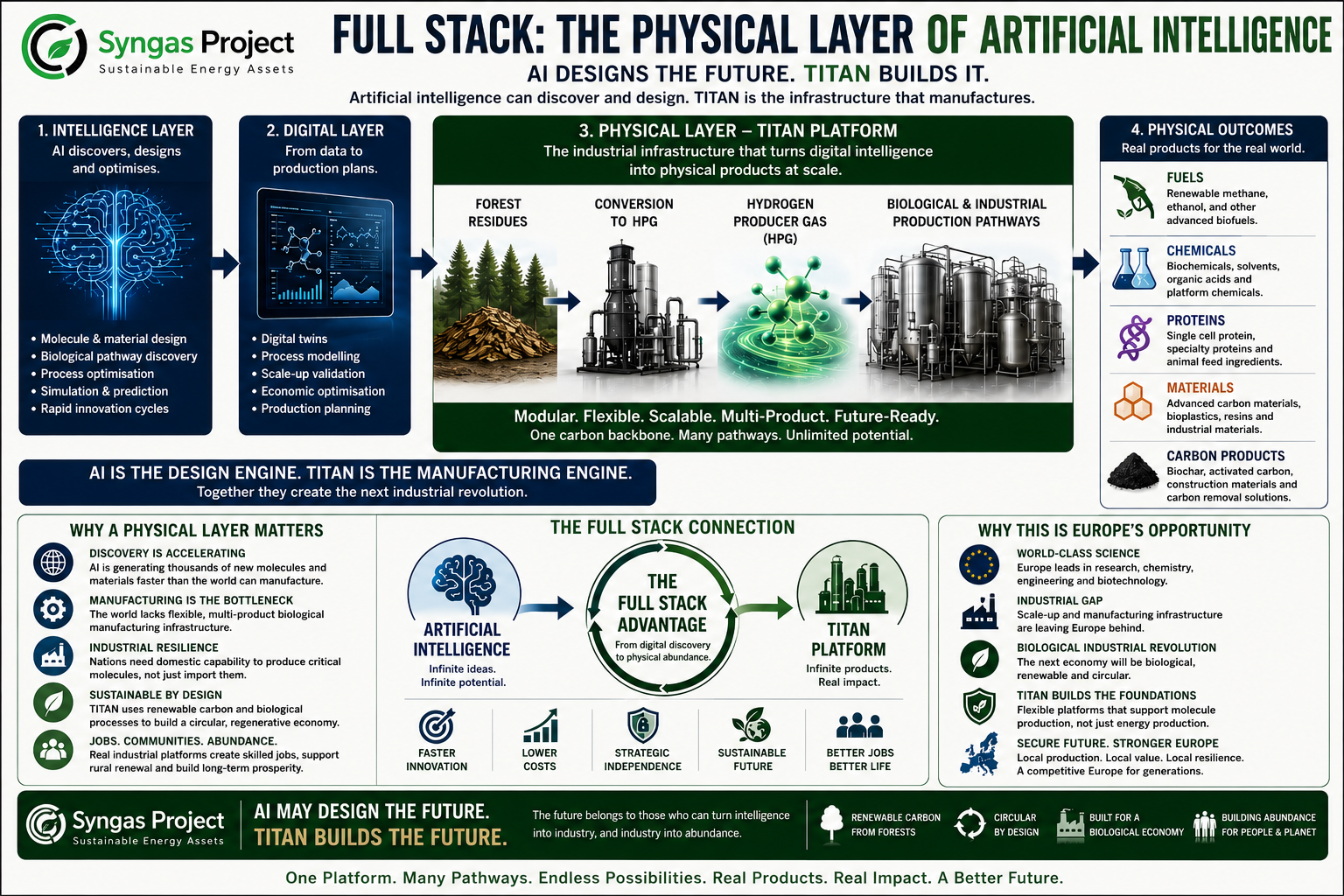
Full Stack: The Physical Layer of Artificial Intelligence

Artificial intelligence is rapidly becoming the defining technology race of the 21st century.

Every week brings announcements about larger models, faster processors, more capable software agents and increasingly advanced machine reasoning systems. Governments are investing billions. Technology companies are competing for dominance. Data centres are expanding across the world at extraordinary speed.

Most discussion focuses on computation.

But very little discussion focuses on what artificial intelligence ultimately needs in the physical world.

Because intelligence alone does not manufacture anything.

Artificial intelligence can design molecules.
It can optimise biological pathways.
It can simulate new materials.
It can improve industrial systems.
It can accelerate chemistry and biotechnology research.

But eventually, something physical must manufacture the result.

This is where the next industrial bottleneck may emerge.

The future may not belong only to countries that control computation.

It may also belong to countries that control biological manufacturing platforms capable of turning digital intelligence into physical products.

That distinction is becoming increasingly important.

Artificial intelligence is already beginning to transform chemistry, material science, pharmaceutical research, biological engineering and industrial process optimisation. The speed of discovery is accelerating dramatically. New materials, proteins, enzymes, carbon structures and biological production pathways are being identified faster than traditional industrial systems can adapt.

But discovery is only one half of the equation.

Manufacturing remains the other half.