Warsaw 01:02:2024 08:08 AM Steve Walker (Updated 2026)
Coming Soon …..
Warsaw 01:02:2024 08:08 AM Steve Walker (Updated 2026)
Coming Soon …..
Warsaw 02:02:2023 08:16 AM Steve Walker
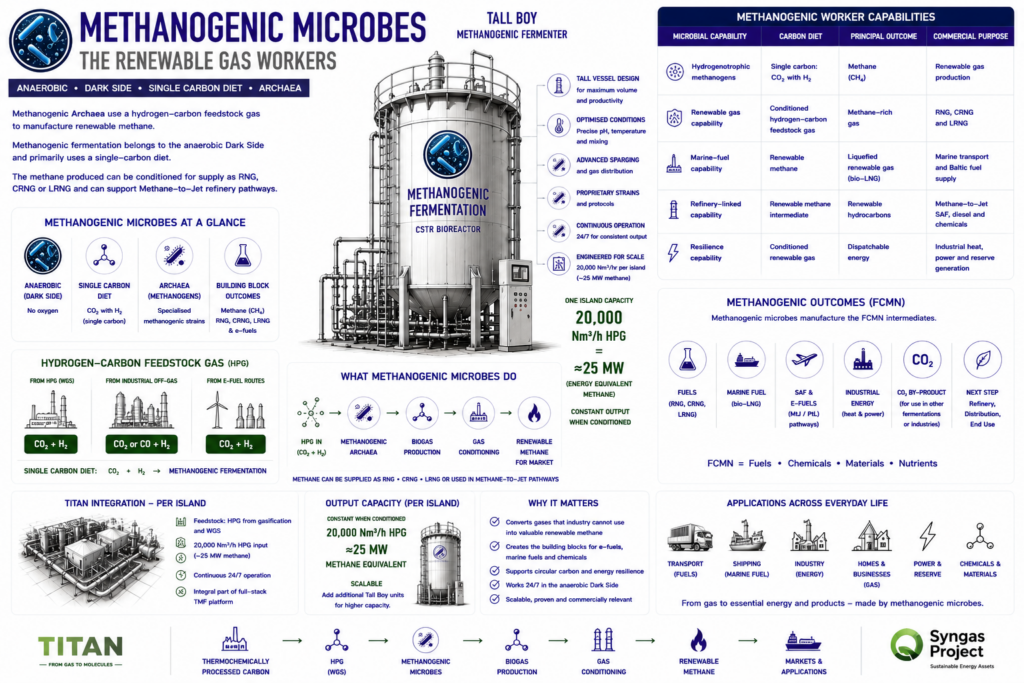
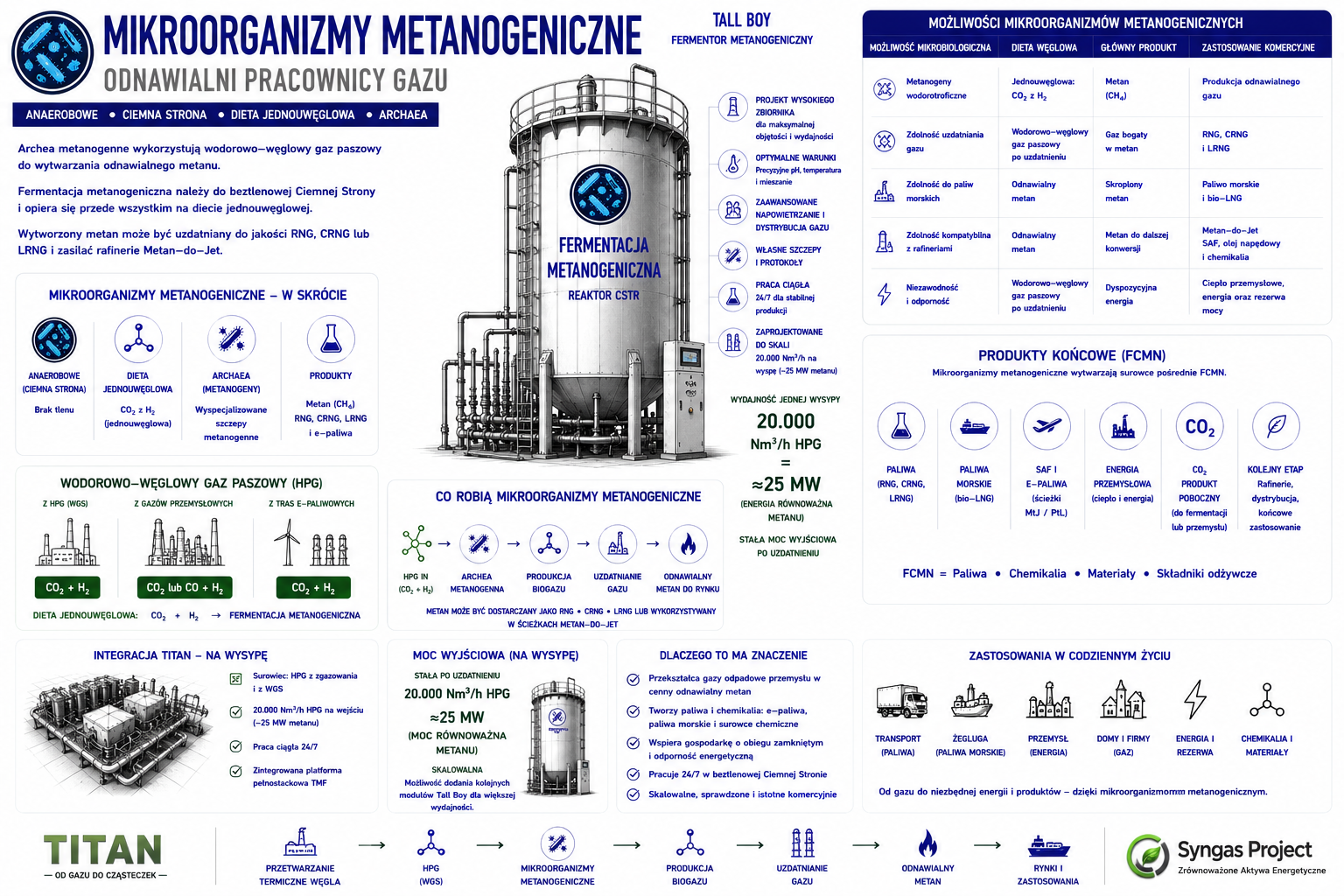
Methanogenic microbes are Archaea, the same microbial family widely used in anaerobic digestion to manufacture methane. Within Targeted Microbial Fermentation, they belong to the anaerobic Dark Side because they work without oxygen.
Methanogenic workers produce very little microbial biomass. Their commercial purpose is not to grow large quantities of cells, proteins or materials. Their purpose is focused: they convert a clean hydrogen–carbon gaseous diet into Renewable Natural Gas — RNG.
Syngas Project supplies their food in controlled industrial conditions. The gas is prepared thermochemically and delivered as a clean, consistent gaseous feed rather than as decomposing organic material.
This distinction is important.
Conventional anaerobic digestion can produce biogas containing siloxanes, sulphur compounds, moisture and other contaminants that require extensive cleaning. Methanogenic Microbial Capability deployed behind the TITAN gas train receives a prepared gaseous diet that is free from siloxanes and controlled within the requirements of the contracted biological package.
Methanogenic workers have a relatively low tolerance for impurities. They are therefore particularly well suited to:
The detailed strains, reactor internals and operating protocols remain protected under the contractual arrangements with specialist Handlers and Biofoundries.
Warsaw 02:02:2023 08:14 AM Steve Walker
Mikroorganizmy metanogeniczne należą do domeny Archaea – tej samej grupy mikroorganizmów, która jest powszechnie wykorzystywana w procesach fermentacji beztlenowej do produkcji metanu. W ramach Ukierunkowanej Fermentacji Mikrobiologicznej (Targeted Microbial Fermentation – TMF) stanowią one część Beztlenowej Ciemnej Strony, ponieważ funkcjonują całkowicie bez udziału tlenu.
Mikroorganizmy metanogeniczne wytwarzają jedynie niewielkie ilości biomasy. Ich celem komercyjnym nie jest produkcja dużych ilości komórek, białek ani materiałów biologicznych. Ich zadanie jest znacznie bardziej wyspecjalizowane – przekształcają czysty gazowy substrat wodorowo–węglowy w Odnawialny Gaz Ziemny (Renewable Natural Gas – RNG).
Syngas Project dostarcza im pożywkę w ściśle kontrolowanych warunkach przemysłowych. Gaz jest przygotowywany metodami termochemicznymi i podawany jako czysty, jednorodny oraz stabilny gazowy substrat, a nie jako rozkładająca się materia organiczna.
To rozróżnienie ma zasadnicze znaczenie.
Konwencjonalna fermentacja beztlenowa wytwarza biogaz zawierający często siloksany, związki siarki, wilgoć oraz inne zanieczyszczenia wymagające rozbudowanych procesów oczyszczania. Natomiast Metanogeniczna Zdolność Mikrobiologiczna (Methanogenic Microbial Capability) stosowana za ciągiem technologicznym TITAN otrzymuje wcześniej przygotowany gazowy substrat pozbawiony siloksanów oraz utrzymywany w parametrach wymaganych przez zakontraktowany pakiet biologiczny.
Mikroorganizmy metanogeniczne wykazują stosunkowo niską tolerancję na zanieczyszczenia. Z tego względu najlepiej sprawdzają się w zastosowaniach obejmujących:
Szczegółowe szczepy mikroorganizmów, konstrukcja reaktorów oraz protokoły prowadzenia procesu pozostają chronione zgodnie z warunkami umów zawartych z wyspecjalizowanymi Handlerami oraz Biofoundries.
Warsaw 01:02:2023 8.15 AM Steve Walker
The Anaerobic Dark Side
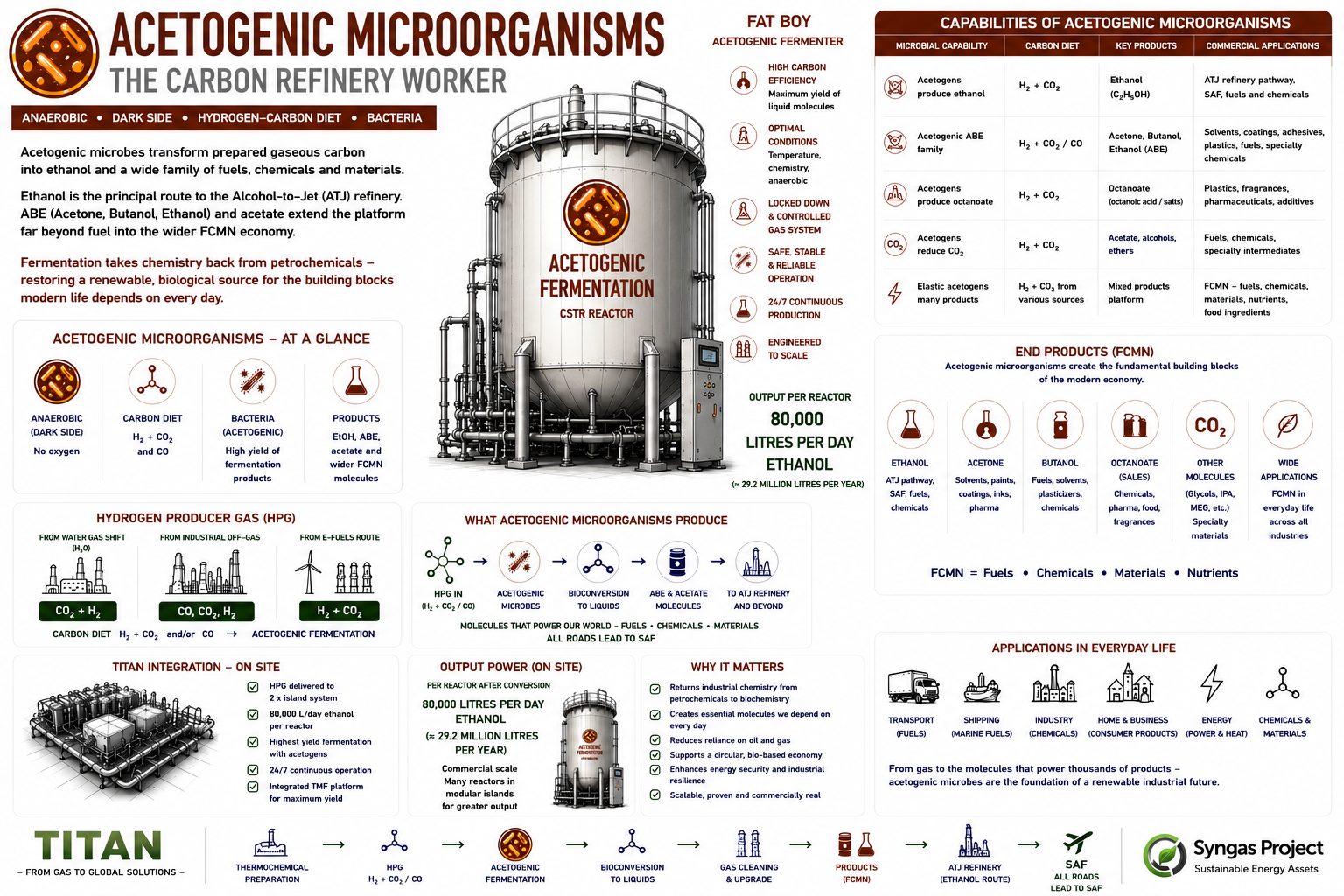
Acetogenic microbes are bacteria. Within Targeted Microbial Fermentation, they belong to the anaerobic Dark Side because they work without oxygen.
These workers produce more microbial biomass than Methanogenic Archaea, but biomass remains a secondary outcome. Their commercial purpose is to convert a clean, single-carbon gaseous diet into valuable liquid molecules.
Their carbon diet is based principally on carbon monoxide and carbon dioxide, supported by hydrogen. These gaseous molecules provide the carbon and energy required to manufacture ethanol and wider chemical intermediates.
The principal TITAN Acetogenic outcome is second-generation ethanol — 2G Ethanol.
Different Acetogenic Microbial Capabilities can also support pathways to acetone, butanol, acetate, acetic acid, isopropanol, 2,3-butanediol and other industrial molecules.
This does not mean that one worker produces every product simultaneously.
The target molecule depends on the selected microbial strain, commercial licence, reactor protocol, gas composition, operating conditions and downstream recovery system.
Syngas Project supplies their food in controlled industrial conditions. Hydrogen Producer Gas is prepared thermochemically, buffered, monitored and conditioned before entering the Acetogenic Fat Boy Tank.
The published TITAN Acetogenic route typically excludes the Water-Gas Shift. The HPG passes directly through buffering, monitoring and conditioning before fermentation.
Acetogenic workers generally produce more liquid broth than Methanogenic workers. This is why their industrial fermentation vessels are represented as Fat Boy Tanks: similar industrial height, but wider and designed around gas-to-liquid biological conversion.
Impurity tolerance varies between workers. The contracted Microbial Capability therefore defines the exact HPG specification and operating limits.
Acetogenic workers are particularly well suited to:
The detailed strains, commercial licences, reactor internals, sparger technology and operating protocols remain protected under contractual arrangements with specialist Handlers and Biofoundries.
Warsaw 01:02:2023 8.10 AM Steve Walker
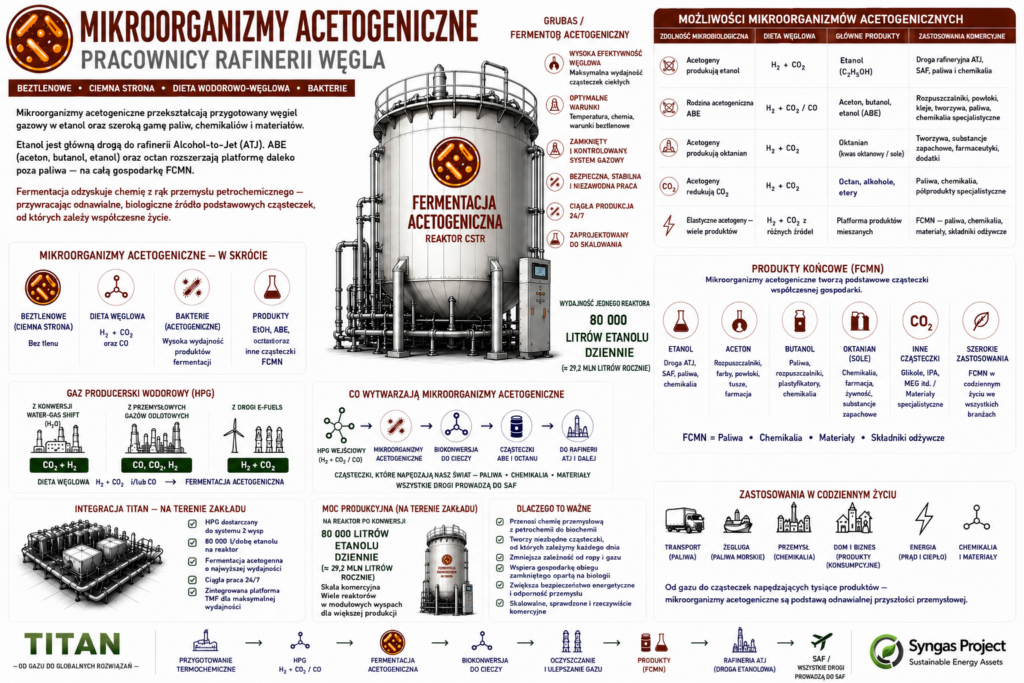
Mikroorganizmy acetogeniczne należą do grupy bakterii. W ramach Ukierunkowanej Fermentacji Mikrobiologicznej (Targeted Microbial Fermentation – TMF) stanowią część Beztlenowej Ciemnej Strony, ponieważ funkcjonują bez udziału tlenu.
Mikroorganizmy acetogeniczne wytwarzają więcej biomasy niż metanogeniczne Archaea, jednak biomasa pozostaje jedynie produktem ubocznym procesu. Ich podstawowym celem komercyjnym jest przekształcanie czystego, jednowęglowego gazowego substratu w wysokowartościowe ciekłe cząsteczki.
Ich dieta węglowa opiera się przede wszystkim na tlenku węgla (CO) oraz dwutlenku węgla (CO₂), wspomaganych przez wodór (H₂). Gazy te dostarczają zarówno węgla, jak i energii niezbędnych do syntezy etanolu oraz szerokiej gamy chemicznych produktów pośrednich.
Podstawowym produktem acetogenicznej platformy TITAN jest bioetanol drugiej generacji (2G Ethanol).
Różne Acetogeniczne Zdolności Mikrobiologiczne (Acetogenic Microbial Capabilities) mogą również prowadzić do produkcji acetonu, butanolu, octanu, kwasu octowego, izopropanolu, 2,3-butanodiolu oraz wielu innych cząsteczek wykorzystywanych w przemyśle.
Nie oznacza to jednak, że jeden mikroorganizm wytwarza wszystkie te produkty jednocześnie.
Końcowy produkt zależy od wybranego szczepu mikroorganizmów, licencji komercyjnej, protokołu prowadzenia reaktora, składu gazu, parametrów pracy oraz zastosowanego systemu odzysku produktu.
Syngas Project dostarcza mikroorganizmom pożywkę w ściśle kontrolowanych warunkach przemysłowych. Hydrogen Producer Gas (HPG) jest przygotowywany metodami termochemicznymi, następnie buforowany, monitorowany i kondycjonowany przed wprowadzeniem do Acetogenicznego Reaktora „Fat Boy”.
Publikowana ścieżka technologiczna TITAN dla procesu acetogenicznego zazwyczaj pomija etap Water-Gas Shift (WGS). HPG przechodzi bezpośrednio przez etap buforowania, monitorowania i kondycjonowania, a następnie trafia do fermentacji.
Mikroorganizmy acetogeniczne wytwarzają zazwyczaj znacznie większą ilość ciekłego bulionu fermentacyjnego niż mikroorganizmy metanogeniczne. Z tego względu ich przemysłowe fermentory przedstawiane są jako reaktory „Fat Boy” — mają zbliżoną wysokość do fermentorów metanogenicznych, lecz większą średnicę i zostały zaprojektowane specjalnie do biologicznej konwersji gaz–ciecz.
Tolerancja na zanieczyszczenia różni się w zależności od zastosowanej Zdolności Mikrobiologicznej. To właśnie zakontraktowana Acetogeniczna Zdolność Mikrobiologiczna określa dokładną specyfikację HPG oraz dopuszczalne granice pracy procesu.
Mikroorganizmy acetogeniczne najlepiej sprawdzają się w zastosowaniach obejmujących:
Szczegółowe szczepy mikroorganizmów, licencje komercyjne, konstrukcja wewnętrzna reaktorów, technologia spargerów oraz protokoły prowadzenia procesu pozostają chronione zgodnie z warunkami umów zawartych z wyspecjalizowanymi Handlerami oraz Biofoundries.
Warsaw 30:01:2023 08:16 AM Steve Walker
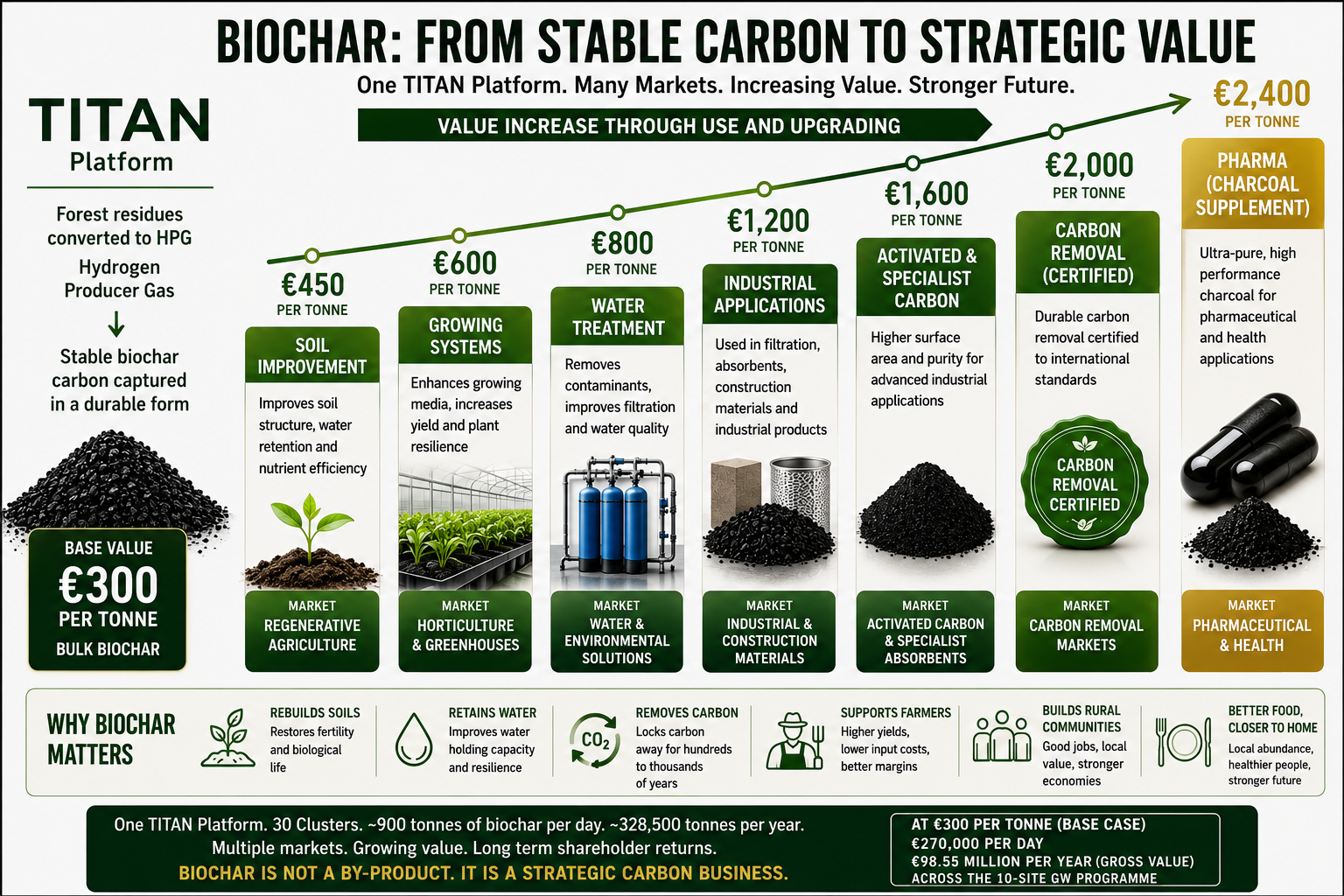
Climbing the Biochar Value Ladder
From stable carbon to certified strategic value
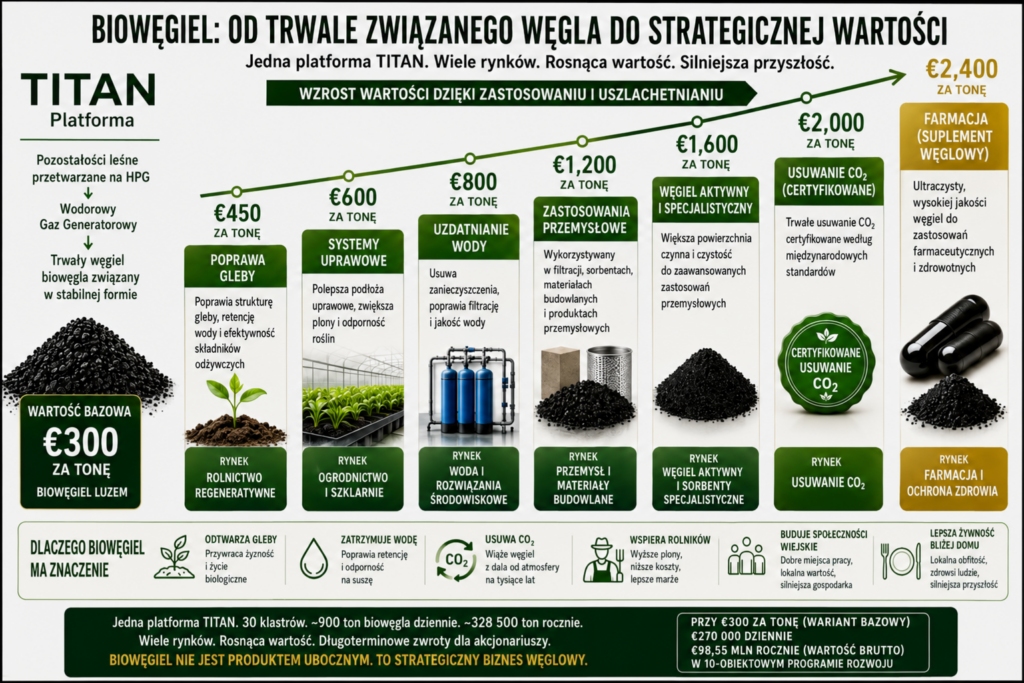
Biochar does not leave the TITAN Platform as a finished €2,400-per-tonne product.
It begins as stable carbon produced from sustainably sourced forest residues during the production of Hydrogen Producer Gas. Its value then increases through controlled processing, product development, certification and verified use.
The value ladder is therefore not simply a price list. It is a structured development programme.
At every step, Syngas Project must answer four questions:
What was the biochar made from?
How was it produced?
Is every production batch safe and consistent?
What certified purpose will it serve?
The better the evidence, consistency and demonstrated performance, the higher the biochar can progress.
Importantly, this is a commercial value ladder, not a legal ranking system. Certification classes confirm that a biochar is suitable for a particular application. They do not automatically describe one product as better than another. A single well-controlled production batch may qualify for several different uses, but it must be tested, documented and marketed correctly for each one.
The foundation: controlled biochar production
The ladder begins inside TITAN.
Forest residues are converted through gasification into Hydrogen Producer Gas, renewable molecules and a stable carbon fraction. That carbon fraction must first become a repeatable industrial product.
TITAN must establish:
Approved and traceable forest-residue feedstocks.
Defined feedstock preparation and moisture limits.
A controlled gasification temperature and residence time.
Restricted oxygen conditions.
Capture or destruction of methane and other process emissions.
Controlled cooling, handling and storage.
Separation of production into identifiable batches.
Representative sampling and retention of reference samples.
Laboratory testing of every defined production batch.
Under the new EU methodology for Biochar Carbon Removal, eligible production must heat biomass to at least 350°C, capture or destroy methane produced during the process and make productive use of the co-produced heat. Each batch must be connected to consistent feedstock and operating conditions. Commission Delegated Regulation (EU) 2026/285
This production discipline creates the foundation for every subsequent market.
Warsaw 30:01:2023 08:12 AM Steve Walker
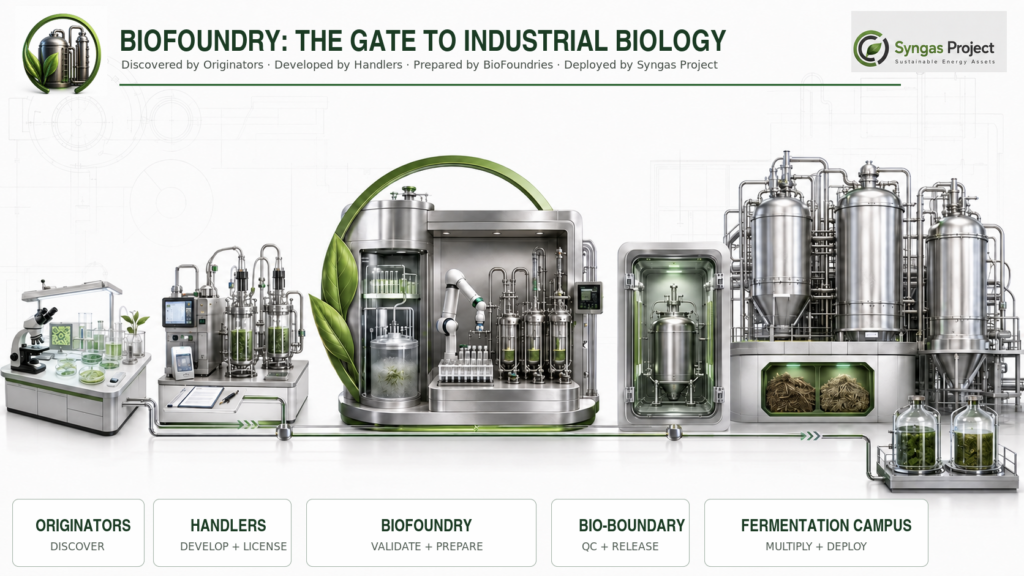
Biowęgiel nie opuszcza platformy TITAN jako gotowy produkt o wartości 2 400 euro za tonę.
Powstaje jako trwały węgiel podczas zgazowania zrównoważonych pozostałości leśnych w procesie produkcji Gazu Producentowego Bogatego w Wodór (HPG). Jego wartość następnie rośnie dzięki kontrolowanemu przetwarzaniu, rozwojowi produktu, certyfikacji oraz potwierdzonym zastosowaniom.
Drabina wartości nie jest więc zwykłym cennikiem. Jest uporządkowanym programem rozwoju produktu.
Na każdym etapie Syngas Project musi odpowiedzieć na cztery podstawowe pytania:
Im lepsze są dowody jakości, powtarzalność procesu oraz potwierdzona skuteczność produktu, tym wyżej biowęgiel może awansować na Drabinie Wartości.
Należy podkreślić, że jest to komercyjna drabina wartości, a nie formalny system klasyfikacji prawnej. Klasy certyfikacyjne potwierdzają przydatność biowęgla do określonych zastosowań, lecz nie oznaczają automatycznie, że jeden produkt jest „lepszy” od drugiego. Jedna dobrze kontrolowana partia produkcyjna może kwalifikować się do wielu różnych zastosowań, pod warunkiem że zostanie odpowiednio przebadana, udokumentowana i wprowadzona na rynek.
Drabina rozpoczyna się wewnątrz TITAN.
Pozostałości leśne są przekształcane w procesie zgazowania w Gaz Producentowy Bogaty w Wodór (HPG), odnawialne cząsteczki oraz trwałą frakcję węglową. Zanim stanie się ona wartościowym produktem, musi zostać przekształcona w powtarzalny produkt przemysłowy.
Platforma TITAN musi zapewnić:
Zgodnie z nową unijną metodyką Biochar Carbon Removal, kwalifikująca się produkcja musi ogrzewać biomasę do temperatury co najmniej 350°C, wychwytywać lub eliminować metan powstający podczas procesu oraz produktywnie wykorzystywać ciepło współprodukowane podczas zgazowania. Każda partia musi być powiązana z jednoznacznie określonym surowcem oraz stabilnymi parametrami pracy instalacji.
Ta dyscyplina produkcyjna stanowi fundament wszystkich kolejnych rynków i zastosowań.
Warsaw 29:01:2023: 08:16 AM Steve Walker
Coming Soon……..
Warsaw 28:01:2023 8:16 AM Steve Walker
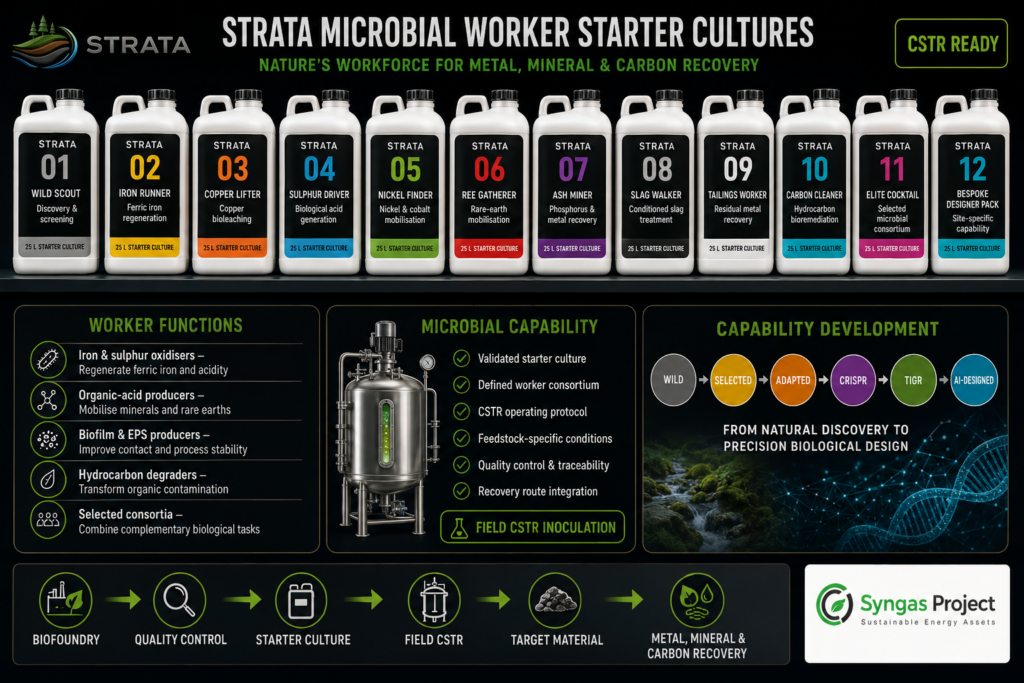
The 25-litre carboys contain validated starter cultures. They are the beginning of the deployment process—not the final field volume. At site, Field CSTRs proliferate the selected workers and progressively supply the PowerCan slurry tanks required for full execution.
From Wild Discovery to AI-Designed Microbial Capability
The materials required for the energy transition are not found only in new mines. Enormous quantities of metals, minerals and useful carbon remain trapped in historic tailings, industrial slag, ash, low-grade ores, contaminated land and other materials that industry has placed outside the productive economy.
STRATA approaches these materials as misplaced resources.
Syngas Project is not a university laboratory, nor do we claim to originate every microbial strain. We are engineers, platform developers, operators and service providers.
Our task is to identify a real industrial problem, define the biological work required and assemble the workers, vessels, power, utilities, controls and recovery systems needed to solve it.
This is where BRAD, our AI Carbon Orchestrator, enters the process.
BRAD connects the scientific originator field with practical industrial applications. It follows advances in microbial discovery, biomining, gene editing, metabolic engineering and artificial intelligence, translating them into capabilities that can be engineered, powered, deployed and measured.
BRAD takes the guesswork out of recovery.
It combines material data, microbial performance, originator progress, field requirements and recovery economics to determine:
BRAD has already participated in numerous workshops with stakeholders examining specific applications. These discussions extend from the mineralogy and chemistry of the target material to the microorganisms, Field CSTRs, slurry tanks, power, fuel, oxygen, water, monitoring and downstream recovery systems required in the field.
BRAD also monitors what microbial originators are working on now and how their development programmes are likely to advance. This includes the expected evolution of the next strains, consortia, enzymes and biological tools—not simply the capabilities already described in published research.
BRAD is already following more than 60 microbial workers and candidate capabilities. As industrial biology expands, this is likely to develop into hundreds of specialist workers addressing increasingly precise materials-recovery and remediation tasks.
Warsaw 31:01:2023 8:12 AM Steve Walker
Aerobic Microbes — The Bridge
Aerobic fermentation is installed during TITAN Phase 2 in Sector 5a.
We call it The Bridge because it connects TITAN with the wider SOLIDEA platform family: ASMARA, AQUIS, STRATA and IGNIS.
Methanogenic fermentation gives TITAN its renewable methane pathway.
Acetogenic fermentation gives TITAN its ethanol, chemicals and materials pathway.
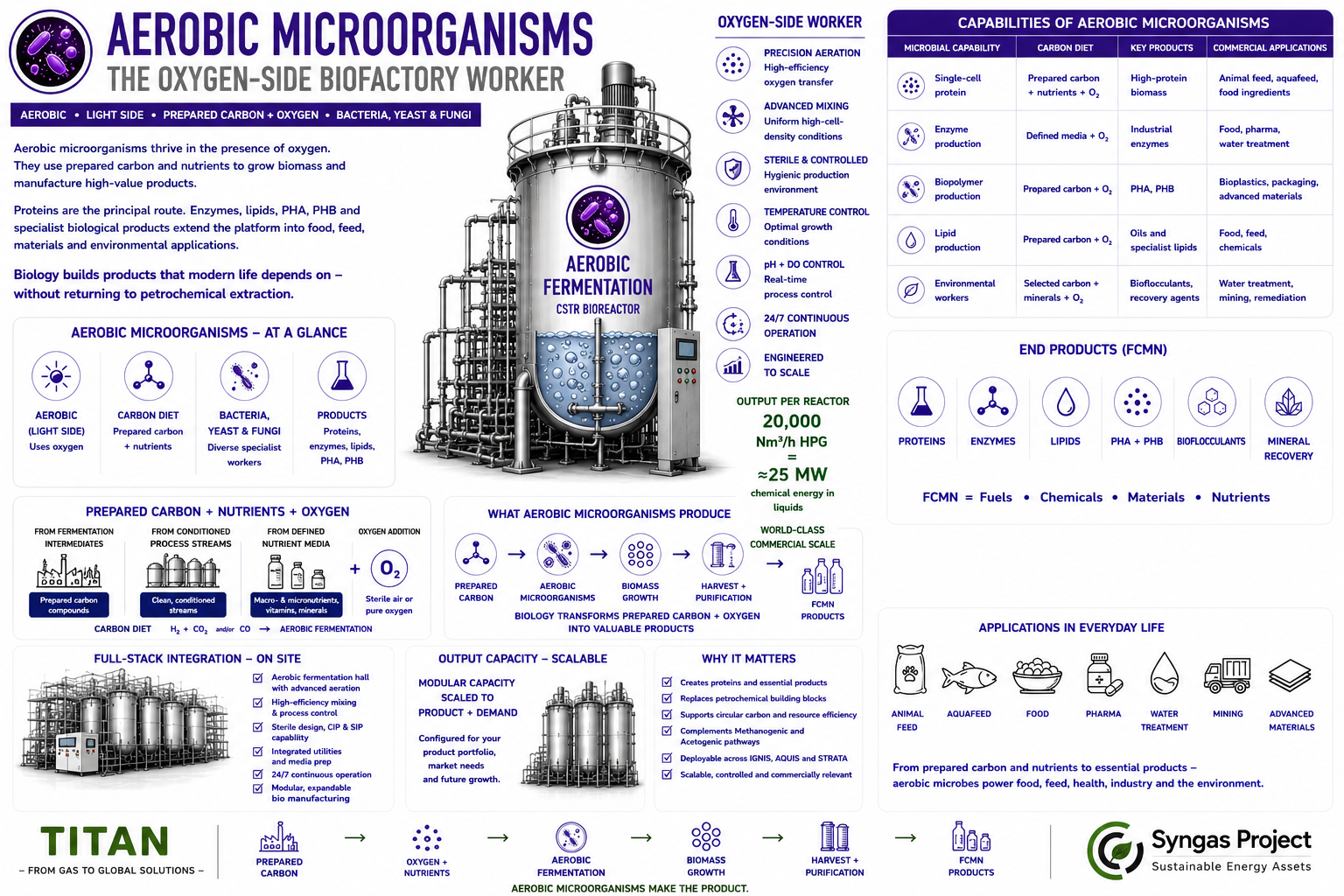
Aerobic fermentation completes the full fermentation stack.
It creates products within the Fermentation CAMPUS, prepares specialist microbial workers for deployment beyond the CAMPUS and connects prepared carbon with a much wider range of biological outcomes.
The Oxygen Side
Aerobic Microbes work in the presence of oxygen.
They use controlled carbon, nutrients and oxygen to grow rapidly and produce substantial microbial biomass.
This distinguishes them from the Methanogenic and Acetogenic families.
Methanogenic Microbes primarily produce methane.
Acetogenic Microbes primarily produce alcohols, acids and chemical intermediates.
With Aerobic Microbes, the microbial biomass itself may become the commercial product or perform the required biological task.
This is why Aerobic fermentation produces the heavy-biomass outcomes within the full fermentation stack.
The biomass can be harvested, separated, washed, dried and formulated into useful products.
It can also be maintained as a living Microbial Capability and deployed into treatment, recovery, extraction and remediation systems.