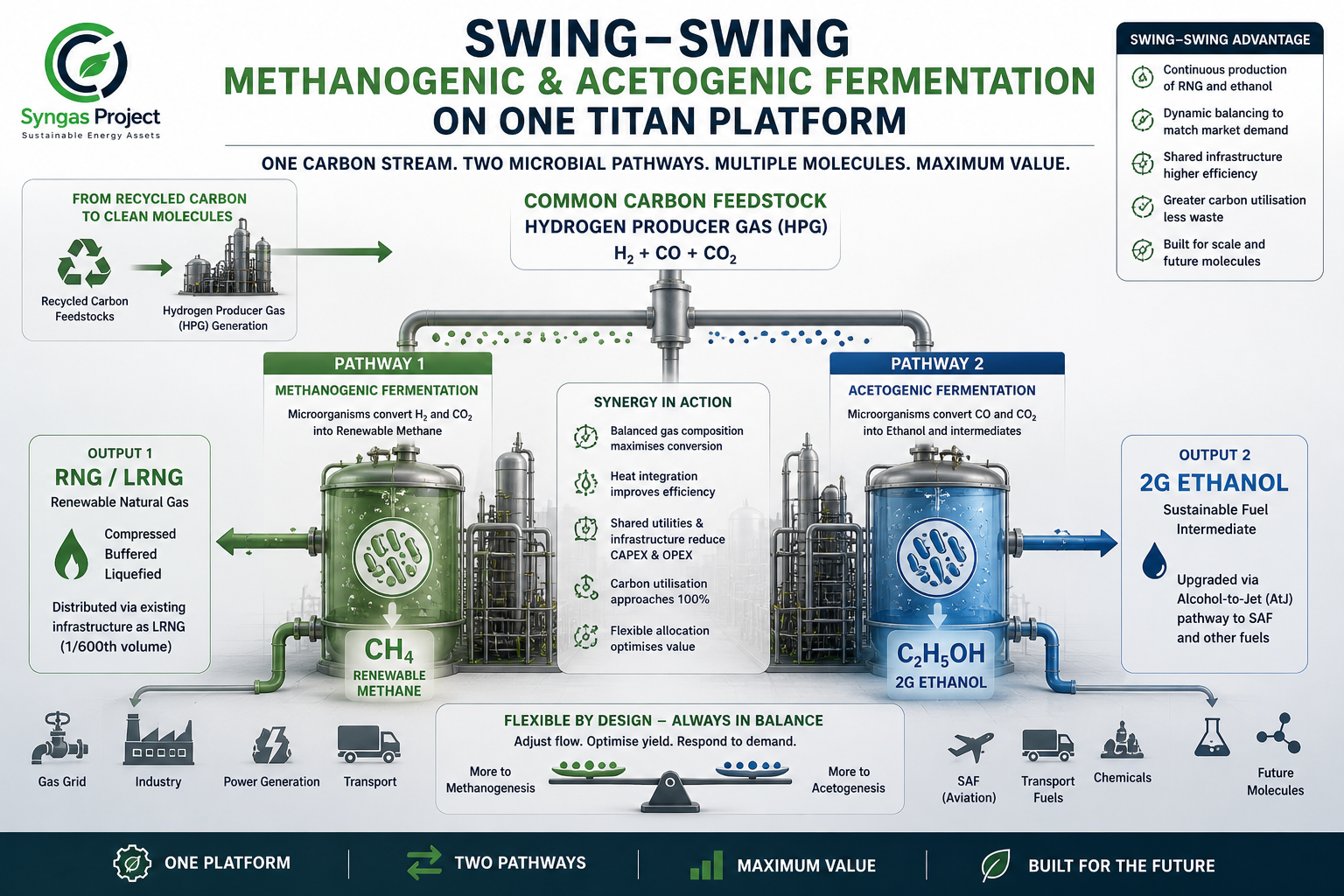
TITAN: From Gas to Molecules — Why Control Matters

Przewiń w dół, aby zobaczyć wersję w języku polskim.

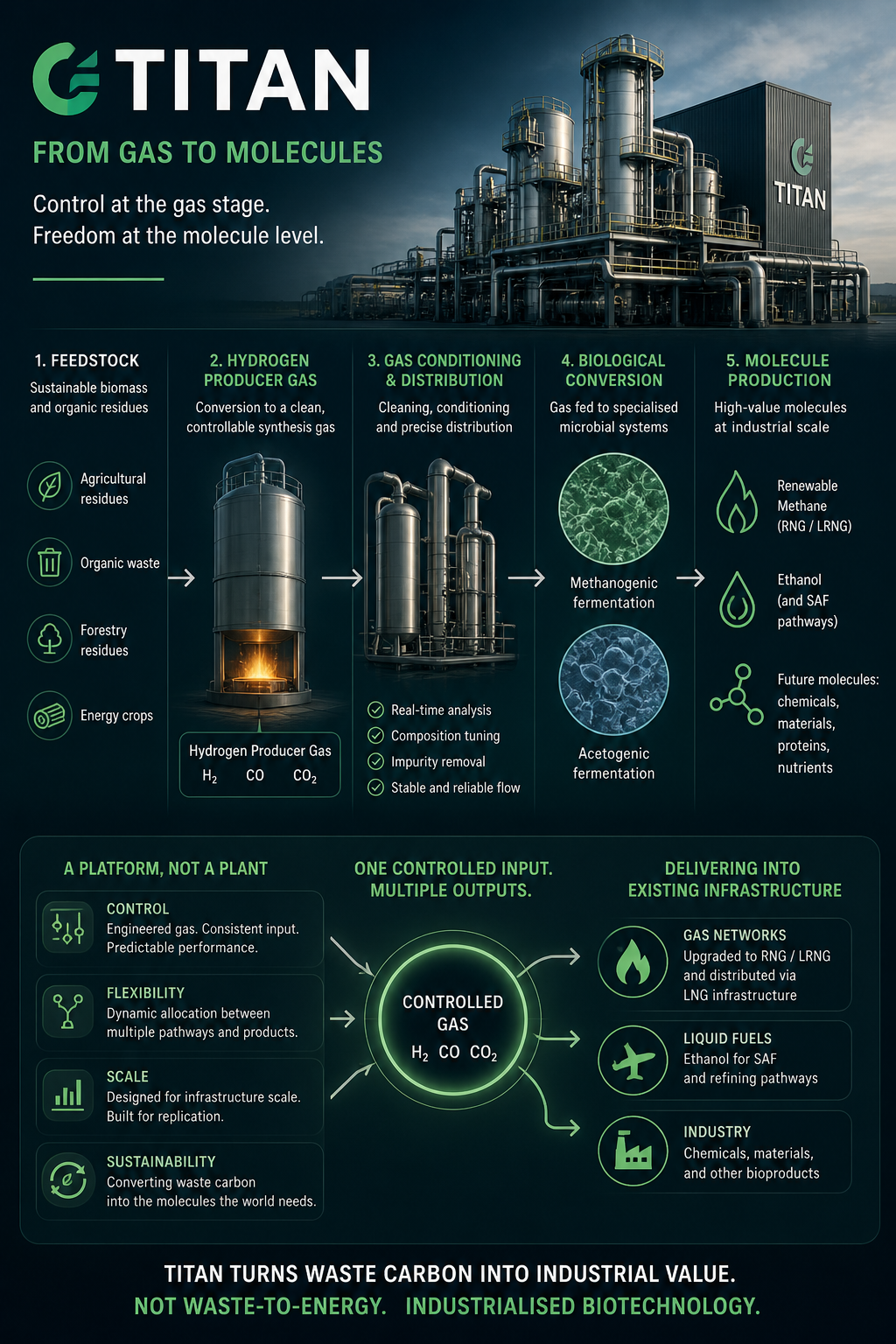
TITAN does not begin with fermentation.

It begins with control.

At the heart of the platform is a simple but critical step: converting solid carbon into a stable, controllable gas. This is achieved through Hydrogen Producer Gas, where biomass is transformed into a defined mixture of hydrogen, carbon monoxide and carbon dioxide.

This step determines everything that follows.

Most carbon conversion systems struggle because they attempt to process variability. Mixed inputs lead to unstable outputs. Biological systems, in particular, are sensitive to inconsistency. When feedstock fluctuates, performance drops, yields fall, and scale becomes difficult.

TITAN removes this problem at the source.

By converting solids into gas first, it separates variability from production. The gas phase becomes a controlled interface between raw material and biology. Instead of managing unpredictable solids, the system manages a measurable, adjustable flow.

Gas can be analysed in real time.

Composition can be tuned. Ratios of hydrogen to carbon monoxide can be adjusted depending on the target pathway. Flow can be stabilised. Impurities can be reduced through conditioning and polishing. What enters the fermentation system is no longer variable waste. It is engineered input.

This is the difference between adaptation and design.

In conventional systems, biology is forced to adapt to the feedstock. In TITAN, the feedstock is engineered to suit the biology. This allows microbial systems to operate under optimal conditions rather than survival conditions.

The result is stability.

Methanogenic and acetogenic pathways require consistency to perform at industrial scale. Methanogens convert hydrogen and carbon dioxide into methane. Acetogens convert carbon monoxide and hydrogen into ethanol and other molecules. Both processes are highly sensitive to gas composition, pressure and flow.

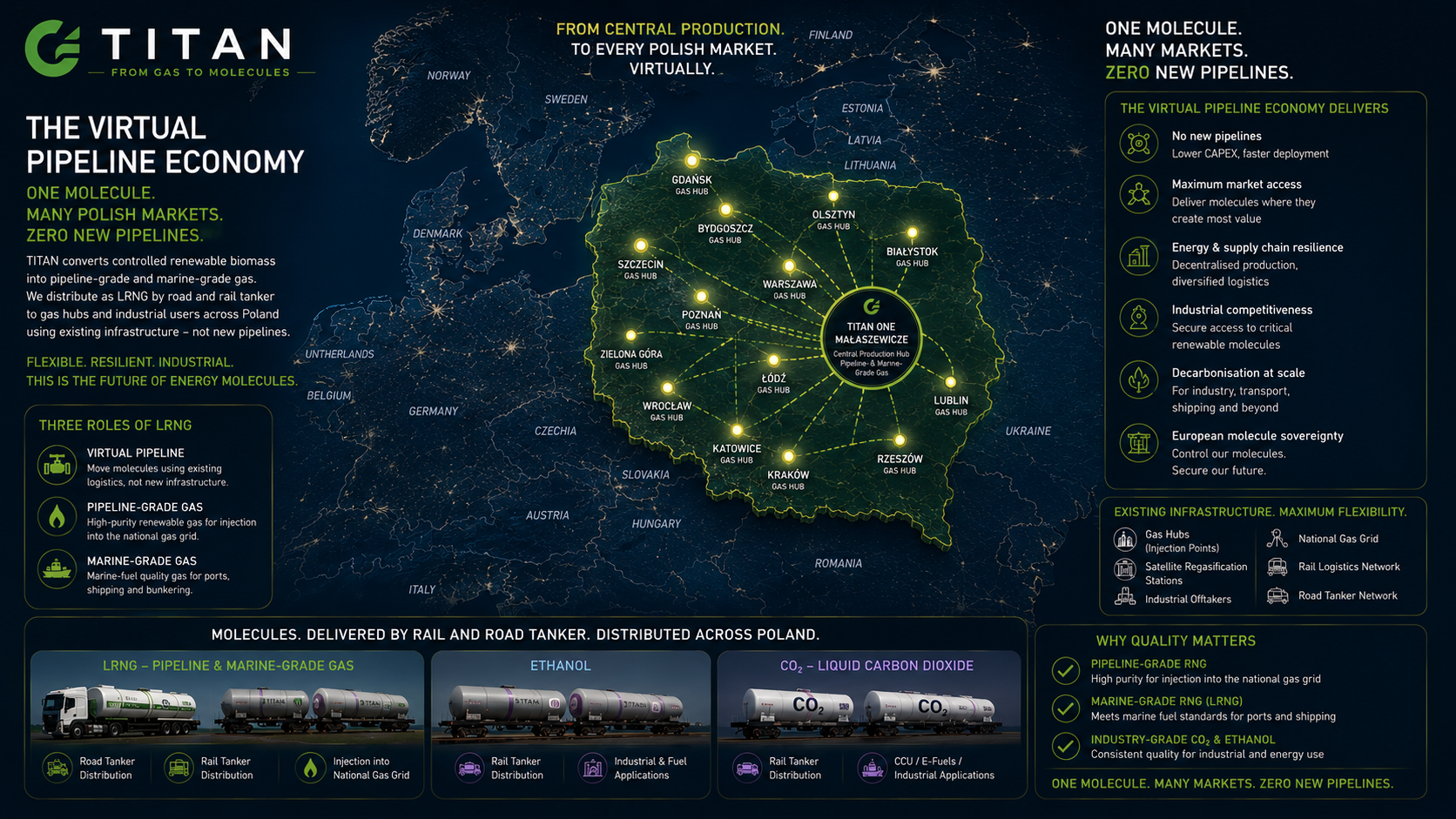
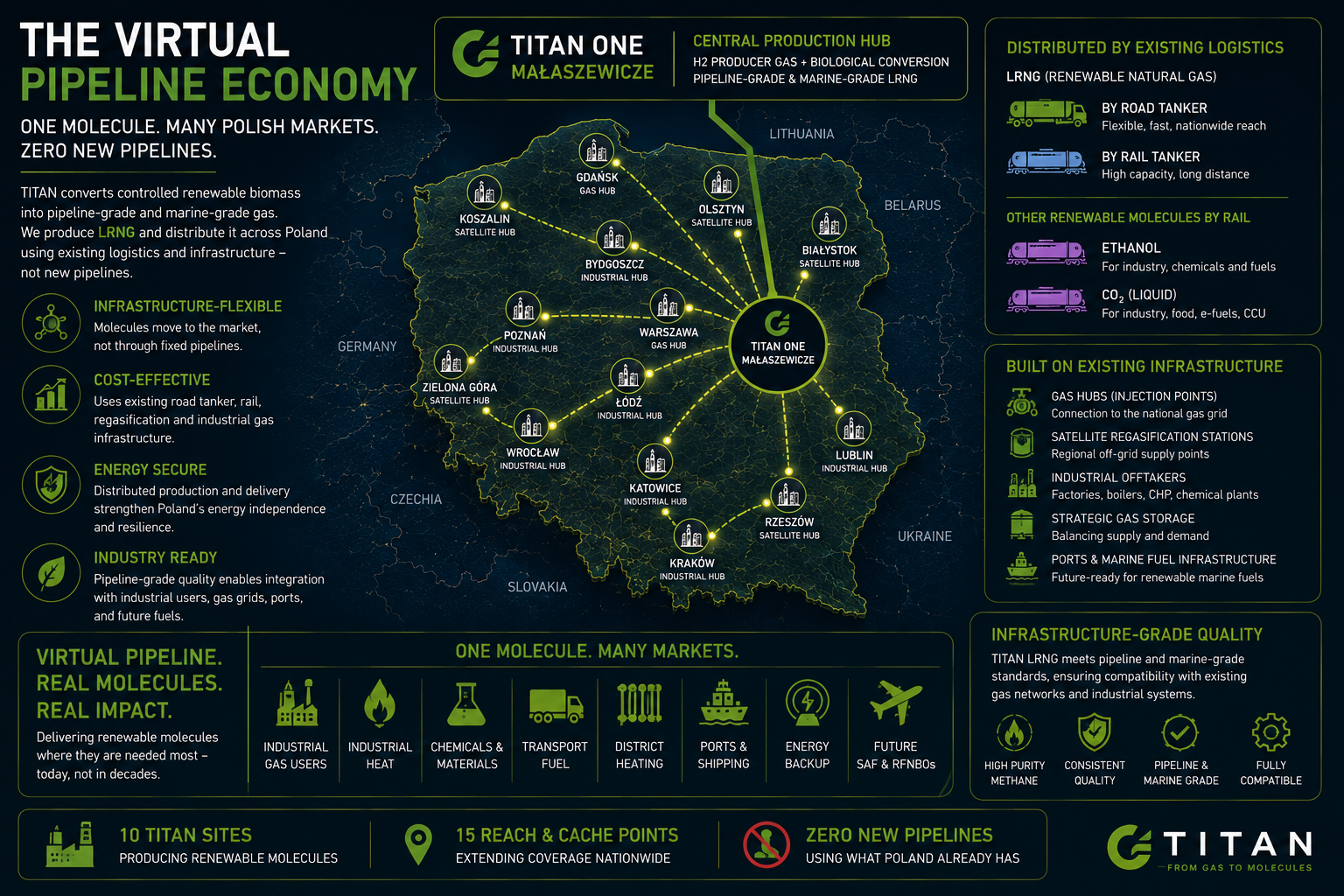
The Virtual Pipeline Economy

Publish date: 25 March 2026

(Polska wersja poniżej.)

For more than a century, industrial gas distribution has depended on fixed pipeline systems.

Pipelines transformed economies because they allowed energy molecules to move continuously between production centres and industrial users. Heavy industry, chemicals, district heating, shipping and manufacturing all developed around this infrastructure model.

But building entirely new national pipeline systems is slow, expensive and politically difficult.

At the same time, Poland faces a growing challenge.

The country requires increasing volumes of renewable molecules for industry, transport, chemicals, heating and future fuel systems, while much of the existing renewable energy discussion remains focused almost entirely on electricity.

Electricity matters.

But molecules matter too.

Factories require molecules.

High-temperature industrial heat requires molecules.

Shipping requires molecules.

Chemicals require molecules.

Future aviation fuels require molecules.

The question is not simply how to produce renewable molecules.

The question is how to distribute them efficiently across the country without waiting decades for entirely new infrastructure to be built.

This is where the virtual pipeline economy begins.

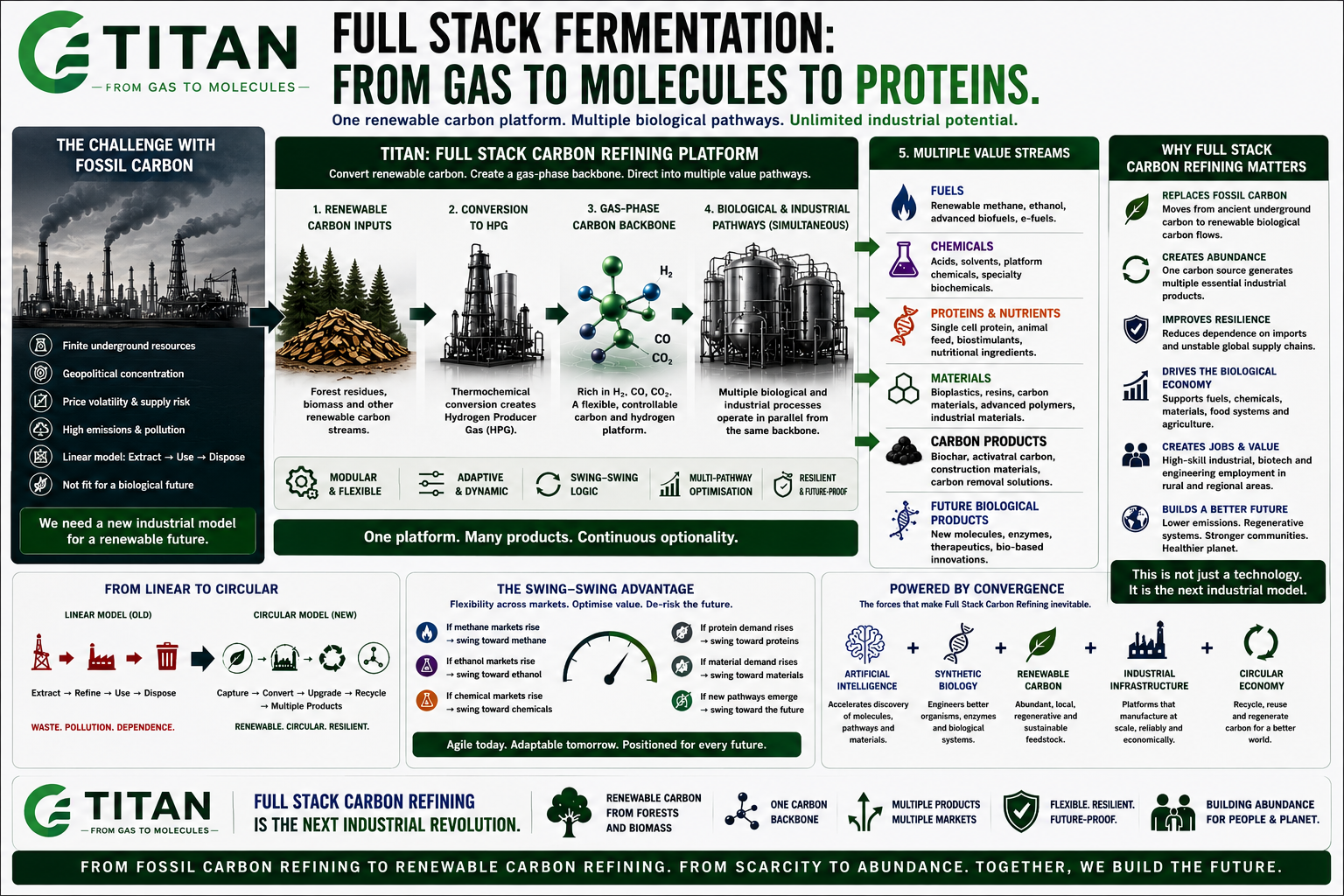
Full Stack Carbon Refining

Publish Date: 11 March 2026

(Przewiń w dół, aby zobaczyć wersję polską.)

For more than a century, industrial civilisation has been built around fossil carbon refining.

Oil refineries transformed crude oil into fuels, chemicals, plastics, solvents and industrial materials. Gas infrastructure supplied heat, power and industrial feedstocks. Petrochemical systems became the molecular foundation of the modern economy.

That system created enormous prosperity.

But it also created dependence on finite underground carbon resources extracted from geopolitically concentrated regions of the world.

The next industrial transition may not simply replace fossil energy.

It may replace fossil carbon itself.

This is where Full Stack Carbon Refining begins.

Syngas Project believes the future economy will increasingly require platforms capable of converting renewable carbon into multiple industrial outputs simultaneously.

Not only energy.

But fuels, chemicals, materials and nutrients.

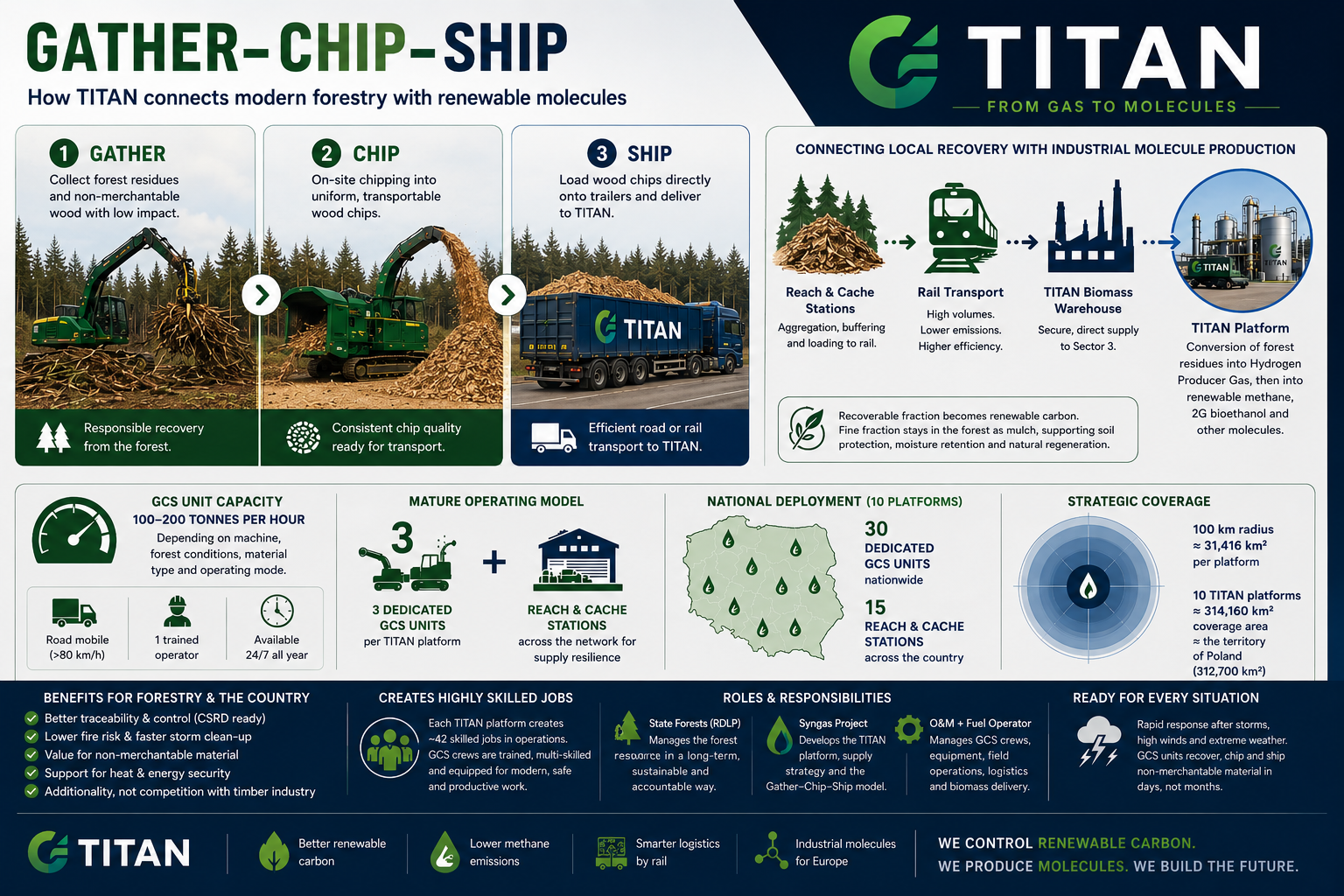
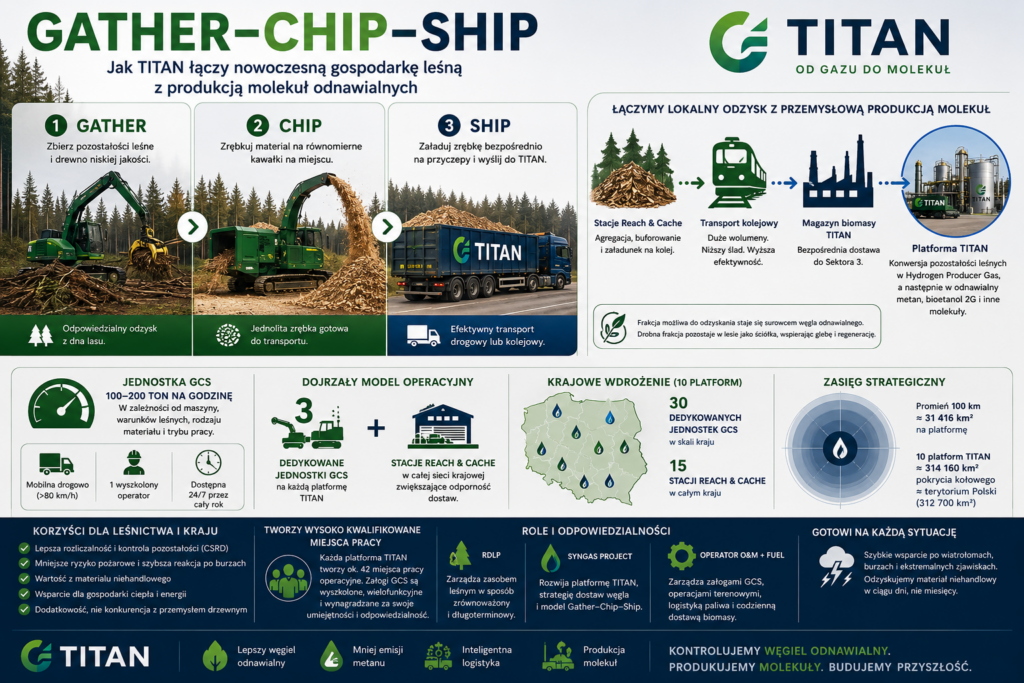
Gather–Chip–Ship: How TITAN Connects Modern Forestry to Renewable Molecules

(Przewiń w dół, aby zobaczyć wersję polską.)

Published February 28 2026

Forestry is often misunderstood.

Many people imagine forest residues as a random, scattered and uncertain resource. They picture a loose biomass market, occasional availability and a feedstock supply chain that is difficult to control.

Nothing could be further from the real position in Poland.

Poland’s State Forests are one of the country’s great strategic assets. They are organised through 17 Regional Directorates of State Forests, known as RDLPs. Across more than 9 million hectares of forest, the system is planned, measured and managed over long biological cycles. Forest stands mature over 40 years and longer. Harvesting, replanting, thinning, species management and timber classification are not accidental. They are known, recorded and managed.

This matters for TITAN.

It also matters for the long-term CSRD logic of forestry.

A platform that converts forest residue into renewable molecules cannot depend on guesswork. It must understand where material is available, when it will be available, what quality it has and how much can be responsibly recovered.

The Polish forestry system already contains much of that knowledge.

The RDLP structure knows its forests. It knows stand maturity, species composition, harvest planning, merchantable timber availability and non-merchantable material potential. It understands where forest residues arise, where windthrow or disease has affected stands, and where clean-up work is required after harvesting.

This means the non-merchantable resource can be accounted for down to the tonne.

That changes its status.

Instead of being treated as a low-value residue, unmanaged by-product or potential liability, it becomes an auditable renewable carbon resource. It can be measured, recovered, priced and reported. For forestry, this is important. CSRD requires better evidence, better inventory logic and better explanation of how environmental resources and impacts are managed.

TITAN helps make that possible.

TITAN is not only a plant waiting at the end of a supply chain. It is active at the front end. The platform is designed around its own Gather–Chip–Ship capability, known as GCS. This means dedicated mobile machinery, trained operators and a controlled recovery system located around the regional forest base.

After AI – Warm Robots

The Machines That Heal—and the Circular Economy They’re Building

She looks almost human. Porcelain skin, careful eyes, anatomical symmetry—delicate, not threatening. A beautiful contradiction. The image evokes a future we’ve long imagined: robots that walk beside us, feel with us, care for us.

But this isn’t the warm robot we meant.

Because the real warm robots—ours—don’t smile or stand. They don’t blink, speak, or age.
They are microbes.
Alive, invisible, programmable.

They live in tanks. They breathe carbon. They manufacture the building blocks of the post-pollution world: fuels, chemicals, nutrients, and materials. And now, aided by generative AI, they are evolving—stacking complexity, mimicking natural processes, and operating with the efficiency of the human brain and the regenerative elegance of skin and bone.

We call this new capability Industrial Lifestacking.
It’s not robotics. It’s regeneration.
Not imitation—but biological infrastructure, scaled.

The Living Stack

Long before artificial intelligence could speak, microbes were building. While generative models were still learning language, fermentation vessels were already producing ethanol, biodegradable polymers, and essential proteins from nothing more than carbon waste and biological design.

What makes this possible is a structure we call the Living Stack—a three-layered system that turns industrial chaos into organic precision:

AI serves as the design layer, where biological systems are mapped, metabolic pathways are simulated, and yield efficiency is optimised.
Gene Editing functions as the software layer, rewriting microbial DNA to perform intentional functions—from synthesising alcohols to building amino acid chains.
Targeted Microbial Fermentation (TMF) forms the hardware layer, where gas-fed microbes in controlled environments transform design and code into physical product.

This stack doesn’t run on electricity alone. It runs on carbon. It doesn’t output noise or abstraction. It outputs life.

From Waste to Sovereignty Alternatives – Chinese Hamster Ovary (CHO) Cells

From Waste to Sovereignty: How TITAN and ASMARA Build Europe’s New Biomanufacturing Landscape

TITAN and ASMARA are not just platforms for converting waste into energy. They are flexible, modular bio-manufacturing hubs designed to anchor a new industrial landscape—one built on sovereignty, sustainability, and regional regeneration.

At their core is a powerful integration of Hydrogen Producer Gas (HPG) and Targeted Microbial Fermentation (TMF)—a pairing that unlocks the ability to produce a vast spectrum of high-value outputs: fuels, bioplastics, chemicals, proteins, and even advanced medical bioproducts like CHO (Chinese Hamster Ovary) cells.

But more importantly, these platforms offer a way to reindustrialise rural Europe, create high-quality employment in overlooked regions, and reduce the continent’s dependence on imported fuels, chemicals, and biopharmaceutical precursors.

Syngas Project Pioneering Solutions for a Healthier Future

 Mr Hyde

Reclaiming Insulin Sovereignty: TITAN and ASMARA Platforms for Mass Biomanufacturing in Europe

Breaking the Cartel: Insulin, Inequality, and the Opportunity for European Leadership

At the heart of the global diabetes crisis lies a quiet but devastating monopoly: a life-saving medicine held hostage by a handful of manufacturers. Despite insulin being off-patent for decades, just three global pharmaceutical giants dominate the market—dictating pricing, supply, and access. This concentration of control has limited the availability of affordable insulin, especially in regions already under economic pressure.

In the United States, insulin prices have soared beyond reason. Europe, including Poland and other Central and Eastern European nations, now faces similar systemic risks: rising diabetes rates, increasing healthcare costs, and inadequate local production capacity. But amid this crisis lies a chance to rewrite the pharmaceutical supply chain—through a bold, sovereign European solution: the TITAN and ASMARA platforms.

The Insulin Crisis: A Manufactured Scarcity

Insulin is not a rare or exotic molecule. It has been biosynthesised for over 40 years using recombinant DNA technology. The science is well-understood. The demand is clear. And yet, millions of people globally still struggle to access it due to pricing structures, regulatory lock-ins, and lack of local production.

  • Patients ration insulin to make it last—resulting in amputations, blindness, kidney failure, and death.
  • Governments overspend on cartel-priced imports—diverting budgets from prevention and education.
  • Local biomanufacturing is nearly nonexistent—especially in rural or post-industrial regions where new health infrastructure is most needed.

Europe’s current strategy, relying on imports and foreign-owned production, offers no resilience, no price control, and no autonomy.

TITAN and ASMARA: A Platform for Pharmaceutical Sovereignty

The TITAN (rural) and ASMARA (urban) platforms are not pharma factories in the traditional sense. They are modular, circular, multi-output bio-industrial systems. Originally designed to transform biomass and waste into hydrogen producer gas (HPG) and ethanol, these platforms now represent the future of distributed biomanufacturing—including insulin.

Each platform features:

  • Renewable, 24-hour power and heat, generated from local waste streams
  • Targeted Microbial Fermentation (TMF) stations, already capable of industrial protein synthesis
  • CO₂-ready infrastructure for enhanced fermentation using waste or captured carbon
  • A scalable, cookie-cutter design that enables low-cost replication across the EU

By adding a dedicated pharmaceutical-grade fermentation unit, any TITAN or ASMARA site can pivot to produce biosynthetic insulin using engineered microbial strains like E. coli or yeast—in clean, stable, sovereign-controlled conditions.

This isn’t hypothetical. TITAN’s ethanol lines already handle 50,000 litres per day. The same bioreactors and feedstock management protocols can be adapted to pharmaceutical production with minimal redesign.

Ammonia Apocalypse: “Tackling Looming Crisis Amidst EU Farmer Strikes”

Syngas AI Series No. 2: Fixing the Ammonia Dilemma Amidst Geo-Political Turmoil

As global tensions rise with Russia’s invasion of Ukraine, the repercussions have extended beyond geopolitical borders, impacting the delicate balance of resource supply and demand. One significant casualty has been the supply of natural gas, a lifeline for many nations, particularly affecting the agricultural sector in Poland and its reliance on ammonia for food production. In this edition, we explore how the Syngas Project’s TITAN platform, coupled with microbial fermentation of nitrogen-fixing bacteria, can offer a sustainable solution to the ammonia dilemma.

The Struggle for Ammonia Supply

The conflict’s ripple effect has been felt keenly in Poland, where sanctions have constrained the supply of natural gas, subsequently affecting ammonia availability for farmers. Ammonia is a vital component for fertiliser production, crucial for sustaining scaled agricultural productivity and ensuring food security.

The way AI is transforming our business is how we are transforming our industry

How Dark Hydrogen became the New Green

The “new green hydrogen” is “dark bio-hydrogen”, so called after the dark fermentation bio-manufacturing process which creates it green because its manufacture and existence are entirely organic, renewable and waterless. 

We choose to go to the moon JFK 1962 Moonshot Speech
60 years on from JFK moonshot speech

One small step ahead of carbon capture and storage CCS replacing it instead with capture and transformation CCT, thus taking the capture and recycling of waste carbon to the next level is a giant leap for mankind. 60 years on from JFK’s moonshot speech and on its anniversary Joe Biden announced the cure for cancer is the new moonshot and its through bio-technology transformation that will get us there.

TITAN and ASMARA incorporate two technologies on one platform, waste to hydrogen producer gas + microbial fermentation to manufacture fuel, chemical and material products. CCT is a well-proven process for recycling both the carbon at the smoke stack, in the waste we produce and in the waste we throw away as it is for the carbon we have already produced. We are presented with a truly value-added proposition because recycling the carbon we already have obviates the need to dig up more carbon. Through converting solid waste into producer’s gas and CCT emission technology to recycle carbon in the producer’s gas through, microbial fermentation, we can reproduce all of the products we currently manufacture from oil and gas, where the likes of transport fuels, plastics and fertilisers are produced with far less environmental impact. In manufacturing, this great array of products as an added bonus, large quantities of waterless green hydrogen is recovered as a byproduct.        

Dark bio-hydrogen presents a disruptive edge to the idea of hydrogen as an energy carrier because it does not burden our ever-depleting water supply, instead, hydrogen is recovered from changing the state of organic feedstock through a proprietary, bio-manufacturing process where carbon-rich waste biomass or bio-waste is transformed from solid state to a gaseous state and as a feedstock for fermentation.