For more than a century, industrial civilisation has been built around fossil carbon refining.
Oil refineries transformed crude oil into fuels, chemicals, plastics, solvents and industrial materials. Gas infrastructure supplied heat, power and industrial feedstocks. Petrochemical systems became the molecular foundation of the modern economy.
That system created enormous prosperity.
But it also created dependence on finite underground carbon resources extracted from geopolitically concentrated regions of the world.
The next industrial transition may not simply replace fossil energy.
It may replace fossil carbon itself.
This is where Full Stack Carbon Refining begins.
Syngas Project believes the future economy will increasingly require platforms capable of converting renewable carbon into multiple industrial outputs simultaneously.
Przez ponad sto lat cywilizacja przemysłowa była budowana wokół rafinacji kopalnego węgla.
Rafinerie ropy przekształcały surową ropę w paliwa, chemikalia, tworzywa sztuczne, rozpuszczalniki i materiały przemysłowe. Infrastruktura gazowa dostarczała ciepło, energię i surowce przemysłowe. Systemy petrochemiczne stały się molekularnym fundamentem nowoczesnej gospodarki.
Ten system stworzył ogromny dobrobyt.
Ale stworzył również zależność od ograniczonych zasobów kopalnego węgla wydobywanego z geopolitycznie skoncentrowanych regionów świata.
Następna transformacja przemysłowa może nie tylko zastąpić energię kopalną.
Może zastąpić sam kopalny węgiel.
Właśnie tutaj zaczyna się Full Stack Carbon Refining.
Syngas Project uważa, że przyszła gospodarka będzie coraz bardziej potrzebowała platform zdolnych jednocześnie przekształcać odnawialny węgiel w wiele różnych produktów przemysłowych.
Nie tylko energię.
Ale paliwa, chemikalia, materiały i składniki odżywcze.
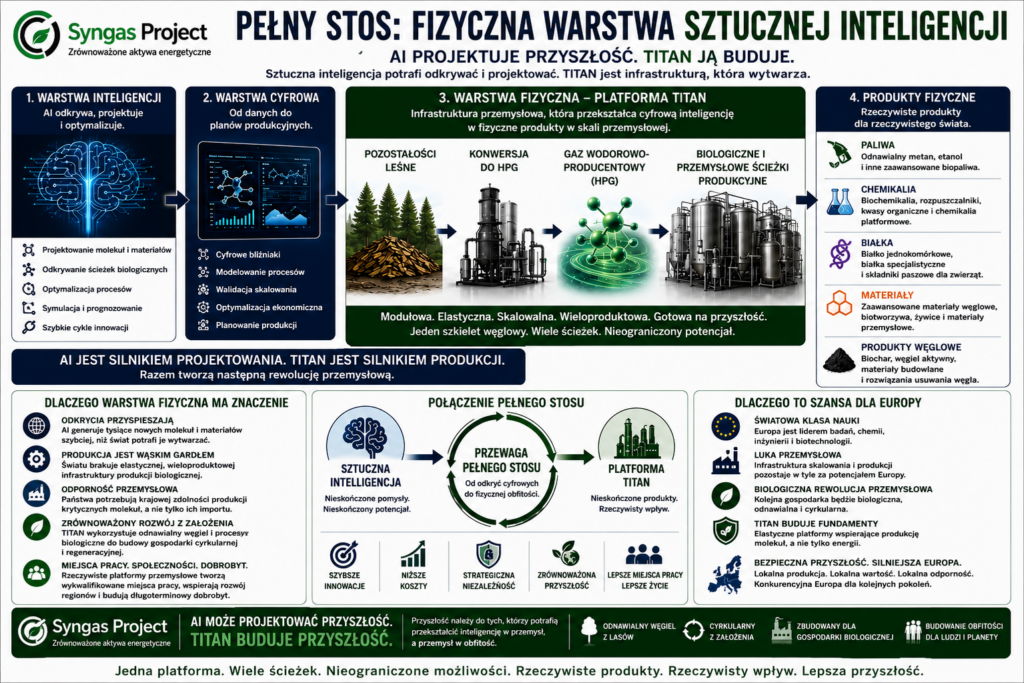
To właśnie logika TITAN.
TITAN nie został zaprojektowany jako klasyczna instalacja waste-to-energy. Nie opiera się na logice prostego unieszkodliwiania odpadów. I nie jest ograniczony do produkcji jednego produktu.
TITAN został zaprojektowany jako odnawialna rafineria węgla.
Proces rozpoczyna się od pozostałości leśnych i odnawialnych biologicznych strumieni węgla. Materiały te są przekształcane w Hydrogen Producer Gas (HPG), tworząc kontrolowany gazowy kręgosłup węglowy bogaty w wodór, tlenek węgla i dwutlenek węgla.
Many people imagine forest residues as a random, scattered and uncertain resource. They picture a loose biomass market, occasional availability and a feedstock supply chain that is difficult to control.
Nothing could be further from the real position in Poland.
Poland’s State Forests are one of the country’s great strategic assets. They are organised through 17 Regional Directorates of State Forests, known as RDLPs. Across more than 9 million hectares of forest, the system is planned, measured and managed over long biological cycles. Forest stands mature over 40 years and longer. Harvesting, replanting, thinning, species management and timber classification are not accidental. They are known, recorded and managed.
This matters for TITAN.
It also matters for the long-term CSRD logic of forestry.
A platform that converts forest residue into renewable molecules cannot depend on guesswork. It must understand where material is available, when it will be available, what quality it has and how much can be responsibly recovered.
The Polish forestry system already contains much of that knowledge.
The RDLP structure knows its forests. It knows stand maturity, species composition, harvest planning, merchantable timber availability and non-merchantable material potential. It understands where forest residues arise, where windthrow or disease has affected stands, and where clean-up work is required after harvesting.
This means the non-merchantable resource can be accounted for down to the tonne.
That changes its status.
Instead of being treated as a low-value residue, unmanaged by-product or potential liability, it becomes an auditable renewable carbon resource. It can be measured, recovered, priced and reported. For forestry, this is important. CSRD requires better evidence, better inventory logic and better explanation of how environmental resources and impacts are managed.
TITAN helps make that possible.
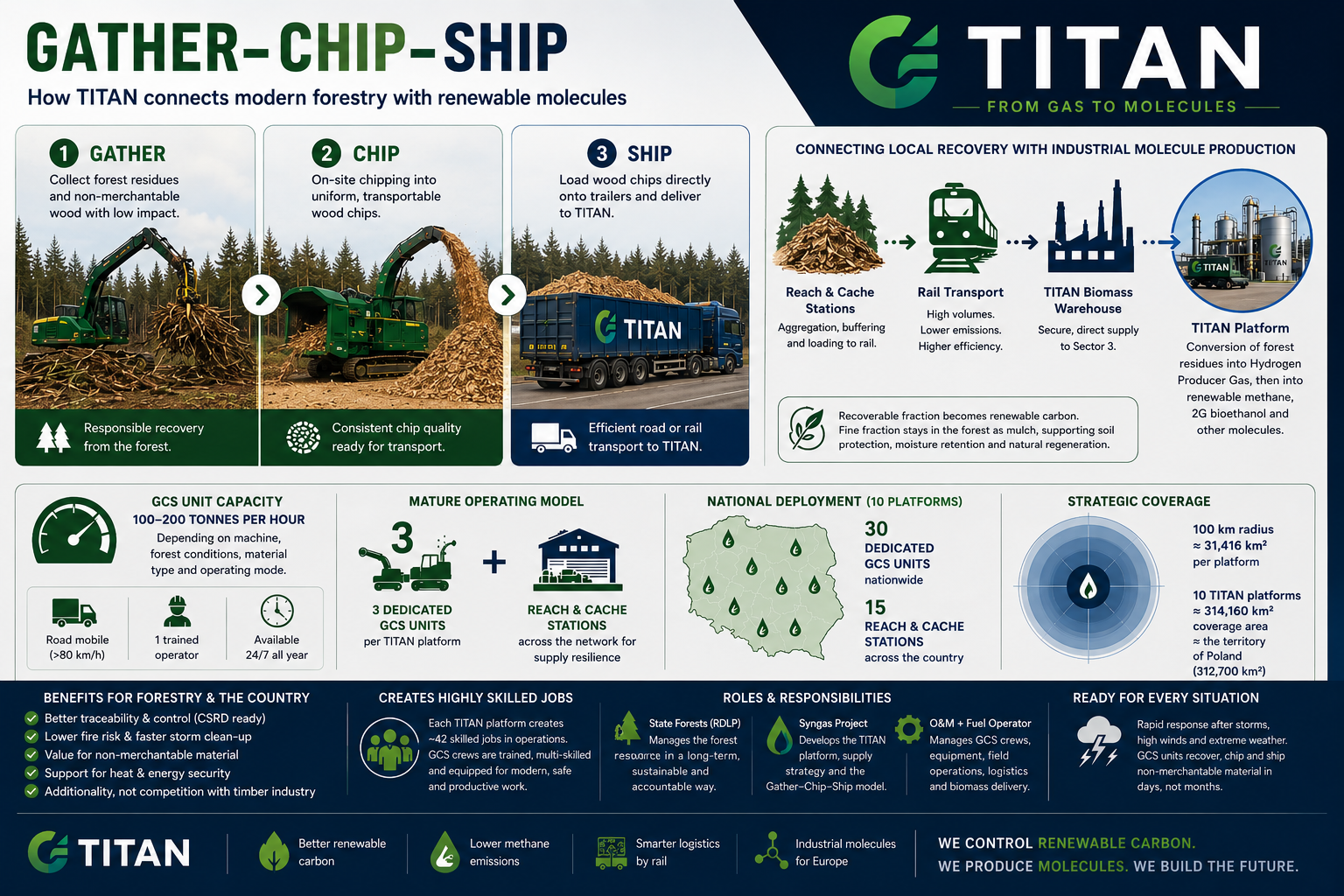
TITAN is not only a plant waiting at the end of a supply chain. It is active at the front end. The platform is designed around its own Gather–Chip–Ship capability, known as GCS. This means dedicated mobile machinery, trained operators and a controlled recovery system located around the regional forest base.