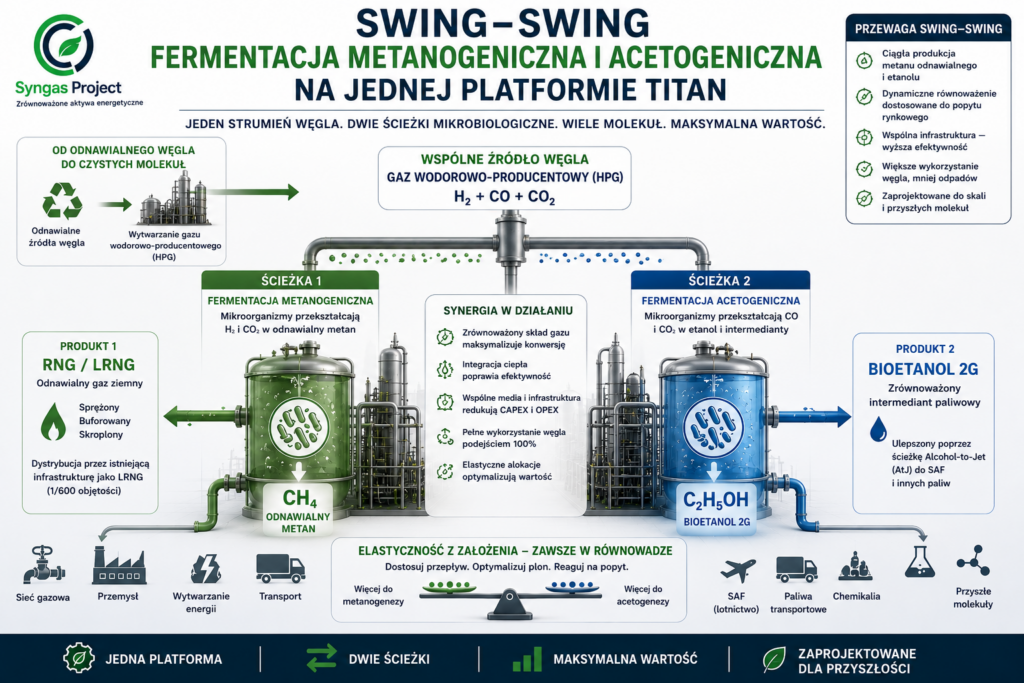
Swing–Swing: fermentacja metanogenna i acetogenna na jednej platformie

TITAN nie wybiera pomiędzy metanem odnawialnym a etanolem.

Produkuje oba produkty na tej samej platformie, z tego samego strumienia węgla.

To jest podstawa trybu Swing–Swing.

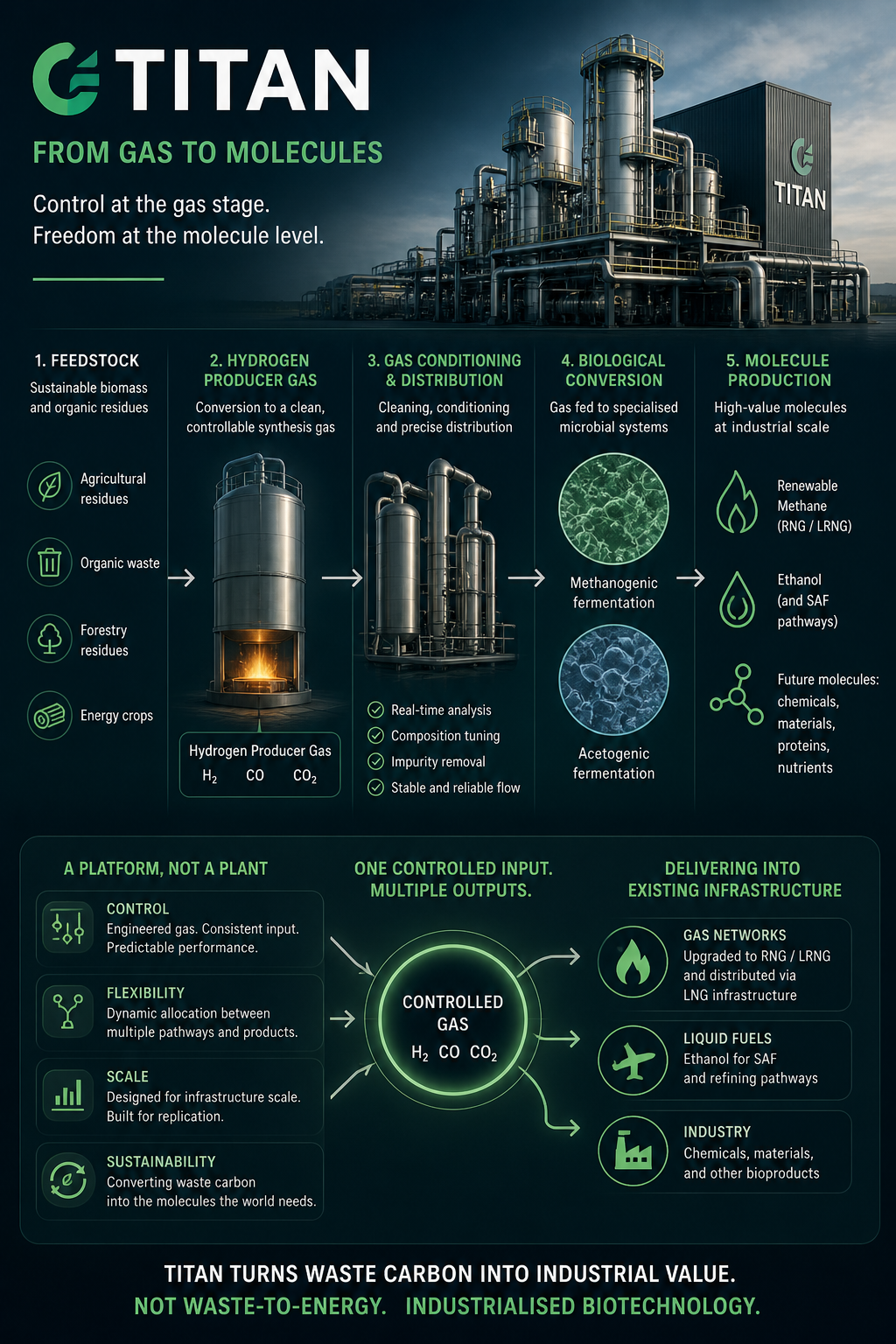
W centrum platformy TITAN znajduje się Hydrogen Producer Gas. Nie jest to gaz odpadowy. Jest to kontrolowany surowiec węglowy, zaprojektowany tak, aby dostarczać stabilną mieszaninę wodoru, tlenku węgla i dwutlenku węgla. Ten gaz staje się interfejsem pomiędzy konwersją termochemiczną a biotechnologią.

Z jednego strumienia gazu równolegle działają dwie ścieżki biologiczne.

Fermentacja metanogenna przekształca gaz w metan odnawialny.

Fermentacja acetogenna przekształca ten sam gaz w etanol.

To nie są procesy konkurencyjne. Są komplementarne.

Tradycyjne systemy wymuszają wybór. Gaz jest spalany, uszlachetniany albo kierowany do jednej ścieżki downstream. Ogranicza to elastyczność i zmniejsza wartość. TITAN został zaprojektowany inaczej. Gaz jest kondycjonowany i dystrybuowany w ramach platformy, która może kierować węgiel tam, gdzie w danym momencie tworzy największą wartość.

To nie jest przewaga teoretyczna. To zdolność na poziomie systemu.

Organizmy metanogenne preferują warunki bogate w wodór. Efektywnie i niezawodnie przekształcają wodór i dwutlenek węgla w metan. Ta ścieżka produkuje odnawialny gaz ziemny, który może być sprężany, skraplany i dystrybuowany jako LRNG przez istniejącą infrastrukturę.

Organizmy acetogenne działają inaczej. Zużywają tlenek węgla i dwutlenek węgla, przekształcając je w etanol i inne półprodukty. Ta ścieżka wspiera produkcję etanolu 2G, który może być następnie wykorzystany w ścieżce Alcohol-to-Jet do produkcji zrównoważonego paliwa lotniczego.

Obie ścieżki zależą od jakości gazu, ciśnienia, temperatury i składu. W TITAN te zmienne są kontrolowane. Gaz nie jest po prostu produkowany i wysyłany dalej. Jest zarządzany, kondycjonowany i kierowany.
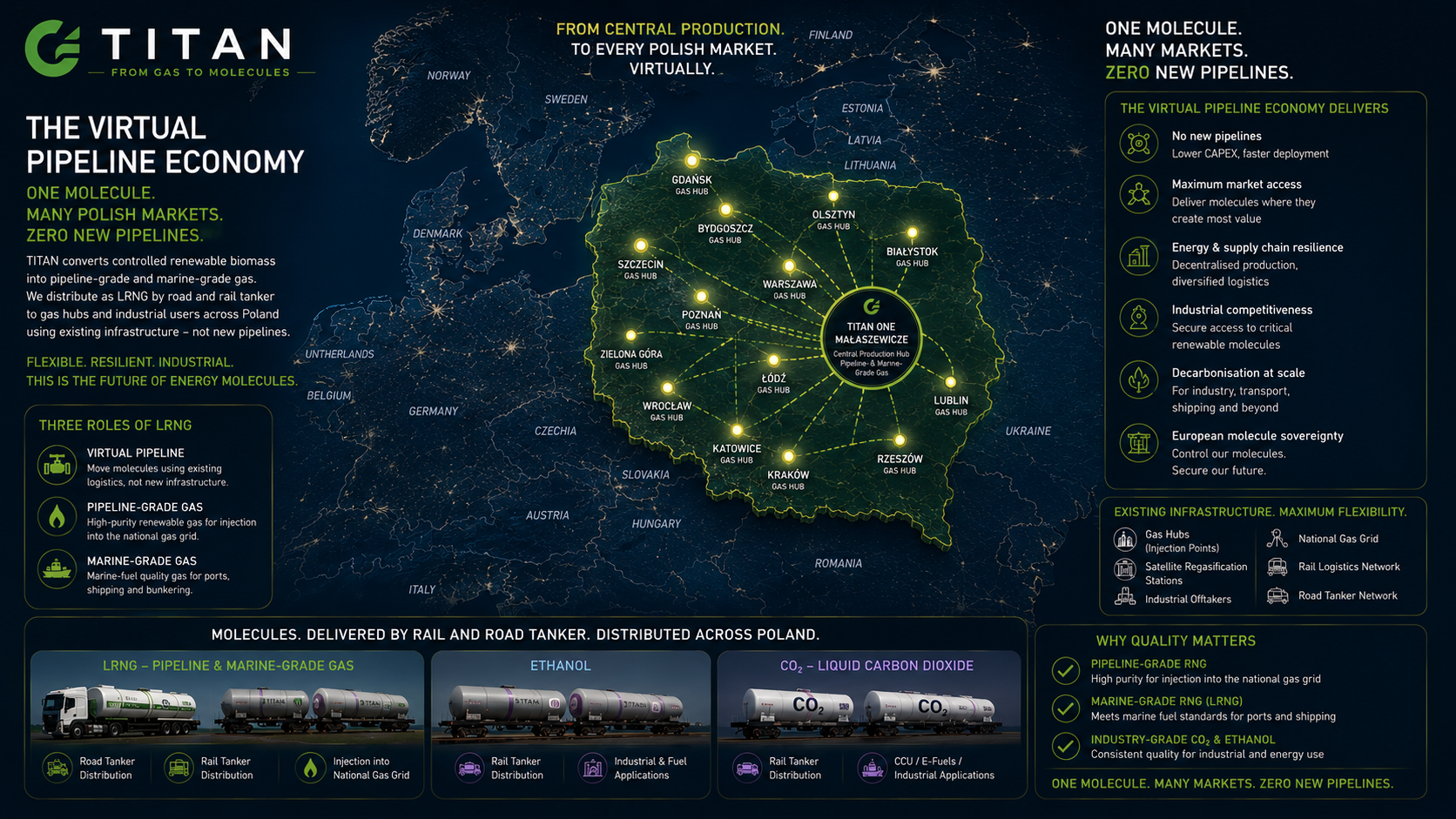
The Virtual Pipeline Economy

For more than a century, industrial gas distribution has been dominated by fixed pipeline infrastructure.

Pipelines transformed economies because they allowed large volumes of energy molecules to move continuously between production centres and industrial demand zones. Entire industries were built around this logic. Heavy industry, fertiliser production, chemicals, district heating, shipping and power generation all evolved around the assumption that gas infrastructure would remain centralised, fixed and geographically constrained.

The problem is that Europe’s energy geography has changed faster than its infrastructure.

The European Union now faces a structural challenge that cannot be solved using electricity alone. Europe may increasingly produce its own electrons, but it still imports a large proportion of its critical molecules. Natural gas, LNG, methanol, ammonia, aviation fuels and chemical feedstocks remain deeply exposed to external supply chains and geopolitical instability.

This is where the virtual pipeline economy begins.

TITAN is designed around the idea that renewable molecules should move through Europe using flexible logistics infrastructure instead of relying exclusively on fixed pipeline systems.

The concept is simple.

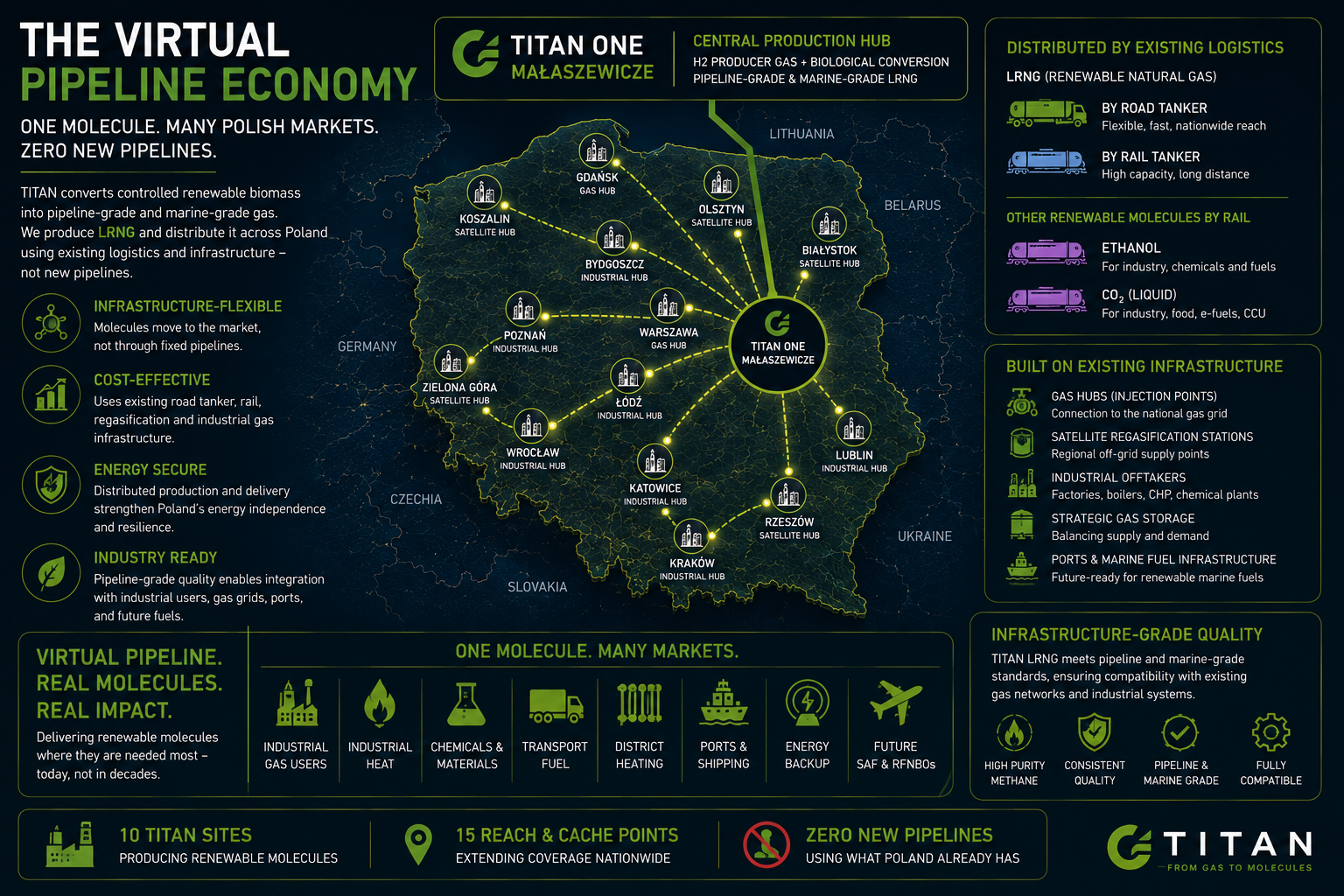
Instead of transporting low-density biomass over very long distances, TITAN converts regional biomass into high-density renewable gas molecules close to the feedstock source. Those molecules are then distributed through existing road, rail, marine and regasification infrastructure using LRNG logistics.

LRNG — Liquefied Renewable Natural Gas — allows renewable methane to be transported at approximately 1/600th of its gaseous volume. This transforms renewable gas from a geographically trapped energy source into a mobile industrial commodity capable of serving national markets.

The result is a virtual pipeline.

The molecule moves without requiring a physical transmission pipe between origin and destination.

This is not a theoretical concept. Europe already operates major LNG logistics infrastructure across ports, storage facilities, satellite regasification terminals, rail systems and tanker fleets. TITAN simply adapts this proven infrastructure for renewable molecule distribution.

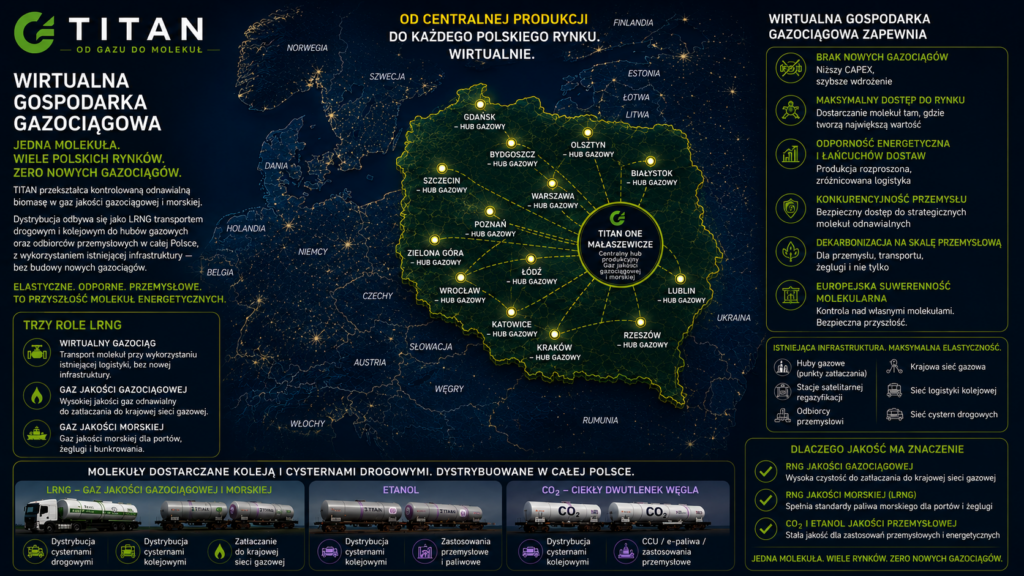
Wirtualna gospodarka rurociągowa

Przez ponad sto lat przemysłowa dystrybucja gazu była zdominowana przez stałą infrastrukturę rurociągową.

Rurociągi zmieniły gospodarki, ponieważ umożliwiły ciągły transport dużych ilości molekuł energii pomiędzy centrami produkcyjnymi a strefami przemysłowego zapotrzebowania. Całe gałęzie przemysłu rozwijały się wokół założenia, że infrastruktura gazowa pozostanie scentralizowana, stała i geograficznie ograniczona.

Problem polega na tym, że europejska geografia energetyczna zmienia się szybciej niż infrastruktura.

Unia Europejska stoi obecnie przed strukturalnym wyzwaniem, którego nie można rozwiązać wyłącznie energią elektryczną. Europa może coraz częściej produkować własne elektrony, ale nadal importuje znaczną część swoich strategicznych molekuł. Gaz ziemny, LNG, metanol, amoniak, paliwa lotnicze oraz surowce chemiczne pozostają silnie uzależnione od zewnętrznych łańcuchów dostaw i niestabilności geopolitycznej.

W tym miejscu rozpoczyna się gospodarka wirtualnego rurociągu.

TITAN został zaprojektowany wokół idei, że odnawialne molekuły powinny przemieszczać się po Europie przy wykorzystaniu elastycznej infrastruktury logistycznej, a nie wyłącznie poprzez stałe systemy rurociągowe.

Koncepcja jest prosta.

Zamiast transportować biomasę o niskiej gęstości na bardzo duże odległości, TITAN przekształca regionalną biomasę w wysokogęstościowe odnawialne molekuły gazowe blisko źródła surowca. Następnie molekuły te są dystrybuowane poprzez istniejącą infrastrukturę drogową, kolejową, morską i regazyfikacyjną przy wykorzystaniu logistyki LRNG.

LRNG — Liquefied Renewable Natural Gas — umożliwia transport odnawialnego metanu przy objętości około 1/600 jego postaci gazowej. Dzięki temu odnawialny gaz przestaje być lokalnym źródłem energii ograniczonym geograficznie i staje się mobilnym surowcem przemysłowym zdolnym obsługiwać rynki krajowe.

Forest Residue Is Not Waste: It Is Europe’s Underused Carbon Resource

Przewiń w dół, aby zobaczyć polską wersję.

Europe does not lack carbon.

It lacks controlled renewable carbon.

Every year, forests produce large volumes of material that never becomes merchantable timber. Branches, tops, twisted wood, undersized stems, storm residues and other low-value material are often difficult to recover economically. Some of this material is left on the forest floor. Some is recovered for low-value uses. Much of it is treated as a logistical problem rather than an industrial opportunity.

TITAN sees this material differently.

Forest residue is not waste. It is renewable carbon. It is local, physical, measurable and already present inside the European landscape. When collected responsibly, it can support a new generation of industrial molecule production without competing directly with food crops or high-value timber markets.

This distinction matters.

Europe’s energy debate has focused heavily on electrons. Wind, solar and grid expansion are essential, but they do not solve the molecule problem. Aviation fuel, industrial gas, chemicals, materials and many liquid fuels still depend on carbon-based molecules. The question is not whether Europe needs carbon. It does. The question is where that carbon should come from.

Today, too much of Europe’s molecule economy still depends on imported fossil carbon.

TITAN offers a different route.

The platform converts forest residue into Hydrogen Producer Gas, creating a controlled gas-phase feedstock for targeted microbial fermentation. From there, carbon can be converted into renewable methane, 2G ethanol and, in future, wider fuels, chemicals, materials and nutrients.

TITAN: From Gas to Molecules — Why Control Matters

Przewiń w dół, aby zobaczyć wersję w języku polskim.

TITAN does not begin with fermentation.

It begins with control.

At the heart of the platform is a simple but critical step: converting solid carbon into a stable, controllable gas. This is achieved through Hydrogen Producer Gas, where biomass is transformed into a defined mixture of hydrogen, carbon monoxide and carbon dioxide.

This step determines everything that follows.

Most carbon conversion systems struggle because they attempt to process variability. Mixed inputs lead to unstable outputs. Biological systems, in particular, are sensitive to inconsistency. When feedstock fluctuates, performance drops, yields fall, and scale becomes difficult.

TITAN removes this problem at the source.

By converting solids into gas first, it separates variability from production. The gas phase becomes a controlled interface between raw material and biology. Instead of managing unpredictable solids, the system manages a measurable, adjustable flow.

Gas can be analysed in real time.

Composition can be tuned. Ratios of hydrogen to carbon monoxide can be adjusted depending on the target pathway. Flow can be stabilised. Impurities can be reduced through conditioning and polishing. What enters the fermentation system is no longer variable waste. It is engineered input.

This is the difference between adaptation and design.

In conventional systems, biology is forced to adapt to the feedstock. In TITAN, the feedstock is engineered to suit the biology. This allows microbial systems to operate under optimal conditions rather than survival conditions.

The result is stability.

Methanogenic and acetogenic pathways require consistency to perform at industrial scale. Methanogens convert hydrogen and carbon dioxide into methane. Acetogens convert carbon monoxide and hydrogen into ethanol and other molecules. Both processes are highly sensitive to gas composition, pressure and flow.

The Virtual Pipeline Economy

Publish date: 25 March 2026

(Polska wersja poniżej.)

For more than a century, industrial gas distribution has depended on fixed pipeline systems.

Pipelines transformed economies because they allowed energy molecules to move continuously between production centres and industrial users. Heavy industry, chemicals, district heating, shipping and manufacturing all developed around this infrastructure model.

But building entirely new national pipeline systems is slow, expensive and politically difficult.

At the same time, Poland faces a growing challenge.

The country requires increasing volumes of renewable molecules for industry, transport, chemicals, heating and future fuel systems, while much of the existing renewable energy discussion remains focused almost entirely on electricity.

Electricity matters.

But molecules matter too.

Factories require molecules.

High-temperature industrial heat requires molecules.

Shipping requires molecules.

Chemicals require molecules.

Future aviation fuels require molecules.

The question is not simply how to produce renewable molecules.

The question is how to distribute them efficiently across the country without waiting decades for entirely new infrastructure to be built.

This is where the virtual pipeline economy begins.

Swing–Swing — Bankability Through Molecule Choice

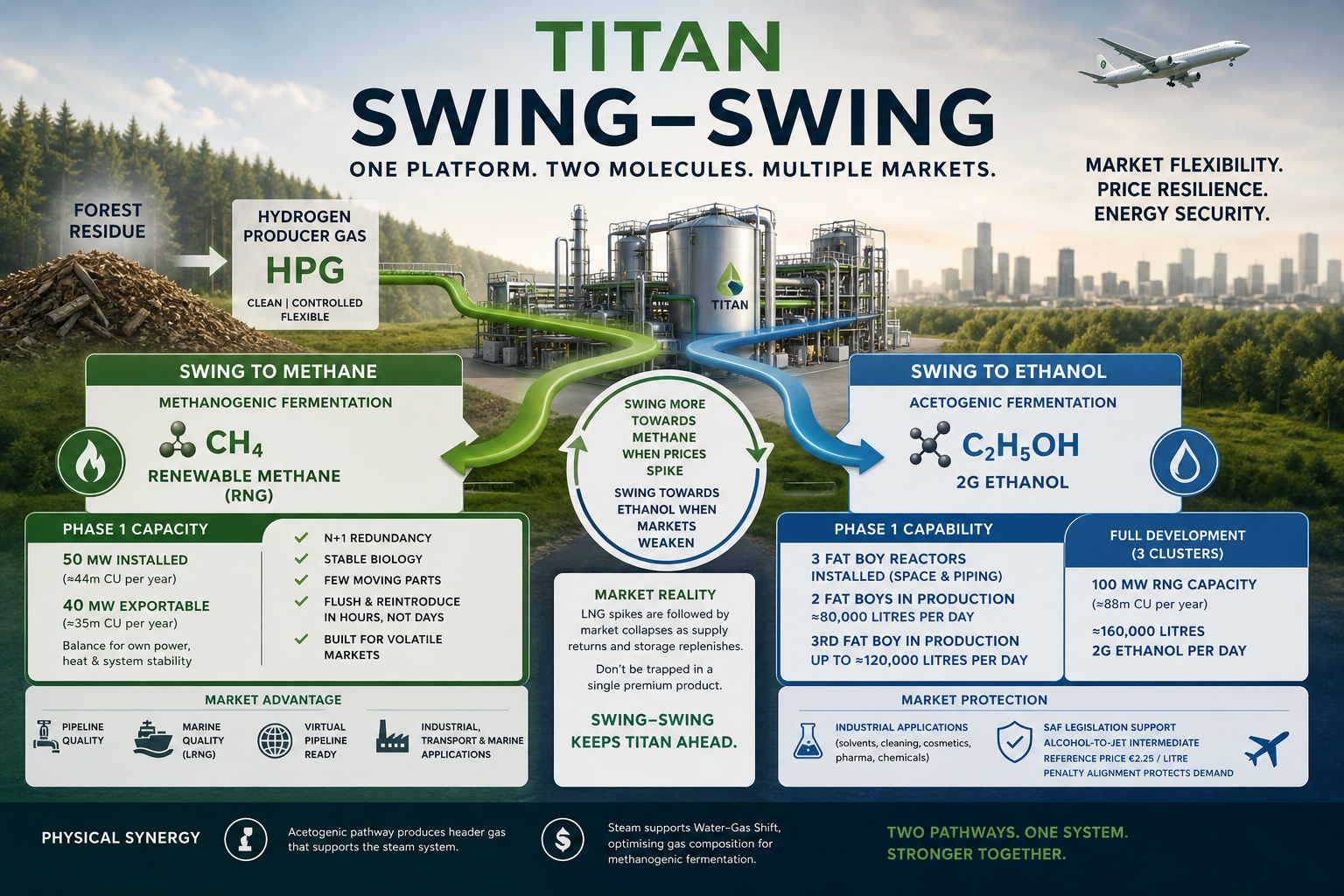
TITAN is built as a molecule platform, not a single-output plant.

In Phase 1, the local materiality case is methane-led. Poland needs a bankable, scalable renewable gas solution, and TITAN answers that need by converting forest residue into Hydrogen Producer Gas and then into renewable methane through methanogenic fermentation. This is the right starting point. It connects directly to existing gas infrastructure, supports energy security, and creates an immediate route to market.

But TITAN is not simply an RNG plant.

The platform is designed from the beginning to move between renewable methane and 2G ethanol. This is the meaning of Swing–Swing 25MW RNG (circa 22m CU per year) + 80,000 litres of 2G EtOH daily.

Phase 1 installs 50 MW (Circa 44m CU a year) of RNG capacity. In normal operation, around 40 MW (circa 35m CU a year) can be exported, while the balance is retained for own power, heat and system stability. The additional installed capacity provides N+1 redundancy, but not because the biology is weak. Methanogenic fermentation is stable. The archaea operate as efficient replicating colonies, with very few moving parts. Once established, the colony regime is unlikely to change materially within a 12-month cycle, and if intervention is needed, flushing and reintroduction are measured in hours, not days.

The redundancy is justified because the market is volatile.

If LNG or gas prices spike, TITAN can swing more gas toward methane and capture that value. If methane prices weaken or collapse as they often do after spikes), the platform is not trapped. It can direct gas toward acetogenic fermentation, producing ethanol instead.

Swing–Swing — Bankowalność poprzez wybór molekuły

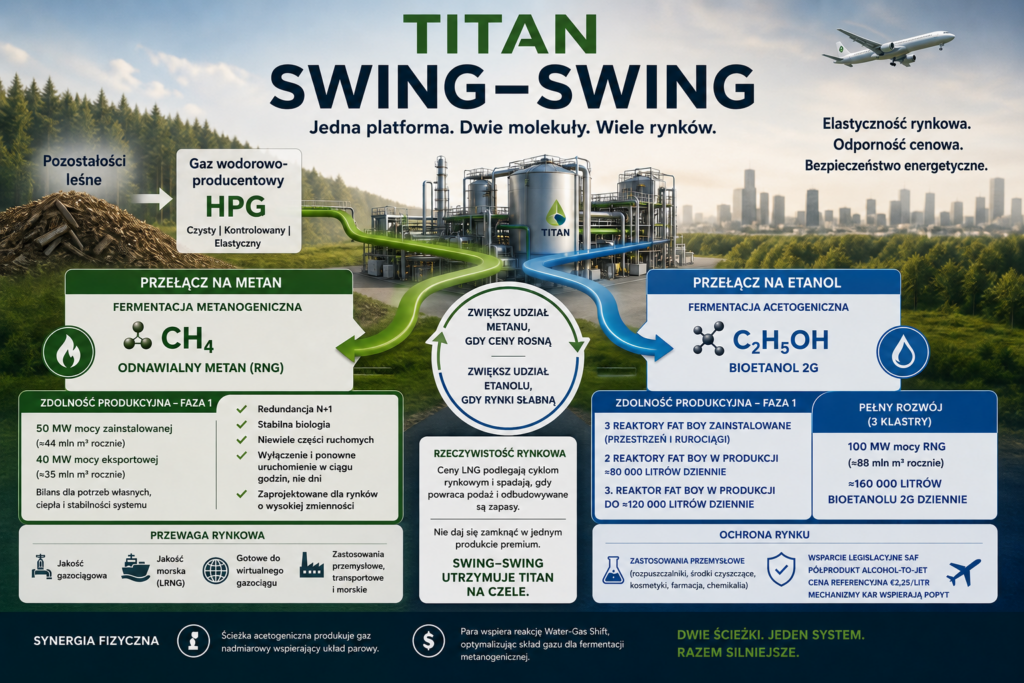
TITAN został zaprojektowany jako platforma molekularna, a nie instalacja jednego produktu.

W Fazie 1 punktem wyjścia jest lokalna materialność, czyli metan. Polska potrzebuje bankowalnego, skalowalnego rozwiązania dla odnawialnego gazu i TITAN odpowiada na tę potrzebę, przekształcając pozostałości leśne w Hydrogen Producer Gas, a następnie w odnawialny metan w procesie fermentacji metanogennej. To właściwy punkt startowy. System łączy się bezpośrednio z istniejącą infrastrukturą gazową, wspiera bezpieczeństwo energetyczne i zapewnia natychmiastową ścieżkę do rynku.

Ale TITAN nie jest po prostu instalacją RNG.

Platforma od początku została zaprojektowana tak, aby mogła przełączać się pomiędzy odnawialnym metanem a etanolem 2G. To właśnie oznacza Swing–Swing.

W trybie Swing–Swing TITAN może produkować około 25 MW RNG, co odpowiada około 22 mln m³ rocznie, oraz około 80 000 litrów etanolu 2G dziennie. Daje to dwa równoległe strumienie przychodów z jednego kontrolowanego systemu gazowego.

Faza 1 obejmuje instalację 50 MW mocy RNG, czyli około 44 mln m³ rocznie. W standardowej pracy około 40 MW, czyli około 35 mln m³ rocznie, może być eksportowane, natomiast pozostała część wykorzystywana jest na potrzeby własne, ciepło oraz stabilizację systemu.

Dodatkowa moc zapewnia redundancję N+1, ale nie dlatego, że biologia jest słaba. Fermentacja metanogenna jest stabilna. Archeony funkcjonują jako efektywna, samoreplikująca się kolonia, z bardzo niewielką liczbą elementów ruchomych. Po ustabilizowaniu układu zmiana reżimu pracy w ciągu 12 miesięcy jest mało prawdopodobna, a ewentualne czyszczenie i ponowne zaszczepienie zajmuje godziny, a nie dni.

Redundancja jest uzasadniona zmiennością rynku.

Rynki LNG i gazu często podlegają gwałtownym zmianom. Gdy ceny rosną, użytkownicy szukają alternatyw. Odbudowa zapasów zajmuje czas, a ceny mogą pozostawać wysokie przez pewien okres. Jednak gdy podaż wraca, ceny LNG mogą gwałtownie spaść. To niebezpieczna sytuacja dla instalacji uzależnionej od jednego produktu o wysokiej cenie.

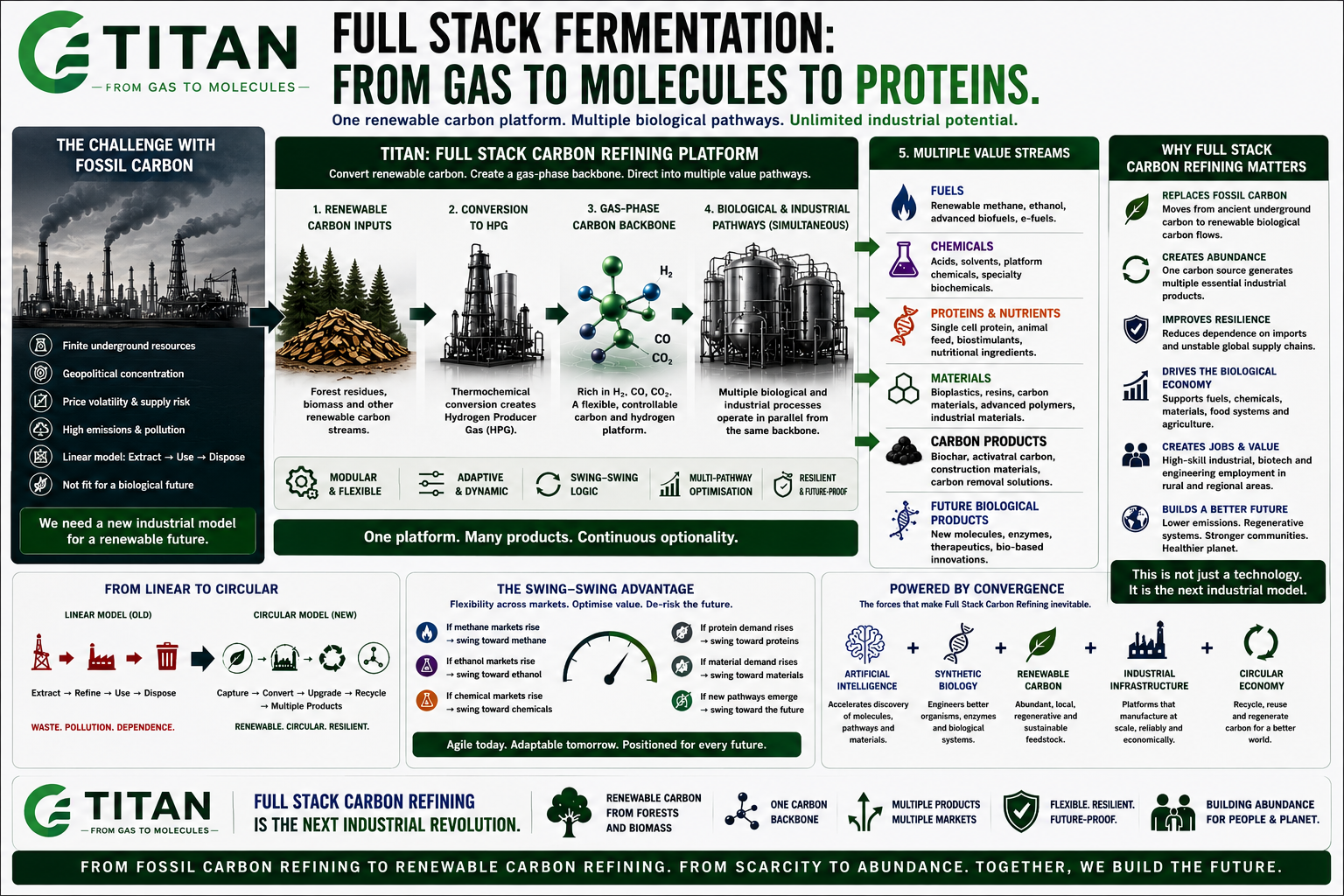
Full Stack Carbon Refining

For more than a century, industrial civilisation has been built around fossil carbon refining.

Oil refineries transformed crude oil into fuels, chemicals, plastics, solvents and industrial materials. Gas infrastructure supplied heat, power and industrial feedstocks. Petrochemical systems became the molecular foundation of the modern economy.

That system created enormous prosperity.

But it also created dependence on finite underground carbon resources extracted from geopolitically concentrated regions of the world.

The next industrial transition may not simply replace fossil energy.

It may replace fossil carbon itself.

This is where Full Stack Carbon Refining begins.

Syngas Project believes the future economy will increasingly require platforms capable of converting renewable carbon into multiple industrial outputs simultaneously.

Not only energy.

But fuels, chemicals, materials and nutrients.

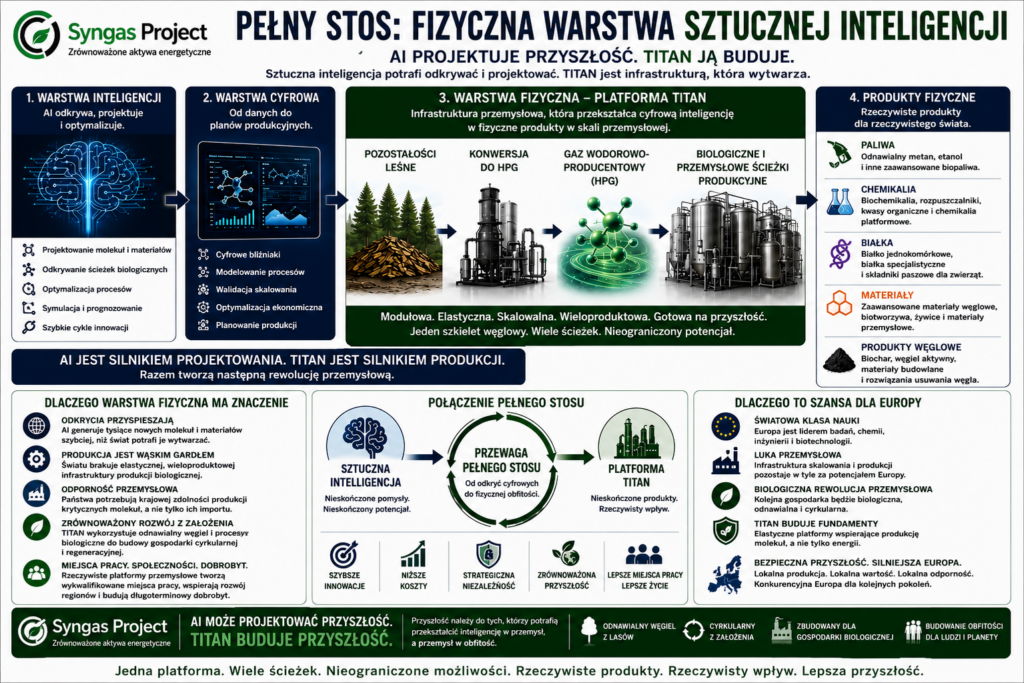
Pełnostosowa rafineria węgla odnawialnego

Warsaw 11:03:2026 1.05 PM Steve Walker

Przez ponad sto lat cywilizacja przemysłowa była budowana wokół rafinacji kopalnego węgla.

Rafinerie ropy przekształcały surową ropę w paliwa, chemikalia, tworzywa sztuczne, rozpuszczalniki i materiały przemysłowe. Infrastruktura gazowa dostarczała ciepło, energię i surowce przemysłowe. Systemy petrochemiczne stały się molekularnym fundamentem nowoczesnej gospodarki.

Ten system stworzył ogromny dobrobyt.

Ale stworzył również zależność od ograniczonych zasobów kopalnego węgla wydobywanego z geopolitycznie skoncentrowanych regionów świata.

Następna transformacja przemysłowa może nie tylko zastąpić energię kopalną.

Może zastąpić sam kopalny węgiel.

Właśnie tutaj zaczyna się Full Stack Carbon Refining.

Syngas Project uważa, że przyszła gospodarka będzie coraz bardziej potrzebowała platform zdolnych jednocześnie przekształcać odnawialny węgiel w wiele różnych produktów przemysłowych.

Nie tylko energię.

Ale paliwa, chemikalia, materiały i składniki odżywcze.

To właśnie logika TITAN.

TITAN nie został zaprojektowany jako klasyczna instalacja waste-to-energy. Nie opiera się na logice prostego unieszkodliwiania odpadów. I nie jest ograniczony do produkcji jednego produktu.

TITAN został zaprojektowany jako odnawialna rafineria węgla.

Proces rozpoczyna się od pozostałości leśnych i odnawialnych biologicznych strumieni węgla. Materiały te są przekształcane w Hydrogen Producer Gas (HPG), tworząc kontrolowany gazowy kręgosłup węglowy bogaty w wodór, tlenek węgla i dwutlenek węgla.