
Warsaw 28:02:2026 02:02 PM Steve Walker
Forestry is often misunderstood.
Many people imagine forest residues as a random, scattered and uncertain resource. They picture a loose biomass market, occasional availability and a feedstock supply chain that is difficult to control.
Nothing could be further from the real position in Poland.
Poland’s State Forests are one of the country’s great strategic assets. They are organised through 17 Regional Directorates of State Forests, known as RDLPs. Across more than 9 million hectares of forest, the system is planned, measured and managed over long biological cycles. Forest stands mature over 40 years and longer. Harvesting, replanting, thinning, species management and timber classification are not accidental. They are known, recorded and managed.
This matters for TITAN.
It also matters for the long-term CSRD logic of forestry.
A platform that converts forest residue into renewable molecules cannot depend on guesswork. It must understand where material is available, when it will be available, what quality it has and how much can be responsibly recovered.
The Polish forestry system already contains much of that knowledge.
The RDLP structure knows its forests. It knows stand maturity, species composition, harvest planning, merchantable timber availability and non-merchantable material potential. It understands where forest residues arise, where windthrow or disease has affected stands, and where clean-up work is required after harvesting.
This means the non-merchantable resource can be accounted for down to the tonne.
That changes its status.
Instead of being treated as a low-value residue, unmanaged by-product or potential liability, it becomes an auditable renewable carbon resource. It can be measured, recovered, priced and reported. For forestry, this is important. CSRD requires better evidence, better inventory logic and better explanation of how environmental resources and impacts are managed.
TITAN helps make that possible.
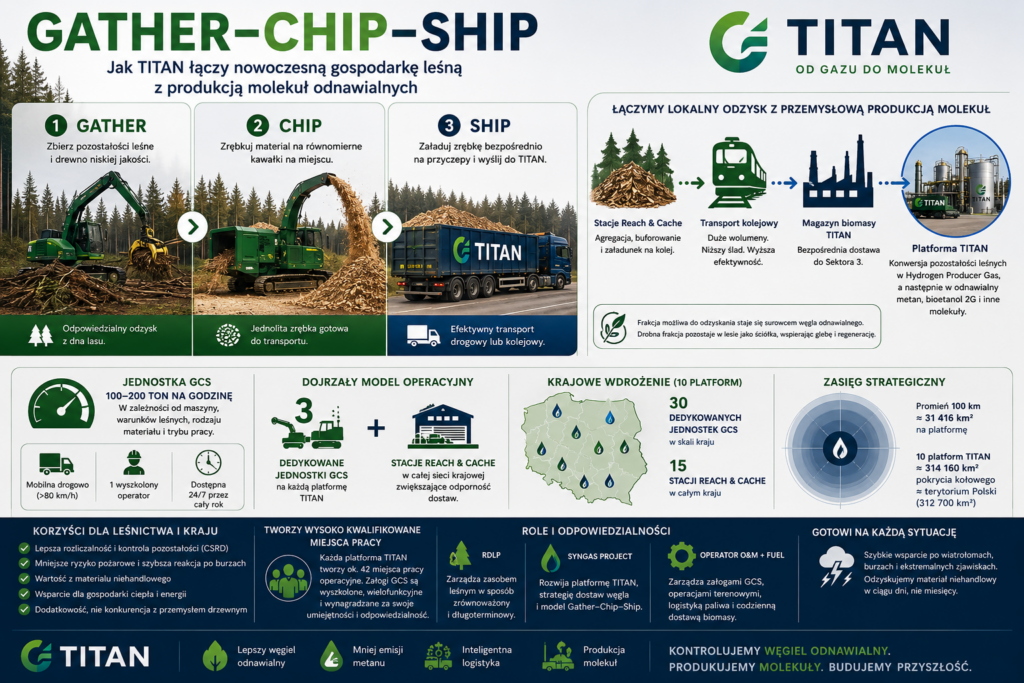
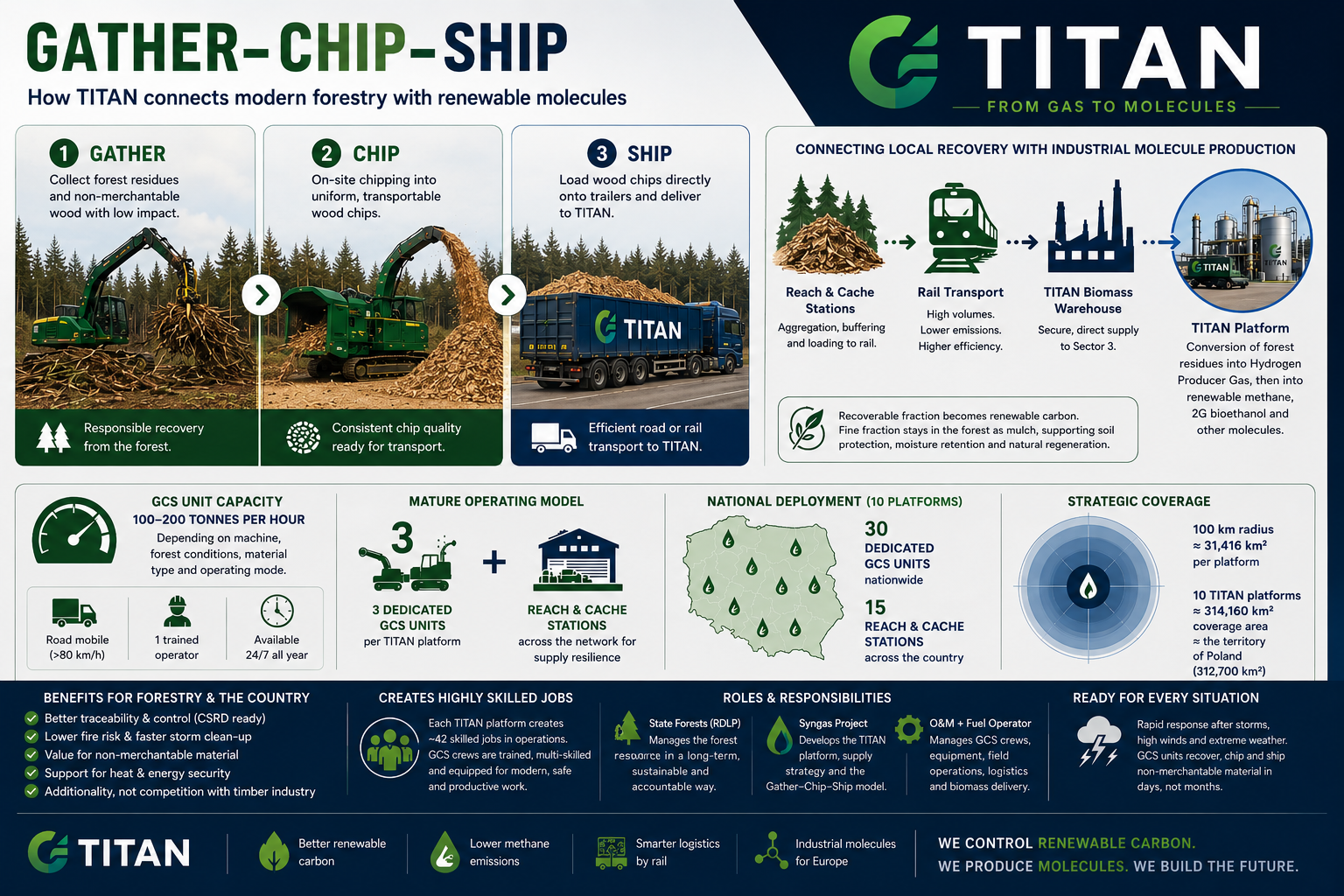
TITAN is not only a plant waiting at the end of a supply chain. It is active at the front end. The platform is designed around its own Gather–Chip–Ship capability, known as GCS. This means dedicated mobile machinery, trained operators and a controlled recovery system located around the regional forest base.