The Virtual Pipeline Economy

For more than a century, industrial gas distribution has been dominated by fixed pipeline infrastructure.

Pipelines transformed economies because they allowed large volumes of energy molecules to move continuously between production centres and industrial demand zones. Entire industries were built around this logic. Heavy industry, fertiliser production, chemicals, district heating, shipping and power generation all evolved around the assumption that gas infrastructure would remain centralised, fixed and geographically constrained.

The problem is that Europe’s energy geography has changed faster than its infrastructure.

The European Union now faces a structural challenge that cannot be solved using electricity alone. Europe may increasingly produce its own electrons, but it still imports a large proportion of its critical molecules. Natural gas, LNG, methanol, ammonia, aviation fuels and chemical feedstocks remain deeply exposed to external supply chains and geopolitical instability.

This is where the virtual pipeline economy begins.

TITAN is designed around the idea that renewable molecules should move through Europe using flexible logistics infrastructure instead of relying exclusively on fixed pipeline systems.

The concept is simple.

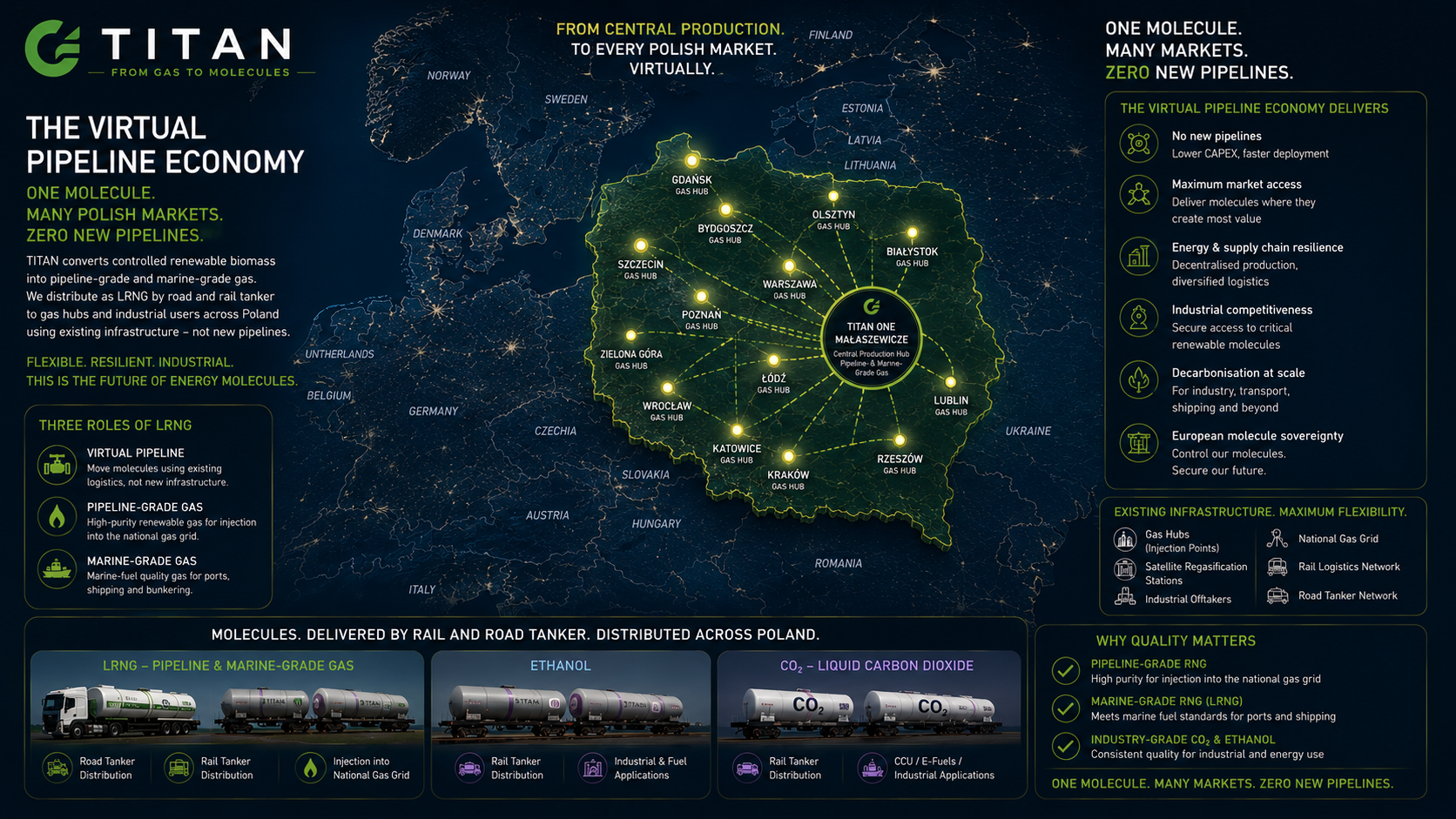
Instead of transporting low-density biomass over very long distances, TITAN converts regional biomass into high-density renewable gas molecules close to the feedstock source. Those molecules are then distributed through existing road, rail, marine and regasification infrastructure using LRNG logistics.

LRNG — Liquefied Renewable Natural Gas — allows renewable methane to be transported at approximately 1/600th of its gaseous volume. This transforms renewable gas from a geographically trapped energy source into a mobile industrial commodity capable of serving national markets.

The result is a virtual pipeline.

The molecule moves without requiring a physical transmission pipe between origin and destination.

This is not a theoretical concept. Europe already operates major LNG logistics infrastructure across ports, storage facilities, satellite regasification terminals, rail systems and tanker fleets. TITAN simply adapts this proven infrastructure for renewable molecule distribution.
Forest Residue Is Not Waste: It Is Europe’s Underused Carbon Resource

Przewiń w dół, aby zobaczyć polską wersję.

Europe does not lack carbon.

It lacks controlled renewable carbon.

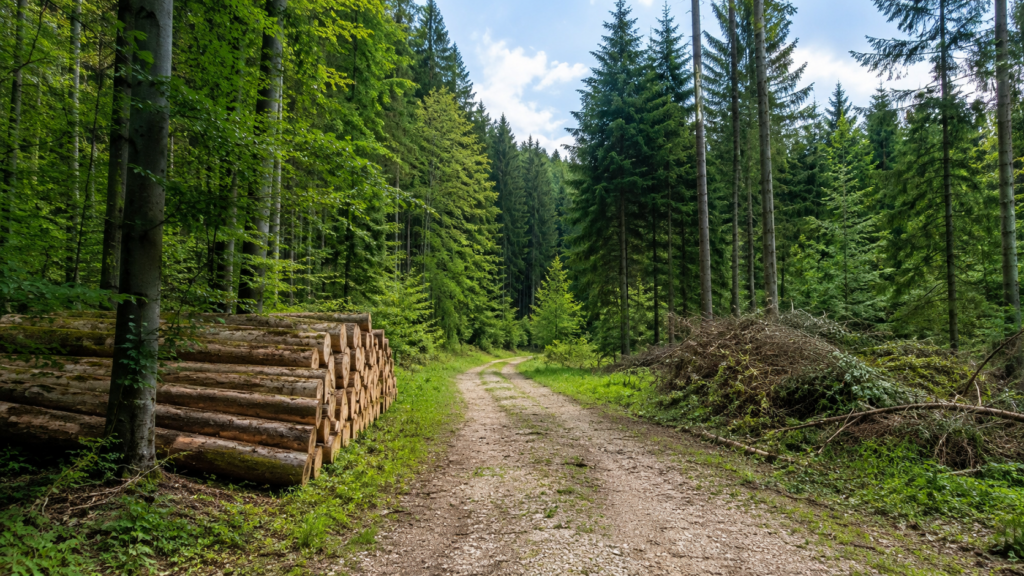
Every year, forests produce large volumes of material that never becomes merchantable timber. Branches, tops, twisted wood, undersized stems, storm residues and other low-value material are often difficult to recover economically. Some of this material is left on the forest floor. Some is recovered for low-value uses. Much of it is treated as a logistical problem rather than an industrial opportunity.

TITAN sees this material differently.

Forest residue is not waste. It is renewable carbon. It is local, physical, measurable and already present inside the European landscape. When collected responsibly, it can support a new generation of industrial molecule production without competing directly with food crops or high-value timber markets.

This distinction matters.

Europe’s energy debate has focused heavily on electrons. Wind, solar and grid expansion are essential, but they do not solve the molecule problem. Aviation fuel, industrial gas, chemicals, materials and many liquid fuels still depend on carbon-based molecules. The question is not whether Europe needs carbon. It does. The question is where that carbon should come from.

Today, too much of Europe’s molecule economy still depends on imported fossil carbon.

TITAN offers a different route.

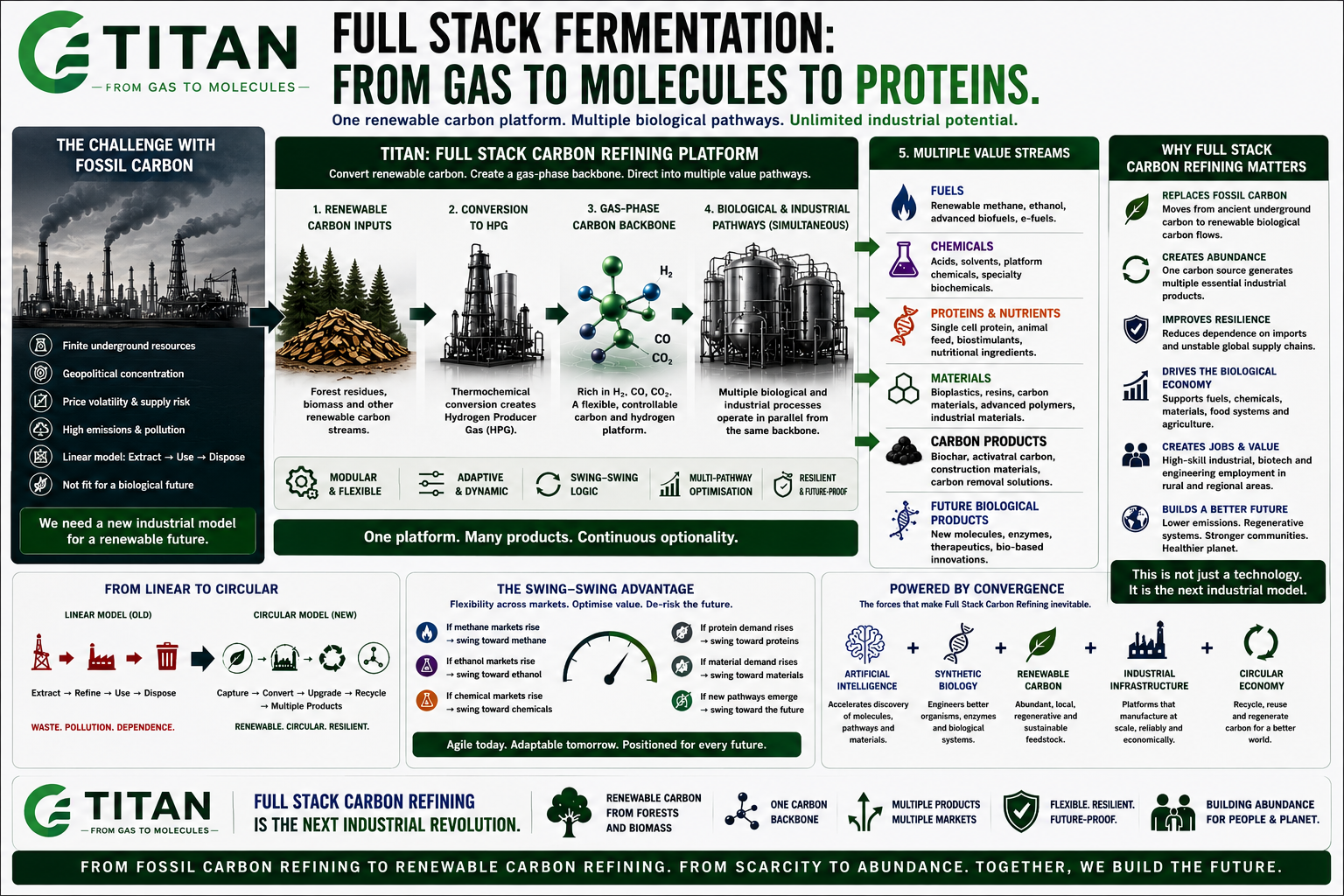
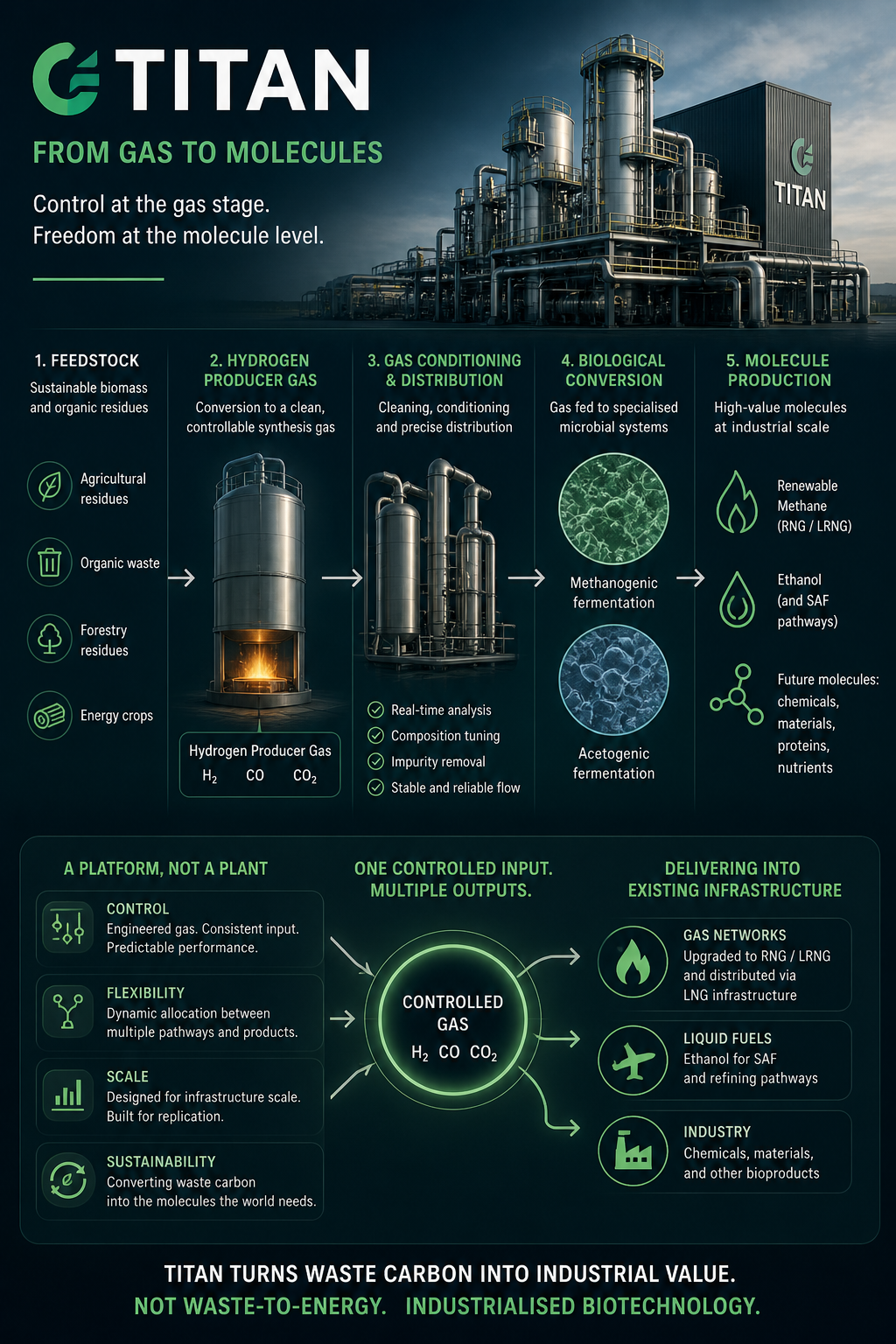
The platform converts forest residue into Hydrogen Producer Gas, creating a controlled gas-phase feedstock for targeted microbial fermentation. From there, carbon can be converted into renewable methane, 2G ethanol and, in future, wider fuels, chemicals, materials and nutrients.

TITAN: From Gas to Molecules — Why Control Matters

Przewiń w dół, aby zobaczyć wersję w języku polskim.

TITAN does not begin with fermentation.

It begins with control.

At the heart of the platform is a simple but critical step: converting solid carbon into a stable, controllable gas. This is achieved through Hydrogen Producer Gas, where biomass is transformed into a defined mixture of hydrogen, carbon monoxide and carbon dioxide.

This step determines everything that follows.

Most carbon conversion systems struggle because they attempt to process variability. Mixed inputs lead to unstable outputs. Biological systems, in particular, are sensitive to inconsistency. When feedstock fluctuates, performance drops, yields fall, and scale becomes difficult.

TITAN removes this problem at the source.

By converting solids into gas first, it separates variability from production. The gas phase becomes a controlled interface between raw material and biology. Instead of managing unpredictable solids, the system manages a measurable, adjustable flow.

Gas can be analysed in real time.

Composition can be tuned. Ratios of hydrogen to carbon monoxide can be adjusted depending on the target pathway. Flow can be stabilised. Impurities can be reduced through conditioning and polishing. What enters the fermentation system is no longer variable waste. It is engineered input.

This is the difference between adaptation and design.

In conventional systems, biology is forced to adapt to the feedstock. In TITAN, the feedstock is engineered to suit the biology. This allows microbial systems to operate under optimal conditions rather than survival conditions.

The result is stability.

Methanogenic and acetogenic pathways require consistency to perform at industrial scale. Methanogens convert hydrogen and carbon dioxide into methane. Acetogens convert carbon monoxide and hydrogen into ethanol and other molecules. Both processes are highly sensitive to gas composition, pressure and flow.

Full Stack Carbon Refining

For more than a century, industrial civilisation has been built around fossil carbon refining.

Oil refineries transformed crude oil into fuels, chemicals, plastics, solvents and industrial materials. Gas infrastructure supplied heat, power and industrial feedstocks. Petrochemical systems became the molecular foundation of the modern economy.

That system created enormous prosperity.

But it also created dependence on finite underground carbon resources extracted from geopolitically concentrated regions of the world.

The next industrial transition may not simply replace fossil energy.

It may replace fossil carbon itself.

This is where Full Stack Carbon Refining begins.

Syngas Project believes the future economy will increasingly require platforms capable of converting renewable carbon into multiple industrial outputs simultaneously.

Not only energy.

But fuels, chemicals, materials and nutrients.

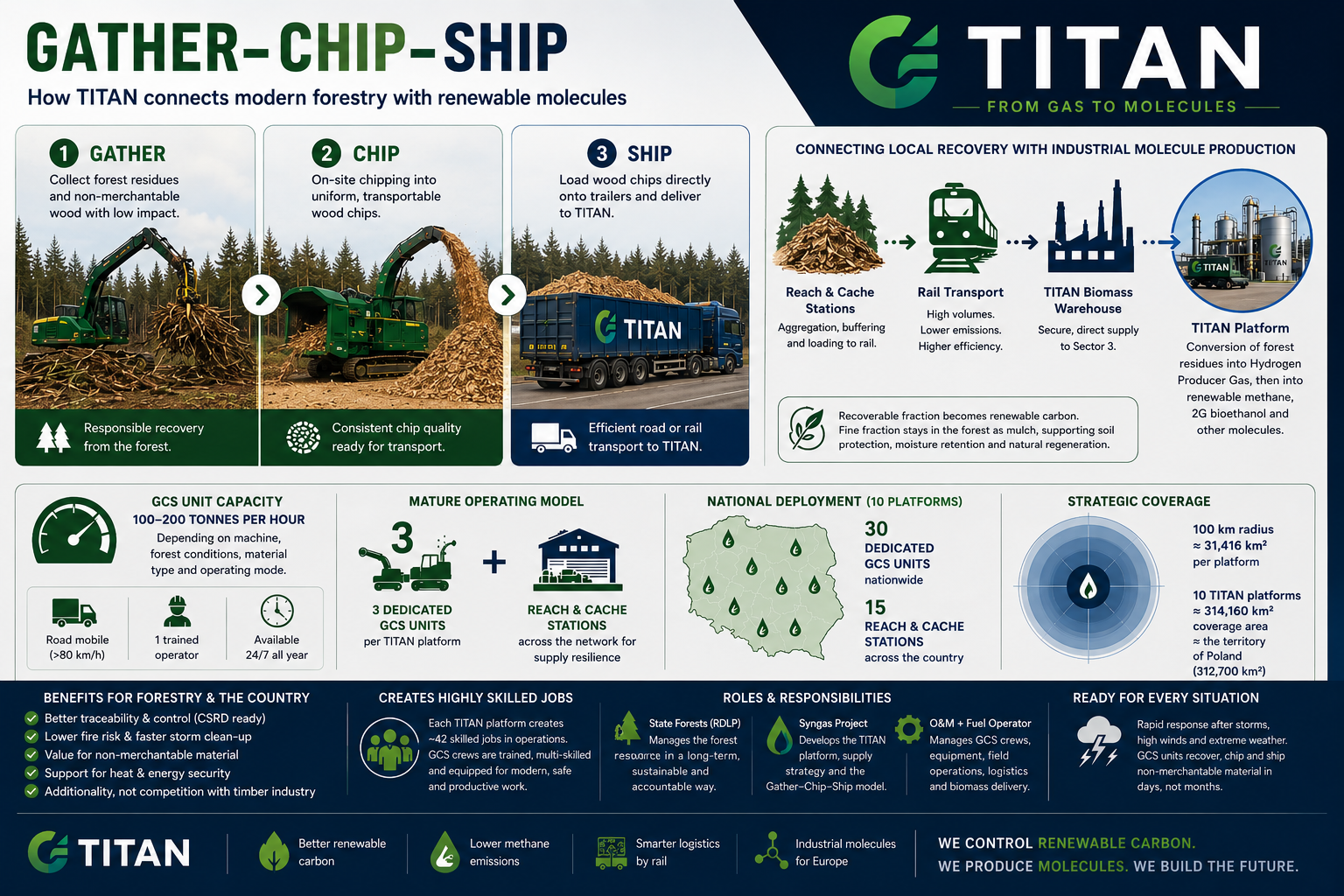
Gather–Chip–Ship: How TITAN Connects Modern Forestry to Renewable Molecules

Forestry is often misunderstood.

Many people imagine forest residues as a random, scattered and uncertain resource. They picture a loose biomass market, occasional availability and a feedstock supply chain that is difficult to control.

Nothing could be further from the real position in Poland.

Poland’s State Forests are one of the country’s great strategic assets. They are organised through 17 Regional Directorates of State Forests, known as RDLPs. Across more than 9 million hectares of forest, the system is planned, measured and managed over long biological cycles. Forest stands mature over 40 years and longer. Harvesting, replanting, thinning, species management and timber classification are not accidental. They are known, recorded and managed.

This matters for TITAN.

It also matters for the long-term CSRD logic of forestry.

A platform that converts forest residue into renewable molecules cannot depend on guesswork. It must understand where material is available, when it will be available, what quality it has and how much can be responsibly recovered.

The Polish forestry system already contains much of that knowledge.

The RDLP structure knows its forests. It knows stand maturity, species composition, harvest planning, merchantable timber availability and non-merchantable material potential. It understands where forest residues arise, where windthrow or disease has affected stands, and where clean-up work is required after harvesting.

This means the non-merchantable resource can be accounted for down to the tonne.

That changes its status.

Instead of being treated as a low-value residue, unmanaged by-product or potential liability, it becomes an auditable renewable carbon resource. It can be measured, recovered, priced and reported. For forestry, this is important. CSRD requires better evidence, better inventory logic and better explanation of how environmental resources and impacts are managed.

TITAN helps make that possible.

TITAN is not only a plant waiting at the end of a supply chain. It is active at the front end. The platform is designed around its own Gather–Chip–Ship capability, known as GCS. This means dedicated mobile machinery, trained operators and a controlled recovery system located around the regional forest base.

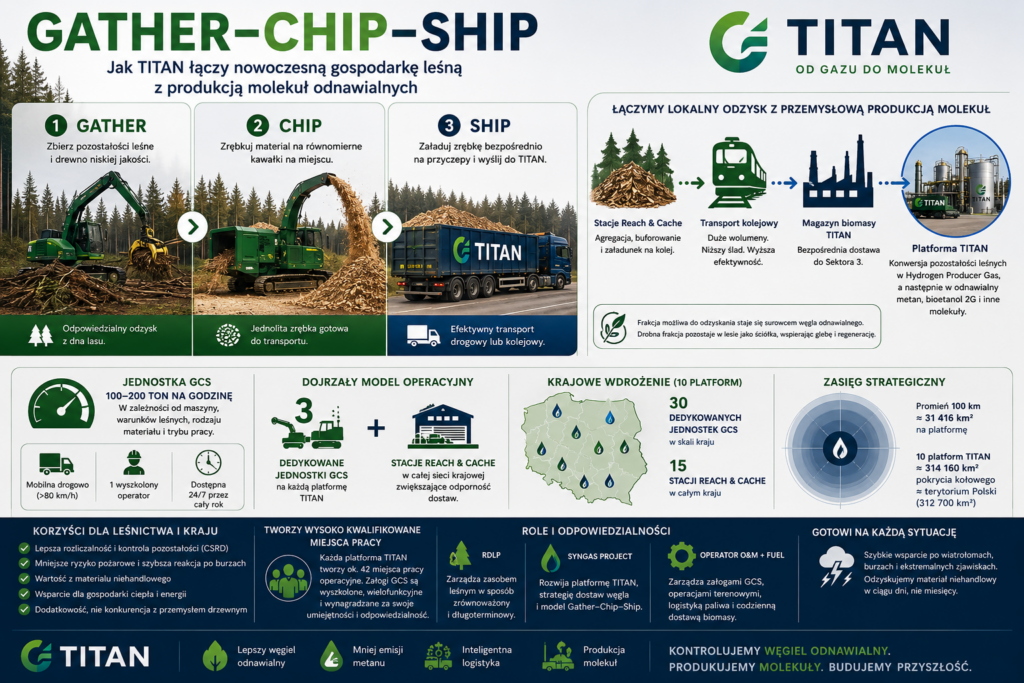
Gather–Chip–Ship: Jak TITAN łączy nowoczesną gospodarkę leśną z produkcją molekuł odnawialnych

Gospodarka leśna jest często źle rozumiana.

Wiele osób wyobraża sobie pozostałości leśne jako przypadkowy, rozproszony i niepewny zasób. Widzą luźny rynek biomasy, okazjonalną dostępność i łańcuch dostaw surowca, który trudno kontrolować.

Nic nie może być dalsze od rzeczywistości w Polsce.

Polskie Lasy Państwowe są jednym z wielkich strategicznych zasobów kraju. Są zorganizowane poprzez 17 Regionalnych Dyrekcji Lasów Państwowych, znanych jako RDLP. Na obszarze ponad 9 milionów hektarów lasówsystem jest planowany, mierzony i zarządzany w długich cyklach biologicznych. Drzewostany dojrzewają przez 40 lat i dłużej. Pozyskanie, odnowienia, trzebieże, zarządzanie gatunkami i klasyfikacja drewna nie są przypadkowe. Są znane, rejestrowane i zarządzane.

To ma znaczenie dla TITAN.

Ma to również znaczenie dla długoterminowej logiki CSRD w leśnictwie.

Platforma, która przekształca pozostałości leśne w molekuły odnawialne, nie może opierać się na domysłach. Musi wiedzieć, gdzie materiał jest dostępny, kiedy będzie dostępny, jaką ma jakość i ile można odpowiedzialnie odzyskać.

Polski system leśny już posiada dużą część tej wiedzy.

Struktura RDLP zna swoje lasy. Zna dojrzałość drzewostanów, skład gatunkowy, plany pozyskania, dostępność drewna handlowego oraz potencjał materiału niehandlowego. Rozumie, gdzie powstają pozostałości leśne, gdzie wiatrołomy lub choroby dotknęły drzewostany oraz gdzie po pozyskaniu drewna potrzebne są prace porządkowe.

Oznacza to, że zasób niehandlowy może być rozliczany co do tony.

To zmienia jego status.

Zamiast być traktowany jako pozostałość o niskiej wartości, niezarządzany produkt uboczny lub potencjalne zobowiązanie, staje się audytowalnym zasobem węgla odnawialnego. Można go zmierzyć, odzyskać, wycenić i raportować. Dla leśnictwa jest to ważne. CSRD wymaga lepszych dowodów, lepszej logiki inwentaryzacji i lepszego wyjaśnienia, w jaki sposób zarządzane są zasoby środowiskowe oraz ich wpływy.