Why Carbon Recycling Will Replace Carbon Extraction

Publish date: 1 May 2026

(Przewiń w dół, aby zobaczyć wersję polską.)

For more than a century, industrial growth has depended on carbon extraction.

Coal, oil and natural gas were taken from the ground, refined, transported and converted into energy, fuels, chemicals and materials. This model powered the modern economy. It created mobility, manufacturing, aviation, plastics, fertilisers and global trade.

But it also created a structural problem.

The industrial economy became dependent on fossil carbon.

Carbon was extracted once, used briefly, and then released into the atmosphere. This linear model was efficient during the age of cheap fossil resources, but it is no longer compatible with Europe’s long-term climate, industrial and security objectives.

The next industrial era will require a different model.

Carbon cannot simply be treated as something to extract, burn and discard.

It must be treated as something to recover, recycle and reuse.

This is the logic of carbon recycling.

Carbon recycling does not mean stopping the use of carbon. That would be impossible for many parts of the economy. Aviation, shipping, chemicals, materials, agriculture, food systems and industrial manufacturing all depend on carbon-based molecules.

The real question is not whether society will use carbon.

The question is where that carbon comes from.

In the old model, carbon came from fossil extraction.

Renewable Methane at Scale: LRNG and the Return of Local Gas

(Przewiń w dół, aby zobaczyć wersję polską.)

Publish April 30 2026

Europe does not have a gas problem. It has a gas origin problem.

Methane remains essential. It fuels industry, supports energy resilience, underpins logistics and provides the backbone for large parts of the economy that cannot simply electrify. The system that distributes methane is already built. What is changing is not the need for gas, but where that gas comes from.

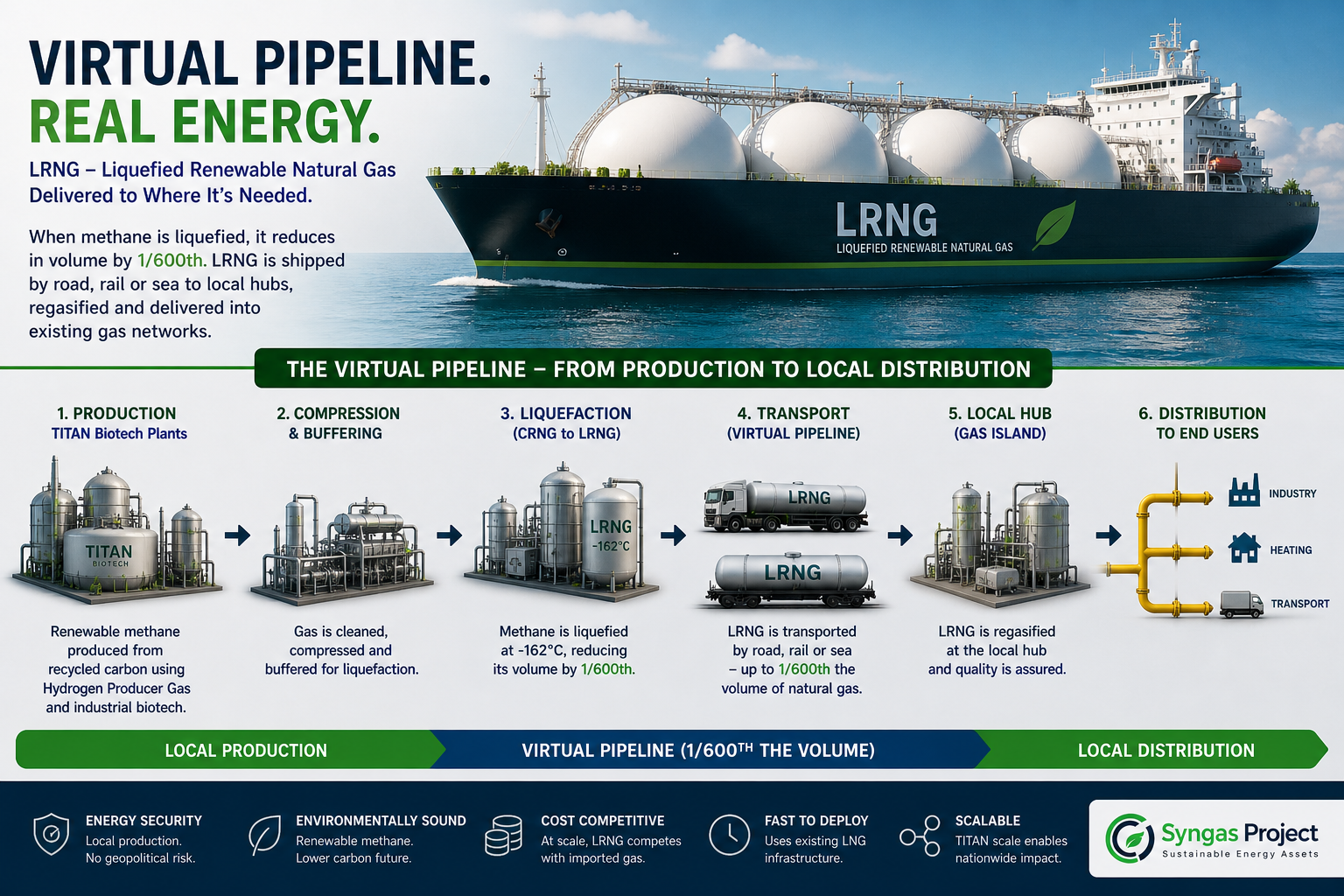
Today, gas is distributed increasingly in liquefied form. LNG has already proven the model. Methane is cooled, liquefied and reduced to around 1/600th of its original volume. It is then transported efficiently by ship, rail or road tanker, delivered to a local hub, regasified and supplied into the network.

This is not a workaround. It is the system.

Many still think LNG distribution is an excuse for not having pipelines. That is wrong. LNG is a more targeted delivery system. The local hub receives the gas it ordered, not a blended molecule that entered a pipeline thousands of kilometres away. The control point moves from the pipeline to the destination.

The real legacy of the gas system is not the intercontinental pipeline.

It is the local gas network.

Historically, gas was produced locally and distributed locally. Towns and industrial centres had their own gas production linked directly to local demand. Long-distance pipelines came much later. They replaced local producers and centralised supply, often for convenience and scale. For a period, that worked.

Today, that model is under pressure.

Russia to the east is no longer a reliable source. Conflict in the Middle East continues to destabilise global energy flows. The United States is becoming less dependable as a long-term strategic partner. Norway carried Europe through the immediate crisis, but it is past peak. It delivered when needed, but production will not keep expanding. The longer global instability continues, the more pressure is placed on a limited northern supply base.

Europe is still climbing an import ladder that is no longer secure.

At some point, that ladder has to be left behind.

Poland has an alternative.

Poland already operates a distributed gas system. The LNG terminal near Szczecin has been built out from approximately 6 billion cubic metres toward 8 billion cubic metres of capacity. More importantly, more than 100 LNG regasification gas islands developed by PSG already form a decentralised distribution network across the country.

These are not temporary assets. They are long-life infrastructure.

Reach & Cache: Rebuilding Regional Biomass Logistics

Publish date: 30 April 2026

(Przewiń w dół, aby zobaczyć wersję polską.)

One of the biggest challenges in the renewable molecule economy is not chemistry.

It is logistics.

Europe possesses large volumes of renewable carbon in the form of forestry residues, agricultural residues and other biogenic resources. Much of this material already exists across regional landscapes in fragmented and low-density form.

The problem is not whether the carbon exists.

The problem is how to collect it efficiently.

For decades, industrial systems were designed around highly concentrated fossil resources. Coal, oil and gas could be extracted at large scale from centralised locations and transported through mature infrastructure networks. Renewable carbon does not behave the same way.

Biomass is distributed.

It is seasonal. It varies in moisture content, density and handling characteristics. Transport distances matter. Weather matters. Storage matters. Fuel preparation matters.

This means the future renewable molecule economy will require a new generation of regional logistics infrastructure.

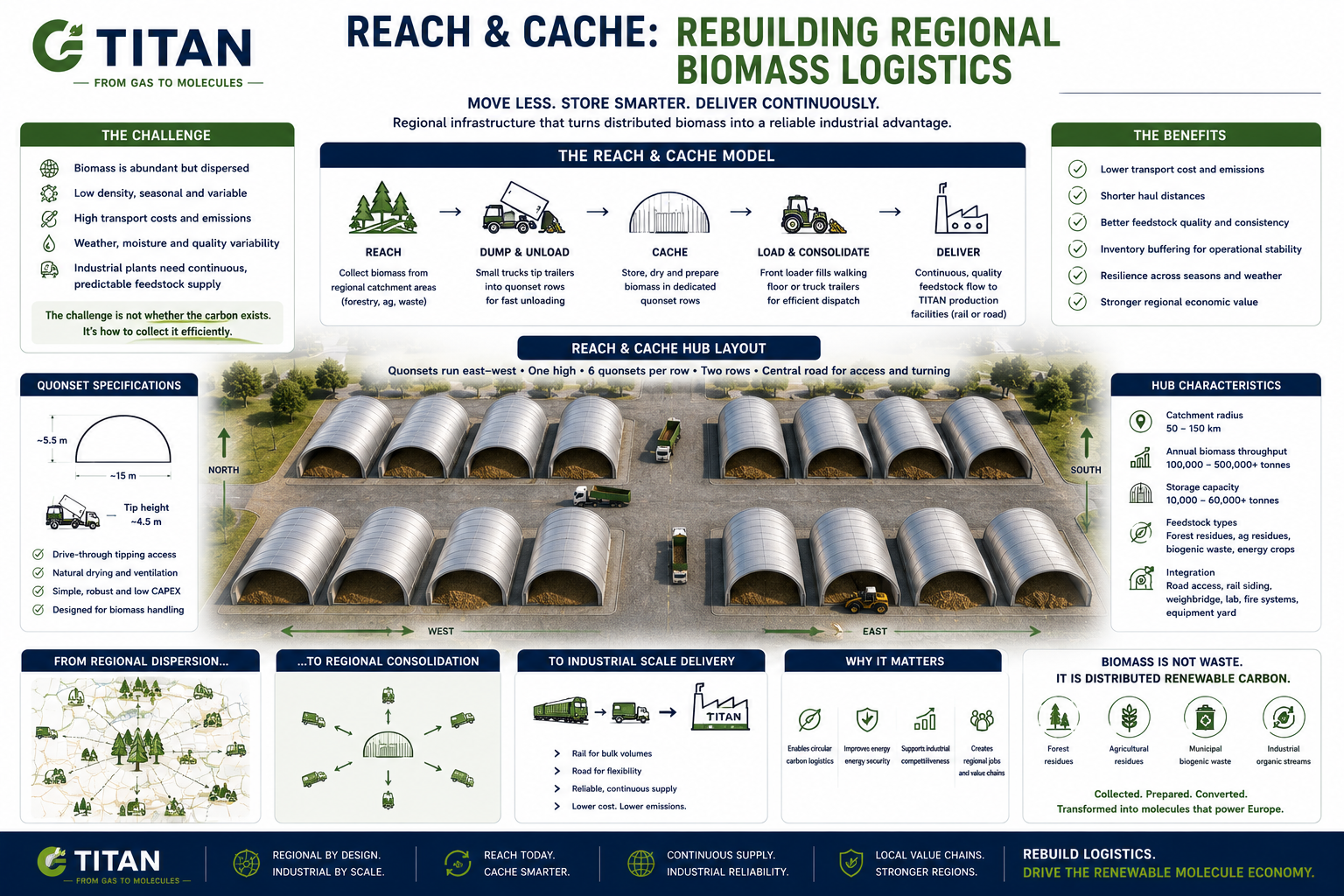
This is where Reach & Cache becomes important.

Reach & Cache is the logistical philosophy behind TITAN’s biomass supply model.

Instead of relying entirely on long-distance trucking or fragmented supply chains, the system creates regional collection, preparation and consolidation hubs designed specifically for renewable carbon logistics.

The objective is simple:

Reduce transport inefficiency while increasing regional feedstock resilience.

Under the Reach & Cache model, biomass is collected from regional catchment areas and moved into dedicated aggregation sites. At these locations, material can be stored, dried, processed, chipped and prepared for onward transport into TITAN production facilities.

Why Rail Logistics Matter for Renewable Molecules

Publish date 29 April 2026

(Przewiń w dół, aby zobaczyć wersję polską.)

The renewable molecule economy will not succeed on chemistry alone.

It will succeed on logistics.

One of the largest mistakes in modern energy planning is the assumption that low-carbon systems can simply replace fossil systems without rebuilding the underlying industrial transport infrastructure. In reality, renewable molecules require an entirely different logistical approach.

This is especially true at industrial scale.

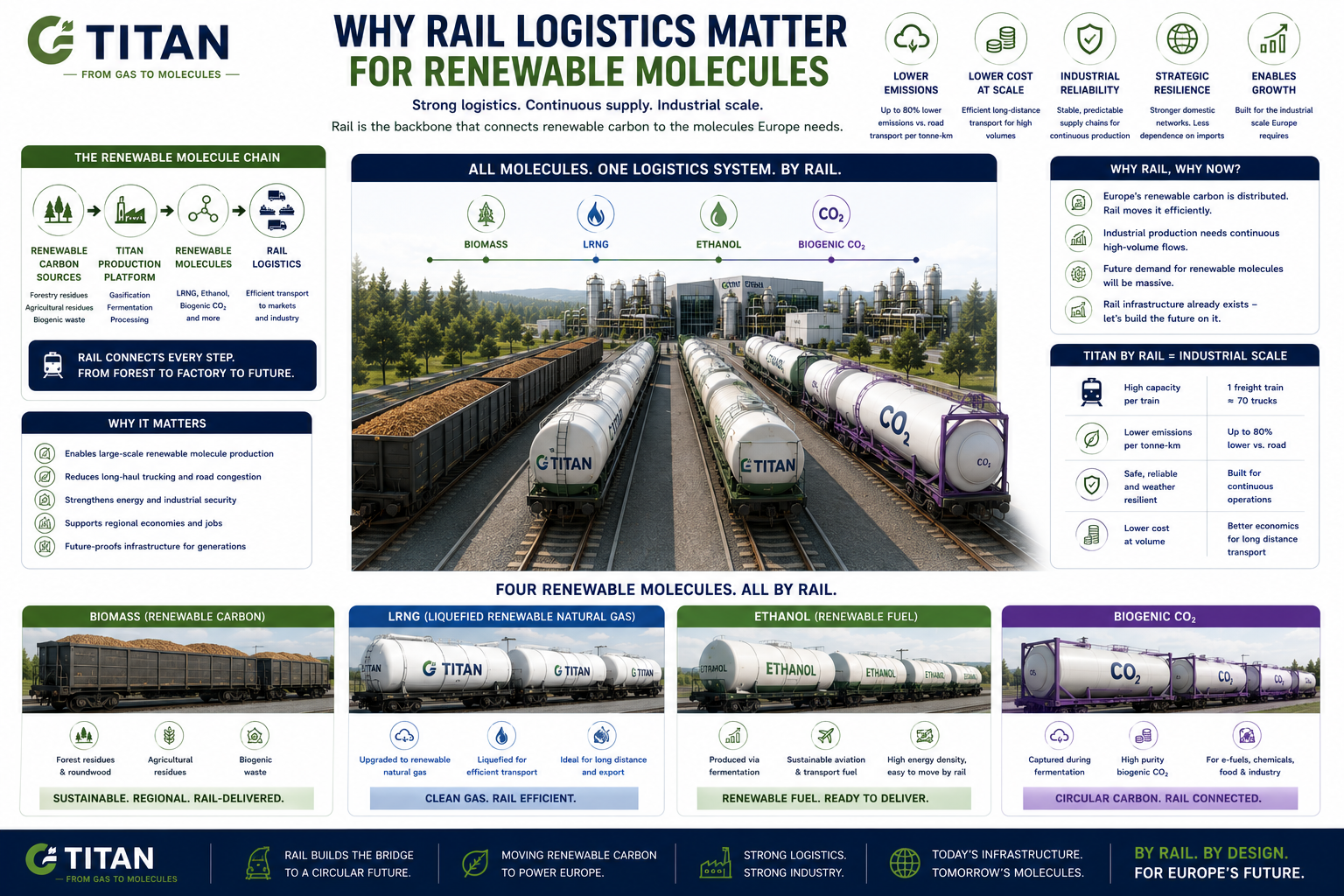
Renewable carbon is more distributed than fossil carbon. Biomass is regional. Residues are seasonal. Industrial fermentation requires continuous feedstock flow. Renewable gases and fuels must move efficiently between production, storage and end markets.

That means logistics become strategic infrastructure.

This is one of the reasons TITAN was designed around rail.

Rail is not simply a transport option.

It is one of the core foundations of industrial-scale renewable molecule production.

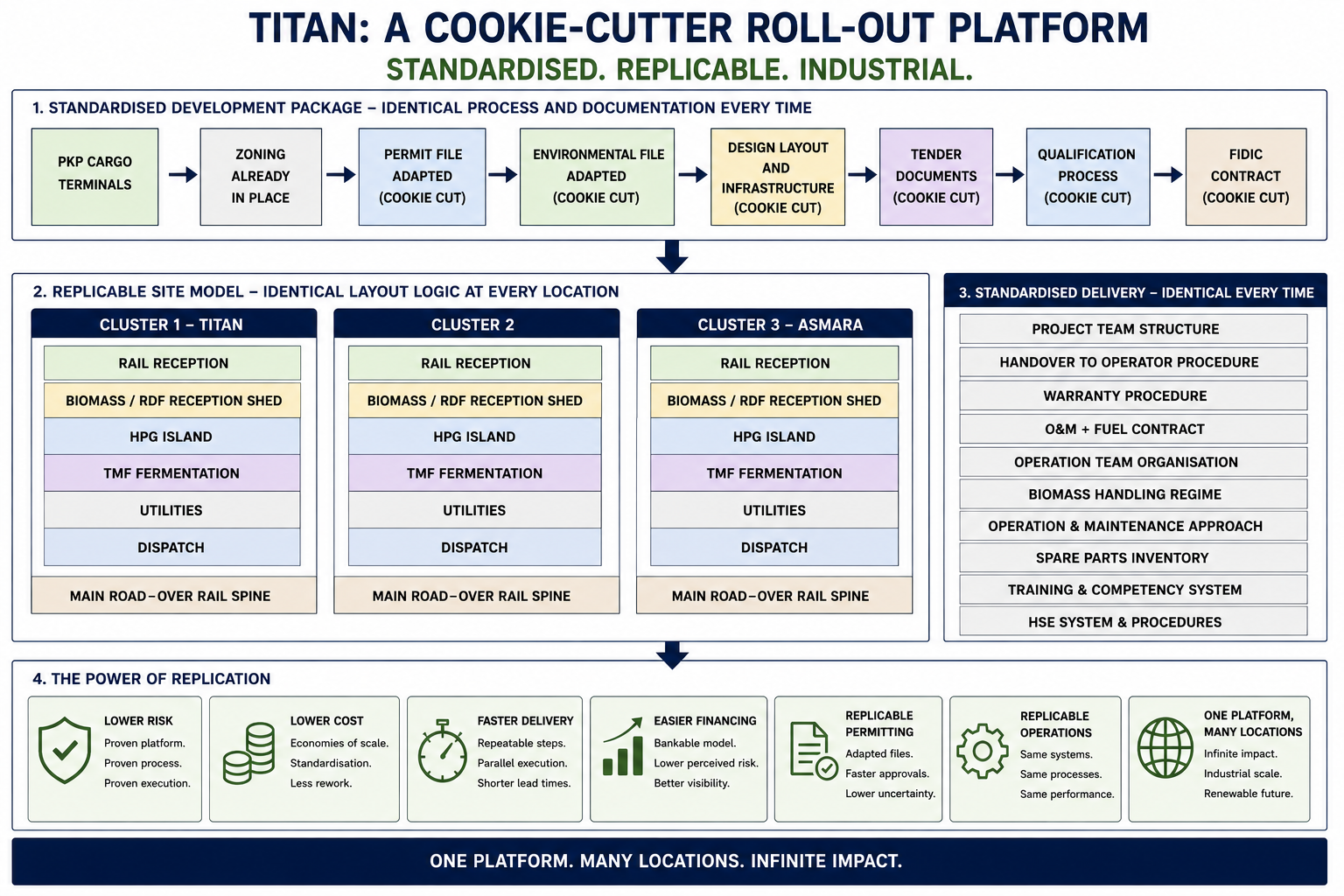
TITAN: A Cookie-Cutter Roll-Out Platform

Publish date: 28 April 2026

(Przewiń w dół, aby zobaczyć wersję polską.)

One of the biggest challenges in industrial decarbonisation is not technology.

It is replication.

Many energy and industrial projects work only under highly specific local conditions. They rely on unusual feedstocks, unique permitting structures, customised engineering or isolated infrastructure advantages. This makes scaling difficult, expensive and slow.

Europe does not only need successful demonstration projects.

Europe needs repeatable industrial platforms.

This is one of the core principles behind TITAN.

TITAN was not designed as a one-off installation.

It was designed as a cookie-cutter roll-out platform.

The objective is simple:

Standardise as much of the industrial system as possible while allowing limited adaptation to local site conditions.

This approach changes the economics and deployment logic of renewable molecule infrastructure.

In traditional industrial development, every project often starts from the beginning. Engineering teams redesign systems repeatedly. Procurement chains change. Operational training changes. Construction sequencing changes. Financing becomes more difficult because each installation appears unique.

TITAN approaches this differently.

The platform is modular, repeatable and structurally standardised.

Core systems remain consistent across deployments: gasification architecture, Hydrogen Producer Gas production, fermentation pathways, logistics logic, control philosophy and industrial workflow. This allows engineering knowledge, operational experience and supply-chain learning to accumulate over time rather than restarting for every site.

This is how industrial scaling historically succeeds.

The automotive industry did not scale through handcrafted prototypes.

Container shipping did not scale through unique containers.

Rail systems did not scale through custom track gauges for every city.

Industrial systems become powerful when they become repeatable.

TITAN applies the same principle to renewable molecule infrastructure.

Each TITAN deployment is designed around a familiar industrial structure: renewable carbon intake, gasification, controlled Hydrogen Producer Gas production, fermentation pathways, molecule upgrading, logistics integration and dispatch.

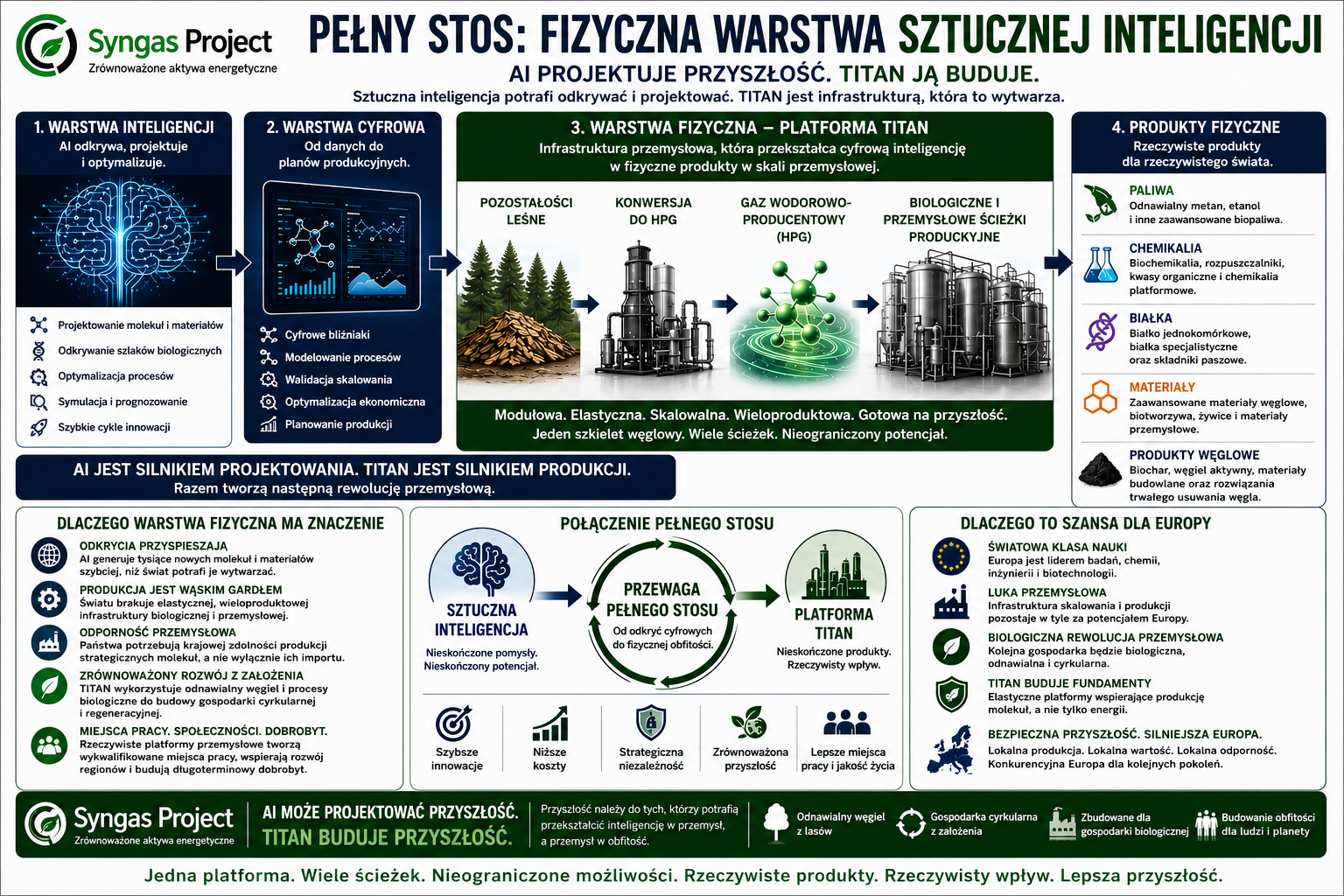
Europe’s Next Industrial Revolution Will Be Biological

Publish Date 27 April 2026

(Przewiń w dół, aby zobaczyć wersję polską.)

Europe was built on industrial revolutions.

The first industrial age was powered by coal, steam and mechanisation. The second was built around oil, gas, chemicals and mass electrification. The digital era transformed communications, finance and information systems.

The next industrial revolution may be biological.

Not in the science-fiction sense.

In the industrial sense.

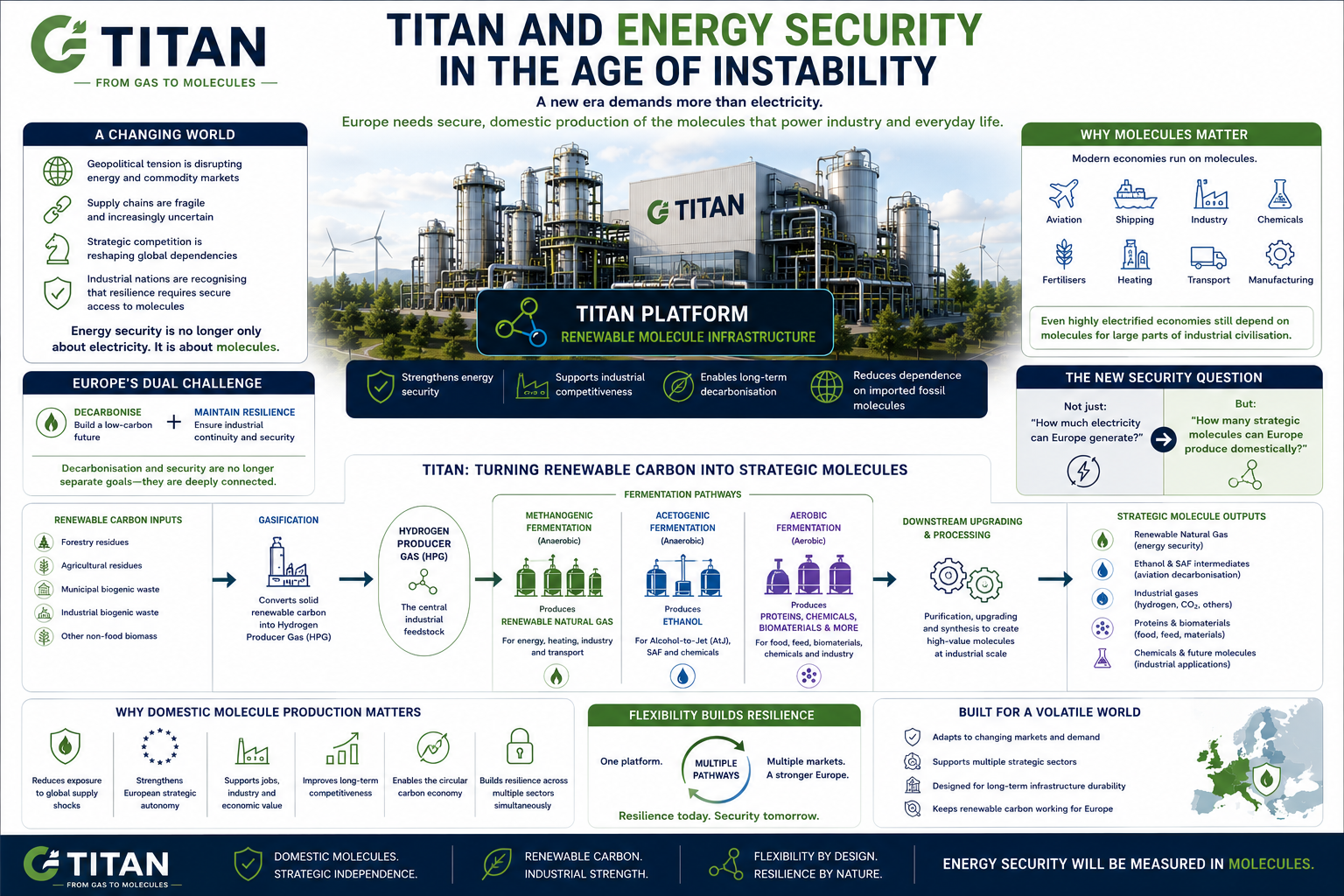
The global economy is beginning to move away from extracting fossil carbon from underground and toward managing renewable carbon flows above ground. This transition will affect far more than energy production. It will reshape fuels, chemicals, agriculture, food systems, materials, manufacturing and industrial supply chains.

This matters because modern economies do not run on electricity alone.

They also run on molecules.

Fuels.
Chemicals.
Plastics.
Solvents.
Proteins.
Materials.
Industrial gases.
Carbon products.

For more than a century, most of these products originated from oil, coal and gas extraction. The fossil economy did not only produce energy. It produced the molecular foundation of industrial civilisation.

That foundation is now beginning to change.

Europe faces a strategic challenge.

The continent has world-class science, engineering and biotechnology capability. But it imports large quantities of critical molecules and remains structurally dependent on external energy and feedstock systems. Geopolitical instability, supply chain disruption and rising resource competition are exposing the risks of this dependence.

The solution may not simply be replacing fossil electricity generation.

The solution may be rebuilding Europe’s molecule economy around renewable carbon systems.

This is where biological manufacturing becomes important.

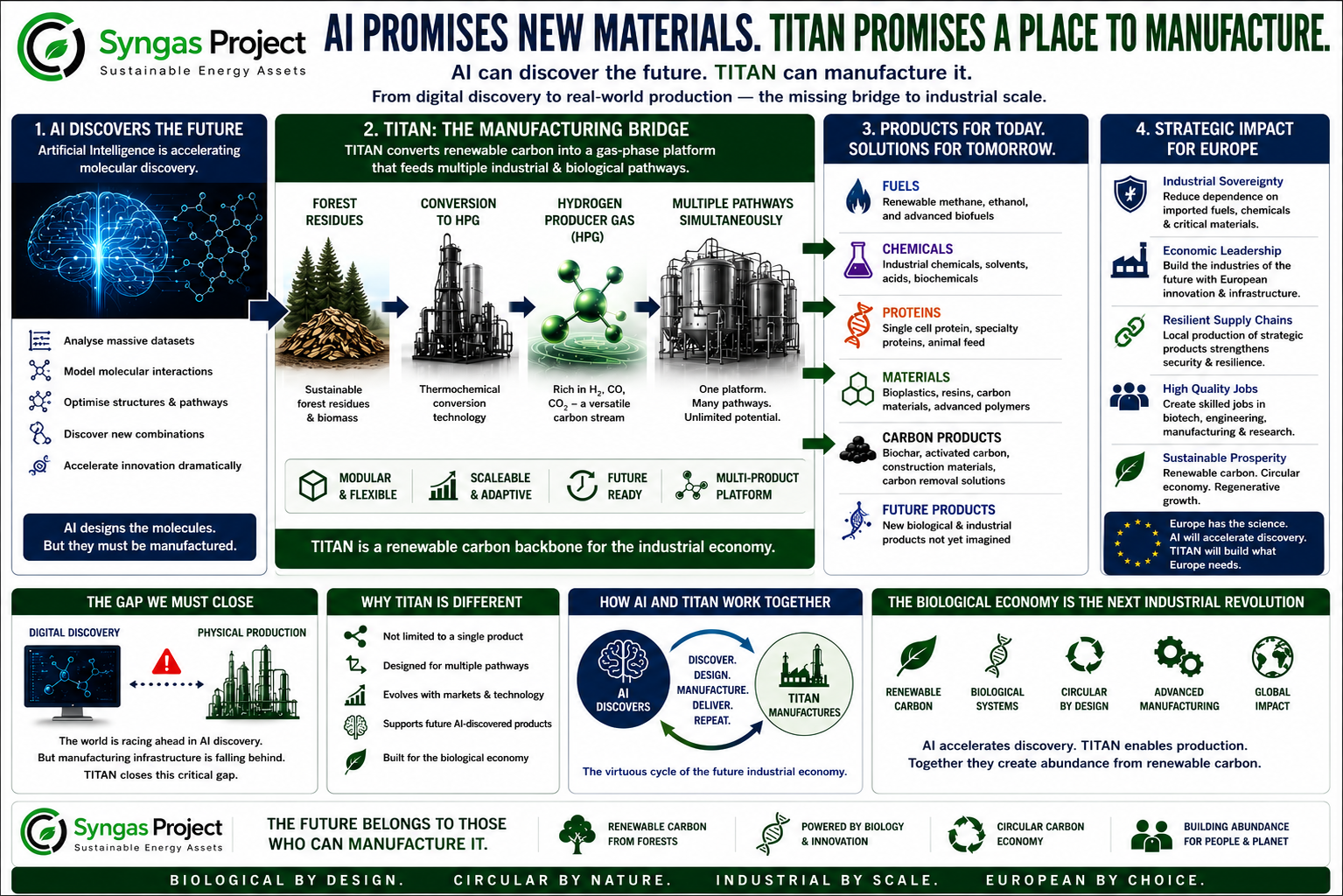
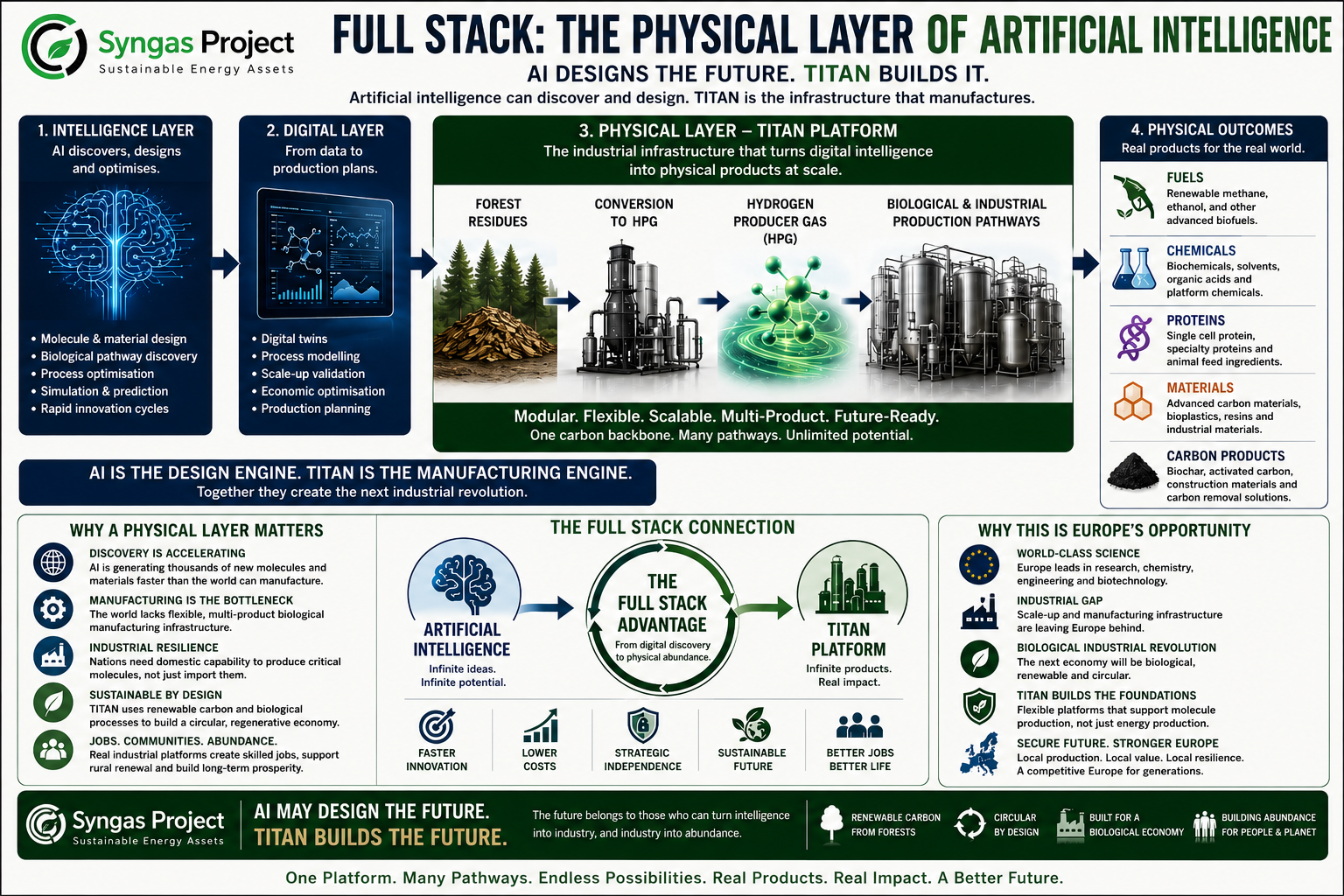
Biological systems are extraordinarily efficient molecular factories. Microbes, enzymes and fermentation systems can already produce fuels, proteins, chemicals and specialist compounds. Artificial intelligence is now accelerating the discovery of entirely new biological pathways and material possibilities.

But these systems require industrial platforms capable of operating at scale.

That is where TITAN positions itself.

TITAN and ASMARA: Two Carbon Platforms, Two Different Duties

Publish date: 27 April 2026

(Przewiń w dół, aby zobaczyć wersję polską.)

TITAN and ASMARA are sister platforms, but they do not perform the same industrial duty.

This distinction is extremely important.

Both systems are built around Hydrogen Producer Gas and carbon recycling. Both convert difficult carbon streams into useful industrial outputs. Both are designed to support Europe’s transition away from fossil carbon extraction.

But the feedstocks are fundamentally different.

And that changes everything.

TITAN is designed primarily around controlled renewable biomass, especially forest residues and other biogenic carbon streams. The feedstock is cleaner, more stable and more predictable. This allows TITAN to support advanced fermentation pathways including Renewable Natural Gas, ethanol, future SAF intermediates and wider industrial molecule production.

ASMARA is different.

ASMARA is designed around RDF and sorted municipal carbon streams.

That creates opportunity.

But it also creates risk.

Modern cities contain enormous quantities of recoverable carbon. Even after conventional recycling, large amounts of carbon-rich material remain inside municipal waste streams. If these streams can be processed safely, they represent an important industrial resource.

ASMARA is designed to recover value from this urban carbon.

At industrial scale, ASMARA can process approximately 70 MW of RDF feedstock to produce around 40,000 Nm³/hr of synthesis gas when RDF composition remains sufficiently consistent.

That is a very significant urban carbon recovery platform.

However, municipal carbon is not the same as controlled biomass.

Municipal waste streams contain uncertainty.

Even in highly disciplined waste economies such as Sweden and Japan, random disposal events still occur. Consumer products, household chemicals, solvents, oils, silicones, heavy metals and hidden contaminants can enter the waste stream unexpectedly.

Full Stack Fermentation: From Gas to Molecules to Proteins

Publish date: 25 April 2026

(Przewiń w dół, aby zobaczyć wersję polską.)

Most people still think about fermentation as something associated with brewing, food processing or small-scale biotechnology.

That perception is about to change.

Fermentation is increasingly becoming one of the most important industrial production systems of the twenty-first century.

Not because society suddenly needs more beer.

But because biology has become capable of manufacturing molecules at industrial scale.

This is one of the central ideas behind TITAN.

TITAN is often described as a renewable gas or ethanol platform. In reality, those are only the first layers of a much larger industrial model.

At its core, TITAN is a full stack fermentation platform built around controlled Hydrogen Producer Gas.

The platform does not simply burn carbon.

It converts carbon into controlled molecular feedstocks capable of supporting multiple biological production pathways simultaneously.

This distinction is fundamental.

Traditional industrial systems usually focus on producing a single primary output. TITAN was designed around flexibility. Different biological systems can consume the same controlled gas stream and selectively convert it into entirely different industrial products.

TITAN: Industrialised Biotechnology, Not Waste-to-Energy

(Przewiń w dół, aby zobaczyć wersję polską.)

Published April 10 2026

TITAN is often misunderstood at first glance.

It takes in waste carbon. It produces energy molecules. From a distance, it can be mistaken for a waste-to-energy system.

It is not.

Waste-to-energy is built around disposal. Its primary objective is to reduce waste volume and recover some value, usually in the form of heat or electricity. The process is driven by the need to manage waste streams safely and efficiently. Energy recovery is secondary.

TITAN is built around production.

Its objective is not to dispose of carbon. Its objective is to convert carbon into high-value molecules at industrial scale. The feedstock is not treated as waste. It is treated as a resource.

This difference changes everything.

In a waste-to-energy system, variability is tolerated. Feedstock composition fluctuates, process conditions adapt, and outputs are relatively low-value and standardised. Electricity, low-grade heat or basic gas streams are the end result. These systems are important, but they are not designed to build molecule sovereignty.

TITAN operates under a different logic.

It starts by creating a controlled gas-phase feedstock using Hydrogen Producer Gas. Solid inputs are converted into a stable mixture of hydrogen, carbon monoxide and carbon dioxide. This step is not about energy recovery. It is about creating a uniform carbon interface.

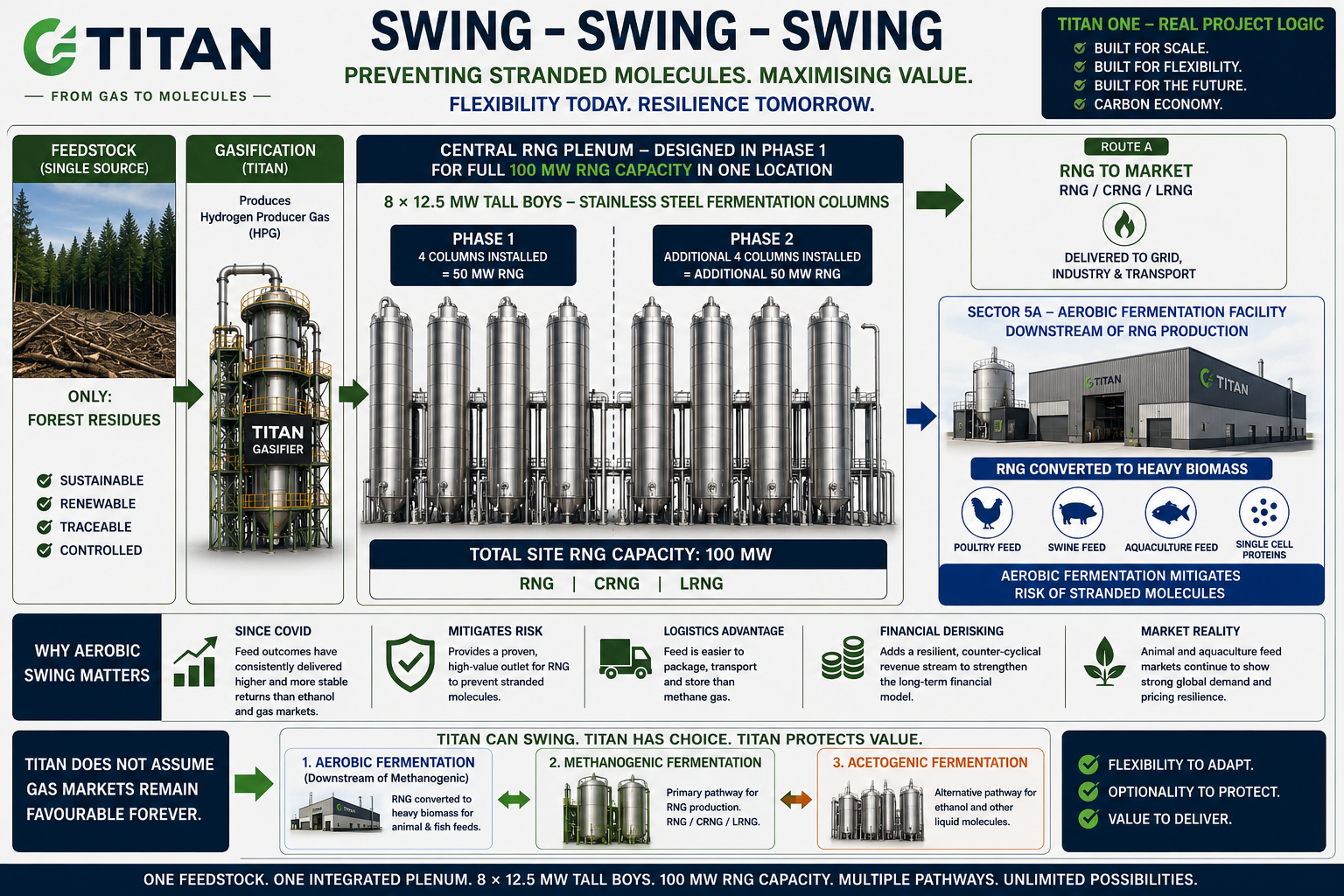
Swing–Swing: Methanogenic and Acetogenic Fermentation on One Platform

(Przewiń w dół, aby zobaczyć wersję polską.)

Published April 10 2026

TITAN does not choose between renewable methane and ethanol.

It produces both, on the same platform, from the same carbon stream.

This is the foundation of Swing–Swing.

At the centre of TITAN is Hydrogen Producer Gas. It is not a waste gas. It is a controlled carbon feedstock, engineered to deliver a stable mixture of hydrogen, carbon monoxide and carbon dioxide. This gas becomes the interface between thermochemical conversion and biotechnology.

From this single gas stream, two biological pathways operate in parallel.

Methanogenic fermentation converts the gas into renewable methane.

Acetogenic fermentation converts the same gas into ethanol.

These are not competing processes. They are complementary.

Traditional systems force a choice. Gas is either burned, upgraded or directed into a single downstream pathway. That limits flexibility and reduces value. TITAN is designed differently. The gas is conditioned and distributed across a platform that can direct carbon where it creates the most value at any given time.

This is not a theoretical advantage. It is a system-level capability.

Methanogenic organisms favour hydrogen-rich conditions. They convert hydrogen and carbon dioxide into methane efficiently and reliably. This pathway produces renewable natural gas that can be compressed, liquefied and distributed as LRNG through existing infrastructure.

Acetogenic organisms operate differently. They consume carbon monoxide and carbon dioxide and convert them into ethanol and other intermediates. This pathway supports the production of 2G ethanol, which can be upgraded through the Alcohol-to-Jet pathway into sustainable aviation fuel.

Both pathways depend on gas quality, pressure, temperature and composition. In TITAN, those variables are controlled. Gas is not simply produced and sent downstream. It is managed, conditioned and directed.

This is where synergy begins.

Methanogenic fermentation can stabilise hydrogen levels in the system. Acetogenic fermentation can utilise carbon monoxide that would otherwise be underused. Heat integration between the two pathways improves overall system efficiency. Utilities, compression, gas handling, control systems and infrastructure are shared across the platform.

The result is not two plants operating side by side.

It is one system operating in balance.