Biochar: Turning Stable Carbon into a Strategic Product

Publish Date: 22 April 2026
(Przewiń w dół, aby zobaczyć wersję polską.)

A sceptical investor may reasonably ask a simple question.

What is biochar?

Is it just charcoal?

Is it something for barbecues?

And if it can really be worth much more money, why is Syngas Project not simply making the highest-value version from day one?

These are the right questions.

Biochar is not ordinary charcoal. Charcoal is usually made for burning. Biochar is made to remain stable, porous and useful. It is carbon designed for function, not carbon designed for fire.

That difference matters.

In the TITAN platform, biochar is produced when forest residues are converted into Hydrogen Producer Gas. Most of the carbon is converted into useful gas-phase molecules. A smaller part remains as a stable solid carbon material. This material can hold water, retain nutrients, support microbial life, improve soils and, with further processing, become a platform for higher-value carbon products.

Syngas Project does not view biochar as a waste stream.

It views biochar as a separate carbon product business.

The starting point is scale.

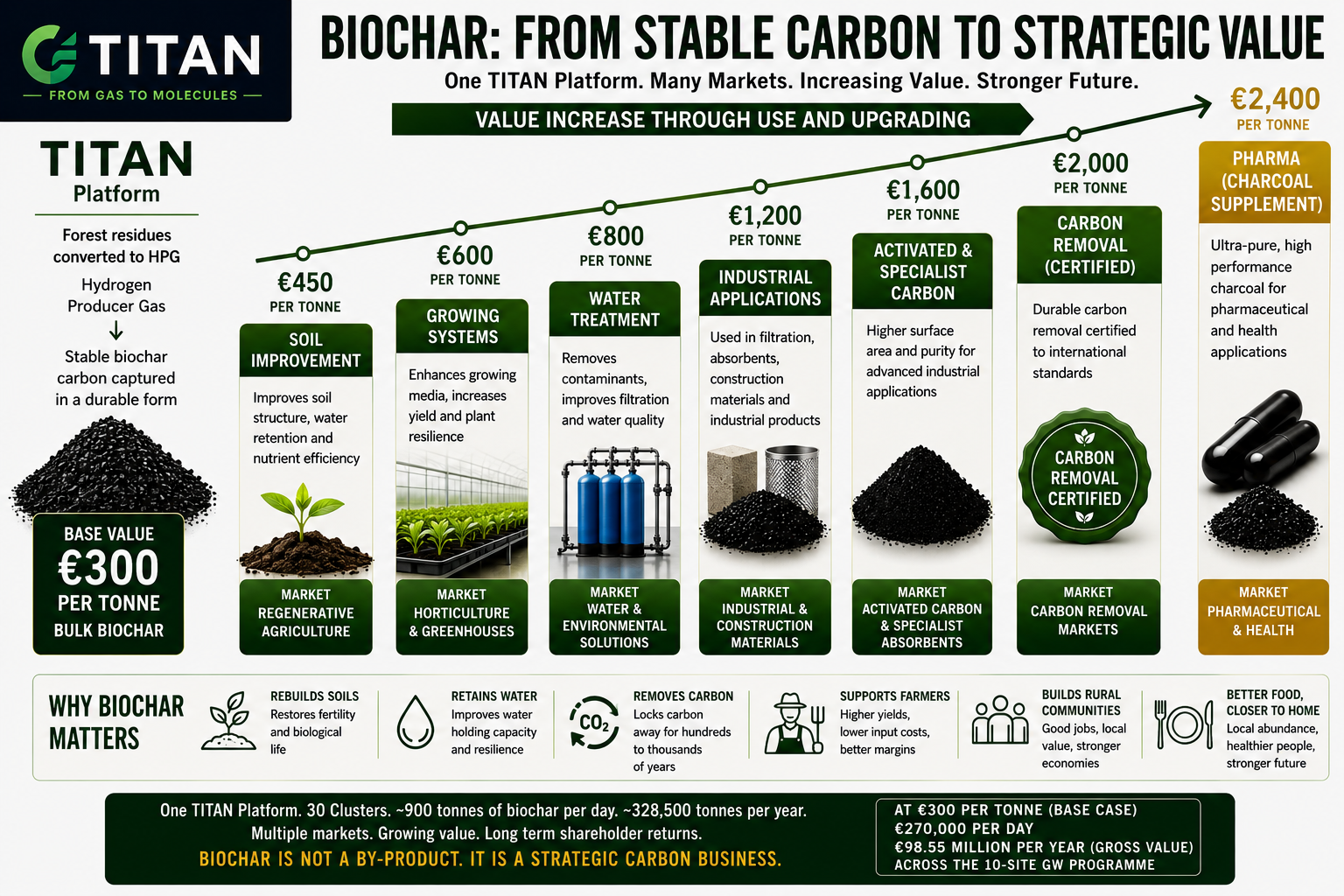
One TITAN cluster can produce approximately 30 tonnes of biochar per day. A fully built TITAN site with three clusters can produce approximately 90 tonnes per day. Across the planned 10-site GW programme, this becomes 30 clusters producing approximately 900 tonnes per day.
That is approximately 328,500 tonnes per year.

At a conservative base value of €300 per tonne, this is already close to €100 million per year in potential gross product value across the GW programme.

But that is only the base case.

The real strategy is not to sell all biochar as one low-margin commodity. The strategy is to segment the product stream.

The first market is practical and immediate. Biochar can be sold into soil improvement, growing systems and regenerative agriculture. This gives TITAN a clear early product route while the platform gathers operating data, product testing data and certification evidence.

The second market is certification. Once the process is stable and independently measured, selected biochar fractions can be prepared for carbon-removal certification. Certified carbon removal can command a different value from ordinary bulk biochar because the buyer is not only buying a material. The buyer is buying evidence that carbon has been removed from the active carbon cycle and stored in a durable form.

The third market is upgrading. Some biochar fractions can be further processed into higher-value carbon materials. These may include filtration media, industrial absorbents, construction materials, water treatment products, activated carbon, specialist growing media and future engineered carbon products.

This is why Syngas Project will not rush immediately into the most complex market.

A new product business must be built in stages.

First, prove consistent production.
Then prove quality.
Then prove application.
Then certify selected streams.
Then upgrade the best fractions into higher-value markets.

That is how shareholder value is protected.

The wrong strategy would be to promise pharmaceutical, battery or advanced material markets before the product specification, certification and customer base are properly established.

The right strategy is staged value uplift.

Bulk biochar creates early revenue. Certified biochar creates stronger value. Engineered biochar creates long-term upside.

This is where the investor story becomes important.

Biochar may become a billion-dollar market segment because it sits at the intersection of carbon removal, soil restoration, water management, sustainable materials and regenerative farming. TITAN has the potential to produce biochar continuously, predictably and at industrial scale.

That is rare.

Small biochar producers may have a useful product. TITAN has the potential to create a platform-scale carbon materials business.

But the most important part of the story is not only financial.

Syngas Project believes regenerative farming will become one of the major economic and social shifts of the next generation.

Industrial farming has produced enormous food volumes, but often by exhausting soil, increasing chemical dependency, reducing biodiversity and making farmers work harder for lower margins. Many soils have been pushed too far. More fertiliser is not always the answer. More chemistry is not always the answer. Bigger machines are not always the answer.

The answer may be better biology.

Healthy soils can hold more water. They can support stronger microbial life. They can reduce nutrient loss. They can help growers produce better food on smaller areas of land with less stress, less waste and more resilience.

Biochar can help support that transition.

It is not magic. It is not a single solution. But it can become one of the practical tools that allows farmers and growers to rebuild soil quality, improve water retention and increase biological productivity.

This is why Syngas Project sees biochar as part of a wider abundance economy.

Abundance does not only mean producing more industrial volume. It also means producing better food, closer to people, with healthier land, better local jobs and stronger rural communities.

A future shaped by artificial intelligence and automation should not mean removing people from productive life. It should create the chance for more people to return to meaningful, skilled, local work connected to food, land, water and biological systems.

That is where regenerative farming becomes strategic.

It is not only an environmental idea.

It is a jobs idea.
It is a health idea.
It is a food security idea.
It is a rural renewal idea.
It is an abundance idea.

TITAN’s role is to provide the industrial backbone.

Forest residues become Hydrogen Producer Gas. Hydrogen Producer Gas becomes renewable molecules. Part of the carbon becomes stable biochar. That biochar can then support soils, growers, carbon removal and higher-value carbon markets.

This is not a barbecue story.

It is a carbon strategy.

And for investors, that is the point.

Biochar is not the largest product stream inside TITAN today. But it may become one of the most valuable strategic options inside the platform.

Syngas Project intends to build that value carefully, in stages, with the objective of turning stable carbon into a long-term shareholder return opportunity.

Biochar: Przekształcanie Stabilnego Węgla w Produkt Strategiczny

Sceptyczny inwestor może zadać bardzo proste pytanie.

Czym właściwie jest biochar?

Czy to po prostu węgiel drzewny?

Czy to coś do grilla?

A jeżeli naprawdę może być wart znacznie więcej, dlaczego Syngas Project nie produkuje od razu jego najdroższej wersji?

To są właściwe pytania.

Biochar nie jest zwykłym węglem drzewnym. Węgiel drzewny jest zwykle produkowany po to, aby go spalić. Biochar jest produkowany po to, aby pozostał stabilny, porowaty i użyteczny. To węgiel zaprojektowany do funkcji, a nie do ognia.

Ta różnica ma znaczenie.

W platformie TITAN biochar powstaje podczas konwersji pozostałości leśnych na Hydrogen Producer Gas. Większość węgla zostaje przekształcona w użyteczne molekuły gazowe. Mniejsza część pozostaje jako stabilny stały materiał węglowy. Materiał ten może zatrzymywać wodę, magazynować składniki odżywcze, wspierać życie mikrobiologiczne, poprawiać gleby, a po dalszym przetwarzaniu stać się podstawą produktów węglowych o wyższej wartości.

Syngas Project nie traktuje biocharu jako odpadu.

Traktuje biochar jako osobny biznes produktów węglowych.

Punktem wyjścia jest skala.

Jeden klaster TITAN może produkować około 30 ton biocharu dziennie. W pełni rozwinięta instalacja TITAN z trzema klastrami może produkować około 90 ton dziennie. W planowanym programie GW obejmującym 10 lokalizacji oznacza to 30 klastrów produkujących około 900 ton dziennie.

To około 328 500 ton rocznie.

Przy konserwatywnej wartości bazowej 300 euro za tonę daje to potencjalną wartość brutto bliską 100 milionów euro rocznie w skali programu GW.

Ale to tylko punkt wyjścia.

Prawdziwa strategia nie polega na sprzedaży całego biocharu jako jednego niskomarżowego produktu masowego. Strategia polega na segmentacji strumienia produktu.

Pierwszy rynek jest praktyczny i natychmiastowy. Biochar może być sprzedawany do poprawy gleb, systemów upraw i rolnictwa regeneracyjnego. Daje to TITAN jasną drogę do pierwszych przychodów, podczas gdy platforma gromadzi dane operacyjne, wyniki badań jakościowych i materiał do certyfikacji.

Drugi rynek to certyfikacja. Po ustabilizowaniu procesu i niezależnym potwierdzeniu danych wybrane frakcje biocharu mogą zostać przygotowane do certyfikacji usuwania CO₂. Certyfikowane usuwanie węgla może osiągać inną wartość niż zwykły biochar masowy, ponieważ nabywca kupuje nie tylko materiał. Kupuje dowód, że węgiel został usunięty z aktywnego obiegu węgla i zmagazynowany w trwałej formie.

Trzeci rynek to uszlachetnianie. Niektóre frakcje biocharu mogą być dalej przetwarzane w materiały węglowe o wyższej wartości. Mogą to być media filtracyjne, absorbenty przemysłowe, materiały budowlane, produkty do uzdatniania wody, węgiel aktywny, specjalistyczne podłoża uprawowe oraz przyszłe inżynieryjne produkty węglowe.

Dlatego Syngas Project nie będzie od razu wchodzić w najbardziej złożone rynki.

Nowy biznes produktowy trzeba budować etapami.

Najpierw trzeba udowodnić stabilną produkcję.
Następnie jakość.
Następnie zastosowanie.
Następnie certyfikować wybrane strumienie.
Następnie uszlachetnić najlepsze frakcje dla rynków o wyższej wartości.

Tak chroni się wartość dla akcjonariuszy.

Błędną strategią byłoby obiecywanie rynków farmaceutycznych, bateryjnych lub zaawansowanych materiałów zanim specyfikacja produktu, certyfikacja i baza klientów zostaną właściwie zbudowane.

Właściwa strategia to etapowe podnoszenie wartości.

Biochar masowy daje wczesne przychody. Biochar certyfikowany daje wyższą wartość. Biochar inżynieryjny daje długoterminowy potencjał wzrostu.

Tutaj zaczyna się ważna historia inwestycyjna.

Biochar może stać się miliardowym segmentem rynku, ponieważ znajduje się na styku usuwania węgla, odbudowy gleb, gospodarki wodnej, zrównoważonych materiałów i rolnictwa regeneracyjnego. TITAN ma potencjał, aby produkować biochar w sposób ciągły, przewidywalny i w skali przemysłowej.

To rzadkie.

Mali producenci biocharu mogą mieć użyteczny produkt. TITAN ma potencjał stworzenia platformowego biznesu materiałów węglowych.

Najważniejsza część tej historii nie jest jednak wyłącznie finansowa.

Syngas Project uważa, że rolnictwo regeneracyjne stanie się jedną z najważniejszych zmian gospodarczych i społecznych następnego pokolenia.

Rolnictwo przemysłowe wyprodukowało ogromne ilości żywności, ale często kosztem wyczerpania gleb, zależności od chemii, spadku bioróżnorodności i coraz większego obciążenia rolników przy niższych marżach. Wiele gleb zostało przeciążonych. Więcej nawozów nie zawsze jest odpowiedzią. Więcej chemii nie zawsze jest odpowiedzią. Większe maszyny nie zawsze są odpowiedzią.

Odpowiedzią może być lepsza biologia.

Zdrowe gleby mogą zatrzymywać więcej wody. Mogą wspierać silniejsze życie mikrobiologiczne. Mogą ograniczać utratę składników odżywczych. Mogą pomagać producentom żywności osiągać lepsze plony na mniejszej powierzchni, przy mniejszym stresie, mniejszych stratach i większej odporności.

Biochar może wspierać tę transformację.

Nie jest magią. Nie jest jedynym rozwiązaniem. Ale może stać się jednym z praktycznych narzędzi pozwalających rolnikom i producentom odbudowywać jakość gleby, poprawiać retencję wody i zwiększać produktywność biologiczną.

Dlatego Syngas Project widzi biochar jako część szerszej gospodarki obfitości.

Obfitość nie oznacza tylko większej produkcji przemysłowej. Oznacza również lepszą żywność, bliżej ludzi, zdrowszą ziemię, lepsze lokalne miejsca pracy i silniejsze społeczności wiejskie.

Przyszłość kształtowana przez sztuczną inteligencję i automatyzację nie powinna oznaczać wykluczania ludzi z produktywnego życia. Powinna stworzyć możliwość powrotu większej liczby osób do sensownej, wyspecjalizowanej, lokalnej pracy związanej z żywnością, ziemią, wodą i systemami biologicznymi.

Właśnie tutaj rolnictwo regeneracyjne staje się strategiczne.

To nie jest wyłącznie idea środowiskowa.

To idea miejsc pracy.
To idea zdrowia.
To idea bezpieczeństwa żywnościowego.
To idea odnowy obszarów wiejskich.
To idea obfitości.

Rolą TITAN jest zapewnienie przemysłowego zaplecza.

Pozostałości leśne stają się Hydrogen Producer Gas. Hydrogen Producer Gas staje się odnawialnymi molekułami. Część węgla staje się stabilnym biocharem. Ten biochar może następnie wspierać gleby, producentów żywności, usuwanie węgla oraz rynki materiałów węglowych o wyższej wartości.

To nie jest historia o grillu.

To strategia węglowa.

I dla inwestorów właśnie to jest najważniejsze.

Biochar nie jest dziś największym strumieniem produktowym w TITAN. Ale może stać się jedną z najważniejszych strategicznych opcji wartości wewnątrz platformy.

Syngas Project zamierza budować tę wartość ostrożnie, etapami, z celem przekształcenia stabilnego węgla w długoterminową szansę zwrotu dla akcjonariuszy.

A sceptical investor may reasonably ask a simple question.

What is biochar?

Is it just charcoal?

Is it something for barbecues?

And if it can really be worth much more money, why is Syngas Project not simply making the highest-value version from day one?

These are the right questions.

Biochar is not ordinary charcoal. Charcoal is usually made for burning. Biochar is made to remain stable, porous and useful. It is carbon designed for function, not carbon designed for fire.

That difference matters.

In the TITAN platform, biochar is produced when forest residues are converted into Hydrogen Producer Gas. Most of the carbon is converted into useful gas-phase molecules. A smaller part remains as a stable solid carbon material. This material can hold water, retain nutrients, support microbial life, improve soils and, with further processing, become a platform for higher-value carbon products.

Syngas Project does not view biochar as a waste stream.

It views biochar as a separate carbon product business.

The starting point is scale.

One TITAN cluster can produce approximately 30 tonnes of biochar per day. A fully built TITAN site with three clusters can produce approximately 90 tonnes per day. Across the planned 10-site GW programme, this becomes 30 clusters producing approximately 900 tonnes per day.
How Gather–Chip–Ship Benefits the Next Forest

Published: 16 April 2026

(Przewiń w dół, aby zobaczyć wersję polską.)

For decades, forest residue has been viewed in two simplistic ways.

Either it is treated as waste that should be removed completely from the forest floor, or it is treated as untouchable material that must remain exactly where it falls.

Reality is more nuanced.

A healthy forest is not built by abandoning unmanaged residue indefinitely. Nor is it built by stripping the forest clean. Sustainable forestry requires balance between recovery, regeneration, biodiversity, fire management, soil protection and long-term carbon stability.

This is where TITAN’s Gather–Chip–Ship (GCS) model becomes important.

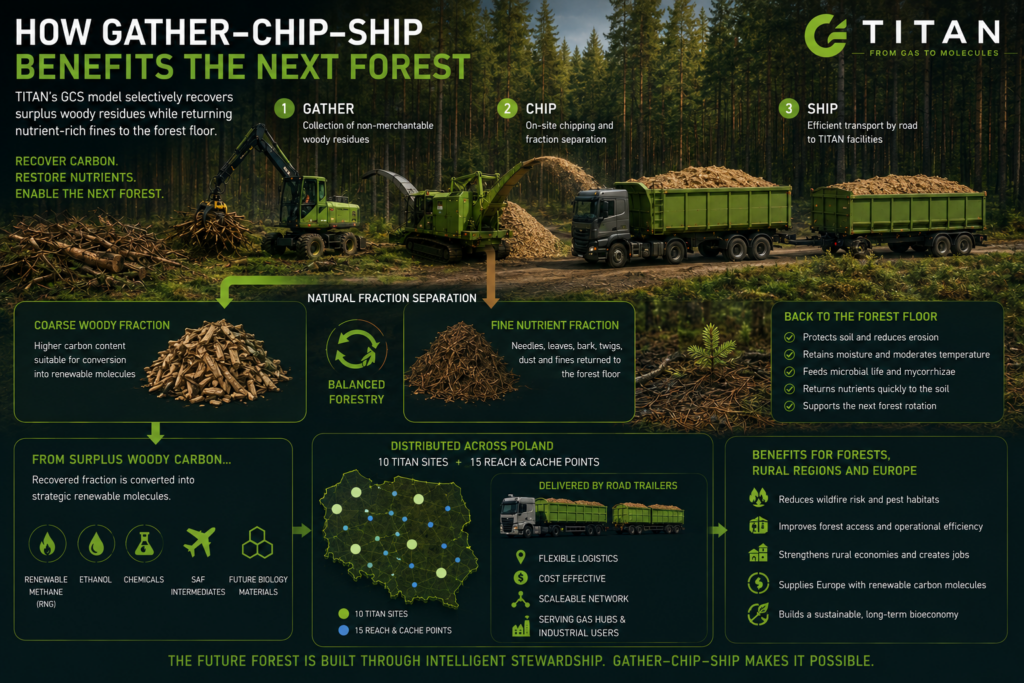
GCS is not designed to “mine” the forest. It is designed to selectively recover surplus woody residues while deliberately retaining the biologically active nutrient fraction where it belongs: on the forest floor.

This distinction matters enormously.

When forest residues are chipped and processed in the field, the material naturally separates into fractions. Larger woody fractions contain most of the recoverable carbon value suitable for conversion into renewable molecules such as renewable methane, ethanol, chemicals and sustainable aviation fuel intermediates.

The finer material behaves differently.

Needles, leaves, bark particles, small twigs, dust, fragmented organics and chipped fines contain much of the rapidly recyclable nutrient content required for healthy soil ecosystems. These materials decompose quickly, retain moisture, protect the soil surface, support fungal networks and microbial life, and help feed the next forest rotation.

In practical terms, the forest floor receives a pre-mulched biological layer.

This acts almost like a natural compost blanket.

It reduces erosion. It slows water loss. It moderates temperature fluctuations at soil level. It supports mycorrhizal activity. It returns nutrients back into the biological cycle far faster than large woody residues that may otherwise remain exposed for years.

This is one of the reasons why modern sustainable forestry increasingly focuses on selective recovery rather than total extraction.

TITAN: Industrialised Biotechnology, Not Waste-to-Energy

(Przewiń w dół, aby zobaczyć wersję polską.)

Published April 10 2026

TITAN is often misunderstood at first glance.

It takes in waste carbon. It produces energy molecules. From a distance, it can be mistaken for a waste-to-energy system.

It is not.

Waste-to-energy is built around disposal. Its primary objective is to reduce waste volume and recover some value, usually in the form of heat or electricity. The process is driven by the need to manage waste streams safely and efficiently. Energy recovery is secondary.

TITAN is built around production.

Its objective is not to dispose of carbon. Its objective is to convert carbon into high-value molecules at industrial scale. The feedstock is not treated as waste. It is treated as a resource.

This difference changes everything.

In a waste-to-energy system, variability is tolerated. Feedstock composition fluctuates, process conditions adapt, and outputs are relatively low-value and standardised. Electricity, low-grade heat or basic gas streams are the end result. These systems are important, but they are not designed to build molecule sovereignty.

TITAN operates under a different logic.

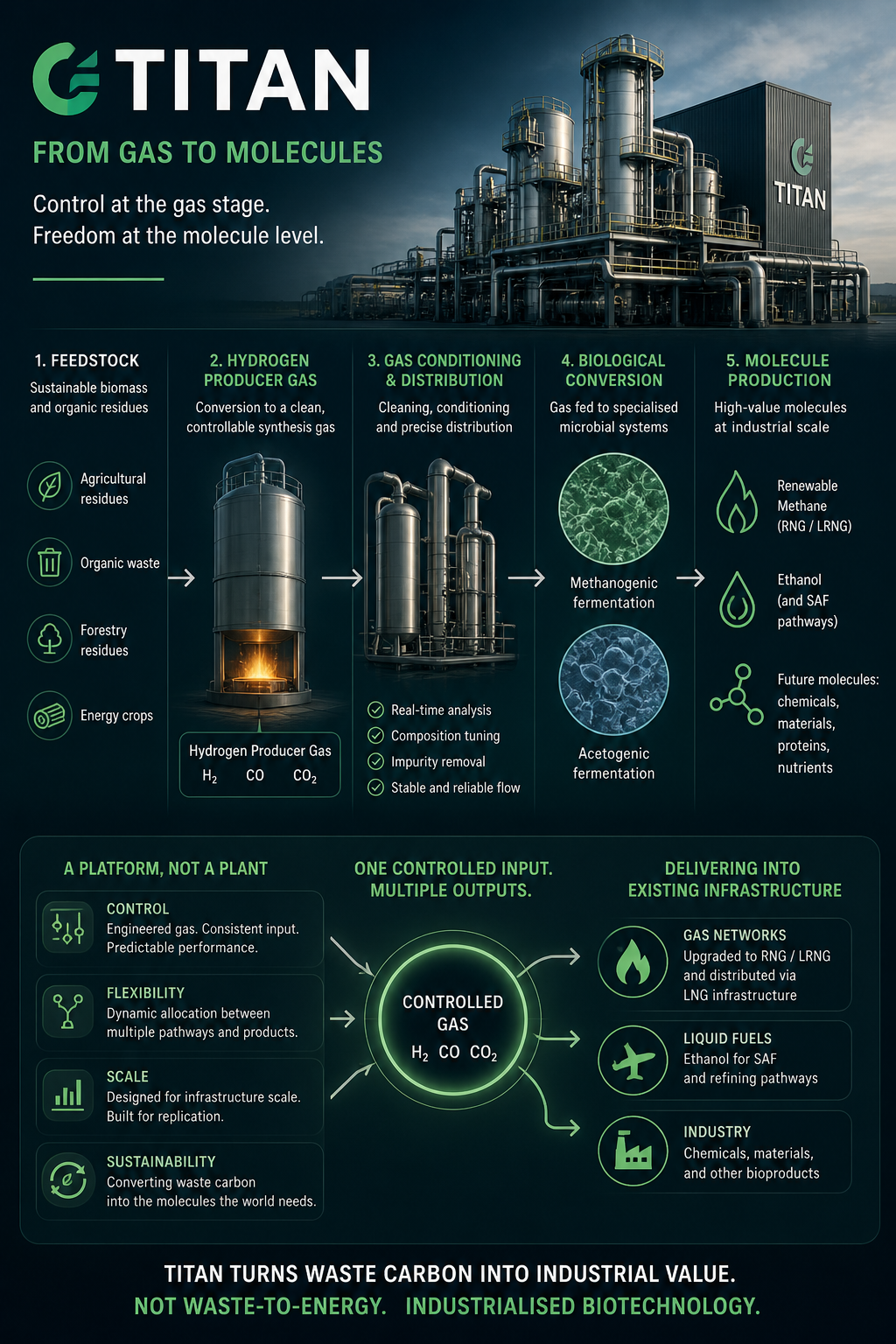
It starts by creating a controlled gas-phase feedstock using Hydrogen Producer Gas. Solid inputs are converted into a stable mixture of hydrogen, carbon monoxide and carbon dioxide. This step is not about energy recovery. It is about creating a uniform carbon interface.

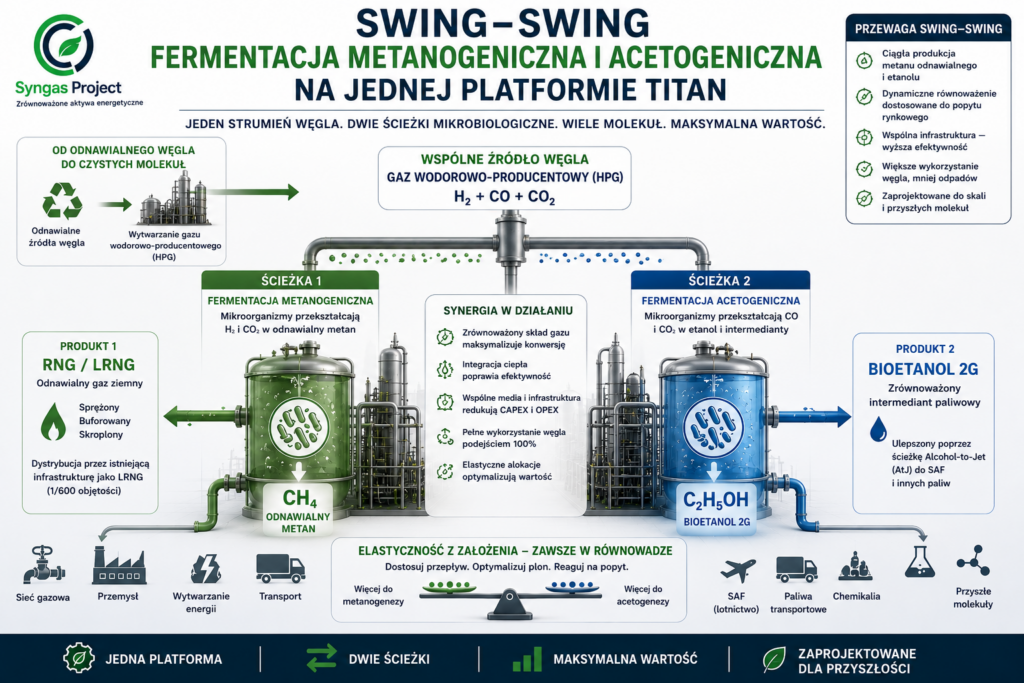
Swing–Swing: Methanogenic and Acetogenic Fermentation on One Platform

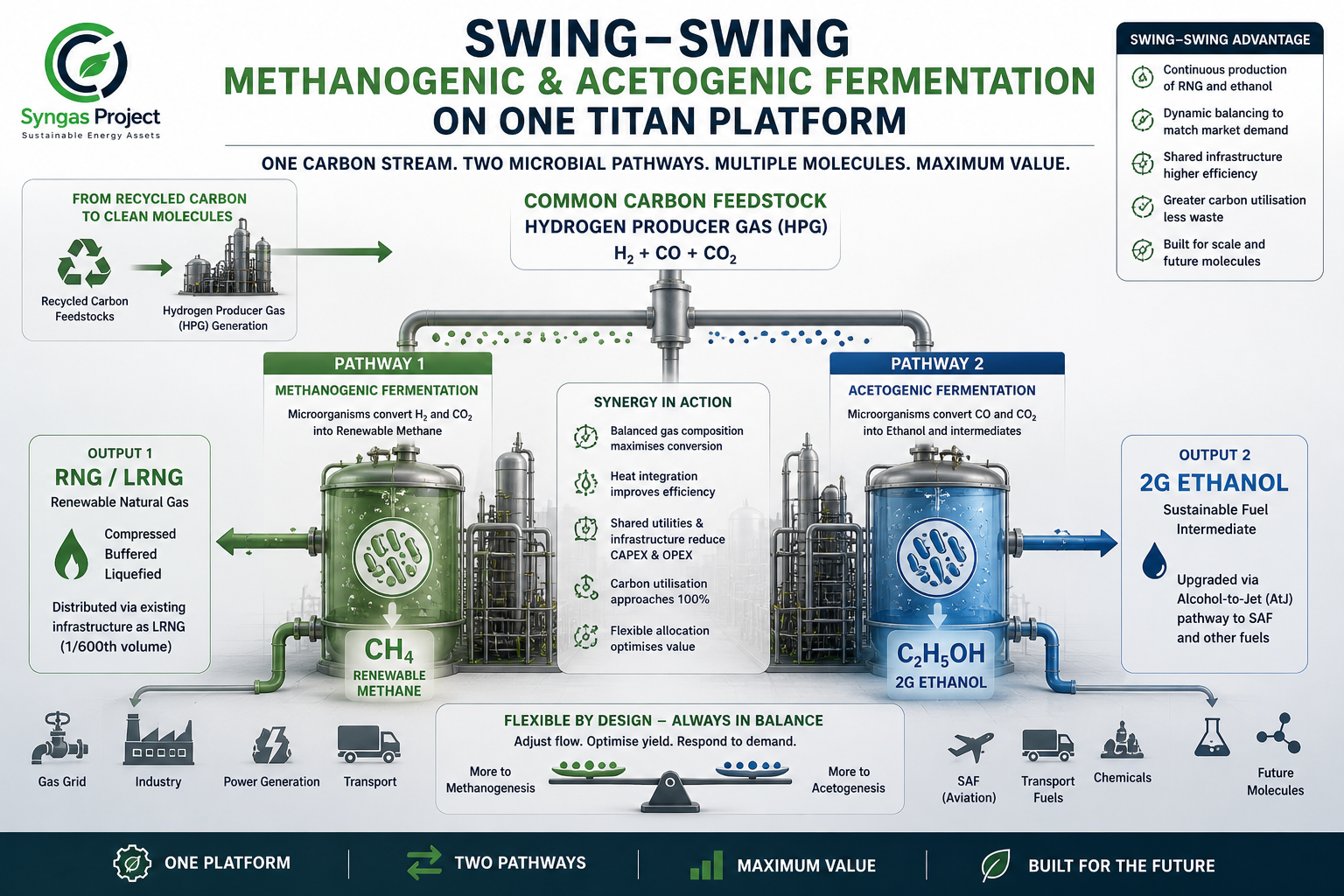
TITAN does not choose between renewable methane and ethanol. It produces both on the same platform, from the same carbon stream.

This is the foundation of Swing–Swing.

At the centre of TITAN is Hydrogen Producer Gas. It is not a waste gas. It is a controlled carbon feedstock, engineered to deliver a stable mixture of hydrogen, carbon monoxide and carbon dioxide. This gas becomes the interface between thermochemical conversion and biotechnology.

From this single gas stream, two biological pathways operate in parallel.

Methanogenic fermentation converts the gas into renewable methane.

Acetogenic fermentation converts the same gas into ethanol.

These are not competing processes. They are complementary.

Traditional systems force a choice. Gas is either burned, upgraded or directed into a single downstream pathway. That limits flexibility and reduces value. TITAN is designed differently. The gas is conditioned and distributed across a platform that can direct carbon where it creates the most value at any given time.

This is not a theoretical advantage. It is a system-level capability.

Methanogenic organisms favour hydrogen-rich conditions. They convert hydrogen and carbon dioxide into methane efficiently and reliably. This pathway produces renewable natural gas that can be compressed, liquefied and distributed as LRNG through existing infrastructure.

Acetogenic organisms operate differently. They consume carbon monoxide and carbon dioxide and convert them into ethanol and other intermediates. This pathway supports the production of 2G ethanol, which can be upgraded through the Alcohol-to-Jet pathway into sustainable aviation fuel.

Both pathways depend on gas quality, pressure, temperature and composition. In TITAN, those variables are controlled. Gas is not simply produced and sent downstream. It is managed, conditioned and directed.

This is where synergy begins.

Methanogenic fermentation can stabilise hydrogen levels in the system. Acetogenic fermentation can utilise carbon monoxide that would otherwise be underused. Heat integration between the two pathways improves overall system efficiency. Utilities, compression, gas handling, control systems and infrastructure are shared across the platform.

The result is not two plants operating side by side.

It is one system operating in balance.

Swing–Swing: fermentacja metanogenna i acetogenna na jednej platformie

TITAN nie wybiera pomiędzy metanem odnawialnym a etanolem.

Produkuje oba produkty na tej samej platformie, z tego samego strumienia węgla.

To jest podstawa trybu Swing–Swing.

W centrum platformy TITAN znajduje się Hydrogen Producer Gas. Nie jest to gaz odpadowy. Jest to kontrolowany surowiec węglowy, zaprojektowany tak, aby dostarczać stabilną mieszaninę wodoru, tlenku węgla i dwutlenku węgla. Ten gaz staje się interfejsem pomiędzy konwersją termochemiczną a biotechnologią.

Z jednego strumienia gazu równolegle działają dwie ścieżki biologiczne.

Fermentacja metanogenna przekształca gaz w metan odnawialny.

Fermentacja acetogenna przekształca ten sam gaz w etanol.

To nie są procesy konkurencyjne. Są komplementarne.

Tradycyjne systemy wymuszają wybór. Gaz jest spalany, uszlachetniany albo kierowany do jednej ścieżki downstream. Ogranicza to elastyczność i zmniejsza wartość. TITAN został zaprojektowany inaczej. Gaz jest kondycjonowany i dystrybuowany w ramach platformy, która może kierować węgiel tam, gdzie w danym momencie tworzy największą wartość.

To nie jest przewaga teoretyczna. To zdolność na poziomie systemu.

Organizmy metanogenne preferują warunki bogate w wodór. Efektywnie i niezawodnie przekształcają wodór i dwutlenek węgla w metan. Ta ścieżka produkuje odnawialny gaz ziemny, który może być sprężany, skraplany i dystrybuowany jako LRNG przez istniejącą infrastrukturę.

Organizmy acetogenne działają inaczej. Zużywają tlenek węgla i dwutlenek węgla, przekształcając je w etanol i inne półprodukty. Ta ścieżka wspiera produkcję etanolu 2G, który może być następnie wykorzystany w ścieżce Alcohol-to-Jet do produkcji zrównoważonego paliwa lotniczego.

Obie ścieżki zależą od jakości gazu, ciśnienia, temperatury i składu. W TITAN te zmienne są kontrolowane. Gaz nie jest po prostu produkowany i wysyłany dalej. Jest zarządzany, kondycjonowany i kierowany.

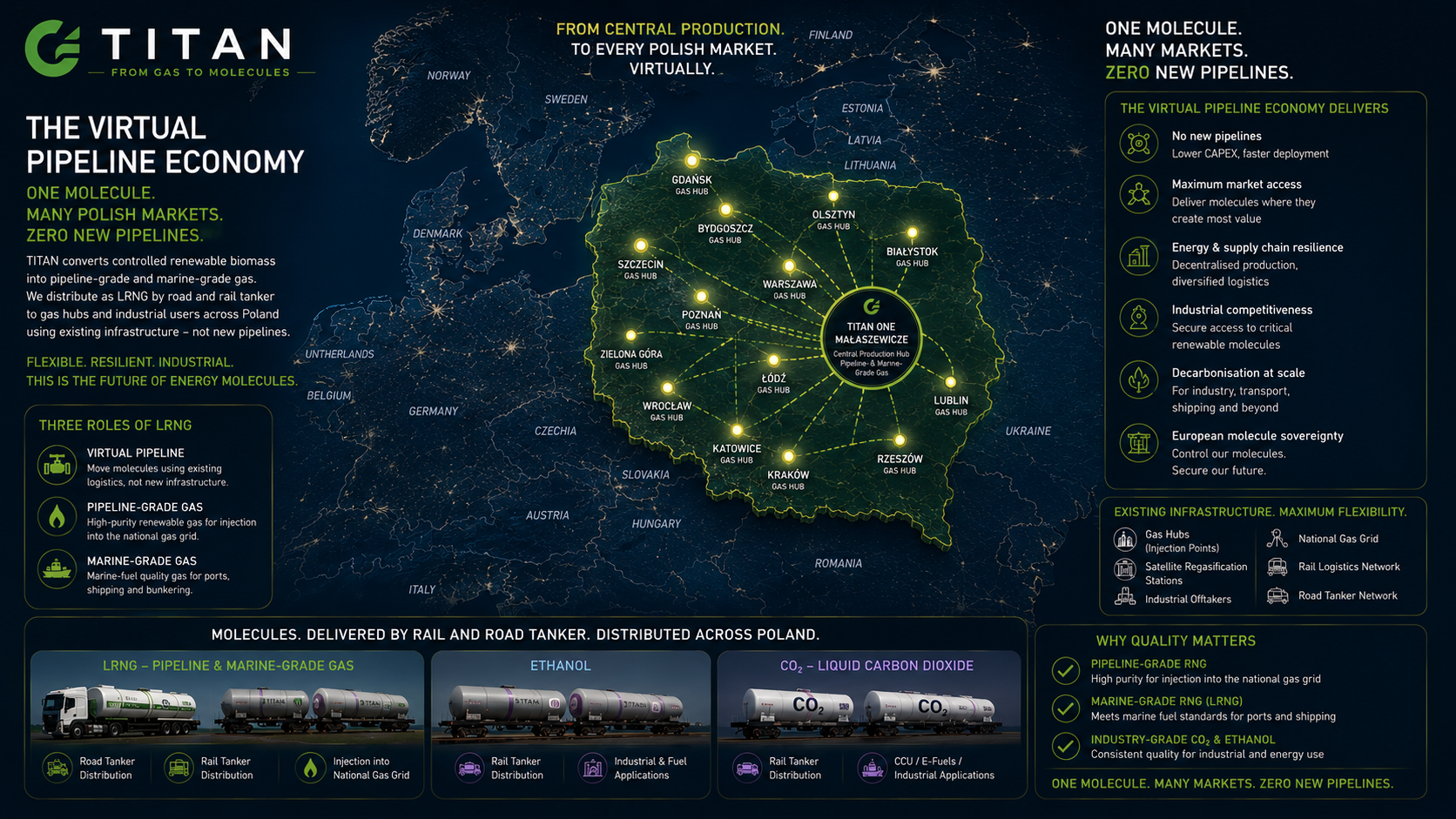
The Virtual Pipeline Economy

For more than a century, industrial gas distribution has been dominated by fixed pipeline infrastructure.

Pipelines transformed economies because they allowed large volumes of energy molecules to move continuously between production centres and industrial demand zones. Entire industries were built around this logic. Heavy industry, fertiliser production, chemicals, district heating, shipping and power generation all evolved around the assumption that gas infrastructure would remain centralised, fixed and geographically constrained.

The problem is that Europe’s energy geography has changed faster than its infrastructure.

The European Union now faces a structural challenge that cannot be solved using electricity alone. Europe may increasingly produce its own electrons, but it still imports a large proportion of its critical molecules. Natural gas, LNG, methanol, ammonia, aviation fuels and chemical feedstocks remain deeply exposed to external supply chains and geopolitical instability.

This is where the virtual pipeline economy begins.

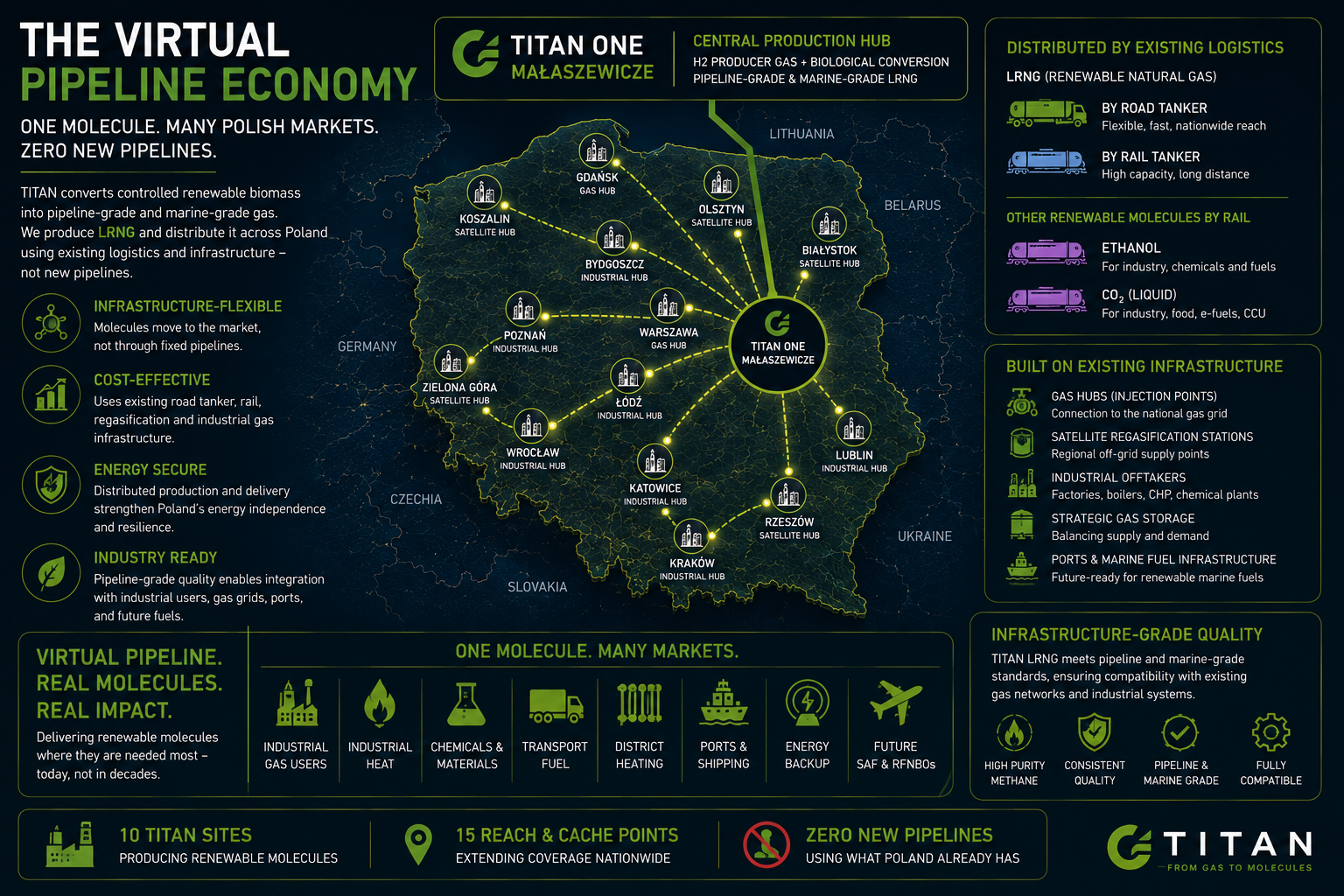
TITAN is designed around the idea that renewable molecules should move through Europe using flexible logistics infrastructure instead of relying exclusively on fixed pipeline systems.

The concept is simple.

Instead of transporting low-density biomass over very long distances, TITAN converts regional biomass into high-density renewable gas molecules close to the feedstock source. Those molecules are then distributed through existing road, rail, marine and regasification infrastructure using LRNG logistics.

LRNG — Liquefied Renewable Natural Gas — allows renewable methane to be transported at approximately 1/600th of its gaseous volume. This transforms renewable gas from a geographically trapped energy source into a mobile industrial commodity capable of serving national markets.

The result is a virtual pipeline.

The molecule moves without requiring a physical transmission pipe between origin and destination.

This is not a theoretical concept. Europe already operates major LNG logistics infrastructure across ports, storage facilities, satellite regasification terminals, rail systems and tanker fleets. TITAN simply adapts this proven infrastructure for renewable molecule distribution.

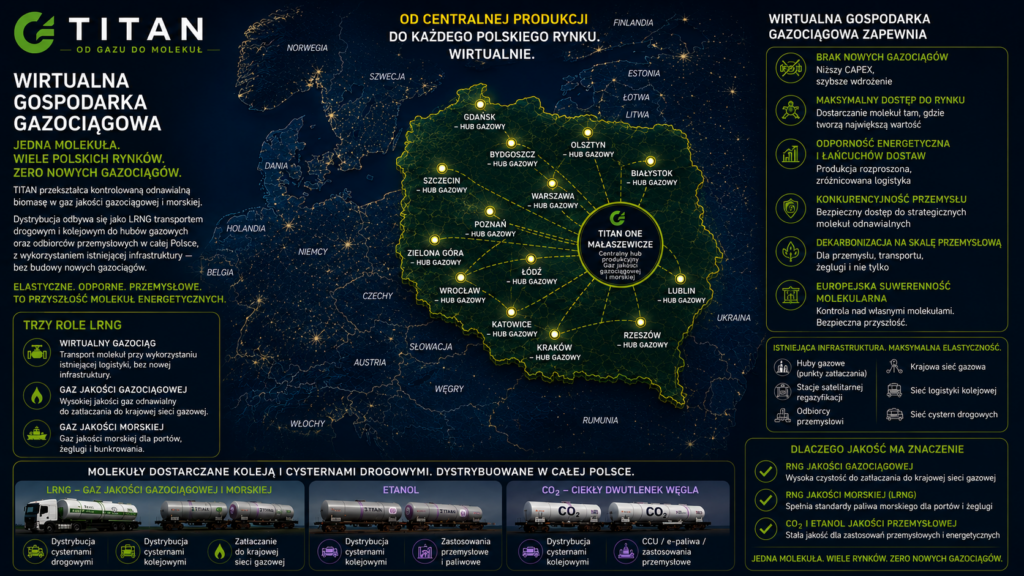
Wirtualna gospodarka rurociągowa

Przez ponad sto lat przemysłowa dystrybucja gazu była zdominowana przez stałą infrastrukturę rurociągową.

Rurociągi zmieniły gospodarki, ponieważ umożliwiły ciągły transport dużych ilości molekuł energii pomiędzy centrami produkcyjnymi a strefami przemysłowego zapotrzebowania. Całe gałęzie przemysłu rozwijały się wokół założenia, że infrastruktura gazowa pozostanie scentralizowana, stała i geograficznie ograniczona.

Problem polega na tym, że europejska geografia energetyczna zmienia się szybciej niż infrastruktura.

Unia Europejska stoi obecnie przed strukturalnym wyzwaniem, którego nie można rozwiązać wyłącznie energią elektryczną. Europa może coraz częściej produkować własne elektrony, ale nadal importuje znaczną część swoich strategicznych molekuł. Gaz ziemny, LNG, metanol, amoniak, paliwa lotnicze oraz surowce chemiczne pozostają silnie uzależnione od zewnętrznych łańcuchów dostaw i niestabilności geopolitycznej.

W tym miejscu rozpoczyna się gospodarka wirtualnego rurociągu.

TITAN został zaprojektowany wokół idei, że odnawialne molekuły powinny przemieszczać się po Europie przy wykorzystaniu elastycznej infrastruktury logistycznej, a nie wyłącznie poprzez stałe systemy rurociągowe.

Koncepcja jest prosta.

Zamiast transportować biomasę o niskiej gęstości na bardzo duże odległości, TITAN przekształca regionalną biomasę w wysokogęstościowe odnawialne molekuły gazowe blisko źródła surowca. Następnie molekuły te są dystrybuowane poprzez istniejącą infrastrukturę drogową, kolejową, morską i regazyfikacyjną przy wykorzystaniu logistyki LRNG.

LRNG — Liquefied Renewable Natural Gas — umożliwia transport odnawialnego metanu przy objętości około 1/600 jego postaci gazowej. Dzięki temu odnawialny gaz przestaje być lokalnym źródłem energii ograniczonym geograficznie i staje się mobilnym surowcem przemysłowym zdolnym obsługiwać rynki krajowe.

Forest Residue Is Not Waste: It Is Europe’s Underused Carbon Resource

Przewiń w dół, aby zobaczyć polską wersję.

Europe does not lack carbon.

It lacks controlled renewable carbon.

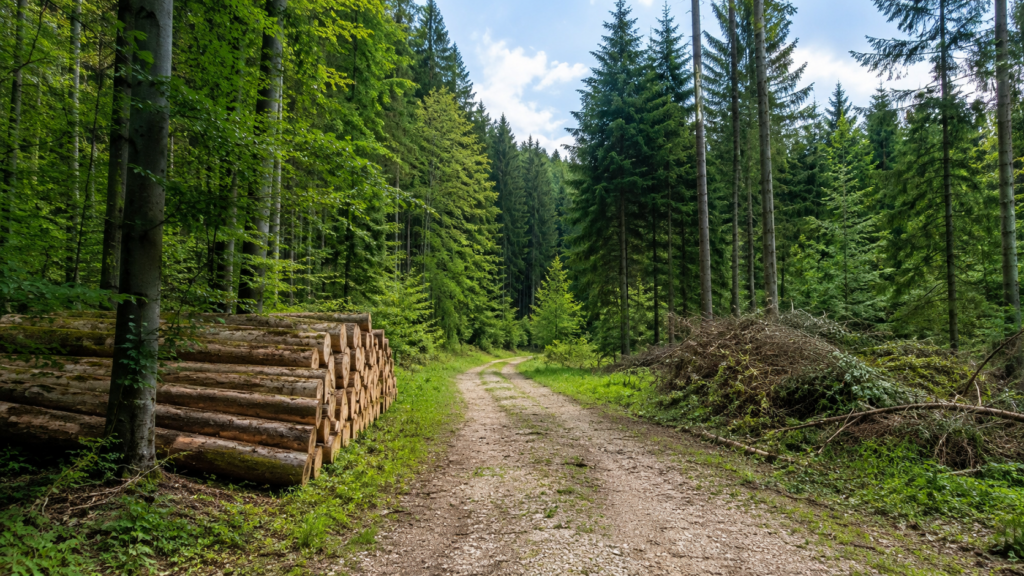
Every year, forests produce large volumes of material that never becomes merchantable timber. Branches, tops, twisted wood, undersized stems, storm residues and other low-value material are often difficult to recover economically. Some of this material is left on the forest floor. Some is recovered for low-value uses. Much of it is treated as a logistical problem rather than an industrial opportunity.

TITAN sees this material differently.

Forest residue is not waste. It is renewable carbon. It is local, physical, measurable and already present inside the European landscape. When collected responsibly, it can support a new generation of industrial molecule production without competing directly with food crops or high-value timber markets.

This distinction matters.

Europe’s energy debate has focused heavily on electrons. Wind, solar and grid expansion are essential, but they do not solve the molecule problem. Aviation fuel, industrial gas, chemicals, materials and many liquid fuels still depend on carbon-based molecules. The question is not whether Europe needs carbon. It does. The question is where that carbon should come from.

Today, too much of Europe’s molecule economy still depends on imported fossil carbon.

TITAN offers a different route.

The platform converts forest residue into Hydrogen Producer Gas, creating a controlled gas-phase feedstock for targeted microbial fermentation. From there, carbon can be converted into renewable methane, 2G ethanol and, in future, wider fuels, chemicals, materials and nutrients.

TITAN: From Gas to Molecules — Why Control Matters

Przewiń w dół, aby zobaczyć wersję w języku polskim.

TITAN does not begin with fermentation.

It begins with control.

At the heart of the platform is a simple but critical step: converting solid carbon into a stable, controllable gas. This is achieved through Hydrogen Producer Gas, where biomass is transformed into a defined mixture of hydrogen, carbon monoxide and carbon dioxide.

This step determines everything that follows.

Most carbon conversion systems struggle because they attempt to process variability. Mixed inputs lead to unstable outputs. Biological systems, in particular, are sensitive to inconsistency. When feedstock fluctuates, performance drops, yields fall, and scale becomes difficult.

TITAN removes this problem at the source.

By converting solids into gas first, it separates variability from production. The gas phase becomes a controlled interface between raw material and biology. Instead of managing unpredictable solids, the system manages a measurable, adjustable flow.

Gas can be analysed in real time.

Composition can be tuned. Ratios of hydrogen to carbon monoxide can be adjusted depending on the target pathway. Flow can be stabilised. Impurities can be reduced through conditioning and polishing. What enters the fermentation system is no longer variable waste. It is engineered input.

This is the difference between adaptation and design.

In conventional systems, biology is forced to adapt to the feedstock. In TITAN, the feedstock is engineered to suit the biology. This allows microbial systems to operate under optimal conditions rather than survival conditions.

The result is stability.

Methanogenic and acetogenic pathways require consistency to perform at industrial scale. Methanogens convert hydrogen and carbon dioxide into methane. Acetogens convert carbon monoxide and hydrogen into ethanol and other molecules. Both processes are highly sensitive to gas composition, pressure and flow.

The Virtual Pipeline Economy

Publish date: 25 March 2026

(Polska wersja poniżej.)

For more than a century, industrial gas distribution has depended on fixed pipeline systems.

Pipelines transformed economies because they allowed energy molecules to move continuously between production centres and industrial users. Heavy industry, chemicals, district heating, shipping and manufacturing all developed around this infrastructure model.

But building entirely new national pipeline systems is slow, expensive and politically difficult.

At the same time, Poland faces a growing challenge.

The country requires increasing volumes of renewable molecules for industry, transport, chemicals, heating and future fuel systems, while much of the existing renewable energy discussion remains focused almost entirely on electricity.

Electricity matters.

But molecules matter too.

Factories require molecules.

High-temperature industrial heat requires molecules.

Shipping requires molecules.

Chemicals require molecules.

Future aviation fuels require molecules.

The question is not simply how to produce renewable molecules.

The question is how to distribute them efficiently across the country without waiting decades for entirely new infrastructure to be built.

This is where the virtual pipeline economy begins.