TITAN i bezpieczeństwo energetyczne w epoce niestabilności

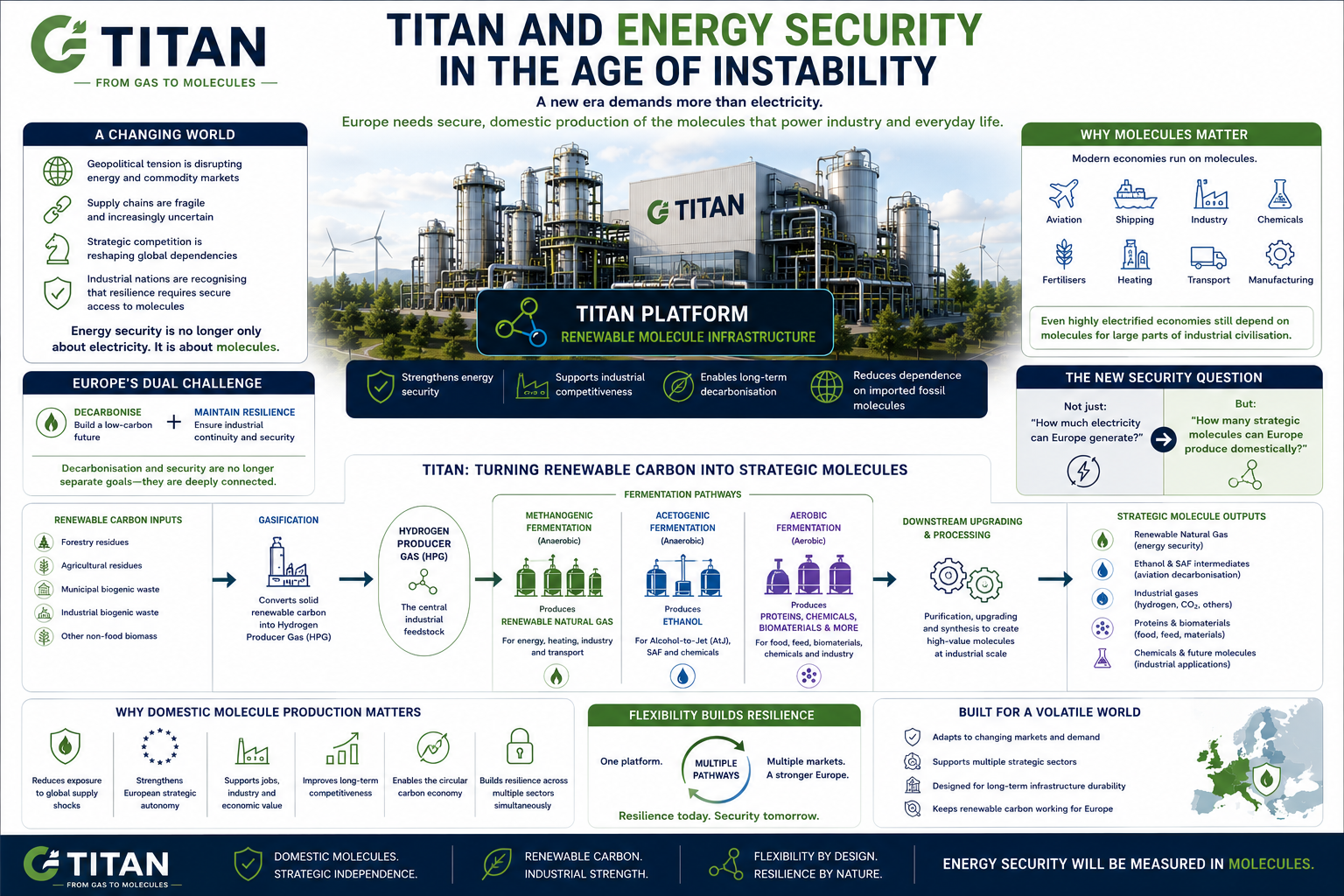
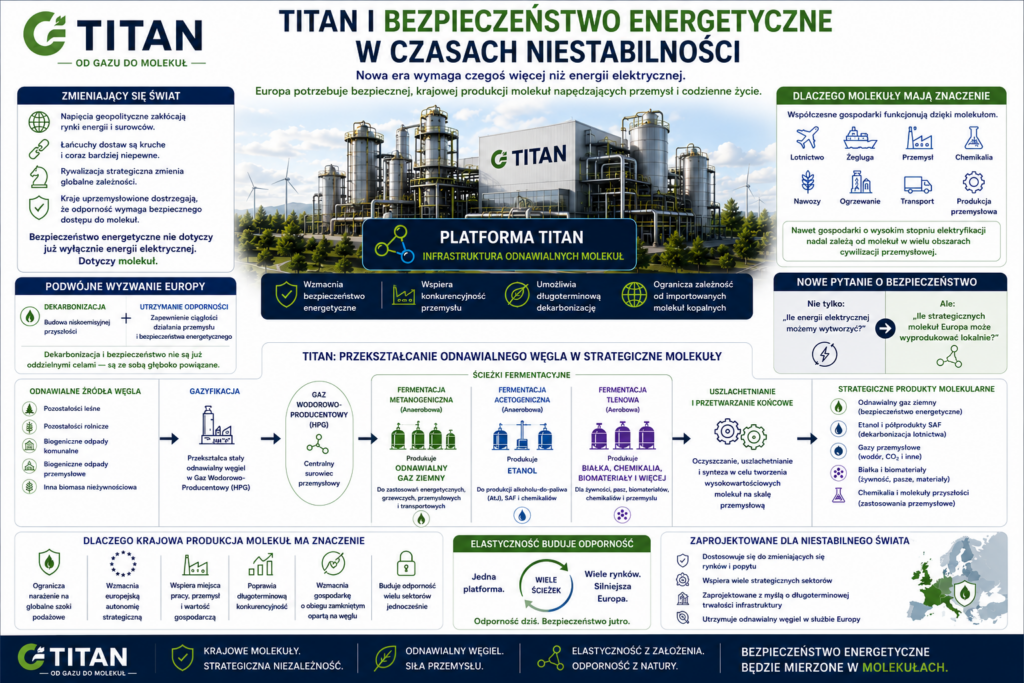
Europa wchodzi w coraz bardziej niestabilny świat.

Przez dekady znaczna część europejskiego modelu przemysłowego opierała się na założeniu, że energia, paliwa i surowce przemysłowe pozostaną globalnie dostępne, względnie tanie i politycznie osiągalne. Rozbudowane międzynarodowe łańcuchy dostaw umożliwiały import molekuł z odległych regionów, podczas gdy polityka wewnętrzna koncentrowała się głównie na konsumpcji i efektywności.

Ten świat się zmienia.

Napięcia geopolityczne powróciły na rynki energii. Łańcuchy dostaw stały się bardziej kruche. Rośnie strategiczna konkurencja między państwami. Kraje przemysłowe zaczynają dostrzegać, że długoterminowa odporność zależy nie tylko od produkcji energii elektrycznej, ale również od bezpiecznego dostępu do molekuł.

To rozróżnienie ma ogromne znaczenie.

Nowoczesne gospodarki nie funkcjonują wyłącznie dzięki energii elektrycznej.

Przemysł ciężki, lotnictwo, żegluga, chemia, nawozy, ciepłownictwo i transport przemysłowy nadal wymagają produktów molekularnych: gazu, paliw ciekłych, surowców węglowych i gazów przemysłowych. Nawet silnie zelektryfikowane gospodarki pozostają zależne od molekuł w wielu obszarach współczesnej cywilizacji przemysłowej.

Europa stoi więc przed podwójnym wyzwaniem.

Musi przeprowadzić dekarbonizację.

Ale jednocześnie musi utrzymać ciągłość przemysłową i strategiczną odporność.

Cele te często traktowane są oddzielnie. W rzeczywistości stają się coraz bardziej ze sobą powiązane.

Odchodzenie od kopalnego węgla nie jest wyłącznie transformacją środowiskową. Jest również transformacją przemysłową i geopolityczną.

Państwa zdolne do krajowej produkcji strategicznych molekuł będą prawdopodobnie posiadały większą odporność długoterminową niż państwa zależne od importowanych systemów opartych na węglu kopalnym.

I właśnie tutaj infrastruktura odnawialnych molekuł staje się ważna.

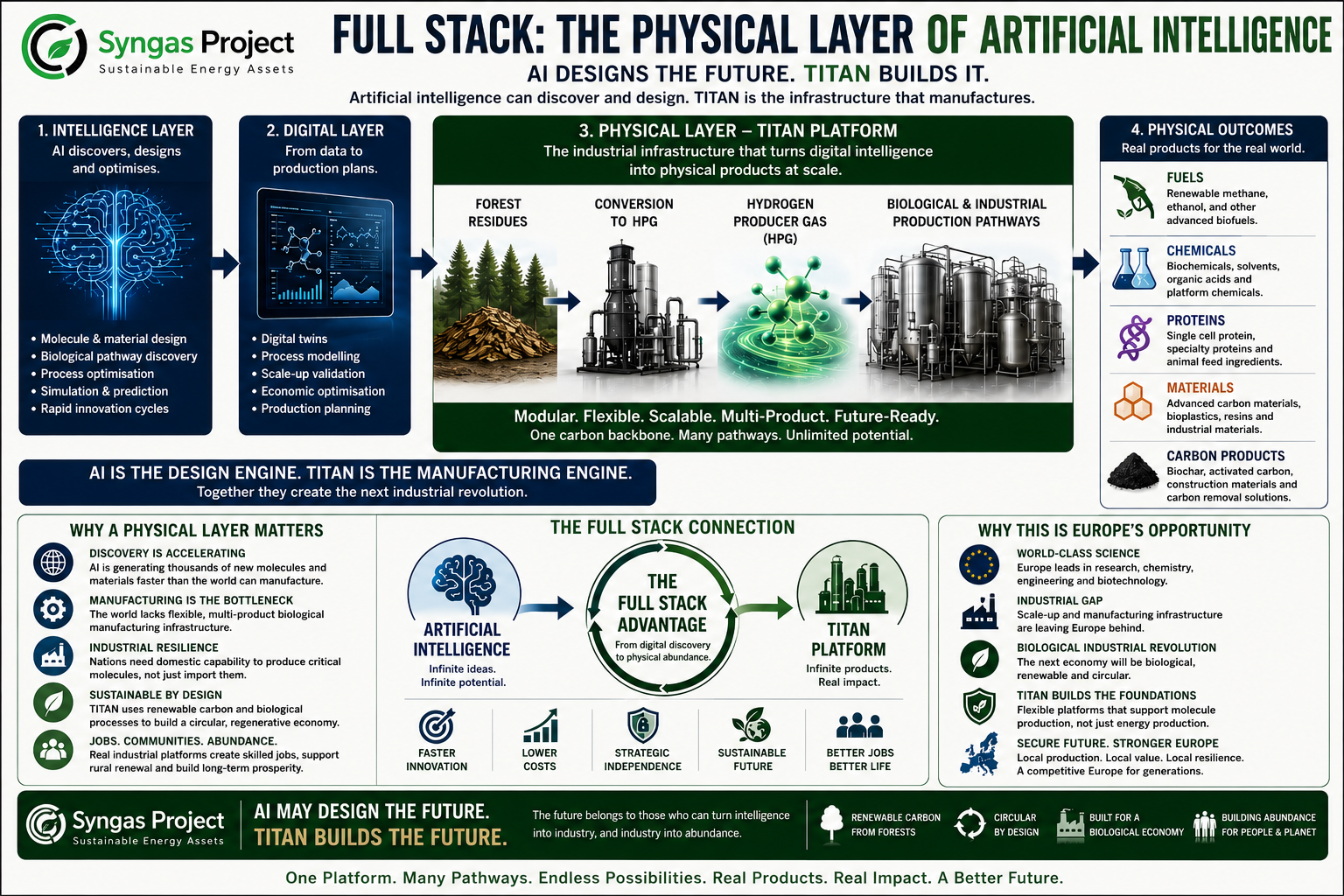
AI Promises New Materials. TITAN Promises a Place to Manufacture Them

Artificial intelligence is beginning to change chemistry faster than most people realise.

For decades, discovering new materials, biological pathways and industrial compounds was slow, expensive and uncertain. Research teams could spend years testing molecules, enzymes and formulations with limited success.

That is changing rapidly.

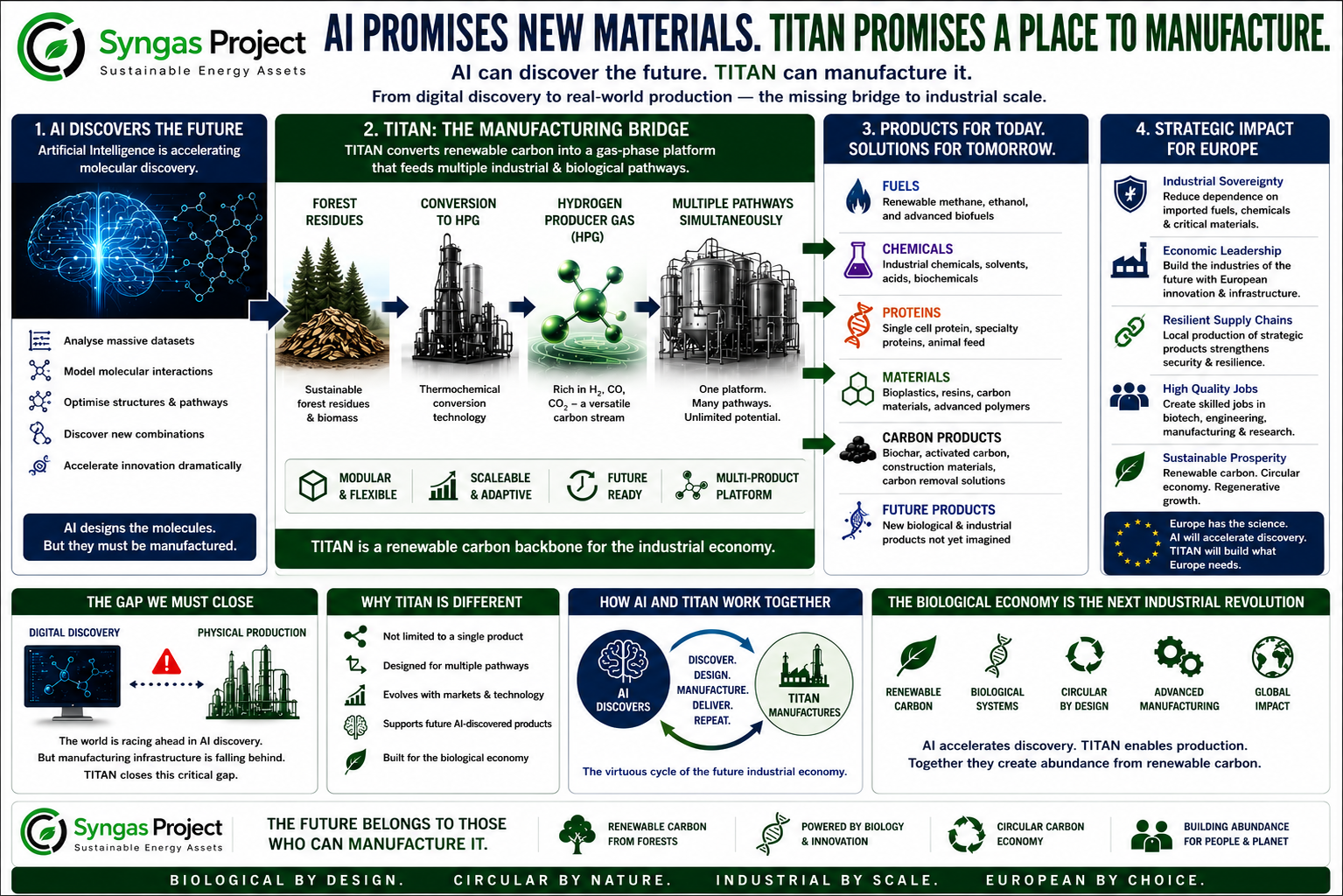
Artificial intelligence can now analyse enormous quantities of chemical, biological and material data simultaneously. It can model interactions, optimise molecular structures and identify entirely new combinations far faster than traditional research methods.

The implications are enormous.

AI may help discover:

New fuels.
New plastics.
New proteins.
New medicines.
New industrial chemicals.
New biological materials.
New agricultural systems.
New carbon products.

Governments and technology companies are investing billions into this transition because whoever controls the next generation of materials and molecules may help define the next industrial economy.

But there is a problem.

Discovery alone does not create industry.

A molecule discovered by artificial intelligence still needs to be manufactured physically, economically and at scale.

This is where the conversation becomes industrial rather than digital.

The world is rapidly building artificial intelligence systems capable of designing future products. But the physical infrastructure capable of manufacturing those products is developing far more slowly.

This creates a growing gap between digital discovery and real-world production.

AI Obiecuje Nowe Materiały. TITAN Oferuje Miejsce do Ich Produkcji

Sztuczna inteligencja zaczyna zmieniać chemię szybciej, niż większość ludzi zdaje sobie z tego sprawę.

Przez dekady odkrywanie nowych materiałów, ścieżek biologicznych i związków przemysłowych było powolne, kosztowne i niepewne. Zespoły badawcze mogły spędzać lata na testowaniu molekuł, enzymów i formulacji z ograniczonym powodzeniem.

To szybko się zmienia.

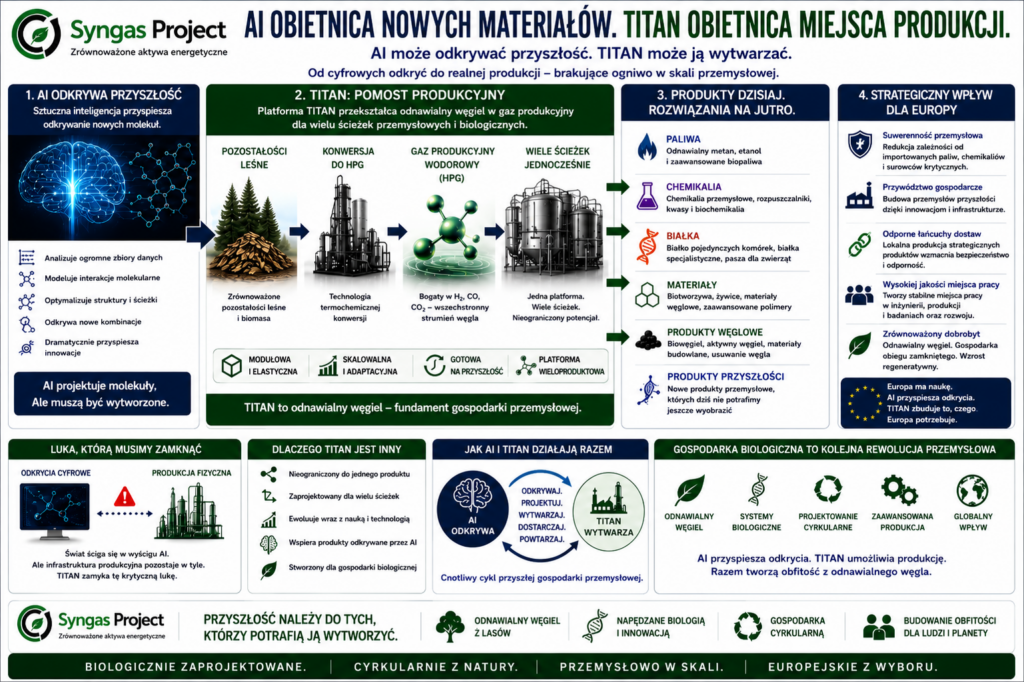
Sztuczna inteligencja potrafi dziś analizować ogromne ilości danych chemicznych, biologicznych i materiałowych jednocześnie. Może modelować interakcje, optymalizować struktury molekularne i identyfikować zupełnie nowe kombinacje znacznie szybciej niż tradycyjne metody badawcze.

Konsekwencje są ogromne.

AI może pomóc odkrywać:

Nowe paliwa.
Nowe tworzywa sztuczne.
Nowe białka.
Nowe leki.
Nowe chemikalia przemysłowe.
Nowe materiały biologiczne.
Nowe systemy rolnicze.
Nowe produkty węglowe.

Rządy i firmy technologiczne inwestują miliardy w tę transformację, ponieważ ci, którzy będą kontrolować następną generację materiałów i molekuł, mogą współtworzyć następną gospodarkę przemysłową.

Ale istnieje problem.

Samo odkrycie nie tworzy przemysłu.

Molekuła odkryta przez sztuczną inteligencję nadal musi zostać wyprodukowana fizycznie, ekonomicznie i w dużej skali.

W tym miejscu rozmowa staje się przemysłowa, a nie cyfrowa.

Świat bardzo szybko buduje systemy sztucznej inteligencji zdolne projektować produkty przyszłości. Jednak fizyczna infrastruktura zdolna do ich produkcji rozwija się znacznie wolniej.

Tworzy to rosnącą lukę pomiędzy cyfrowym odkrywaniem a rzeczywistą produkcją.

Syngas Project uważa, że ta luka może stać się jedną z najważniejszych szans przemysłowych następnego pokolenia.

Ponieważ TITAN nie jest wyłącznie platformą energetyczną.

Jest platformą odnawialnej produkcji węglowej.

Proces TITAN rozpoczyna się od konwersji pozostałości leśnych w Hydrogen Producer Gas (HPG). Tworzy to stabilny gazowy strumień węgla bogaty w wodór, tlenek węgla i dwutlenek węgla. Ten strumień może następnie jednocześnie zasilać wiele ścieżek przemysłowych i biologicznych.

Dziś ścieżki te koncentrują się głównie na produkcji odnawialnego metanu i etanolu.

Jutro te same ścieżki mogą wspierać całkowicie nowe klasy produktów biologicznych i przemysłowych.

Full Stack: The Physical Layer of Artificial Intelligence

Artificial intelligence is rapidly becoming the defining technology race of the 21st century.

Every week brings announcements about larger models, faster processors, more capable software agents and increasingly advanced machine reasoning systems. Governments are investing billions. Technology companies are competing for dominance. Data centres are expanding across the world at extraordinary speed.

Most discussion focuses on computation.

But very little discussion focuses on what artificial intelligence ultimately needs in the physical world.

Because intelligence alone does not manufacture anything.

Artificial intelligence can design molecules.
It can optimise biological pathways.
It can simulate new materials.
It can improve industrial systems.
It can accelerate chemistry and biotechnology research.

But eventually, something physical must manufacture the result.

This is where the next industrial bottleneck may emerge.

The future may not belong only to countries that control computation.

It may also belong to countries that control biological manufacturing platforms capable of turning digital intelligence into physical products.

That distinction is becoming increasingly important.

Artificial intelligence is already beginning to transform chemistry, material science, pharmaceutical research, biological engineering and industrial process optimisation. The speed of discovery is accelerating dramatically. New materials, proteins, enzymes, carbon structures and biological production pathways are being identified faster than traditional industrial systems can adapt.

But discovery is only one half of the equation.

Manufacturing remains the other half.

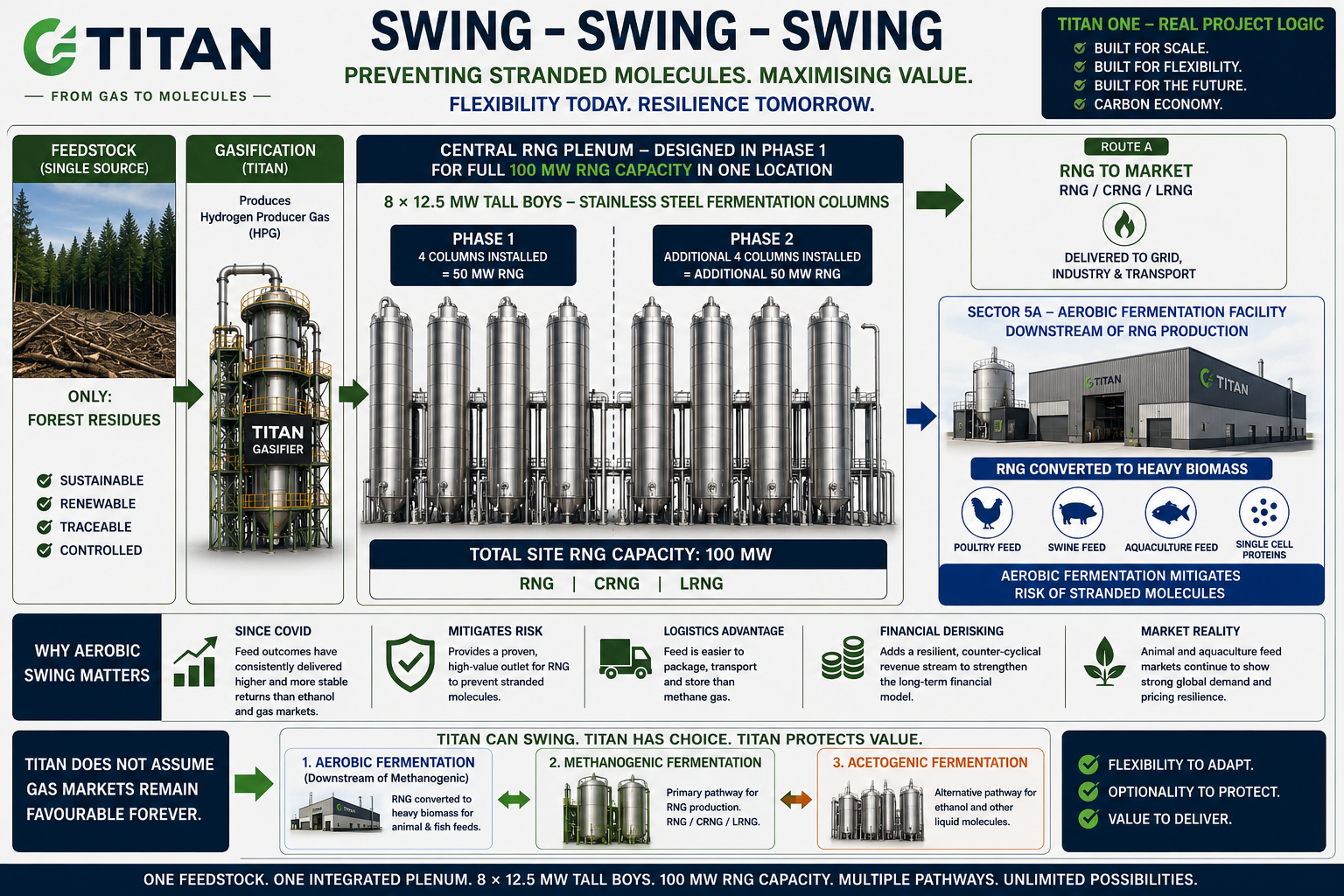
Swing–Swing–Swing: Preventing Stranded Molecules in the Biological Economy

Publish date: 1 May 2026

(Przewiń w dół, aby zobaczyć wersję polską.)

One of the greatest risks in the future molecule economy is not production.

It is stranded molecules.

History repeatedly shows that energy markets move in cycles. Periods of high gas pricing are often followed by oversupply, infrastructure expansion and eventual price collapse. LNG markets have historically demonstrated this pattern many times.

Renewable molecules will not be immune from volatility simply because they are renewable.

This is one of the reasons TITAN was never designed as a single-pathway platform.

It was designed around optionality.

The platform already operates at industrial scale between methanogenic and acetogenic fermentation pathways. TITAN can dynamically allocate Hydrogen Producer Gas between Renewable Natural Gas production and ethanol production depending on market conditions, infrastructure demand and industrial pricing.

This is the first Swing–Swing capability.

But the long-term strategic opportunity may be even larger.

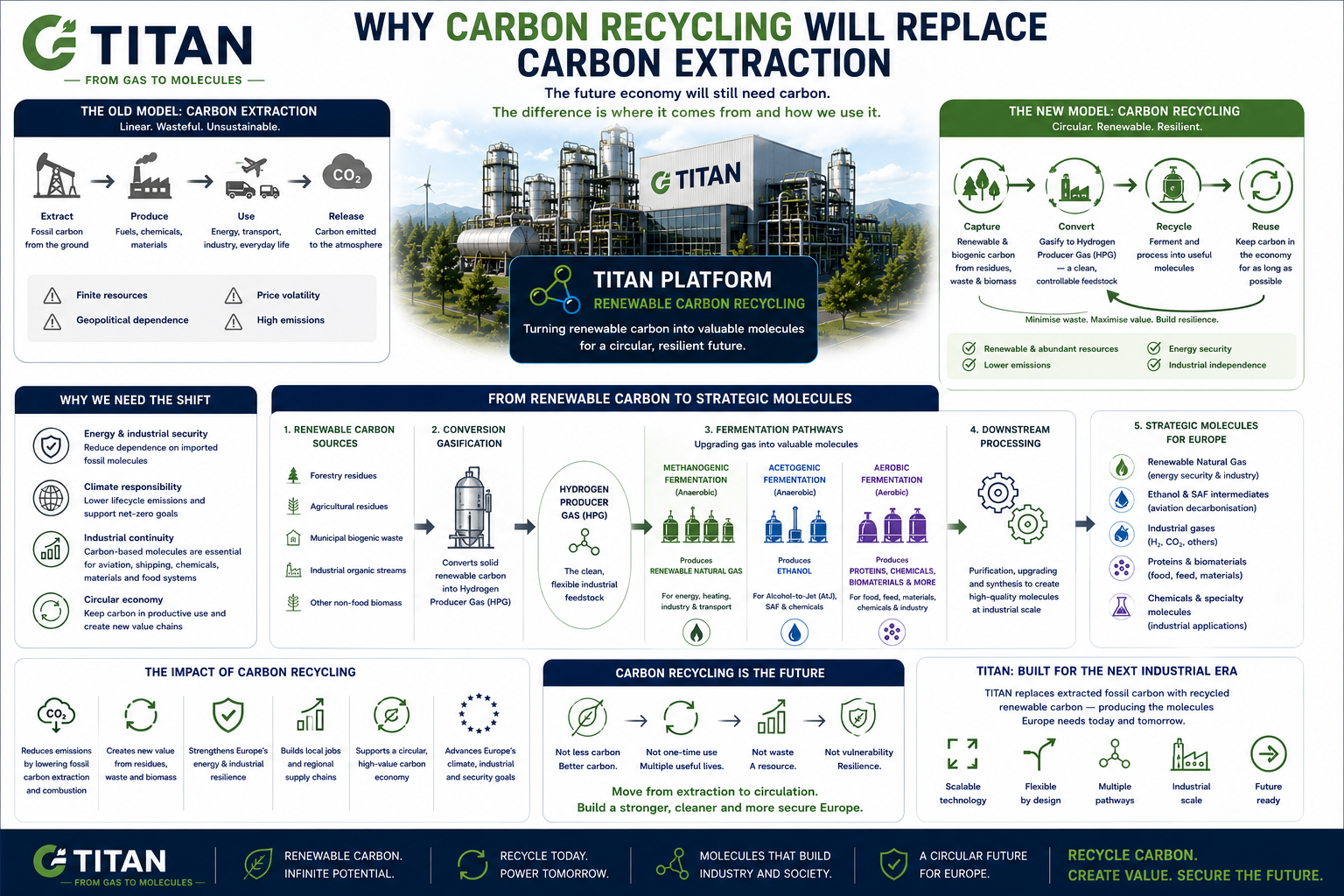
Why Carbon Recycling Will Replace Carbon Extraction

Publish date: 1 May 2026

(Przewiń w dół, aby zobaczyć wersję polską.)

For more than a century, industrial growth has depended on carbon extraction.

Coal, oil and natural gas were taken from the ground, refined, transported and converted into energy, fuels, chemicals and materials. This model powered the modern economy. It created mobility, manufacturing, aviation, plastics, fertilisers and global trade.

But it also created a structural problem.

The industrial economy became dependent on fossil carbon.

Carbon was extracted once, used briefly, and then released into the atmosphere. This linear model was efficient during the age of cheap fossil resources, but it is no longer compatible with Europe’s long-term climate, industrial and security objectives.

The next industrial era will require a different model.

Carbon cannot simply be treated as something to extract, burn and discard.

It must be treated as something to recover, recycle and reuse.

This is the logic of carbon recycling.

Carbon recycling does not mean stopping the use of carbon. That would be impossible for many parts of the economy. Aviation, shipping, chemicals, materials, agriculture, food systems and industrial manufacturing all depend on carbon-based molecules.

The real question is not whether society will use carbon.

The question is where that carbon comes from.

In the old model, carbon came from fossil extraction.

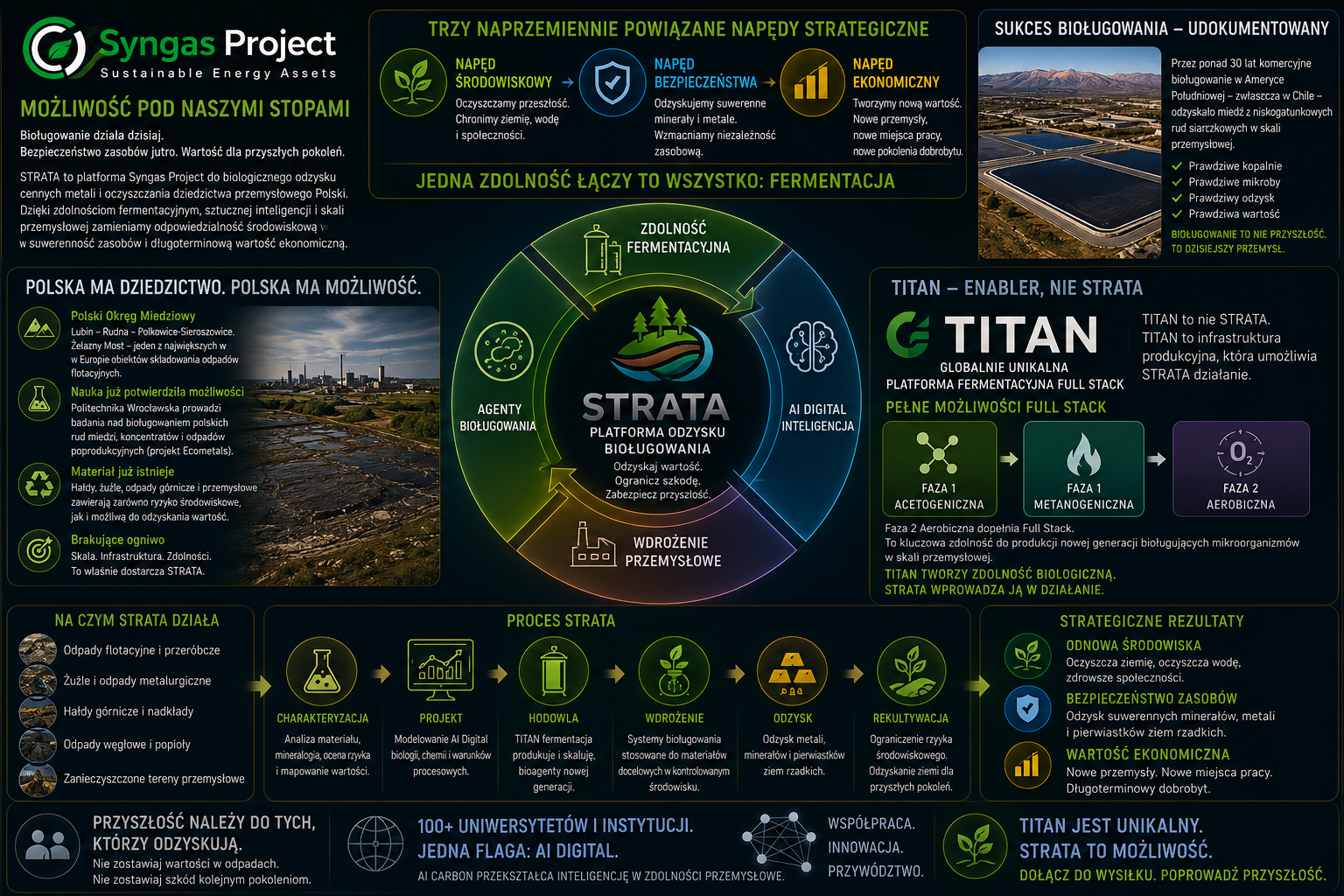
STRATA: Możliwość Pod Naszymi Stopami

Warsaw 01:05:2026 Steve Walker

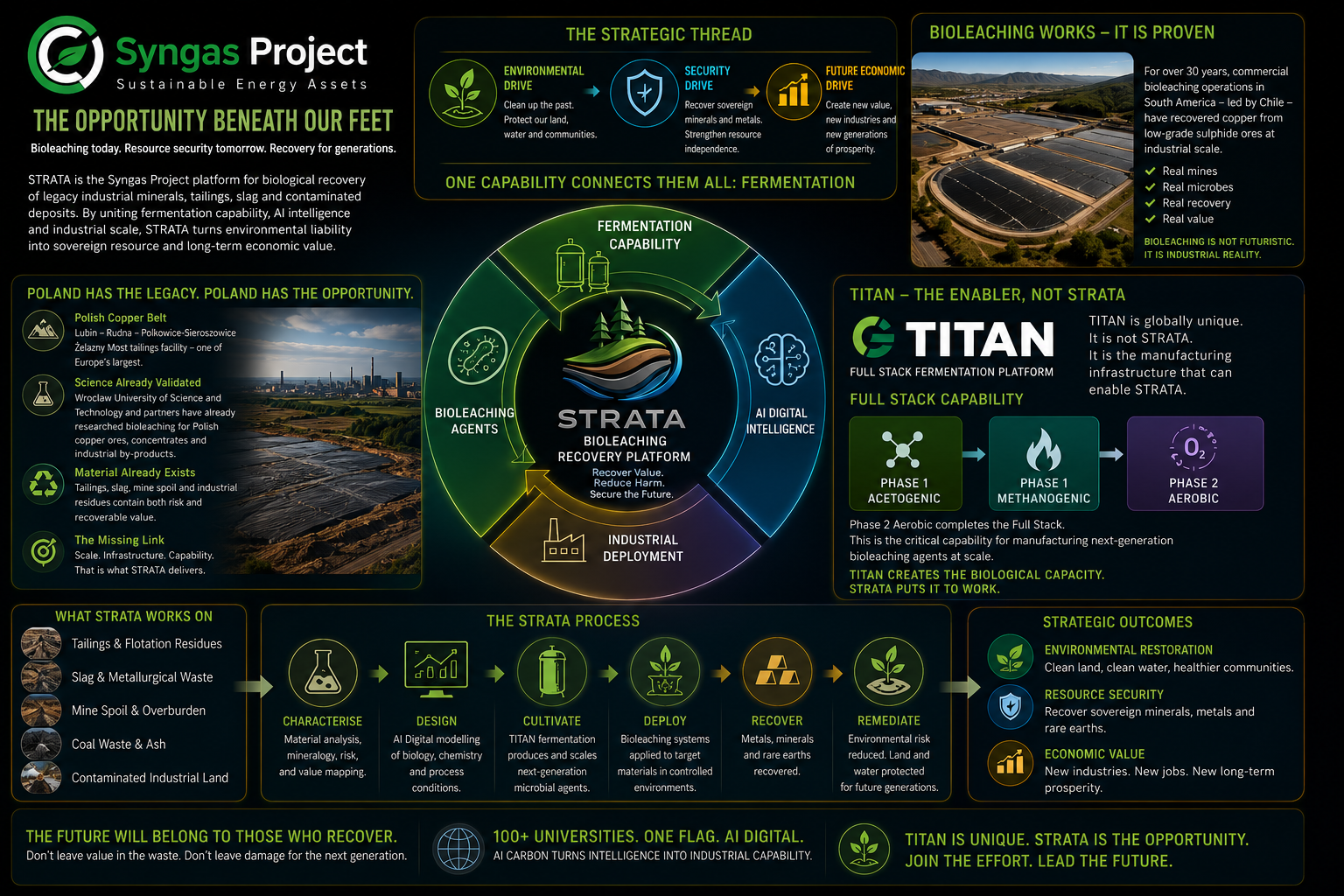
Przez ponad trzy dekady część południowoamerykańskiego przemysłu miedziowego po cichu udowadniała coś niezwykłego.

Mikroorganizmy potrafią odzyskiwać rzeczywistą wartość przemysłową.

W Chile i innych dużych regionach wydobycia miedzi bioługowanie było wykorzystywane komercyjnie do odzysku miedzi z niskogatunkowych rud siarczkowych, których tradycyjne przetwarzanie często nie uzasadniało ekonomicznie. Materiał uznawany wcześniej za marginalny stał się ekonomicznie odzyskiwalny, ponieważ biologiczne procesy umożliwiły uwolnienie zawartego w nim metalu.

To ma ogromne znaczenie, ponieważ potwierdza jedną ważną rzecz.

Bioługowanie nie jest spekulacyjną teorią naukową.

To już rzeczywistość przemysłowa.

Sam proces jest pozornie prosty. Starannie dobrane mikroorganizmy są hodowane i wprowadzane do środowisk mineralnych, gdzie pomagają utleniać minerały siarczkowe i uwalniać metale. W praktyce oznacza to, że biologia pomaga odzyskiwać wartość z materiałów, które starsze systemy przemysłowe pozostawiały niewykorzystane.

Przez wiele lat tę zdolność postrzegano jako niszową technikę górniczą.

Dziś wygląda ona na znacznie większą od samego górnictwa.

Ponieważ świat zaczyna rozumieć, że epoka przemysłowa pozostawiła po sobie coś więcej niż tylko zanieczyszczenia.

Pozostawiła zasoby.

Hałdy flotacyjne.

Żużle.

Nadkłady kopalniane.

Popioły.

Odpady hutnicze.

Pozostałości przemysłowe.

Niektóre z nich stanowią ryzyko środowiskowe. Inne zawierają możliwe do odzyskania metale. Wiele zawiera jedno i drugie.

Właśnie tutaj zaczyna się STRATA.

Polska Niesie Podobne Dziedzictwo

Polska rozumie ciężki przemysł.

Węgiel.

Stal.

Miedź.

Hutnictwo.

Kolej.

Chemia przemysłowa.

Rozwój przemysłowy zbudował nowoczesną Polskę, ale pozostawił również materiały, które do dziś wpływają na krajobraz i lokalne społeczności.

STRATA: The Opportunity Beneath Our Feet

Warsaw 01:05:2026 Steve Walker

For more than three decades, parts of the South American copper industry have quietly demonstrated something extraordinary.

Microbes can recover real industrial value.

In Chile and other major copper regions, biological leaching has been used commercially to help recover copper from low-grade sulphide ores that conventional processing may struggle to justify economically. What was once considered marginal material became economically recoverable because biological workers helped unlock the metal.

That matters because it proves something important.

Bioleaching is not speculative science.

It is already industrial reality.

The process itself is deceptively simple. Carefully selected microorganisms are cultivated and introduced into mineral environments where they help oxidise sulphide minerals and mobilise metals. In practical terms, biology helps release value from material that older industrial systems may leave behind.

For years, this capability was viewed as a niche mining technique.

Today it looks much larger than that.

Because the world is beginning to realise that the industrial age left behind more than pollution.

It left behind inventories.

Tailings.

Slag heaps.

Mine spoil.

Ash deposits.

Metallurgical waste.

Industrial residues.

Some contain environmental risk. Some contain recoverable metals. Many contain both.

This is where STRATA begins.

Poland Carries the Same Legacy

Poland understands heavy industry.

Coal.

Steel.

Copper.

Smelting.

Rail.

Chemicals.

Industrial growth built modern Poland, but industrial growth also left behind material that still shapes landscapes and communities today.

The Polish Copper Belt remains one of Europe’s most important copper-producing regions. Facilities such as Żelazny Most demonstrate the sheer scale of legacy mineral and flotation material already accumulated over decades of industrial production.

The important point is this:

the material already exists.

And researchers already know biology can interact with it.

Renewable Methane at Scale: LRNG and the Return of Local Gas

(Przewiń w dół, aby zobaczyć wersję polską.)

Publish April 30 2026

Europe does not have a gas problem. It has a gas origin problem.

Methane remains essential. It fuels industry, supports energy resilience, underpins logistics and provides the backbone for large parts of the economy that cannot simply electrify. The system that distributes methane is already built. What is changing is not the need for gas, but where that gas comes from.

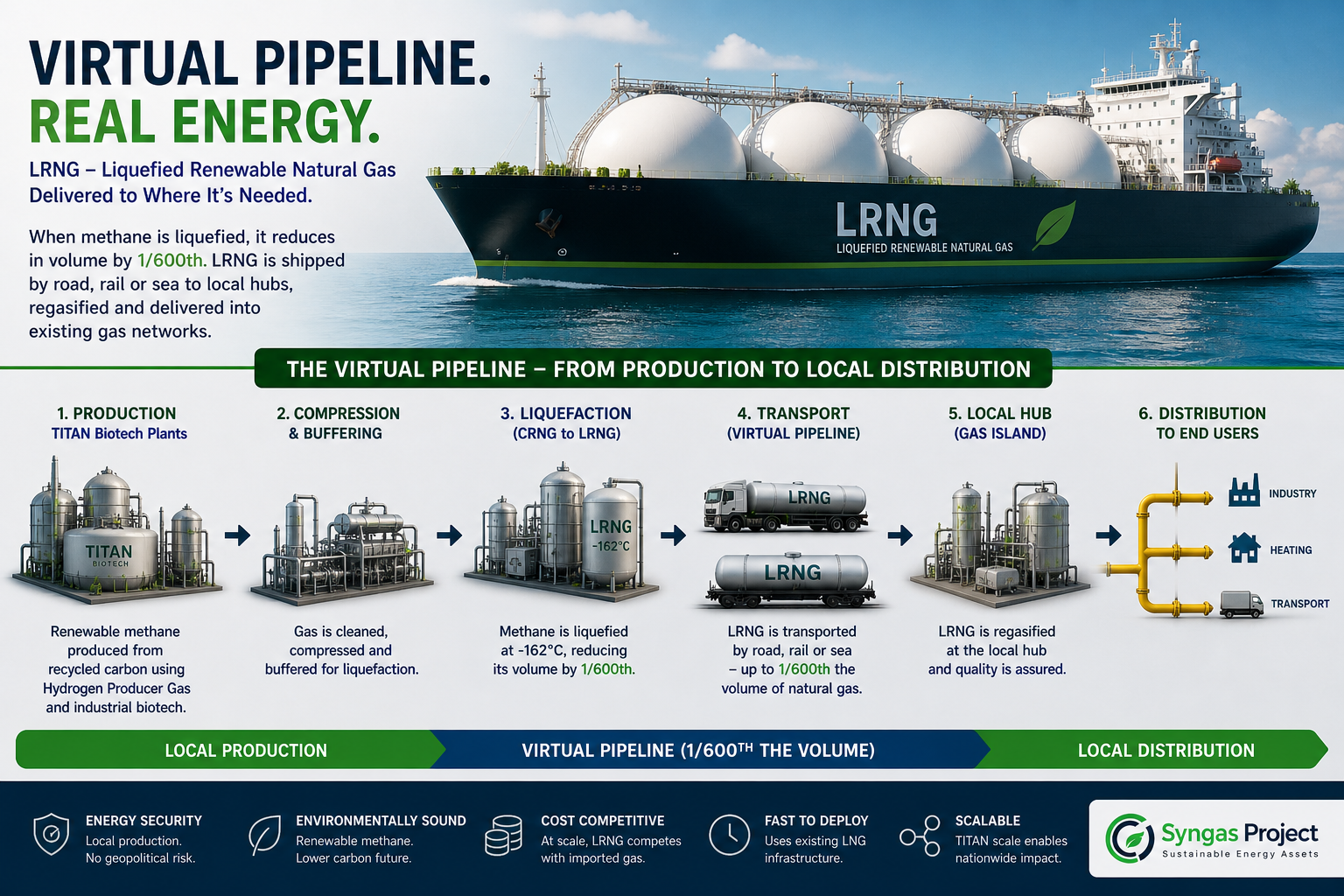
Today, gas is distributed increasingly in liquefied form. LNG has already proven the model. Methane is cooled, liquefied and reduced to around 1/600th of its original volume. It is then transported efficiently by ship, rail or road tanker, delivered to a local hub, regasified and supplied into the network.

This is not a workaround. It is the system.

Many still think LNG distribution is an excuse for not having pipelines. That is wrong. LNG is a more targeted delivery system. The local hub receives the gas it ordered, not a blended molecule that entered a pipeline thousands of kilometres away. The control point moves from the pipeline to the destination.

The real legacy of the gas system is not the intercontinental pipeline.

It is the local gas network.

Historically, gas was produced locally and distributed locally. Towns and industrial centres had their own gas production linked directly to local demand. Long-distance pipelines came much later. They replaced local producers and centralised supply, often for convenience and scale. For a period, that worked.

Today, that model is under pressure.

Russia to the east is no longer a reliable source. Conflict in the Middle East continues to destabilise global energy flows. The United States is becoming less dependable as a long-term strategic partner. Norway carried Europe through the immediate crisis, but it is past peak. It delivered when needed, but production will not keep expanding. The longer global instability continues, the more pressure is placed on a limited northern supply base.

Europe is still climbing an import ladder that is no longer secure.

At some point, that ladder has to be left behind.

Poland has an alternative.

Poland already operates a distributed gas system. The LNG terminal near Szczecin has been built out from approximately 6 billion cubic metres toward 8 billion cubic metres of capacity. More importantly, more than 100 LNG regasification gas islands developed by PSG already form a decentralised distribution network across the country.

These are not temporary assets. They are long-life infrastructure.

Reach & Cache: Rebuilding Regional Biomass Logistics

Publish date: 30 April 2026

(Przewiń w dół, aby zobaczyć wersję polską.)

One of the biggest challenges in the renewable molecule economy is not chemistry.

It is logistics.

Europe possesses large volumes of renewable carbon in the form of forestry residues, agricultural residues and other biogenic resources. Much of this material already exists across regional landscapes in fragmented and low-density form.

The problem is not whether the carbon exists.

The problem is how to collect it efficiently.

For decades, industrial systems were designed around highly concentrated fossil resources. Coal, oil and gas could be extracted at large scale from centralised locations and transported through mature infrastructure networks. Renewable carbon does not behave the same way.

Biomass is distributed.

It is seasonal. It varies in moisture content, density and handling characteristics. Transport distances matter. Weather matters. Storage matters. Fuel preparation matters.

This means the future renewable molecule economy will require a new generation of regional logistics infrastructure.

This is where Reach & Cache becomes important.

Reach & Cache is the logistical philosophy behind TITAN’s biomass supply model.

Instead of relying entirely on long-distance trucking or fragmented supply chains, the system creates regional collection, preparation and consolidation hubs designed specifically for renewable carbon logistics.

The objective is simple:

Reduce transport inefficiency while increasing regional feedstock resilience.

Under the Reach & Cache model, biomass is collected from regional catchment areas and moved into dedicated aggregation sites. At these locations, material can be stored, dried, processed, chipped and prepared for onward transport into TITAN production facilities.